
Where Are They Now: OCZ
Welcome to the first of a weekly series where I dig up the companies whose hardware we reviewed back in the day and find out what happened to them. Some are bigger than ever. Some are gone. Some are a sticker on a box made by somebody else. We’re starting with the company that probably filled more of our mailboxes than anyone else: OCZ.
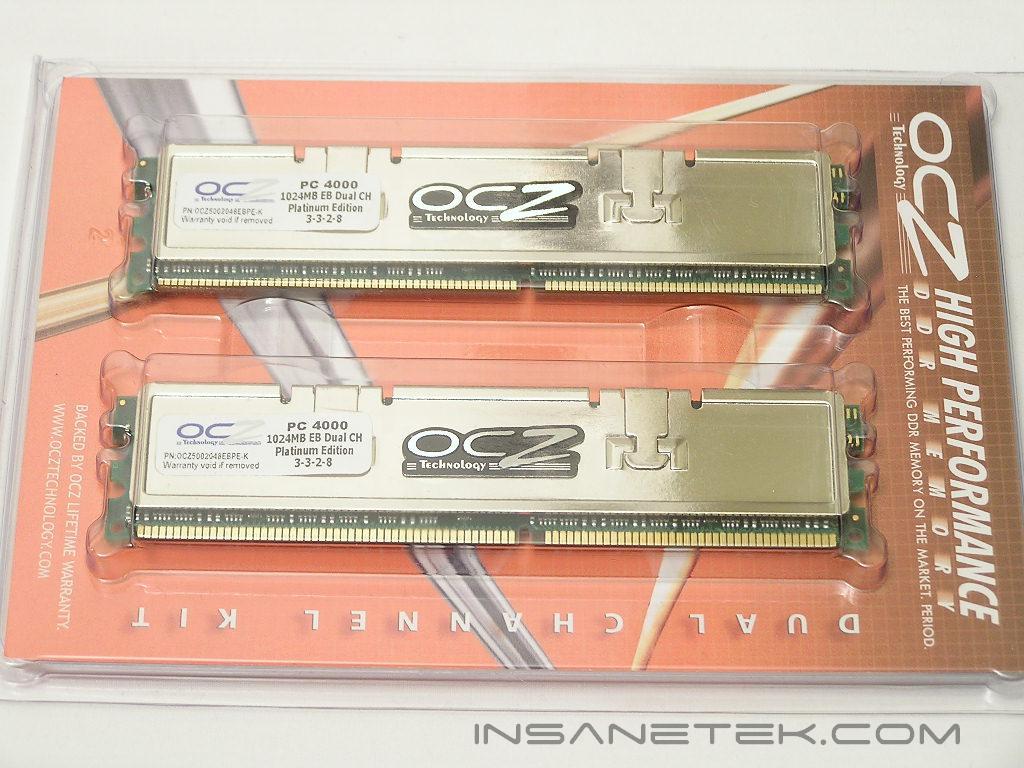
OCZ Platinum PC4000 EB, from our 2005 review.
Who they were
OCZ started out in 2000 as The Overclockerz Store, selling pre-overclocked Athlons, and became OCZ Technology in 2002. If you were overclocking in 2004, you knew the name. OCZ made memory for people like us. Not for office PCs, not for grandma’s Dell. For the guy with a DFI board, a Winbond chart taped to the wall and a fan pointed at his DIMMs.
We reviewed about twenty OCZ products between 2004 and 2005, more than any other vendor. One of our reviews opened with “OCZ and InsaneTek are like two peas in a pod,” and honestly, that wasn’t far off. The OCZ Gold PC4000 was one of our earliest reviews, and it hit 290FSB at 1:1 on a P4 2.4C. At “just below $300” for a gigabyte, it was a “clear winner.” That’s how much fun 2004 was.
Product spotlight: the generations
Here’s OCZ year by year while InsaneTek was around, starting with what we got our hands on.
2003–2004: the DDR glory days. The Platinum line chased the tightest timings it could get, first on Winbond BH-5 and then on OCZ’s own Enhanced Bandwidth parts. We put the two head to head in Platinum LE vs EB. The Gold line went the other way and chased megahertz. Then there was the DDR Booster, my personal favorite. Most motherboards topped out around 2.8v to the memory, and the alternative was a soldering iron and a dead warranty. OCZ sold a little board that plugged in and pushed more voltage to your RAM. We loved it. Only an overclocking company would make that, and only overclockers would buy it. Oh, and in 2004 the boxes went from black to bright orange so you’d spot them on a store shelf. It worked. I can still picture it.
2004–2005: power supplies and voltage-hungry DIMMs. The PowerStream 420W had adjustable rail knobs on the outside, which felt like tuning a carburetor, and the ModStream 520W went modular. On the memory side, the Gold PC4000 VX was rated for DDR500 at 2-2-2-5 as long as you fed it 3.3 volts, which at the time only a DFI board could do. A perfectly reasonable Tuesday. By late 2005 DDR2 was taking over and OCZ was putting XTC heatspreaders with holes punched in them on everything, and throwing a “Revolution” party at CES with DFI.
2006–2008: heatpipes and weird stuff. OCZ listed on London’s AIM market in 2006. In 2007 it bolted copper heatpipes and fins onto DDR2 with the Reaper HPC, which looked like a tiny CPU cooler sitting on your RAM, and it bought PC Power & Cooling, the old-school name for serious PSUs. In 2008 it sold the Neural Impulse Actuator, a headband that read your facial muscles and brain activity so you could game without a mouse. It worked about as well as you’d think, but I admire the attempt. The first OCZ SSDs, the Core series, showed up the same year on JMicron controllers that stuttered under random writes.
2009–2010: Vertex. This is the part younger readers might know. The original Vertex switched to the Indilinx Barefoot controller and got close to Intel’s X25-M without the Intel price. The Vertex 2 and Vertex LE moved to SandForce, the PCIe RevoDrive followed, and OCZ moved to NASDAQ in April 2010. For a few years OCZ was the SSD company enthusiasts talked about.
2011–2012: all in on flash. The Vertex 3 was one of the fastest SATA drives you could buy. Then OCZ went back to its own controllers with the Vertex 4 and Everest 2, and finished 2012 with the Vector. Down at the budget end were the Petrol and Octane lines, which we’ll get to.
What happened
By 2010, OCZ had decided memory was a dead end. We covered it at the time: OCZ was leaving the DRAM market, with its last memory going out the door in February 2011. The company that sent us all those Gold and Platinum kits didn’t make RAM anymore.
At first the SSD bet looked brilliant. OCZ bought Indilinx, the controller maker behind the original Vertex, in March 2011, and a week later announced it had sold its millionth SSD. Then the cracks showed. Drives built on the SandForce SF-2000 controller were blue-screening, and OCZ had to push a firmware fix. The budget Petrol and Octane drives picked up return rates over 40 percent at one big French retailer. OCZ was selling a lot of SSDs, and a lot of them were coming back.
The money side was worse. OCZ had to restate its earnings going all the way back to 2008, the leadership changed in 2012, and the shareholder lawsuits followed. OCZ also had a hard time getting enough NAND flash, which is a problem when NAND flash is the product. In November 2013 its lender took control of its bank accounts, and OCZ said it would file for bankruptcy.
Toshiba picked up the SSD business for $35 million, and the deal closed in January 2014. A month later the power supply side, PC Power & Cooling included, went to a company called FirePower Technology.
Where they are now
For a couple of years, OCZ lived on as OCZ Storage Solutions, a Toshiba subsidiary, and kept making drives: the Vertex 460, the budget ARC 100 and Trion, and the RD400 NVMe card. Then in April 2016 it was folded into Toshiba completely, and OCZ became just a brand. By 2017 the Toshiba TR200 had dropped the OCZ name from the drive itself, leaving it on the box. Toshiba’s memory business later spun off and became Kioxia.
So if you want to follow the thread, the company that sold us 2-2-2-5 DDR500 and a box that plugged voltage into your RAM ended up inside the company that makes Kioxia SSDs today. The orange box is gone. The overclockers it was built for mostly moved on too.
I’ll be honest, it’s a little sad to go back through those reviews. OCZ really was an enthusiast company. They read the forums, they sent samples to small sites like ours, and they built things nobody else would have bothered with. They just bet everything on one product, and when that product had problems, there was nothing to fall back on.
I still have a couple of 30GB OCZ Vertex drives in a drawer that I ran in RAID 1 back in the day. Thirty gigabytes. Today that wouldn’t hold a single game patch. If you’ve got a stick of OCZ Platinum or an old Vertex in a drawer somewhere, hang on to it. It’s a piece of history now.
Next up: Abit, and yes, we’re talking about the NF7-S.
— Luke