

OCZ Platinum LE vs EB
Introduction
All overclocking enthusiasts know the Winbond BH5, BH6, and CH5 chips have the best overclocking potential and performance. They’re the only chips that allow extra voltage for an increase in frequency, all the while keeping latencies low. Winbond chips were the hype for the last 6 months, until OCZ introduced their Enhanced Bandwidth memory. The EB series was introduced partially to take over the Winbond craze. The memory allowed for fairly low latencies without sacrificing performance. Not only that, it overclocks extremely well and responds to increased voltage.
In the beginning, enthusiasts were skeptical about the lack of extremely low latencies and the extra performance it provides. But like always, Father Time changed their opinions. The EB can run at latencies of 3-3-2-8 and still provide the performance of the Winbond chips. Just exactly how that is possible lies within the ICs used and the screening of the chips, as well as the PCB used.
Unfortunately, all great things come to an end. Just like the Platinum Limited Edition memory, the EB has been discontinued. One reason might be that Micron stopped making the chips for EB and forced it to come to an end. Who knows? Regardless, this memory is capable of so much more than what it’s rated for. The question now is, which one is better?
Personally, I find that the EB is more favorable. It allows for higher overclocking potential and requires less voltage. Today’s article will be a fair comparison between these two great sticks of memory. The OCZ Platinum Limited Edition versus the OCZ Platinum Enhanced Bandwidth. Both are the same in size, 2x256MB, and both will be supplied with ample voltage to display the high performance they provide.
OCZ Platinum LE and EB
OCZ Platinum Limited Edition:
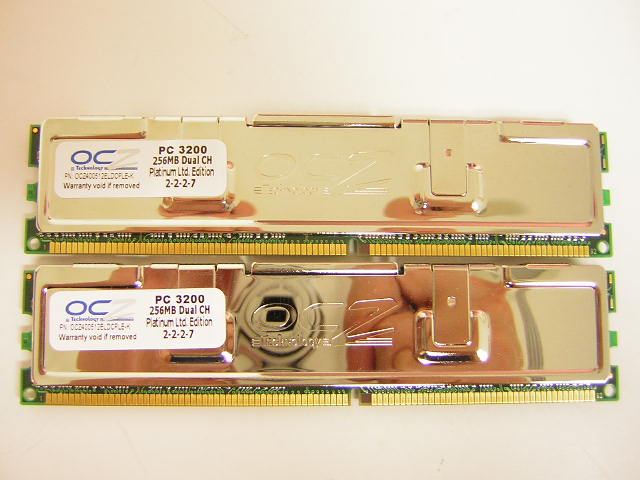
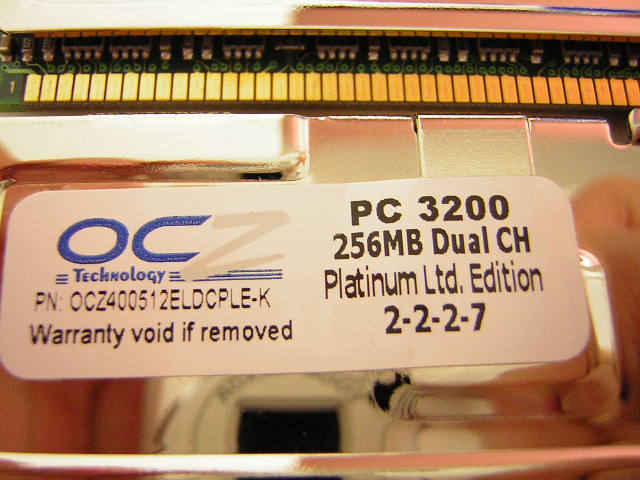
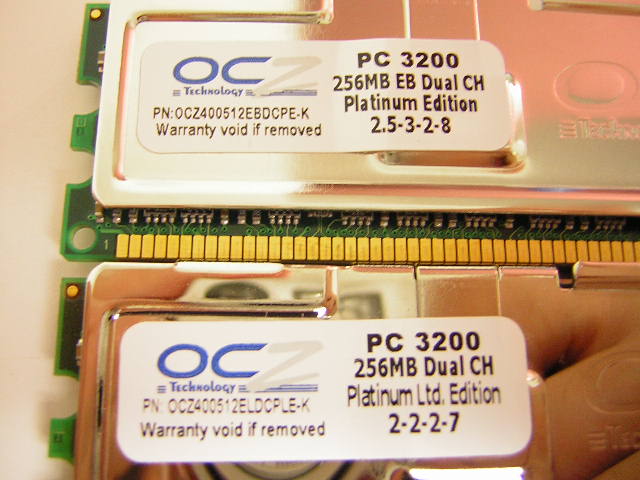
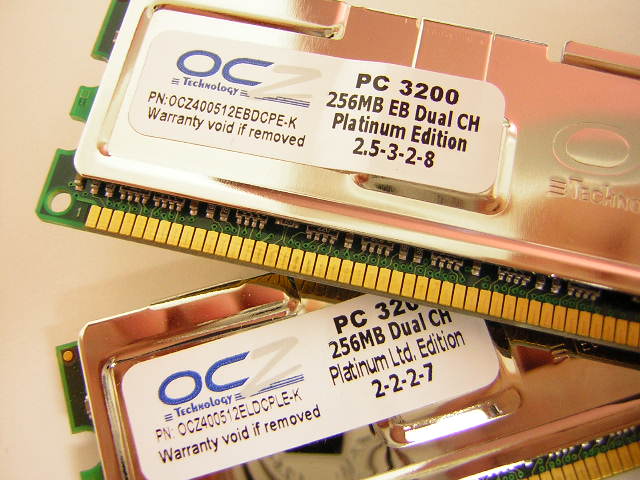
OCZ Platinum PC3200 Limited Edition is based on the Winbond BH6. It’s unfortunate I did not have a pair of PC3500 Limited Edition, as those use Winbond BH5. BH6, however, is known to be able to overclock just as well as BH5 if given enough voltage. The modules are covered by nickel plated copper heatspreaders. Heatspreaders are known to only provide good looks and prevent physical damage instead of providing cooling. The rated latencies of the PC3200 Platinum Limited Edition is 2-2-2-7 at 200MHZ.
OCZ Platinum Enhanced Bandwidth:
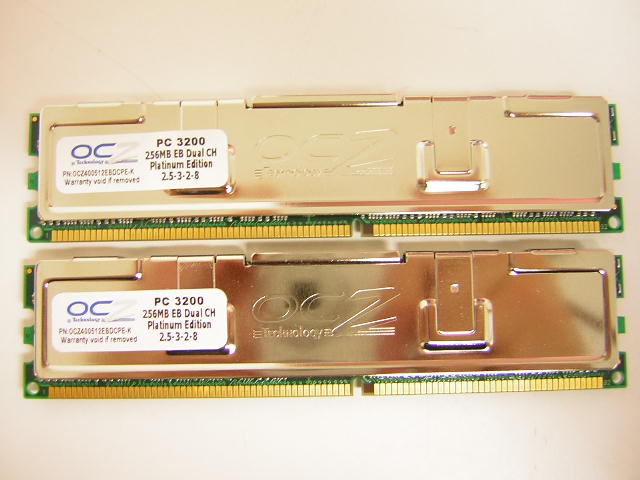
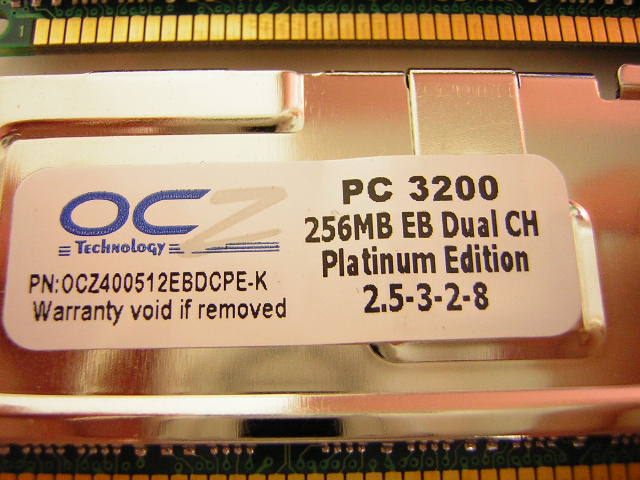
The Enhanced Bandwidth comes with the same nickel plated copper heatspreaders. The ICs used are Micron -5b C revision. OCZ has found these to be able to run as low as 2.5-2-2-5. Although the CAS latency is not 2, the performance differences between CAS 2.5 and 2 is negligible. That’s the main reason why the memory was named Enhanced Bandwidth. It provides the same bandwidth as low latency memory without the low latencies. The PC3200 Platinum Enhanced Bandwidth comes rated at 2.5-3-2-8 at 200MHZ.
The main focus about the Enhanced Bandwidth is that TRP can be kept at 2 while under high frequencies. OCZ has found that the performance of keeping TRP at low latency can match the performance of keeping CAS at low latency.
Test System and Overclocking
Test System:
- Intel 2.4C
- Asus P4C800-E (with droop mod)
- ATI Radeon 9800XT
- 2 x 256MB OCZ Platinum Limited Edition (Winbond BH6)
- 2 x 256MB OCZ Platinum Enhanced Bandwidth (Micron -5b C)
- OCZ DDR Voltage Booster
Overclocking:
Overclocking will be one of the most important deciding factors in differentiating the better memory. The Limited Edition comes overclocked because it uses 6ns (166MHZ) memory chips. I lowered the memory timings to 2-2-2-6 and proceeded to overclock. Maxing out VDIMM at 2.85v resulted in 215FSB. I increased voltage to 3.2v and found a maximum of 240FSB. This is a fairly typical overclock on Winbond chips. All the excellent overclocking results require some kind of burn-in. The modules I had were quite new, so this is considered to be a good overclock without a good burn-in period. I tried to loosen the latencies to see just how much further the memory would go, but it brought me nowhere. Loosening to 2.5-3-3-6 gave me no help. I was still stuck at 240FSB. Winbond chips don’t like CAS latency of 3, which will result with long beeps and no POST.
The Enhanced Bandwidth uses Micron -5b C revision memory chips. The default rating is 2.5-3-2-8, but I dropped the memory to 2.5-2-2-6 to see the overclock potential. The Micron C revision chips won’t do CAS latency of 2 no matter how much voltage you pump into it. The main thing about the Enhanced Bandwidth is that CAS and TRCD can be raised to 3 and TRP can be kept at 2. Typical memory chips are rated to have CAS 2 with TRCD and TRP to be at 3. I started with 2.5-2-2-6 with 2.85v and managed to get the same 225FSB. Raising VDIMM to 3.2v results with the same 240FSB. I loosened the latencies to 3-3-2-8 (best suggested timings of EB memory) and managed to squeeze out an extra 10FSB to 250FSB.
Platinum LE Overclocking Results:
- 200FSB 2.0-2-2-7 2.85v
- 215FSB 2.0-2-2-6 2.85v
- 240FSB 2.0-2-2-6 3.20v
Platinum EB Overclocking Results:
- 200FSB 2.5-3-2-8 2.85v
- 200FSB 2.5-2-2-6 2.85v
- 225FSB 2.5-2-2-6 2.85v
- 240FSB 2.5-2-2-6 3.20v
- 250FSB 3.0-3-2-8 3.20v
Results
A series of memory intensive benchmarks will be run to test the performance of our sample. The following tests will be based on common benchmark programs such as 3DMark and PCMark. Real life performance differences will be tested through current games such as Doom 3, Far Cry, and UT2004. Memory bandwidth benchmarks will be based off of SiSoft Sandra and Aida32. Super PI will also be used to test memory performance, as the benchmark benefits largely from FSB increases.
All memory tests are conducted with memory running synchronously with Front Side Bus. VAGP has been kept at 1.8v to allow tight latencies be run while under 1:1 ratio.
SiSoft Sandra
Aida32
3DMark2001SE
PCMark
Results Continued
Doom 3
Far Cry
Unreal Tournament 2004
Super PI
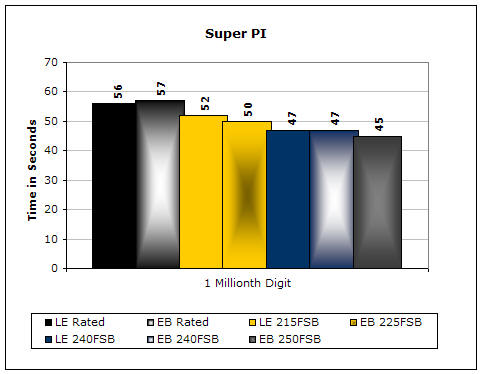
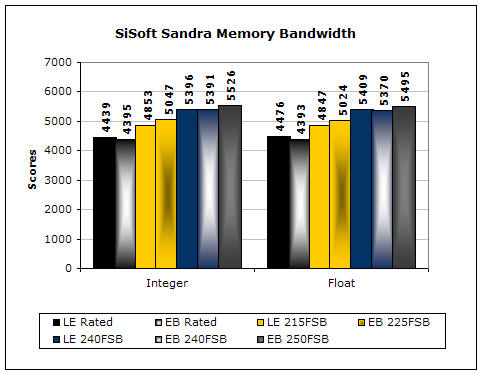
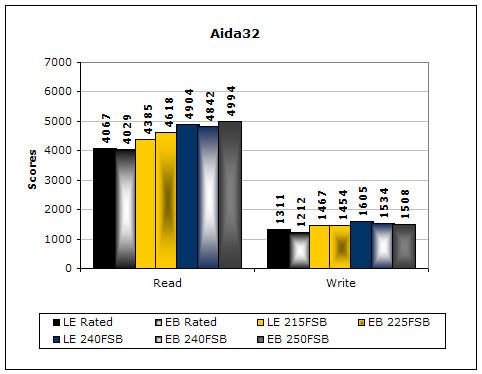
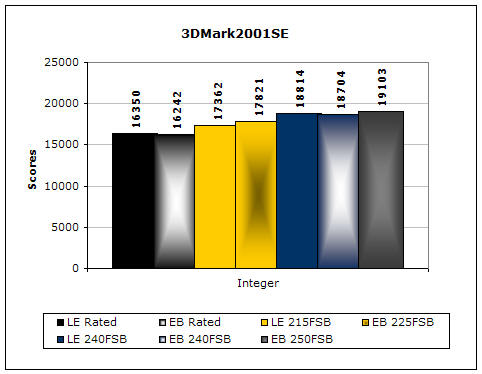
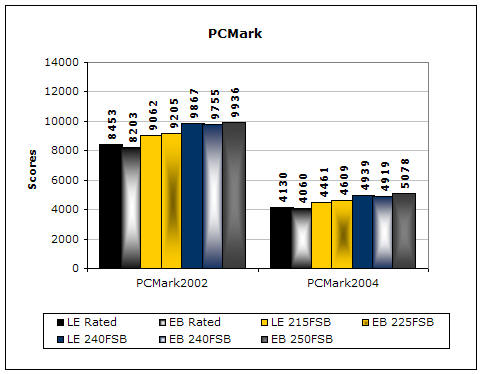
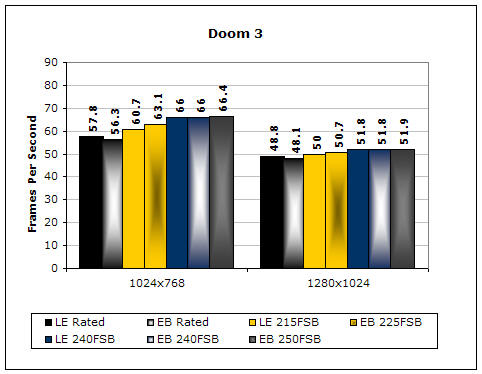
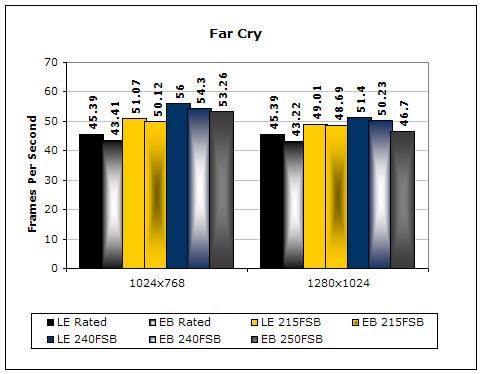
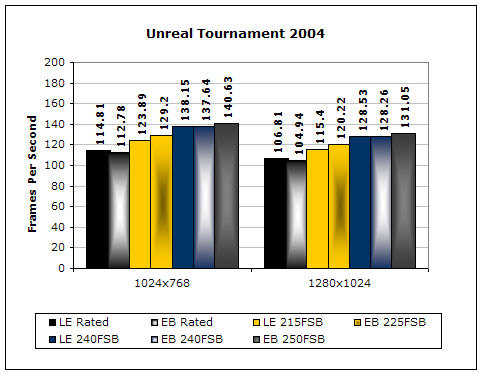
The results show the LE consistently ahead on most of the benchmarks. Having the lowest latencies is definitely ideal. Yet the EB doesn’t trail behind much. It stays close throughout all the memory benchmarks and most of the gaming performance benchmarks. One thing to note is that Far Cry seems to favor extremely low latencies, as it has a 2 fps lead over the EB at 240FSB. When the EB’s latencies are loosened and FSB raised, the game suffers even more. This reveals that the game benefits more from low latencies than an extra 10MHZ memory and 120MHZ CPU increase. All other benchmarks are as predicted, with the difference in CAS latency minimal and pretty much negligible.
Conclusion and Thoughts
The results show that the EB is indeed an excellent replacement for the infamous Winbond chips. The memory is capable of a higher overclock with lower voltage, and it does achieve this. Many argue that the Winbond chips are better suited for Intel platforms. In my personal opinion, I find the EB much better. The EB requires lower voltage to achieve a decent overclock. As shown above, I was able to reach 225FSB 2.5-2-2-6 with just 2.85v. Not many people will have the option to increase VDIMM, and the EB is well suited for these people. Overclockers can also use these to hit maximum performance. I now have a pair of OCZ PC3500 EB that I have yet to review, but here is a sneak peak of what it’s capable of.
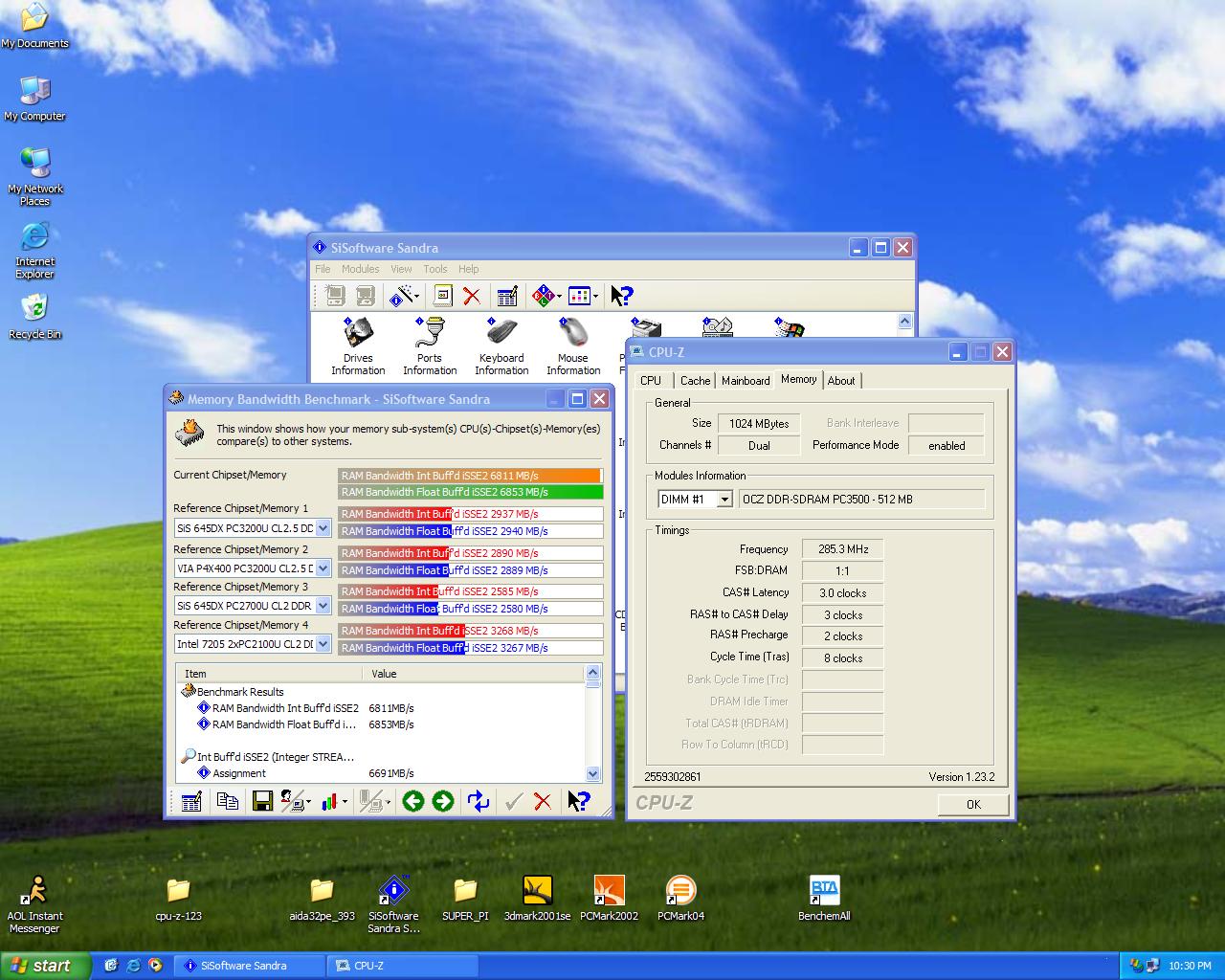
It’s certainly not too shabby. In the end, if you have Winbond memory, think about changing it. It’ll be good for now and for the next couple of months, but it’ll hinder your overclocks if you don’t have the option of increased VDIMM. The EB performs just as well on an Intel platform and is capable of so much more. With many people migrating over to the AMD Athlon64 platforms, you’ll be happy to know that the A64 CPUs love these Micron C revision chips. I have seen many people hit well beyond 270FSB 2.5-2-2-10 with just 2.9v-3.0v. Winbond chips won’t be able to do that without at least 3.4v pumped into them. If you enthusiasts are looking for the best, here it is. I still know many people scrounging around looking for memory based on Winbond BH5 and BH6. They should stop and look for the EB. It’s good for now, and good for the future. With the recent discontinuation, you better act fast and pick these up before they’re sold out and prices are hiked up.
Looking back: Where Are They Now: OCZ