

Overclocking Legends: Winbond BH-5
The first Legends post was a CPU you picked by reading the code on the chip. This one is memory you picked the same way, except the code was on the memory chips, hidden under a heatspreader, and the sticks that had it kept changing. If you overclocked in 2003 or 2004, you know the name. Winbond BH-5.
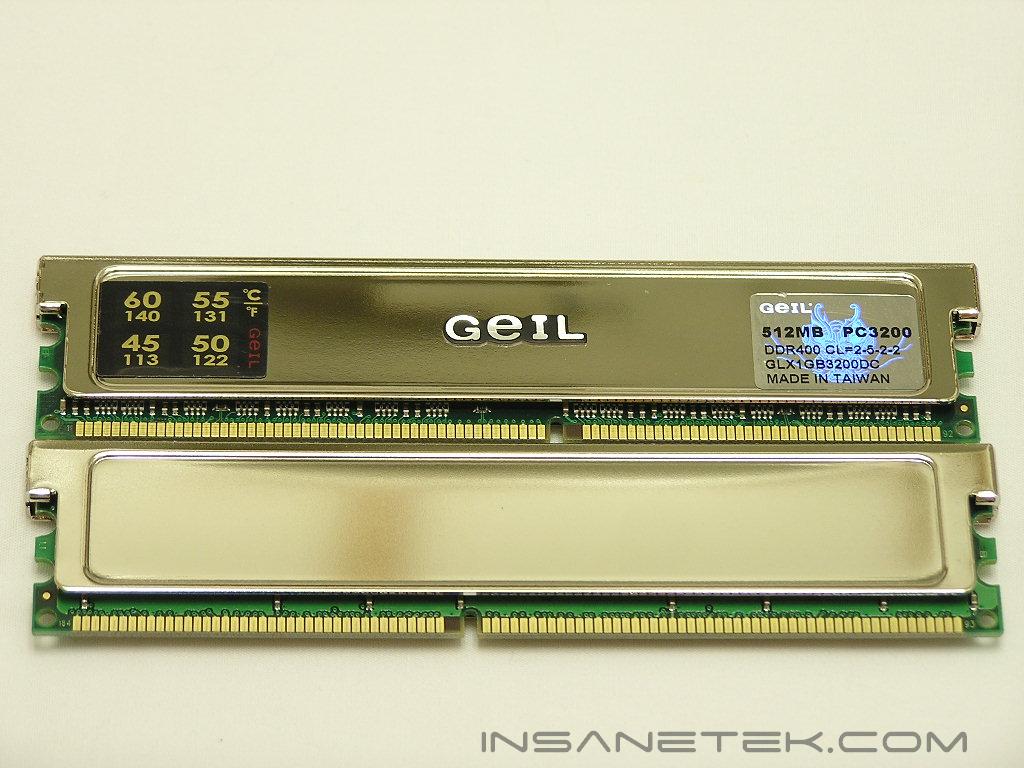
GeIL’s Ultra-X PC3200 on Winbond BH-5, from our 2005 review.
Why it mattered
In the DDR days you usually had to choose. You could run your memory fast with loose timings, or slow with tight ones. BH-5 didn’t make you choose, as long as you gave it voltage. Lots of voltage. Our OCZ Platinum LE vs EB review summed it up: “All overclocking enthusiasts know the Winbond BH5, BH6, and CH5 chips have the best overclocking potential and performance. They’re the only chips that allow extra voltage for an increase in frequency, all the while keeping latencies low.”
Stock DDR ran at 2.5 volts. BH-5 woke up somewhere past 3 volts and kept going. At 3.3 to 3.5 volts, a good pair would run 2-2-2 timings at 250MHz and beyond, which was unheard of. On an nForce2 board with an Athlon XP, or a Pentium 4 on a Springdale or Canterwood board, that low latency at high speed meant better scores in everything.
The hunt
Like the 1700+, you couldn’t just buy BH-5 by name. Memory companies used whatever chips they could get, and many didn’t say which. So the forums turned into detective work: which brand, which part number, which week, and did the label under the heatspreader say BH-5? The cheap legend was TwinMOS Speed Premium PC3200, which used BH-5 for a while and cost a lot less than the big names, so everyone bought it until the chips changed.
The expensive legend was Mushkin. Our Mushkin PC3700 review said its Black Level II PC3200 and PC3500 on BH-5 “almost always overclocked better than the other BH5 based memory,” and our PC2-4200 review called the Level II PC3500 “the most sought after Winbond BH5 based memory.” Our reviewer added: “I once sold a set for $450!”
BH-5 was everywhere in our test rigs too. Our Cooler Master Hyper 6 review ran on “Buffalo PC3700 (BH-5) at 2.8v,” and in our news posts our writer bragged that a hot new Corsair kit “won’t beat the BH-5 memory I have though.” Kingston had a following too. Our HyperX PC4300 review remembered that “When the Winbond BH5 hype began, top overclockers realized that Kingston’s PCB was much better than what the competition provided.”
Feeding it
The problem was that most motherboards stopped at 2.8 or 2.9 volts. You had three choices: volt-mod your board with a pencil or a soldering iron, buy one of the few boards with high voltage options, or buy a gadget. OCZ sold the gadget. Its DDR Booster plugged into a spare memory slot and pushed the voltage higher, and our review said “If you have Winbond BH5, BH6, or even CH5, then you’ll definitely want the Booster. Those chips are voltage hungry and need it like we need overclocked computers.”
Later, DFI built the voltage right in. Its LanParty UT nF4 Ultra-D had a jumper that unlocked 3.3 to 4 volts from the power supply’s 5V rail, with a warning in our review about going past 3.2 volts. Not everyone listened. Plenty of BH-5 sticks died young.
The end, and the comeback
Winbond announced it was leaving the commodity DRAM business, and by 2004 BH-5 was gone. Our OCZ Gold PC4000 review said “It’s tough finding the discontinued Winbond BH5 and BH6 chips. Even if you do, you’ll have to pay premium prices.” Memory makers moved to OCZ’s EB on Micron chips and then to Samsung TCCD (more on that one in December), which ran high speeds at loose timings but couldn’t do 2-2-2 at 250MHz.
Then, in 2005, it came back. Winbond chips started turning up again, sold untested, and memory makers bought them, tested them themselves and sold them as “UTT” BH-5. OCZ’s Gold VX and Gold PC3200 used it, and GeIL’s Ultra-X on BH-5 ran 2-2-2 at 260MHz on a DFI board and won our Highly Recommended award. Our Crucial Ballistix review from that spring said “Now people are going crazy over the new BH5 chips.” We even gave some away in a forum contest, “for your voltage pimpin system.”
Where it is now
DDR2 arrived, the Athlon 64’s memory controller didn’t like high voltage the way older platforms did, and the UTT supply ran out. BH-5 became a collector’s item. Retro benchers still hunt for it, and the voltage numbers still look a little crazy compared to modern memory that runs at 1.35 volts.
What I love about BH-5 is that it was the perfect overclocking story. It was a cheap chip that wasn’t supposed to be special, it needed a mod or a gadget to show what it could do, you had to hunt for it, and every so often it died for the cause.
Next in the series: the Barton 2500+, the chip in my first water-cooled build.
— Luke