

Crucial Ballistix Tracer PC4000 1GB Dual Channel Kit

Introduction
For the past 9 months, Samsung TCCD chips were the craze. It’s only recently that Winbond’s new BH5 chips were being produced again. Now people are going crazy over the new BH5 chips. Yet, people fail to realize that there is another strong competitor in the field. Although not as surprising as the TCCD chips, Crucial’s use of Micron chips are capable of providing top notch performance. We’ve seen what their DDR2 chips can do in the Ballistix PC2-5300 review, and now we’re going to see what their DDR solution is capable of.
If you think that Corsair is the only player in the flashy memory game, you’re wrong. Crucial joins them with their Tracer line of memory. Unlike the Corsair Pro series, where rows of lights flash up and down to show memory activity, Crucial’s Tracer line has blinking LED’s that light up in no specific order to show memory usage. Crucial calls these LED’s “chasing LED’s”. Why? Because the red and green LED’s light up in a circular manner that seem like they’re chasing each other. This look is definitely flashier than Corsair’s solution. Looks are not everything, though. With the Ballistix, you get flashy looks AND performance.
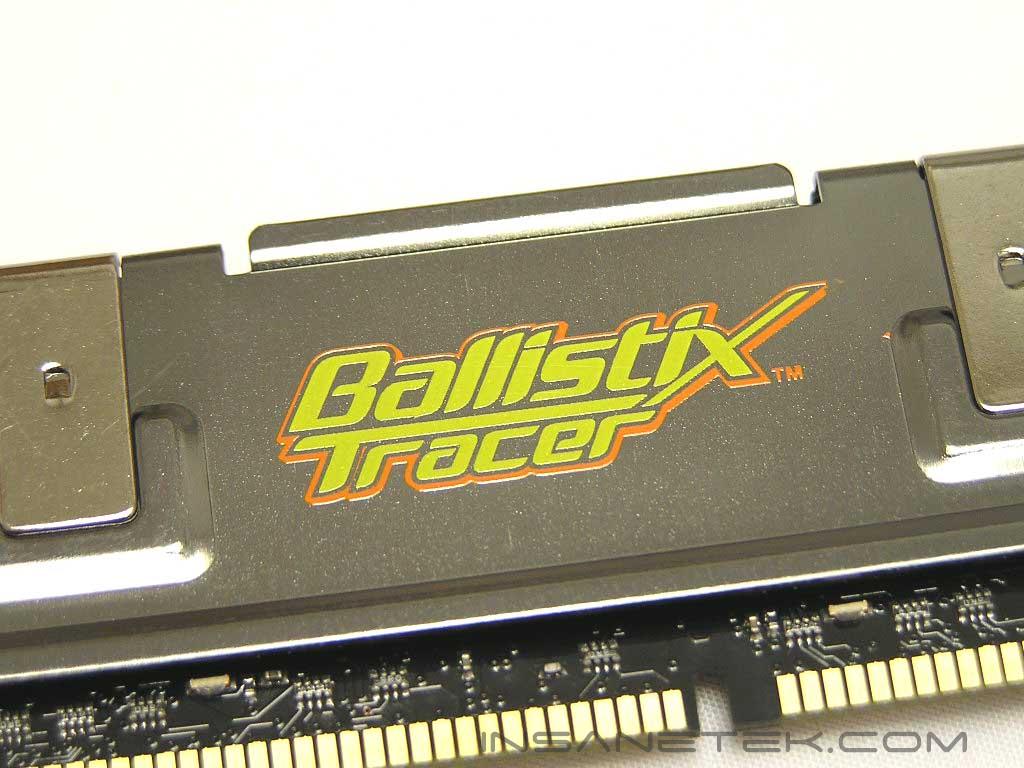
Crucial Ballistix Tracer PC4000
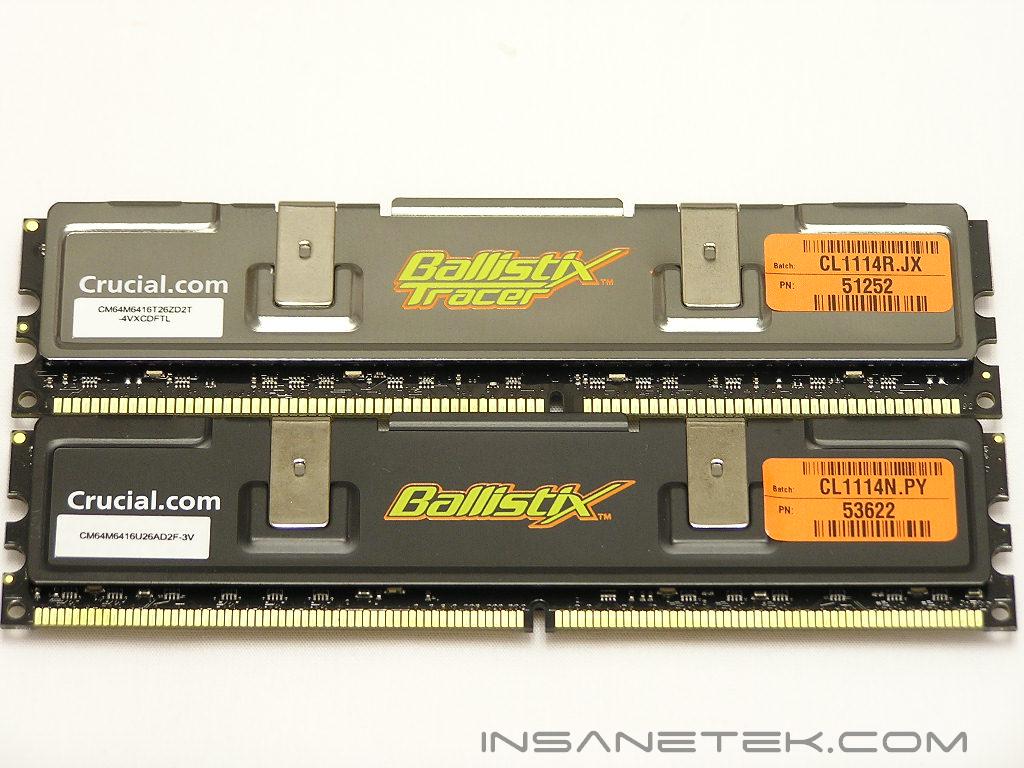
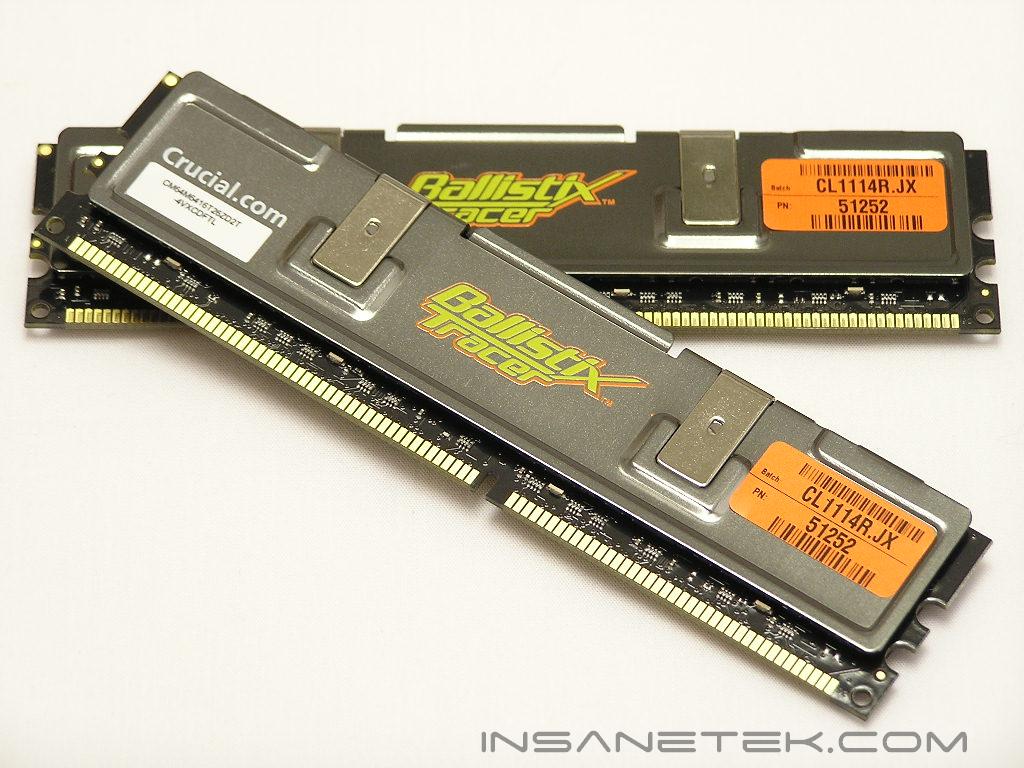
Like the regular Ballistix line, the Tracer memory features a black PCB, straying from the standard ugly green. One special note is that while Crucial says the heatspreaders are also black, my sample came in with a fancy gunmetal color. This combination of colors is freaking awesome. I love the gunmetal look. If you don’t like it, I question your taste. HA! There is a shot below comparing the new gunmetal heatspreaders to the original black heatspreaders. They both look good, but the gunmetal is just on another level for me.
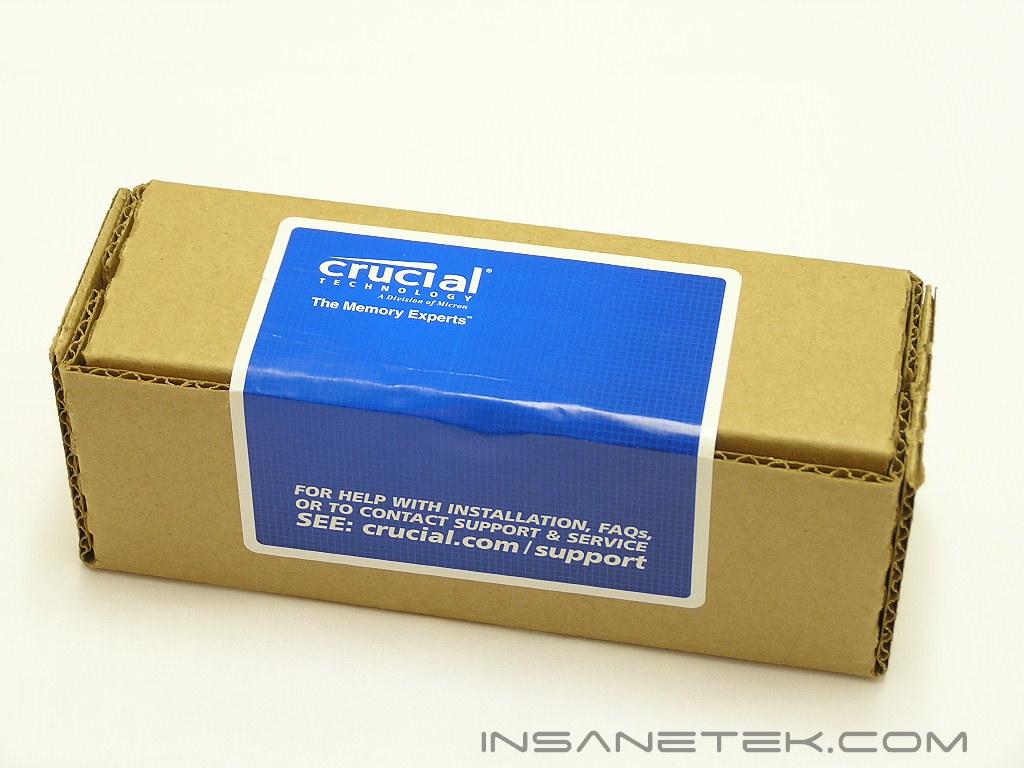
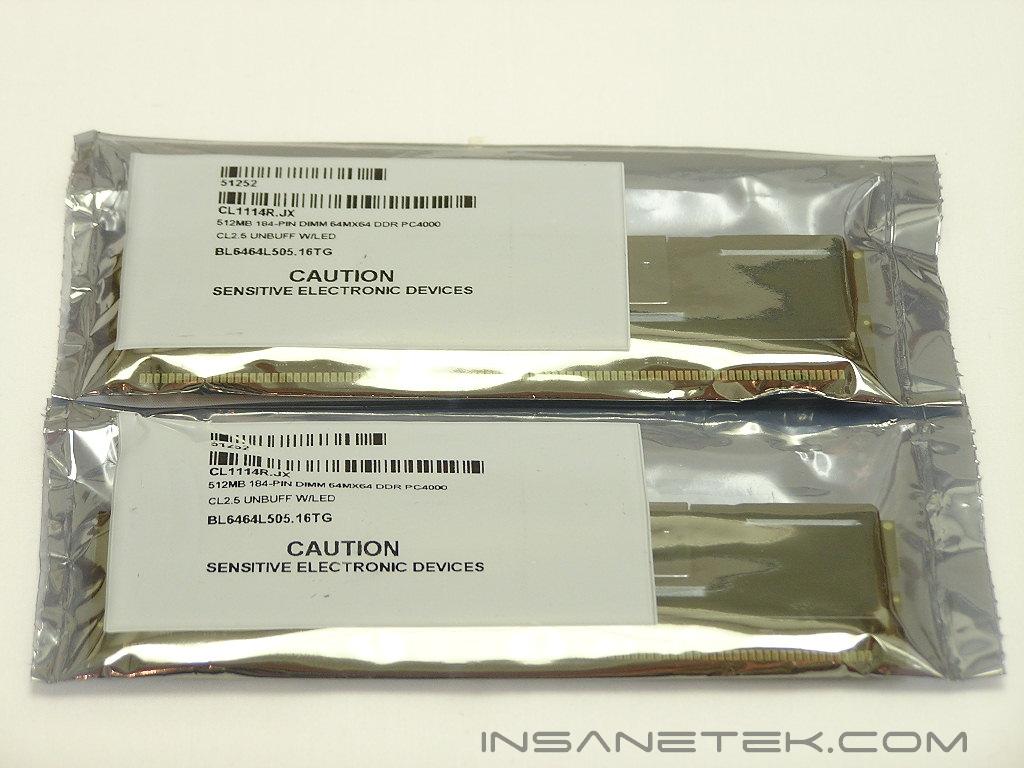
If Crucial continues to the use the same memory IC’s as those found in the regular Ballistix line, then the chips hiding underneath the heatspreaders should be Micron -5b G chips. These chips are capable of reaching low latencies of 2-2-2-5 at 200MHZ without a problem. The black PCB is a specially designed PCB to accommodate the chasing LED’s. Crucial rates the Tracer PC4000 memory at 250MHZ with latencies of 2.5-4-4-8. Although this rating is not as exceptional as some of the TCCD based PC4400 memory out there, keep in mind that the memory IC’s are 5ns chips and theoretically only rated to run 200MHZ. TCCD is 4ns, which yields a theoretical 250MHZ. The Micron chips are rated at 2.8v, but from previous experience, I know that certain Micron chips like voltage. Chips like Micron’s -5b C, which are used in OCZ’s Enhanced Bandwidth, respond very well to increased voltage. We’ll see if the chips here will do the same.
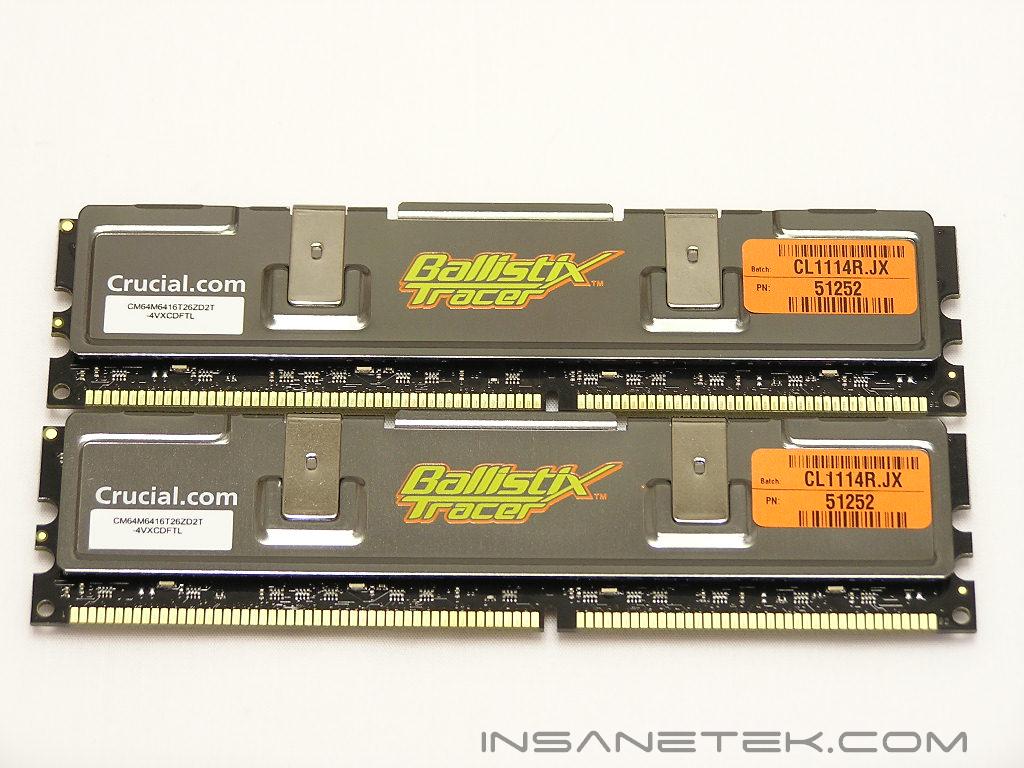
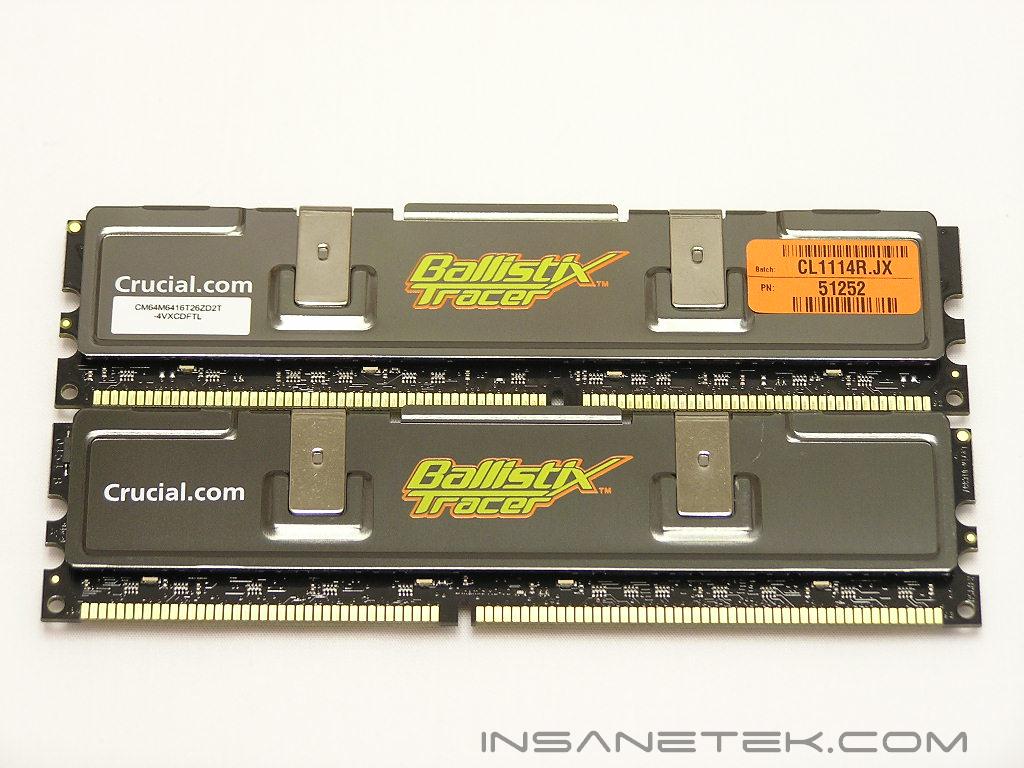
Note that Crucial does not offer dual channel kits. Dual channel is motherboard dependent and making a purchase of 2 separate sticks will enable dual channel. Buying dual channel kits only ensures compatibility, but Crucial only uses Micron chips. You should not run into any problems whatsoever.
Crucial Ballistix Tracer Flashiness
This wouldn’t be a good review if I didn’t provide you with a small movie clip of the LED’s flashing. Notice that at the bottom of the memory, close to the pins, blue LED’s provide a nice eerie glow. The movie clip shows the memory activity during BIOS, exiting BIOS, and running Memtest. Please note that you must have Quicktime installed to view this clip (6.97mbs).
Test System and Overclocking
Test System:
- AMD Athlon64 3000+ Winchester
- DFI LANParty UT nF4 Ultra-D
- 2 x 512MB Crucial Ballistix Tracer PC4000
- ATI X800 (400/490)
- Enermax Noisetaker 470W
- Arctic Freezer 64
Overclocking:
Keep in mind that during overclocking, the latencies are as follows: CAS-TRCD-TRP-TRAS
I began with 200HTT with 2-2-2-5 latencies. I figured that if the Ballistix PC3200 can do it, why not these? Sure enough the memory ran just fine. With 2.8v provided, the Tracer went up to as high as 230HTT with 2-2-2-5. That’s certainly not too shabby considering TCCD can’t maintain the low latencies at anything beyond 220HTT. I loosened the TRCD and TRP to 3 and didn’t receive any help. I moved on to 2.5-3-3-7 and the Tracer went up to a rather high 270HTT. That’s pretty good considering the memory was only rated for 250MHZ 2.5-4-4-8. It’s nice to know that the Tracer can put up a good fight against the TCCD chips.
One thing to note about the Ballistix line is that they don’t have the same overclock results as other memory. Like the OCZ EB memory, the Ballistix are also capable of keeping TRCD and TRP at low latencies and reaching high frequencies. I loosened the CAS latency to 2.5 and maintained TRCD and TRP to 2. The result was a good 245HTT. Certainly not bad eh? With a looser CAS 3, the memory went up to 255HTT 3-2-2-8. This can be considered a good alternative to voltage hungry BH5 as the latencies are not that bad. I tried a looser TRCD at 3 but it didn’t help any. 255HTT 3-2-2-8 1T is certainly good results for something that only requires 2.8v. This just goes to show that not all memory require loose TRCD and TRP to get any increase. Throughout all testing, the memory didn’t respond to increased voltages. It was happy with the rated 2.8v and performed well with just that.
Overclocking Results:
- 200HTT 2.0-2-2-5 1T 2.8v
- 230HTT 2.0-2-2-5 1T 2.8v
- 245HTT 2.5-2-2-6 1T 2.8v
- 255HTT 3.0-2-2-8 1T 2.8v
- 270HTT 2.5-3-3-7 1T 2.8v
Results
A series of memory intensive benchmarks will be run to test the performance of our sample. The other tests will be based on common benchmark programs such as 3DMark and PCMark. Real life performance differences will be tested through current games such as Far Cry and UT2004. Memory bandwidth benchmarks will be based off of SiSoft Sandra and Everest Home Edition. Super PI and PiFast will also be used to test memory performance, as the benchmark benefits largely from FSB increases.
SiSoft Sandra Memory Bandwidth
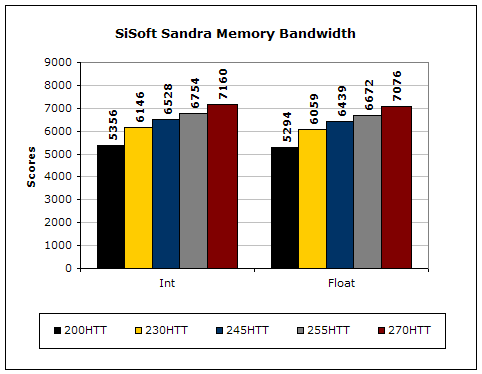
SiSoft Sandra is the most widely used memory bandwidth test and can distinguish increases in performance from lower latency timings.
Everest Home Edition
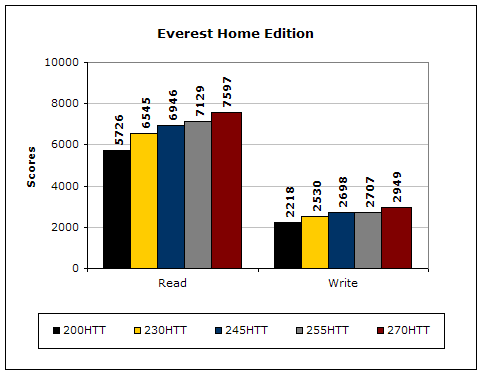
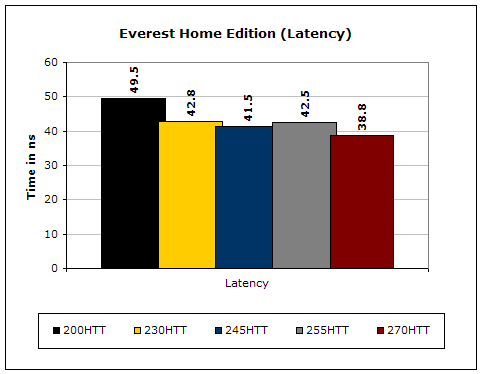
Much like Sandra, Everest Home Edition tests the memory’s ability to read and write data in large chunks. The results reveal the lower latencies helping just a little with performance.
3DMark2001SE
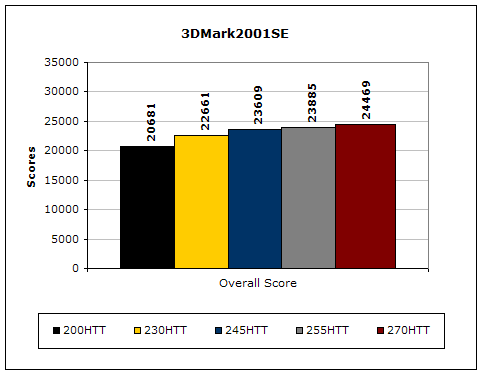
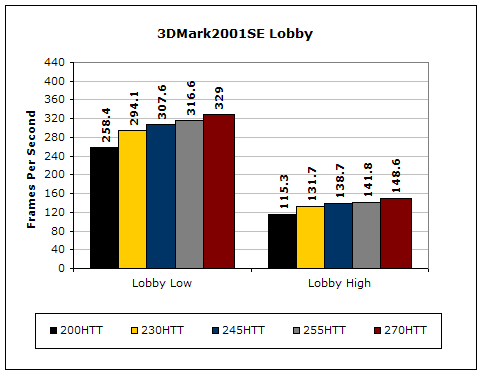
3DMark is probably the overclocker’s favorite benchmark. Unlike 3DMark2003, which stresses mainly the video card, 3DMark2001SE tests all of the system’s main components. Increasing the CPU speed, memory speed, and video card speeds will result in higher results in the final score.
Far Cry
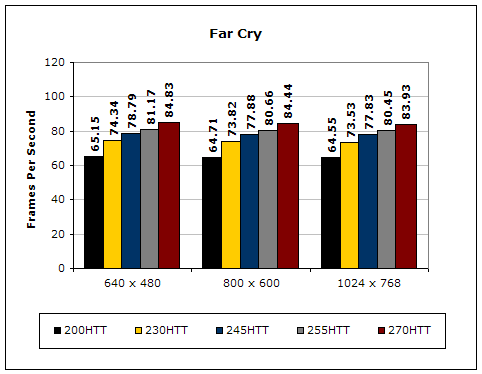
Since Far Cry is a game, the performance results will be very similar to 3dMark2001. I ran the benchmark at 640x480 so the benchmark would not be too GPU dependent. The tests under 1024x768 and 1280x1024 are an approximation of what kind of frames you’ll be getting. While the results are similar to 3dMark2001 in performance, this benchmark will give more significant results because Far Cry is extremely demanding.
Results Continued
Unreal Tournament 2004
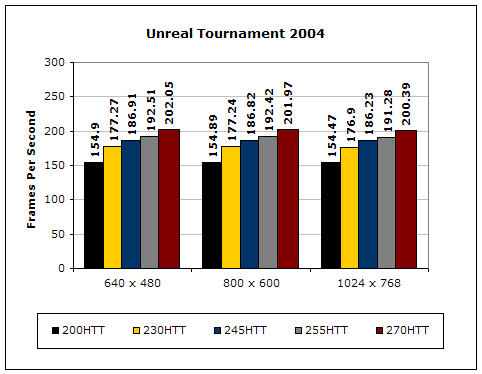
Unreal Tournament is another popular game engine to test overall system performance. Here, we can see the same results as Far Cry and 3dMark2001. Like Far Cry, UT2004 was also run at 640x480 to limit GPU dependency. The other resolutions are to give an approximation of actual gameplay performance.
PCMark2002
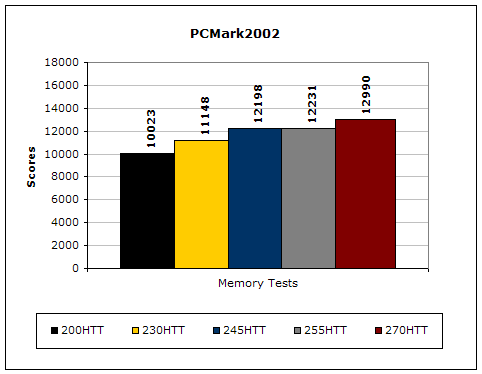
PCMark is another benchmark created by Futuremark. It tests the memory compression and decompression speeds in small to large chunks of data.
Super PI
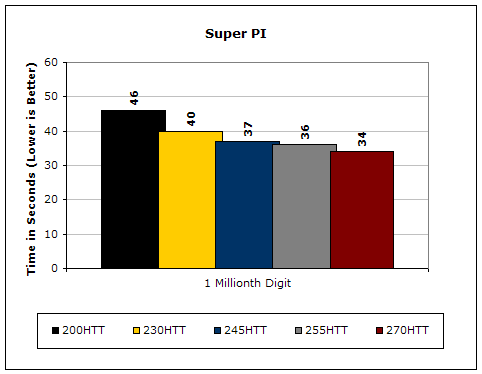
Since the value of PI is an infinite value, Super PI is a speed test to find the digit you’re looking for. In this case, we chose the millionth digit. Super PI benefits greatly from higher FSB as well as low latencies.
PiFast
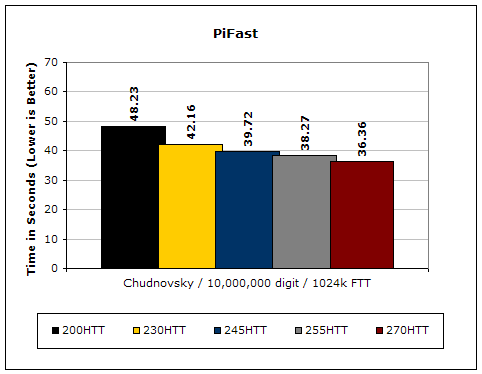
PiFast is similar to Super PI and the results can be greatly affected by a slight adjustment to the memory megahertz and latency.
Conclusion and Thoughts
If you think Corsair is the only high performance memory with flashy looks, you’re dead wrong. Crucial’s Ballistix Tracer is definitely awesome memory. The excellent finish of gunmetal heatspreaders combined with a black PCB makes the memory physically attractive. Added to the appeal are the chasing LED’s that show memory activity. If you have a windowed case, this is something you should definitely consider. The performance and overclocking potential is superb too. Being able to reach a high 270HTT with 2.5-3-3-7 1T makes the Tracer a good competitor for the highly acclaimed Samsung TCCD chips. The memory also packs flexibility too. If you ever happen to run HTT and memory frequencies with a divider, then these are probably the best sticks for you. For example, say you have an AMD A64 2800+ Socket 754 paired with an Abit NF8. You lower the multiplier and raise the HTT. So far you have been running 8x300 = 2.4GHZ. There’s not many memory sticks that can run at a ratio of 1:1, so you run the system with a 166 divider. That brings the memory speed to 240MHZ. With the Tracer at 240MHZ, you can run low latencies of 2.5-2-2-6 1T with only 2.8v. You can do the same with BH5 and run 2-2-2-5, but you’ll most likely need more than 2.8v. What’s wrong with using TCCD in that system? At 240MHZ, your TCCD will most likely need looser timings of 2.5-3-3-6, or 2-3-3-6 if you’re lucky. Catch my drift? For those who still want to run a 1:1 ratio, be glad to know that the Tracer will allow a 270HTT operation. While the Tracer doesn’t win the highest performance crown (the OCZ Platinum PC4800 wins that), it does win with great looks, great performance, and really flexible latency adjustments.
Pros:
- Nice gunmetal heatspreader finish
- Black PCB
- Attractive “chasing” LED’s
- Blue LED’s at bottom provide glow
- Great performance
- Great overclocking potential
- Very flexible with memory timings
Cons:
- Price may be a bit steep when compared to TCCD offerings

We would like to thank Crucial for providing us the sample. If you have any questions or comments, feel free to hit us up in the forums. You can also check out more of our latest reviews on the front page.