

Mushkin PC2-4200 1GB Dual Channel Kit
Introduction
Mushkin is a small company that is capable of making a substantial impact in the industry. Even back in the days of SDRAM, Mushkin’s PC133 memory with the black PCB was a highly recommended option for extreme overclocking. Although Mushkin made extremely high quality memory, the modules were often tagged with high prices. The Mushkin Level II PC3500 was the most sought after Winbond BH5 based memory. People paid top dollars for the sticks because it provided some of the best overclocking results available. I once sold a set for $450! This level of prestige reflects Mushkin’s influence in the industry.
Mushkin was a bit slow with the release of DDR2 solutions. The first and only available choice for DDR2 was their PC2-4200, rated at 4-4-4. The latencies were rather high for a speed of 266MHZ, but they did come with nice silver heatspreaders. Mushkin has now expanded their line of DDR2 options. There are now two choices of PC2-4200 memory, one rated at 4-4-4 without heatspreaders and one rated at 3-3-3 with heatspreaders. The sample we received today would most likely be PC2-4200 3-3-3 with a heatspreader, although the sample was not clearly labeled.
Mushkin PC2-4200
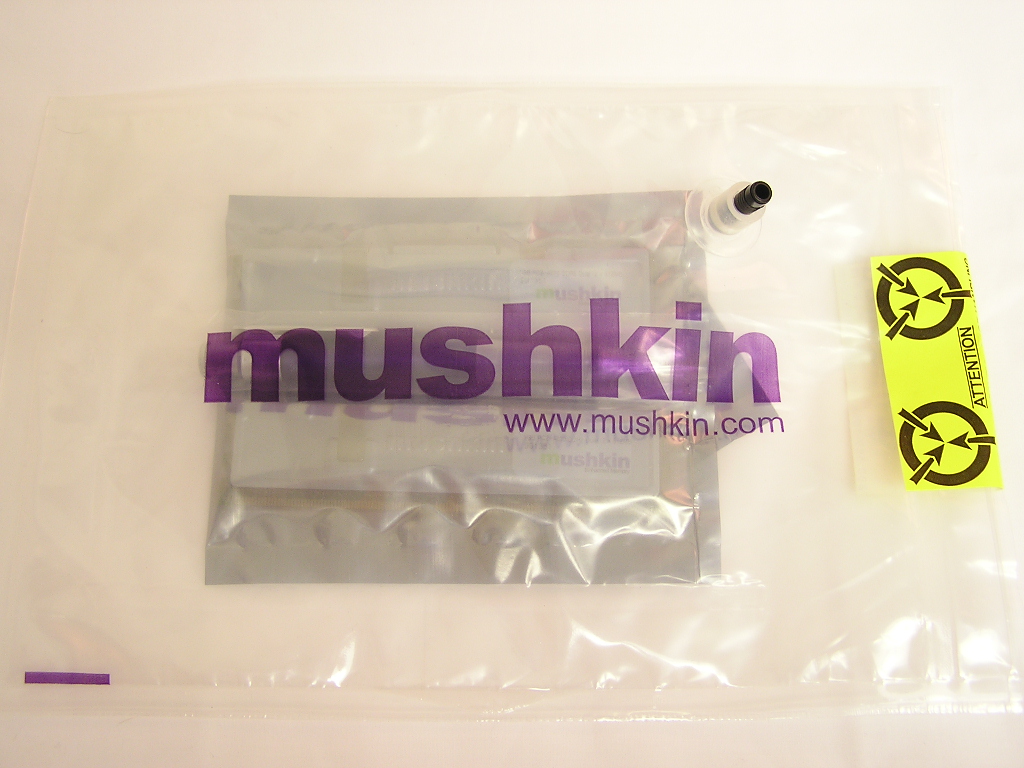
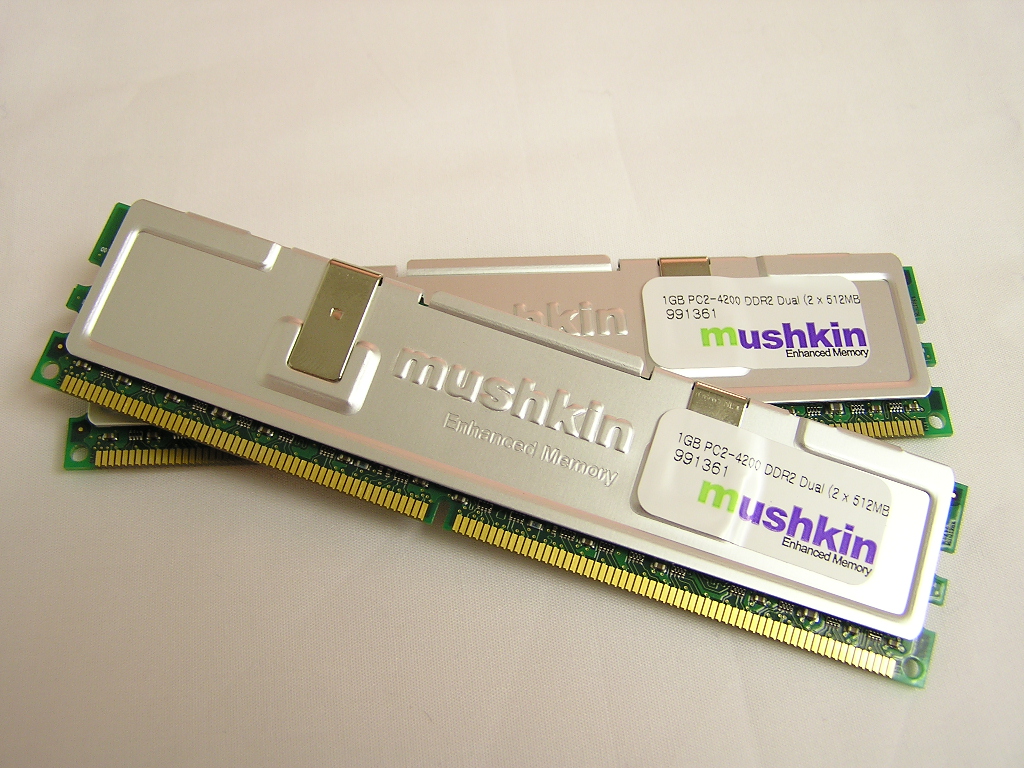
The memory arrived in Mushkin’s well known plastic bubble bag. The bag was not inflated but there was still enough protection for shipping. The modules have a green PCB, something that isn’t very common with Mushkin memory. They usually use a black PCB to add the appealing looks. The chips are likely to be Samsung chips, as the PCB was clearly marked with Samsung. The chips are covered by silver heatspreaders, which are also an addition to the overall look. We all know that heatspreaders do absolutely nothing to aid in cooling. With the smaller form of DDR2 BGA chips and the lower voltage requirement , additional cooling is no longer needed. Cooling is needed if you’re planning to pump high voltage to the memory, but that sort of overclocking is usually left for extreme enthusiasts who focus on benchmarks. Users who want the best performance for their daily games or programs will be happy to know that 2.2v (which is usually the maximum provided by motherboards) won’t overheat and destroy the memory.
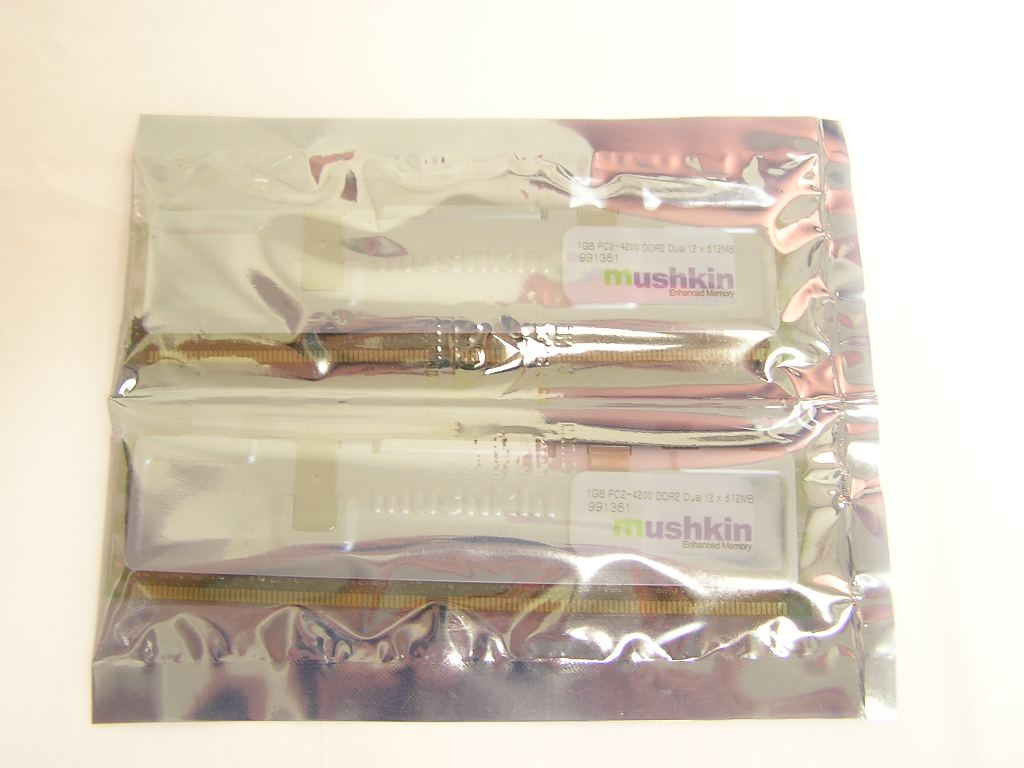
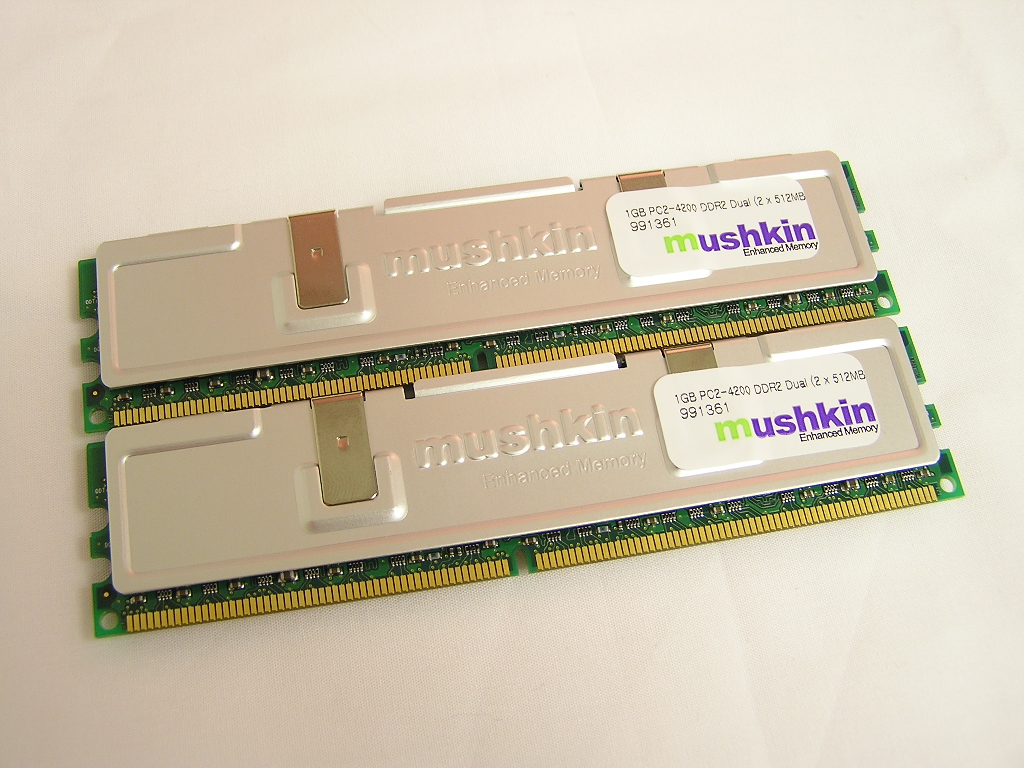
The Mushkin PC2-4200 comes with a label that does not specify any latency timings. It does mention that these are 512MB sticks of PC2-4200. In the overclocking section, you’ll find that these sticks resemble the performance of the Mushkin PC2-4300 3-3-3 memory. The modules I received did not have a specified voltage rating. The PC2-4300 4-4-4 without heatspreaders are rated for 1.8v-2.0v. The PC2-4300 3-3-3 with heatspreaders are rated for 2.0v-2.2v. The version with the heatspreaders was a little less appealing because it was rated to need 2.0v just to run 266MHZ. The previously reviewed Crucial Ballistix and Kingston HyperX did not need that much to run higher speeds. I guess it is possible to run the memory at lower voltage, but the fact that the memory was rated with a minimum of 2.0v wasn’t very appealing. In the overclocking section, you’ll see that this “rated voltage” is definitely not required.
Test System and Overclocking
Test System:
- Intel Pentium 4 520 2.8GHZ
- Abit AA8-Duramax
- 2 x 512MB Mushkin PC2-4200
- 2 x 512MB Crucial Ballistix PC2-5300
- 2 x 512MB Kingston HyperX PC2-5400
- ATI Radeon X800XT PCI-E
- Ultra Products 600W
Overclocking:
Keep in mind that the latencies are as follows: CAS-TRCD-TRP-TRAS
The Mushkin PC2-4200 overclocked extremely well. The memory was rated at 266MHZ 4-4-4 and was able to go as low as 3-3-3-8. Going above the specified speed with the lowest timings proved impossible. The slightest alteration and the system would fail to POST. At first, I had little hope for great overclocking results, but I was proved wrong. I loosened the timings to the rated 4-4-4 and TRAS to 12, allowing me to run it as high as 337MHZ. That’s the speed of PC2-5400 memory! The memory was fast, stable ,and without problem. Memtest was 100% error free. Obviously the next stop was to see whether it would high the highest my motherboard allowed. With just 1.8v at VDIMM, the memory went as high as 354MHZ or DDR708. For memory that was rated only at 266MHZ with poor timings of 4-4-4, the Mushkin PC2-4200 did not fail to impress. I found it absolutely amazing. After playing with the Mushkin’s, I’ve come to realize that all current DDR2 chips should be capable of at least 337MHZ, or PC2-5400 speeds. There is no guarantee when you buy the memory, but the overclocking is where the fun is.
Overclocking Results:
- 200FSB 3:4 266MHZ 3-3-3-8 1.8v
- 200FSB 3:4 266MHZ 4-4-4-12 1.8v (rated speed and timings and voltage)
- 253FSB 3:4 337MHZ 4-4-4-12 1.8v
- 265FSB 3:4 354MHZ 4-4-4-12 1.8v
Results
A series of memory intensive benchmarks will be run to test the performance of our sample. The following tests will be based on common benchmark programs such as 3DMark and PCMark. Real life performance differences will be tested through current games such as Far Cry, UT2003, UT2004, and Halo. Memory bandwidth benchmarks will be based off of SiSoft Sandra and Aida32. Super PI and PiFast will also be used to test memory performance, as the benchmark benefits largely from FSB increases.
SiSoft Sandra
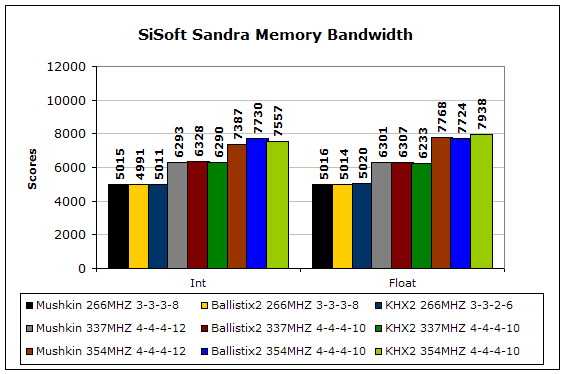
SiSoft Sandra is the most widely used memory bandwidth test. At the same rated speed, the lower latencies did not help memory bandwidth all that much. SiSoft Sandra seems to favor the higher frequencies when it comes to DDR2 memory.
Aida32
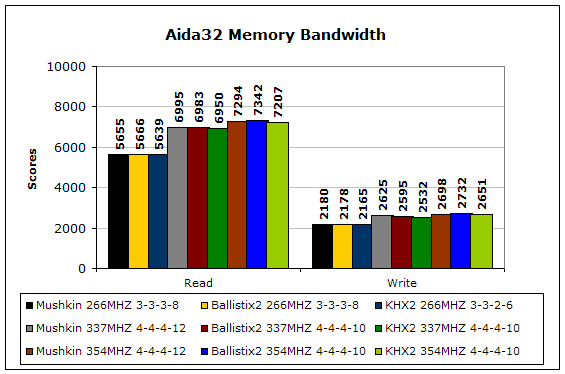
Much like Sandra, Aida32 tests the memory’s ability to read and write data in large chunks. The results reveal that the lower latencies seem to help just a little with performance.
3DMark2001SE
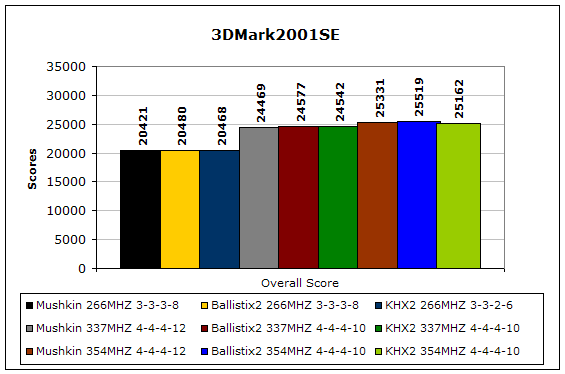
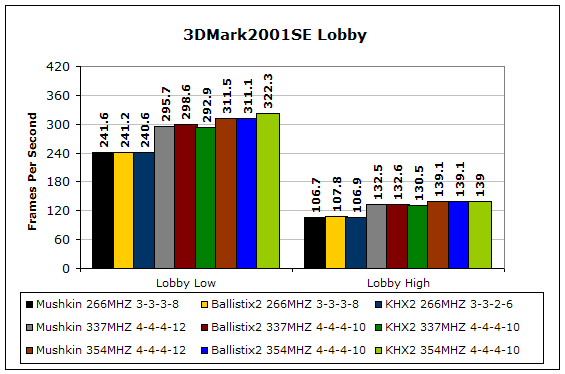
3DMark is probably the overclocker’s favorite benchmark. Unlike 3DMark2003, which stresses mainly the video card, 3DMark2001SE tests all of the system’s main components. Increasing the CPU speed, memory speed, and video card speeds will result in higher results in the final score. The lower latencies definitely helped to squeeze out more points and frames.
PCMark
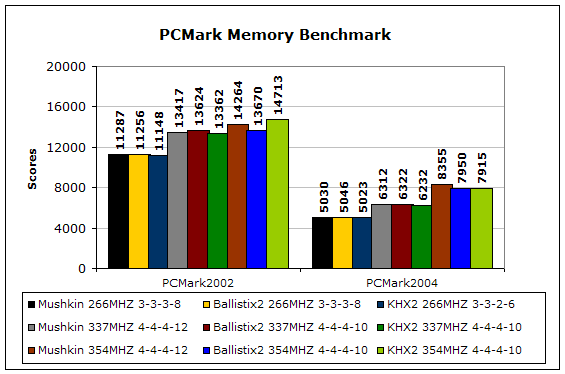
PCMark is another benchmark created by Futuremark. It tests the memory compression and decompression speeds in small to large chunks of data. For reviewing and testing memory, only the PCMark Memory Benchmark is selected. The score does display the overall PCMark system score, but only the memory score. Strangely, the Mushkin PC2-4200 scored higher in PCMark2004 than the Ballistix2 and KHX2. I’ve tested this over and over with the same results. Perhaps PCMark2004 needs a new patch for these DDR2 benchmarks. The PCB and chips alone should not produce such a dramatic difference in scores.
Results Continued
Doom 3
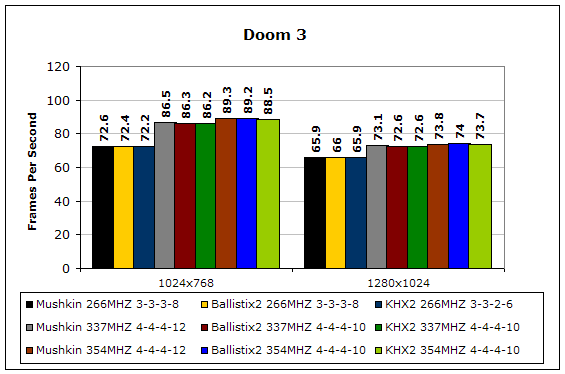
Although Doom 3 is known to be more graphic dependent than system dependent, the game responds positively when latencies are lowered and system bus is increased.
Far Cry
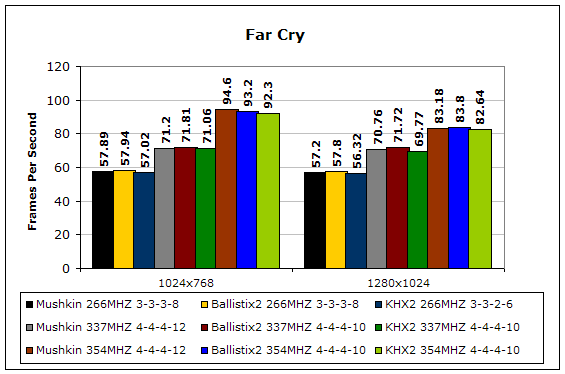
Far Cry is currently one of the most popular games and does a great job of taxing your system.
Unreal Tournament 2004
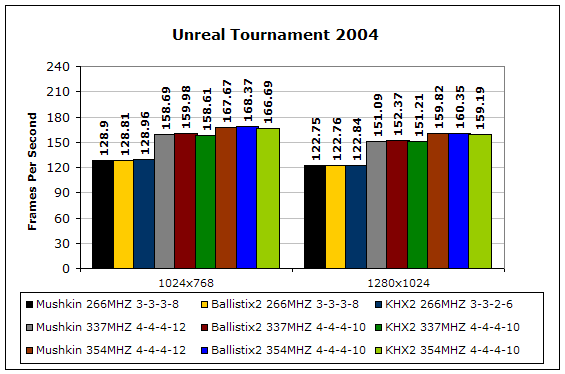
Unreal Tournament 2004 is another popular game that also doubles as a good benchmark. This game really likes memory bandwidth and it shows.
Super PI
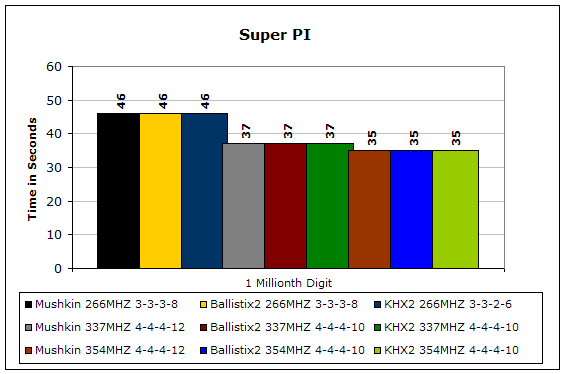
The value of PI is an infinite value and Super PI is a speed test to find the digit you’re looking for. In this case, we chose the millionth digit. Super PI benefits greatly from higher FSB and low latencies. In this case, all sticks of memory performed exactly nearly identically, which should be the case.
PiFast
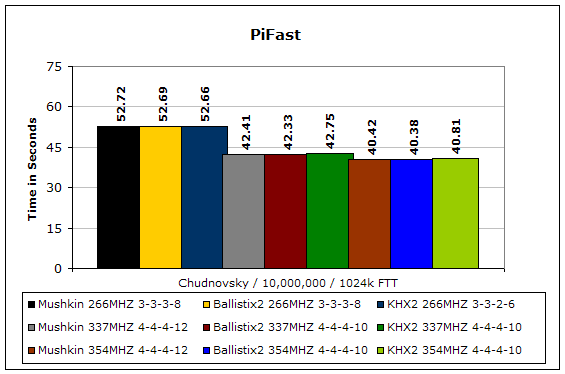
PiFast is similar to Super PI. The results can be greatly affected by a slight adjustment to the memory megahertz and latency.
Conclusion and Thoughts
I have to be honest and say that I didn’t expect too much out of the Mushkin PC2-4200. My main concern was the rated latencies, which were relatively high. After extensive testing, I’ve come to love the memory. It is indeed a great performer. The best thing about the memory is the price. Coming in at around $270, the Mushkin PC2-4200 is the cheapest out of the three sticks of DDR2 memory tested so far. It is able to overclock just as well as the others, and the performance is top notch. You’d think that the slightly higher latencies would result in lower performance, but that’s not the case. In many of the benchmarks, it was able to score higher than the other two brands at lower latencies. It is truly outstanding. Intel users who are forced to make a purchase of DDR2 memory should definitely spend their cash on the Mushkin’s. When DDR2 was first introduced, the memory would cost an arm and a leg; now, it’s become very affordable. The price of these Mushkin’s are lower than many of the available high end DDR sticks of memory, making it a Must-Have at InsaneTek. If you need some DDR2, get yourself some Mushkin PC2-4200 to save some cash without losing the performance.
Pros:
- Extremely affordable
- Great overclocking potential
- Great performance
- Does not require high voltage
Cons:
- Stock rated latencies are high for memory that runs at 266MHZ
- Not really a con, but no more black PCB
- Aesthetics a bit bland

We would like to thank Mushkin for providing us the sample. If you have any questions or comments, feel free to hit us up in the forums. You can also check out more of our latest reviews on the front page.