

Mushkin PC3700 1GB Dual Channel Kit
Introduction
Mushkin is a popular manufacturer of performance memory. Mushkin Memory Systems was founded in 1994 and is based in Denver, Colorado. Mushkin’s most recent success were its Black Level II PC3200 and PC3500 modules with Winbond BH5, which received high acclaim from overclockers near and far. They almost always overclocked better than the other BH5 based memory. It is my pleasure to be able to review their new PC3700 modules today.
Mushkin PC3700
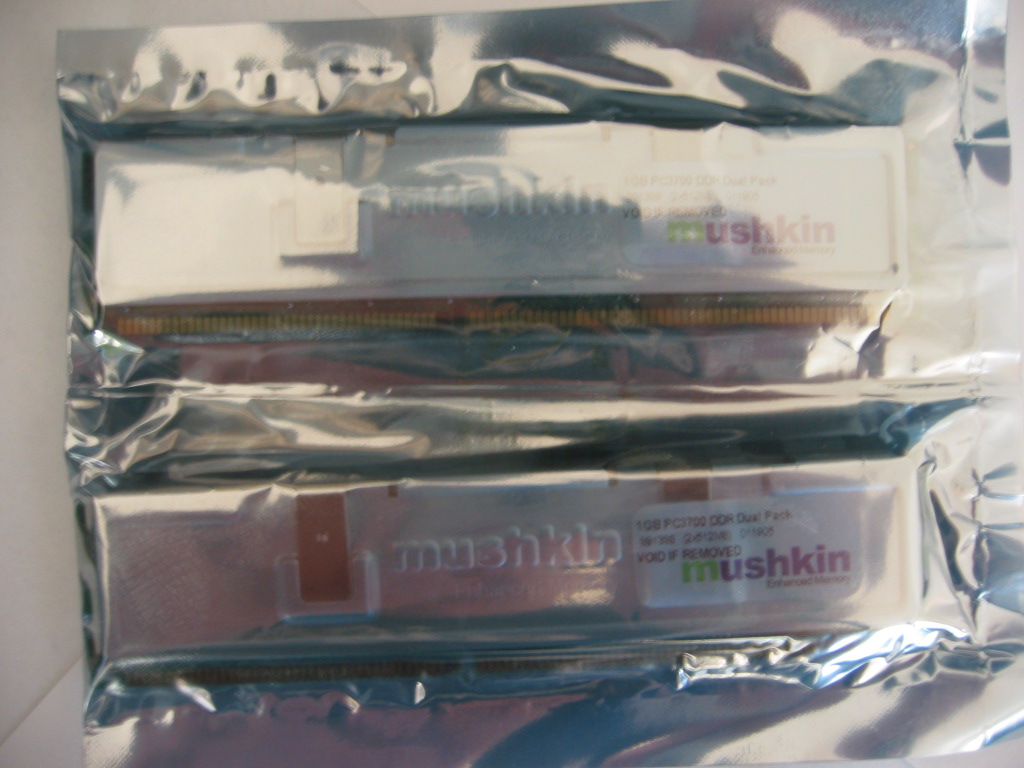
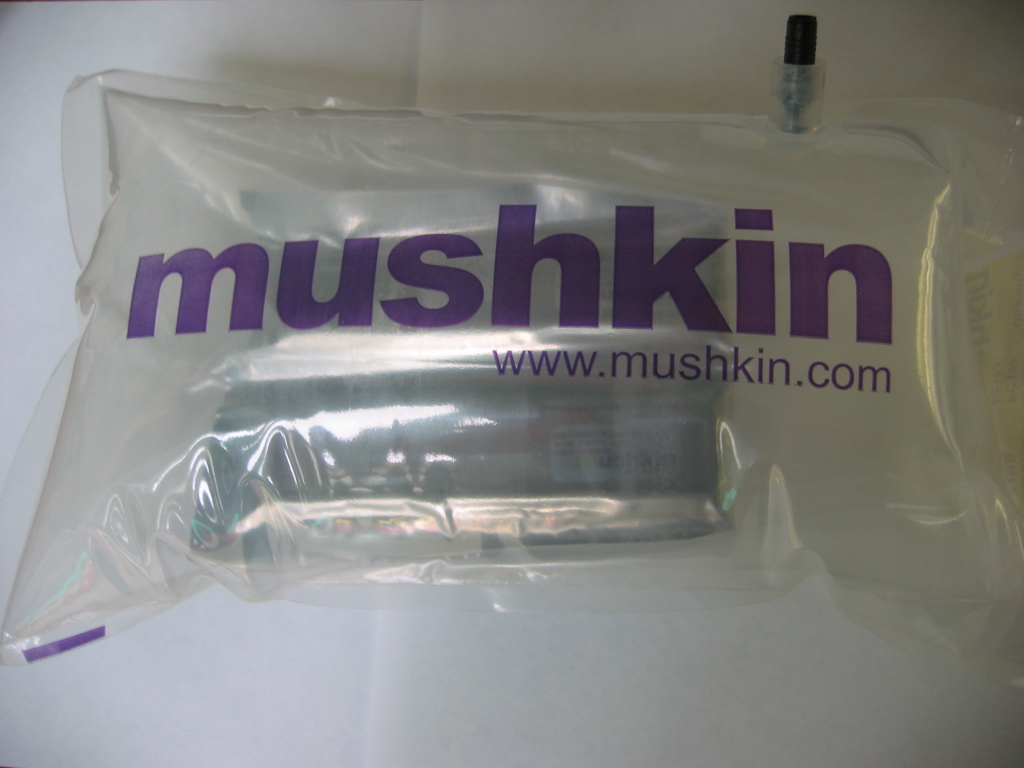
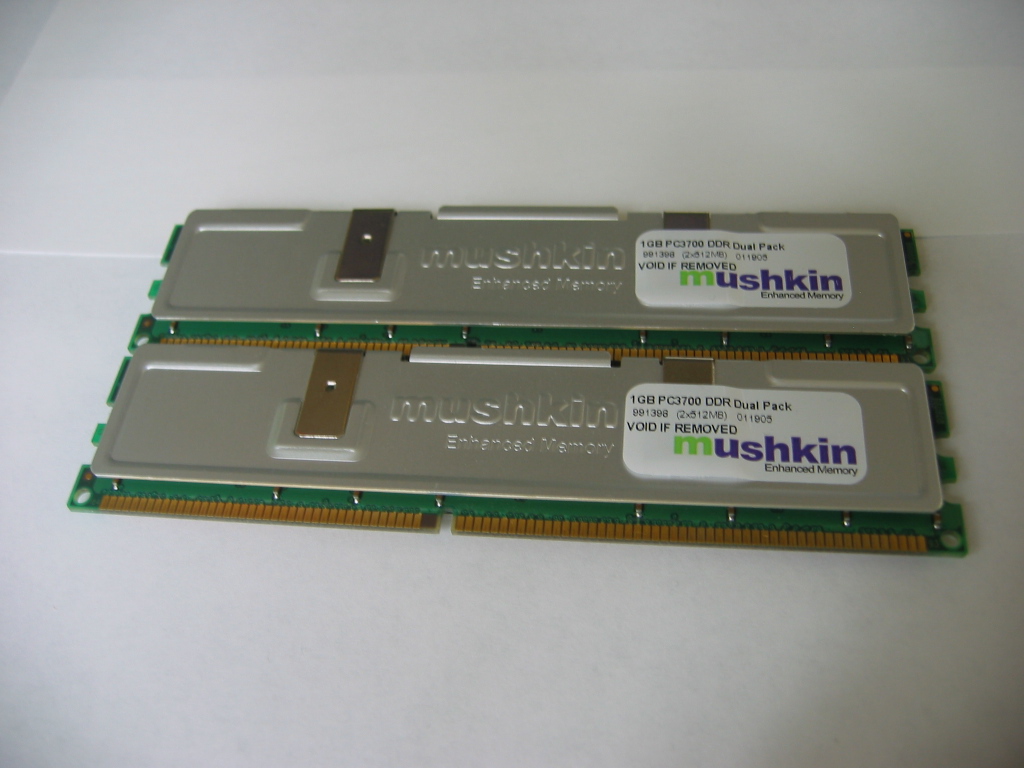
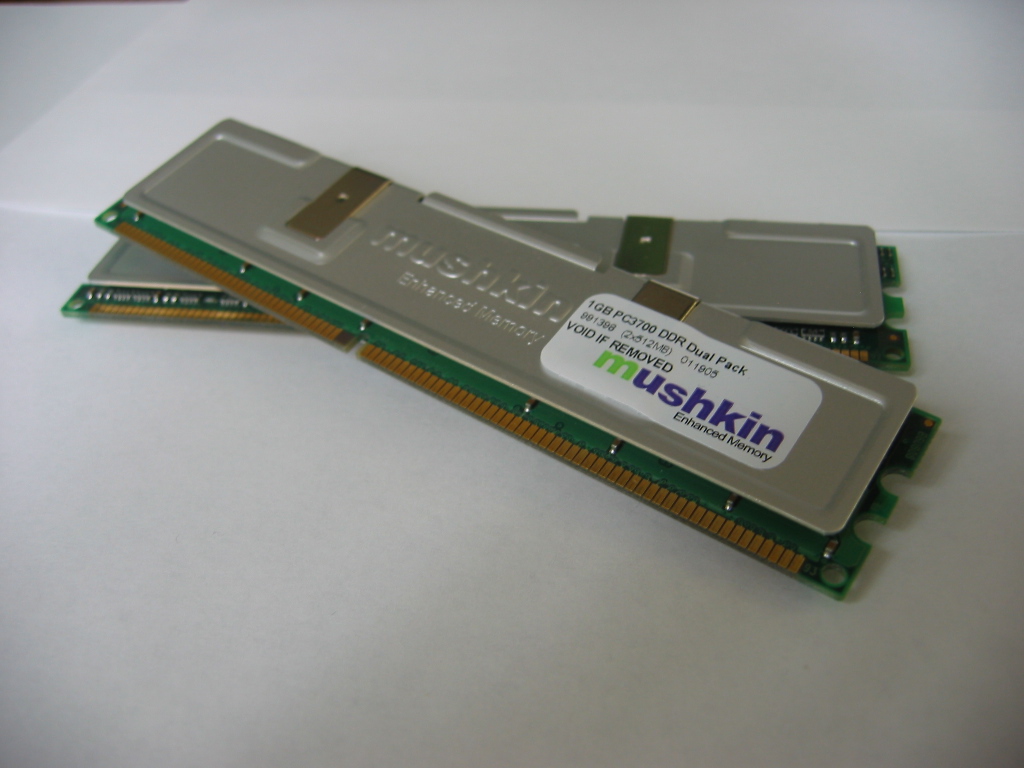
The PC3700 came packed in a sealed anti-static bag, which was then placed within an inflatable plastic bubble. This is one of the neatest packing jobs I’ve ever seen. The bubble ensures safety throughout shipment process. The memory modules are covered by heatspreaders which, in this case, are silver. Mushkin uses heatspreaders of many different colors, ranging from black to purple. Heatspreaders do not always help in keeping the RAM cool; sometimes it hinders their cooling by trapping heat rather than dispersing it. It’s always a good idea to have plenty of airflow over your RAM and motherboard when overclocking. On the heatspreaders we find a tag with a vague description of the RAM, telling us that it is PC3700 and that is is a one gigabyte kit. No information of its timings and voltage ratings are given.
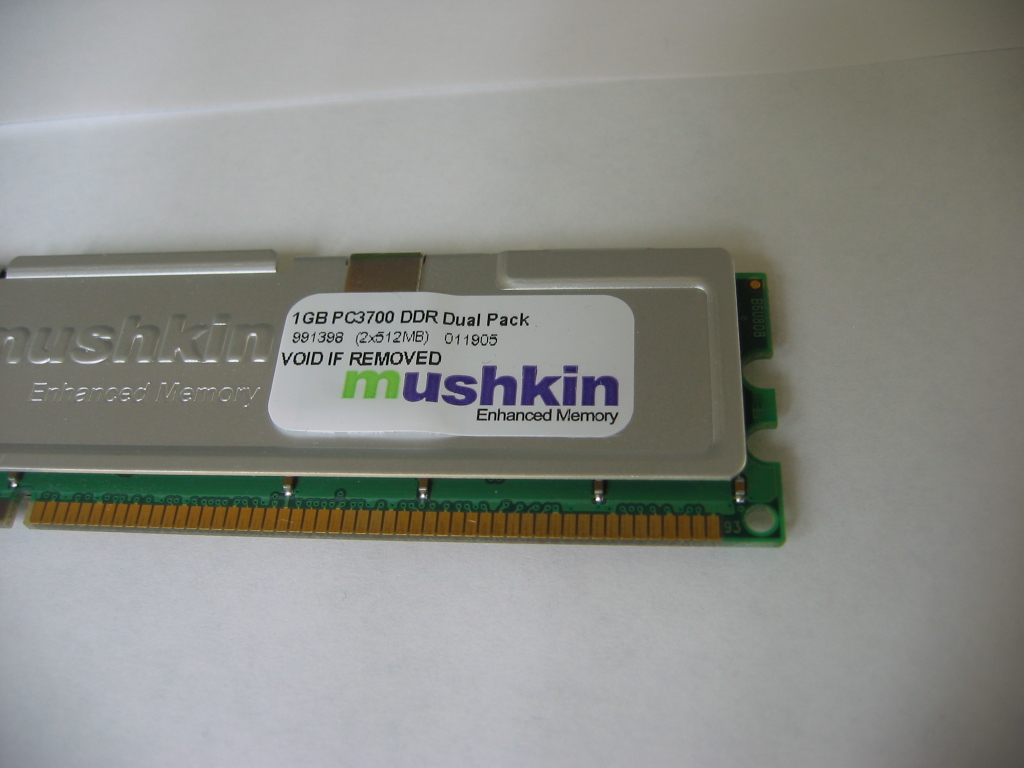
The memory uses Mosel chips, which Mushkin rates at 2.5-4-3 (CAS-TRCD-TRP) for 233MHZ operation with 2.5v-2.8v. You may wonder why TRAS and the command rate are not specified. Mushkin has a reason for this.
“The last two specs in the 2.5-4-3-7 1T, TRAS and CMD (short for Command) rate, are somewhat complicated and more difficult to understand than simple access and precharge latencies (the first three specs). We find the level of misinformation on TRAS and CMD rate somewhat alarming especially when used to create a false concept of performance by unscrupulous memory vendors.”
Unlike other sticks in Mushkin’s High Performance line of memory, Mushkin uses Brainpower PCB on these sticks. You would normally find Mushkin’s custom black PCB, which gives Mushkin’s memory its unmistakable appearance. Brainpower PCB is not noticeably shorter in height than other PCB’s. Its layout is also different and allows shorter traces which may improve how it overclocks. Hey, sometimes shorter is better.
Test System and Overclocking
Test System:
- AMD Athlon64 3200+ Winchester
- MSI K8N Neo2 Platinum
- 2 x 512MB Mushkin PC3700
- VisionTek X800 Pro
- Fortron 530W
Overclocking:
Keep in mind that during overclocking, the latencies are as follows: CAS-TRCD-TRP-TRAS
Taking into consideration that the memory is rated at 233MHZ, I first tested to see how well it would run at lower speeds of 200MHZ (PC3200) and 217MHZ (PC3500). Stability for every speed was tested by Memtest86 test #5, which was run for 45 minutes. At 200MHZ I was able to achieve timings of 2-3-2-5. I was surprised at the fairly tight timings the RAM allowed, considering that the rated timings at 233MHZ are rather loose. At 217MHZ I needed to raise the CAS latency to 2.5 and TRP to 3 to gain stability. I then tested to see how far I could go on these timings of 2.5-3-3-6. I reached a maximum stable speed of 242MHZ. It seemed that I hit a wall and going beyond that speed, even with loosened timings, would not POST.
All tests were done using 1T command rate and a multiplier of 10x. All memory speeds were achieved with a 1:1 ratio.
Overclocking Results:
- 200MHZ 2.0-3-2-5 2.75v
- 217MHZ 2.5-3-3-6 2.75v
- 233MHZ 2.5-3-3-6 2.75v
- 233MHZ 2.5-4-3-6 2.75v (rated speed and timings)
- 242MHZ 2.5-3-3-7 2.85v
Results
A series of memory intensive benchmarks will be run to test the performance of the RAM, including the standard benchmarks such as 3DMark2001SE and PCMark04. Real life performance was measured with Valve’s Half-Life 2 stress test and Unreal Tournament 2004. Game details were set to maximum and AA and AF are off. The resolution was set to 1024x768. Memory bandwidth will be measured with SiSoft Sandra and Everest Home Edition. Super PI and PiFast will also be used to measure memory performance.
SiSoft Sandra
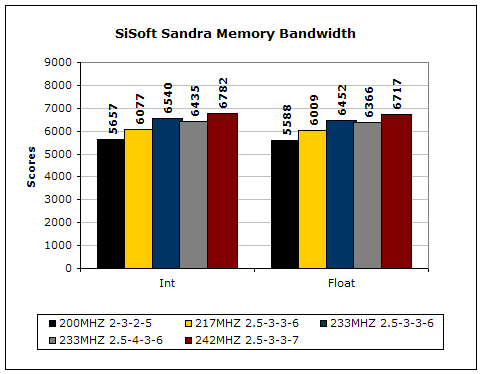
SiSoft Sandra is the most widely used memory bandwidth test. It is affected by memory timings and increased memory frequencies.
Everest Home Edition
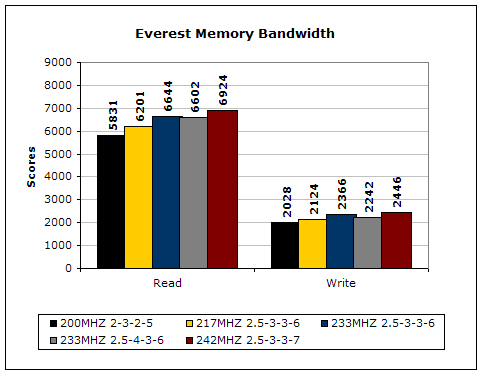
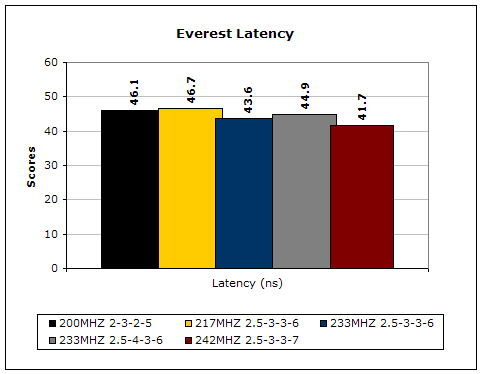
Everest is much like Sandra, it tests theoretical memory bandwidth. the scores follow the same trend as Sandra. Everest also includes a latency test, its scores represent an increase in performance as memory frequency increases while maintaining lower latencies.
3DMark2001SE
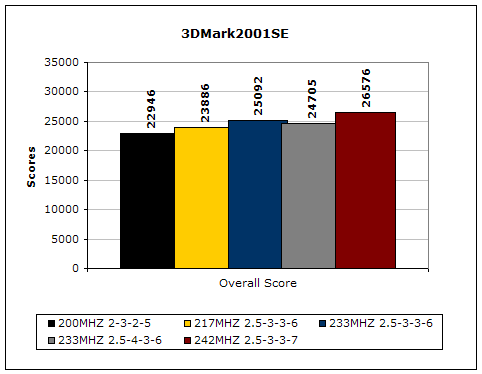
3DMark is probably the overclocker’s favorite benchmark. Unlike 3DMark2003, which stresses mainly the video card, 3DMark2001SE tests all of the system’s main components. Increasing the CPU speed, memory speed, and video card speeds will result in higher results in the final score.
PCMark2004
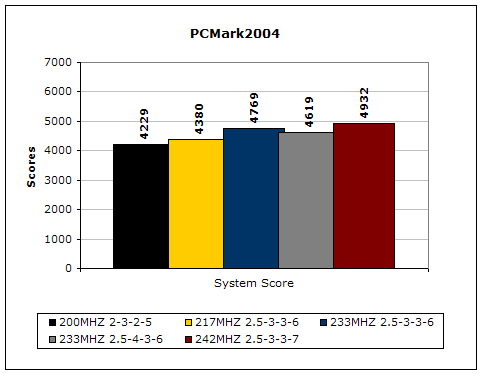
PCMark2004 is an application-based benchmark and a premium tool for measuring overall PC performance.
Results Continued
Valve VST
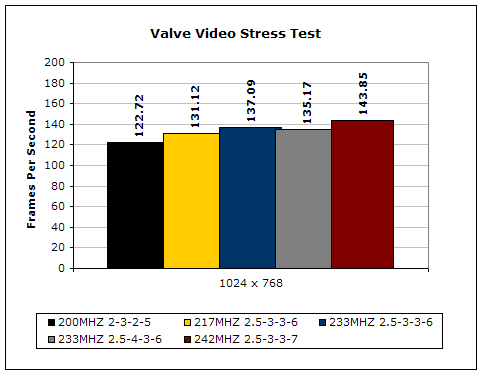
Valve’s Video Stress Test is a benchmark that tests your system on the Source engine, which Half-Life 2 is based upon. It gives a good reference of how well your system will hold up during game play. Here you can see that higher latencies do affect your average frames per second.
Unreal Tournament 2004
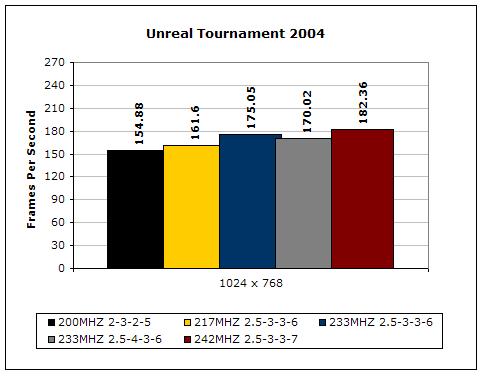
Unreal Tournament 2004 is another popular game to test overall system performance. Results scale similar to Valve’s VST and 3DMark2001SE.
Super PI
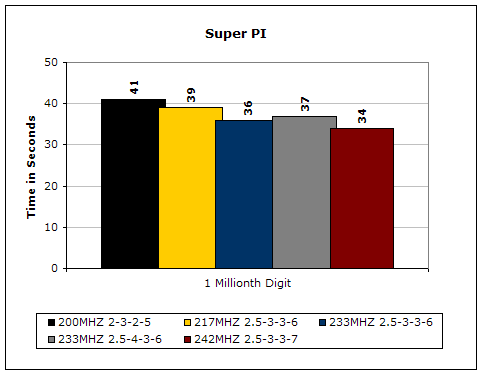
The value of PI is an infinite value and Super PI is a speed test to find the digit you’re looking for. I chose to run it to the 1 millionth digit. This is a very popular test that is greatly affected by memory and CPU speeds.
PiFast
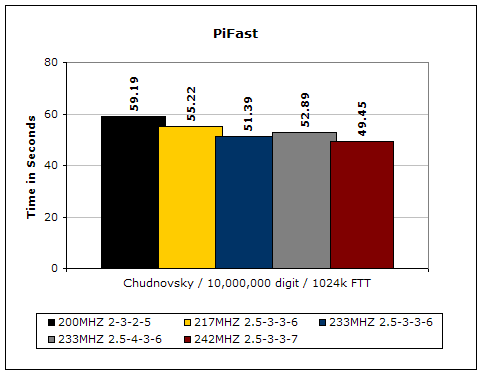
PiFast is similar to Super PI. The results can be greatly affected by a slight adjustment to the memory megahertz and latencies.
Conclusion and Thoughts
Mushkin has produced a great PC3700 offering here. They have taken a chip that I have seen in PC3200 memory and applied it to a great PCB. It provides fantastic performance and is priced lower than many of its competitors’ PC3700. I did not expect to be able to run the memory at the speed I reached with those timings, seeing that TRCD was already rated at 4 by Mushkin. Although I feel the memory’s heatspreaders look a bit plain, there is certainly no reason to penalize them for that. I would recommend this to anyone looking for memory that needs to run around PC3700 speeds.
Pros:
- Great packaging
- Lifetime warranty
- Competitively priced
- Decent overclocking
Cons:
- Nothing really

We would like to thank Mushkin for providing us the sample. If you have any questions or comments, feel free to hit us up in the forums. You can also check out more of our latest reviews on the front page.