

GeIL Ultra-X PC3200 1GB Dual Channel Kit
Introduction
While companies like Kingston, Corsair, and OCZ are enjoying marketing buzz, more discreet companies like Mushkin and GeIL have released memory revisions. Yet, not everyone is so immediate to purchase “other” memory over the Big 3, at least not your average Fry’s consumer awaiting the excellent advice their employees have to offer. GeIL has released equally impressive memory modules as the Big 3 and their products should never be overlooked.
GeIL has been around for a long time, but since their company is based in Asia, we sometimes forget the excellent memory products they have released in the past. I remember the first time I purchased the GeIL Golden Dragons with the nifty clear/golden PCB and chips that never got hot. Simply plugging in GeIL Golden Dragons into my HP Pavilion fostered my interest in LED’s, cathodes, watercooling dye, and case-modding. If it wasn’t for GeIL, I wouldn’t be on the staff of InsaneTek! GeIL has always impressed us with their dedication to the enthusiast community, and today we have the honor of reviewing the GeIL Dual Channel Ultra-X PC3200.
GeIL Ultra-X PC3200
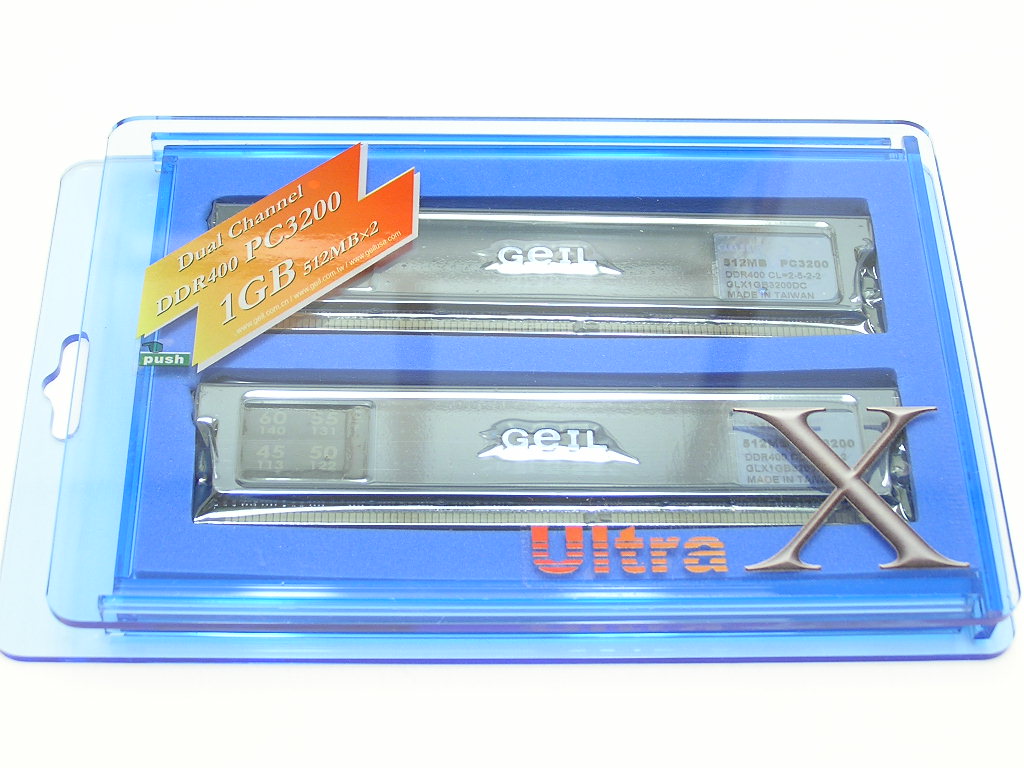
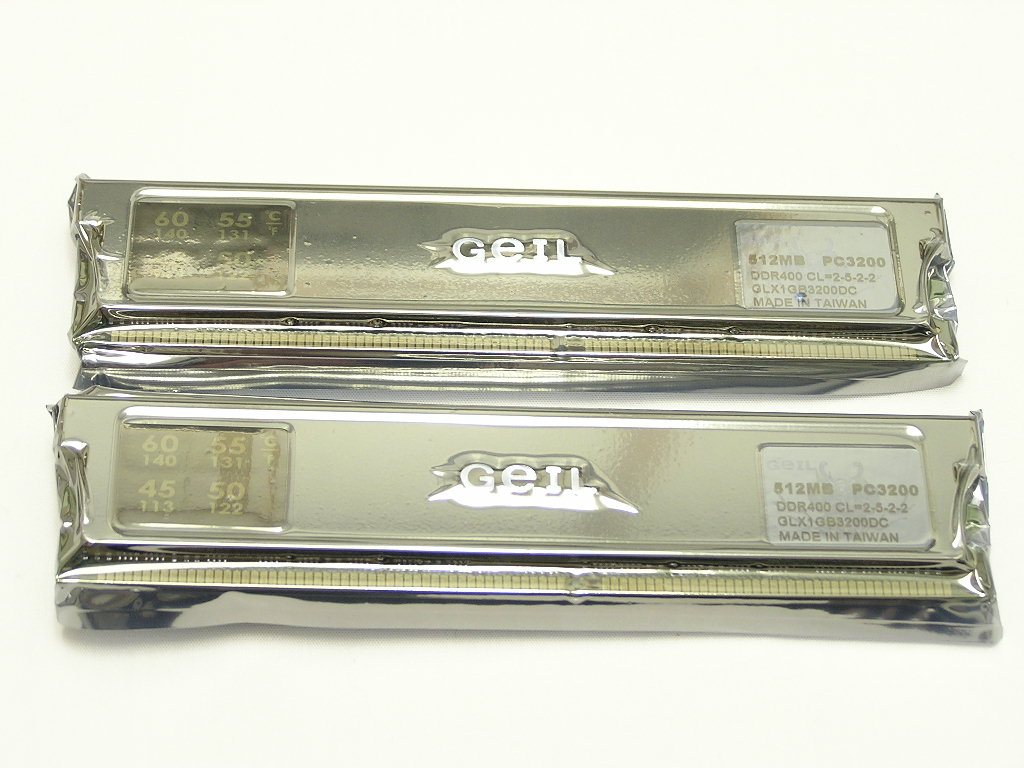
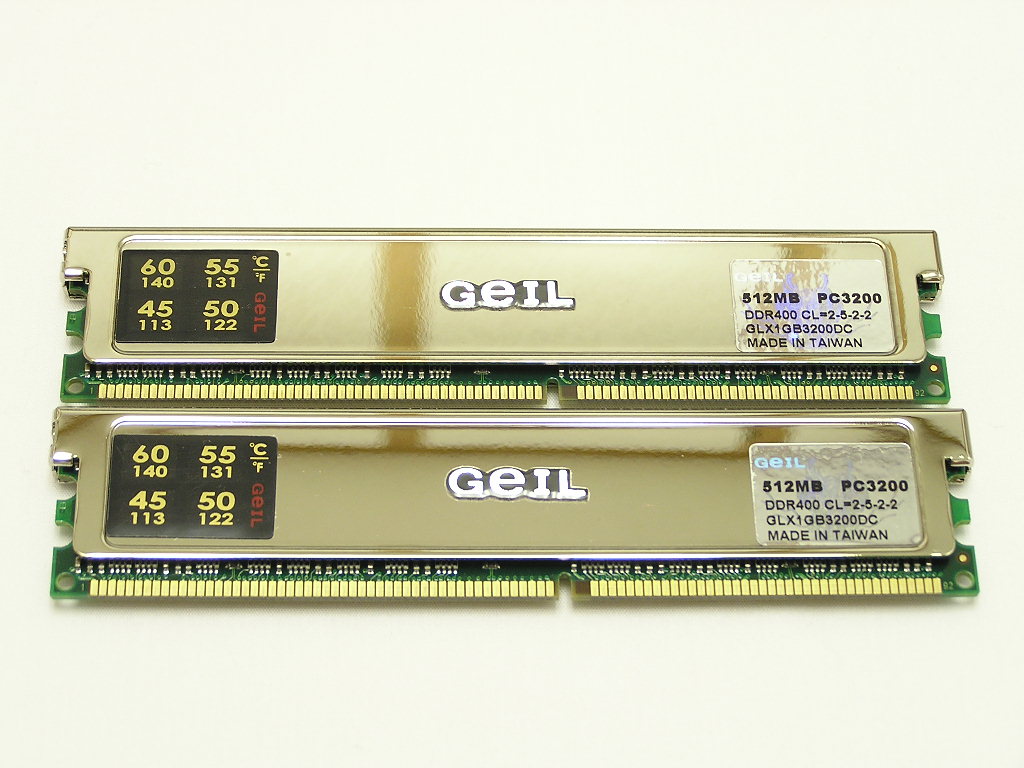
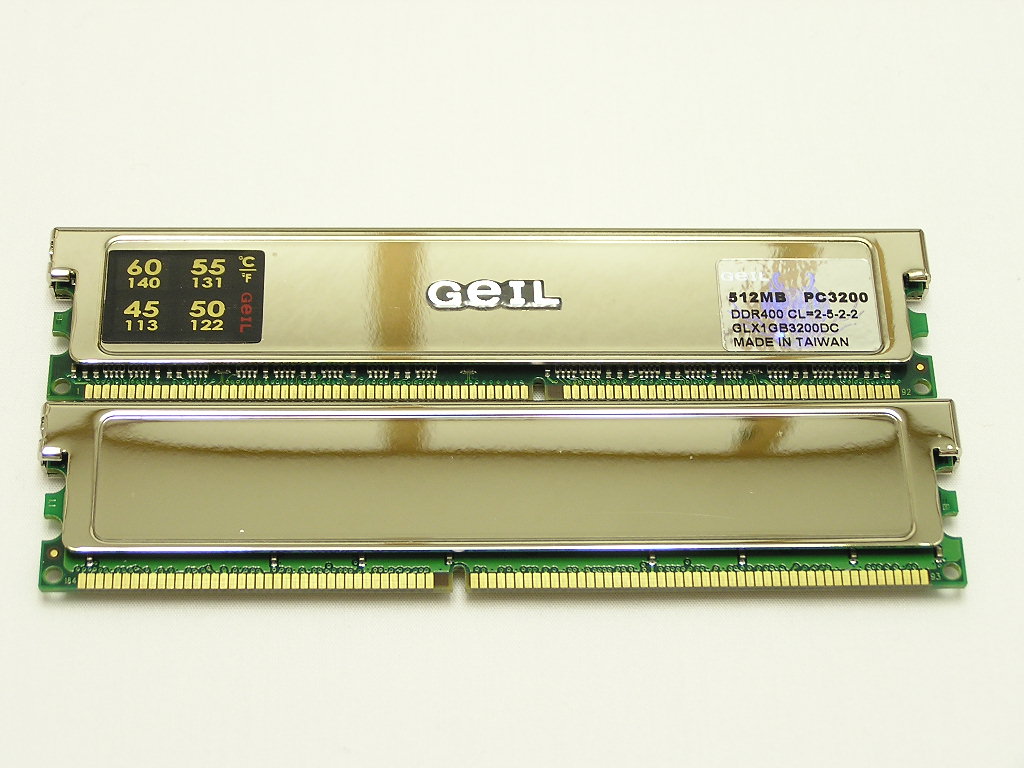
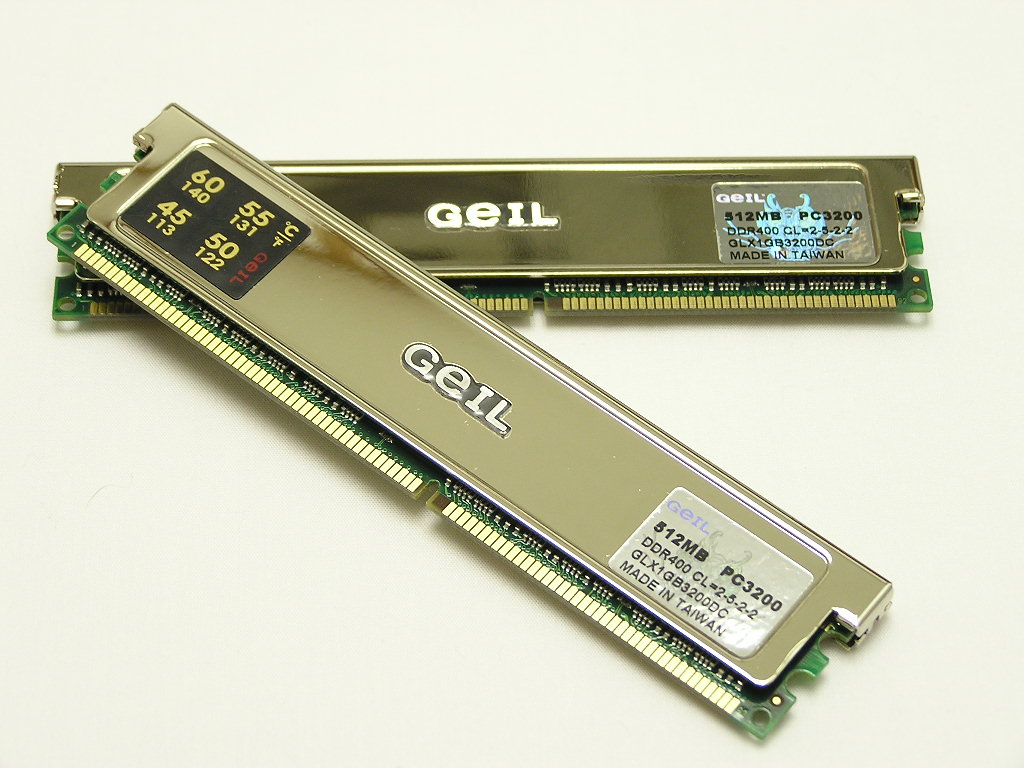
GeIL’s blue foam and transparent packaging has always been their own unique form of packaging. Only Ultra Products’ luxurious wooden box matches GeIL’s packaging. Opening up the packaging revealed air-tight sealed memory modules, ensuring that this kit is well-protected and not tampered with. GeIL has chosen a set of plain copper, tin-coated heatspreaders, which are simple in comparison to the Platinum heatspreaders we’ve seen from PQI and OCZ. Geil also includes a sticker that can reveal the temperature range (in Celsius or Farenheit) of the memory modules. This is a definite plus for those looking to overclock. Lastly, we have their holographic sticker displayed for item number display purposes.
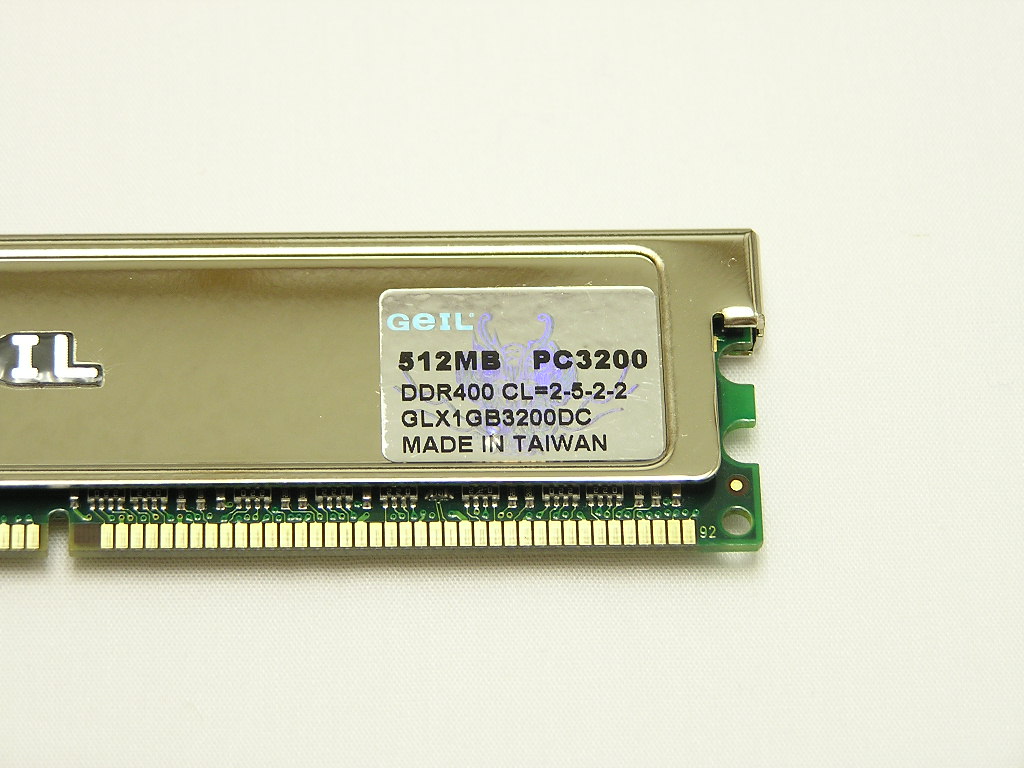
I always remove the heatspreaders to see what kind of ICs/PCB memory modules are used. GeIL’s heatspreaders were particularly difficult to remove. The adhesive looks thick and strong and I did not want to compromise the review by breaking them. I do know that GeIL usually labels the ICs with their own brand name. Judging from the placement of the capacitors and different colors of the PCB around the heatspreaders, the PCB looks to be Brainpower. I decided to look at the website for more information and found the following:
Hand Picked 5ns GeIL Chips. Enhanced SPD for Dual Channel DDR motherboards. Tin Coated Platinum Copper Heat Spreader with Fashion Designed Retail box.
- PC3200 400MHz CAS 2 5-2-2
- GeIL Ultra-X TSOP 32x8 DDR Chips
- 184pin, Non-ECC, Un-buffered DDR DIMM
- 6 Layers Ultra Low Noises Shielded PCB with Gold 30u” Plating
- Temperature thermometers
- Retail Package
- Life time warranty
Most of the LL DDR memory in the market utilizes TCCD. The only other popular ICs are the Microns, but with the overclocks that I have attained with these modules, the behavior is similar to TCCDs. However, TCCDs are rated around 4 ns, and these were “handpicked” by GeIL to be 5ns. I am convinced that these ICs are TCCDs, judging from the overclock results I am about to reveal.
Test System and Overclocking
Test System:
- Athlon 64 3000+ Winchester 0440SPMW
- MSI K8N Neo2 Platinum
- Centon Advanced 3200LL (2x512MB)
- Gigabyte Radeon X800 Pro
- OCZ 600w PowerStream
To test memory stability, I first run Super Pi to the one millionth digit for a quick test. If that passes, I then use Prime95 for about one hour. If that passes, I run memtest86 and loop it for about 3 hours.
Overclocking:
Keep in mind that during overclocking, the latencies are as follows: CAS-TRCD-TRP-TRAS
I first ran the memory at 200 Mhz at its rated speed of 2-2-2-5 to ensure that it ran its rated speeds. After verifying that they did, I proceeded to increase the voltage to the max and check to see the highest overclock the Ultra-X can attain at its lowest latencies. For simplicity’s sake, I always do overclocks in increments of 5Mhz, and I was not able to get even to 205Mhz at 2-2-2-5 without the system getting BSODs. So I relaxed the timings to 2-3-3-7 and managed to get the memory to an impressive 230 Mhz. I proceeded into high latency overclocking and relaxed the timings to 2.5-3-3-7, which resulted in a very impressive 280Mhz. This matches our overclock record of TCCD memory from the Centon TCCD modules. I then relaxed the timings even more to 2.5-4-4-8 and was able to get 5 more Mhz in overclock. However, this increase in latency resulted in decreased performance.
All tests were conducted using the command rate of 1t, as 2t will actually lower performance for an Athlon64.
Highest overclock results: 9 x 280HTT
Overclocking Results:
- 200HTT 2.0-2-2-5 1T 2.65v
- 230HTT 2.0-3-3-7 1T 2.85v
- 280HTT 2.5-3-3-7 1T 2.85v
- 285HTT 2.5-4-4-8 1T 2.85v
Results
A series of common memory intensive benchmarks will be run to test the performance of our sample, such as 3DMark 2001. Real life performance differences will be tested through current games such as Far Cry, UT2004, and Half-Life2. Memory bandwidth benchmarks will be based off of SiSoft Sandra and Everest Home Edition. Super PI will also be used to test memory performance, as the benchmark benefits greatly from FSB increases.
SiSoft Sandra
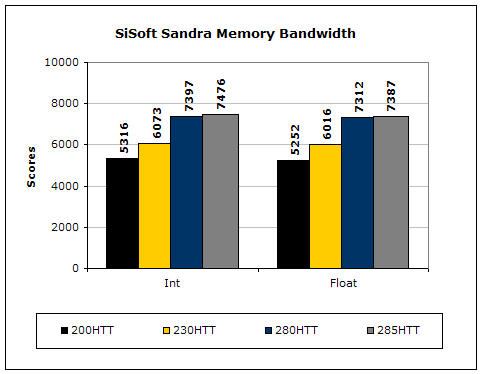
SiSoft Sandra is the most widely used memory bandwidth test. It can tell you the increase in performance from just lowering the latency timings. The results seem to scale linearly, despite the fact that the HyperTransport Bus is different when the overclock increases.
Everest Home Edition
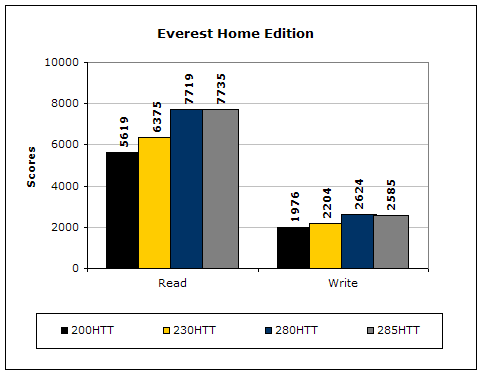
Everest Home Edition’s Memory Benchmarks show the same results as Sandra Memory Bandwidth.
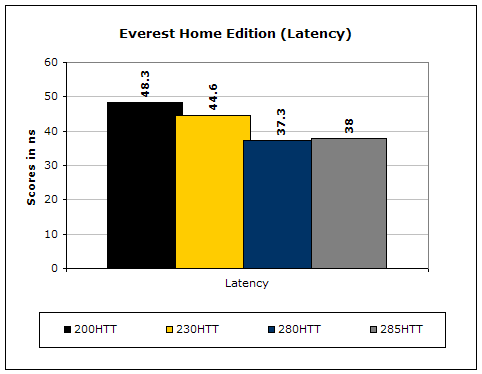
Everest Home Edition also includes a latency benchmark. The Athlon64’s performance with various latencies is also dependent upon its increase in CPU speed.
3DMark2001SE
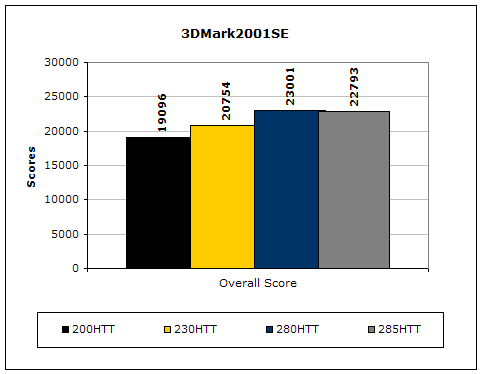
3DMark is probably the overclocker’s favorite benchmark. Unlike 3DMark2003, which stresses mainly the video card, 3DMark2001SE tests all of the system’s main components. Increasing the CPU speed, memory speed, and video card speeds will result in higher results in the final score.
Results Continued
Far Cry
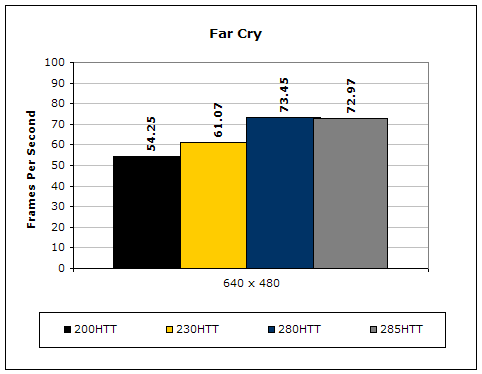
Since Far Cry is a game, the performance results will be very similar to 3dMark2001. I ran the benchmark at 640x480 so the benchmark would not be too GPU dependent. While the results are similar to 3dMark2001 in performance, this benchmark will give more significant results because Far Cry is extremely demanding.
Unreal Tournament 2004
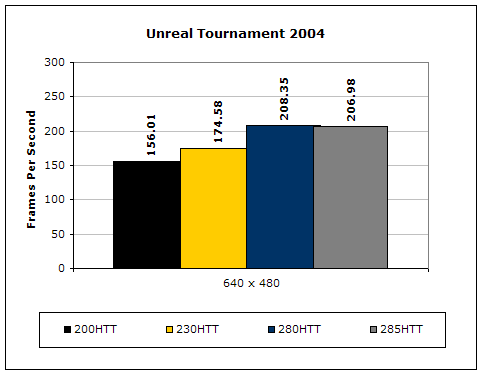
Unreal Tournament is another popular game engine to test overall system performance. Here, we can see the same results as Far Cry and 3dMark2001. Like Far Cry, UT2004 was also run at 640x480 to limit GPU dependency.
Half Life 2
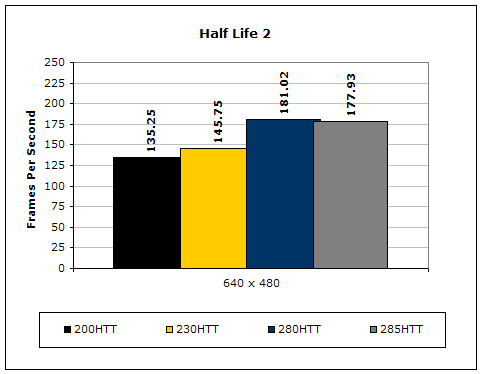
Half-Life 2 is finally here and for those of you who worried about it being too graphically intense for any system, the benchmarks indicate that with a regular 6800 it can scale just as well as UT2004. At 640x480, you can notice the similarities of the results to 3dMark2001, Far Cry, and UT2004.
Super PI
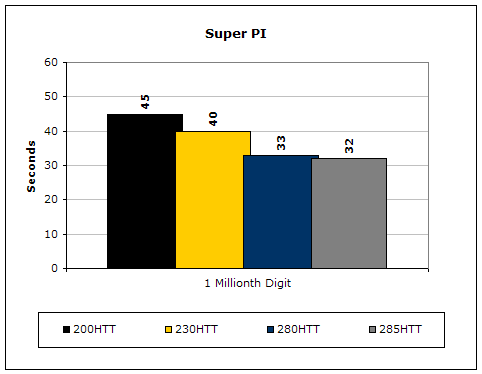
Here we have my favorite benchmark- Super PI. Super PI calculates Pi, an infinite value, so I chose to calculate it to the one millionth digit (which is the most popular digit). An increase in both memory and CPU speed displays an increase in speed in Super PI.
Conclusion and Thoughts
The GeIL Ultra-X is one of the best sets of memory modules that I have reviewed here at InsaneTek. While offering a luxurious form of packaging, beautiful platinum heatspreaders with a temperature-revealing sticker, an excellent choice as a PCB, and performance well beyond my expectations, GeIL’s Ultra-X is also offered at a price competitive to other memory in its class. GeIL continues to impress me with their ability to meet the enthusiasts’ demands, and it appears they are even making even more improvements by releasing a PC4400 version of their Ultra-X series. With features that are more than good enough to view through a window and a price that is affordable, GeIL’s Ultra-X wins Insanetek’s “Must Have” award.
Pros:
- Beautiful Platinum heatspreaders
- Temperature sensitive sticker
- Excellent overclocking ability
- Affordable price
Cons:
- None

We would like to thank GeIL for providing us the sample. If you have any questions or comments, feel free to hit us up in the forums. You can also check out more of our latest reviews on the front page.