

GeIL ONE PC4800 1GB Dual Channel Kit
Introduction
In my eyes, GeIL has taken many steps to reposition themselves in the enthusiast market. Not many know this, but GeIL was the first to release two sticks of memory in a “Dual Channel Kit”. At the time, their PC3200 boomed. The low latencies of 2-2-2 were quite uncommon for speeds of 200MHZ. Unfortunately, the many sticks of GeIL memory I purchased did me no good. Through the past couple of GeIL memory reviews, my thoughts and opinions towards GeIL have drastically changed. Their product quality seems to have taken a 180° turn. Their enthusiast memory is now capable of making an impression against their competitors’ offerings.
Before I begin with the review, I must tell you that I’ve been selected to be a GeIL “power user” to test GeIL engineering samples. Right off the bat, you’ll think that I’m biased, right? That’s not how I am. I am just like everyone else; I go with whatever hardware provides me the best performance for my money. If you’ve been checking around any forums, you may have been seen some great results with GeIL memory. Those results are typically from GeIL’s “power users”. GeIL wanted to have the consumers (us “power users”) to provide input and results. If the results aren’t good, they won’t release it. It’s a good strategy, because they save money by not releasing a poor product while also listening to what consumers actually want.
All enthusiasts know that the two current hottest memory IC’s are the Samsung TCCD and Winbond UTT BH5/CH5. Every single memory manufacturer is using these for their high end enthusiast memory. GeIL is going to do the same. We saw the use of both TCCD and Winbond UTT in their Ultra-X line and we were impressed. Both sticks of memory offered great performance and high overclocking headroom.
If you know your memory, there is one thing that you’ll notice about all the TCCD and UTT based memory out there–the PCB is always from Brainpower, whether it is 808 or 815. What sets all the different companies apart? The first is the speed-binning process. This is actually what we, as consumers and enthusiasts, care about. The second part is how the memory company markets their products. GeIL’s new ONE series takes a new approach and is the first memory ever to be released to run with a CAS latency of 1.5.
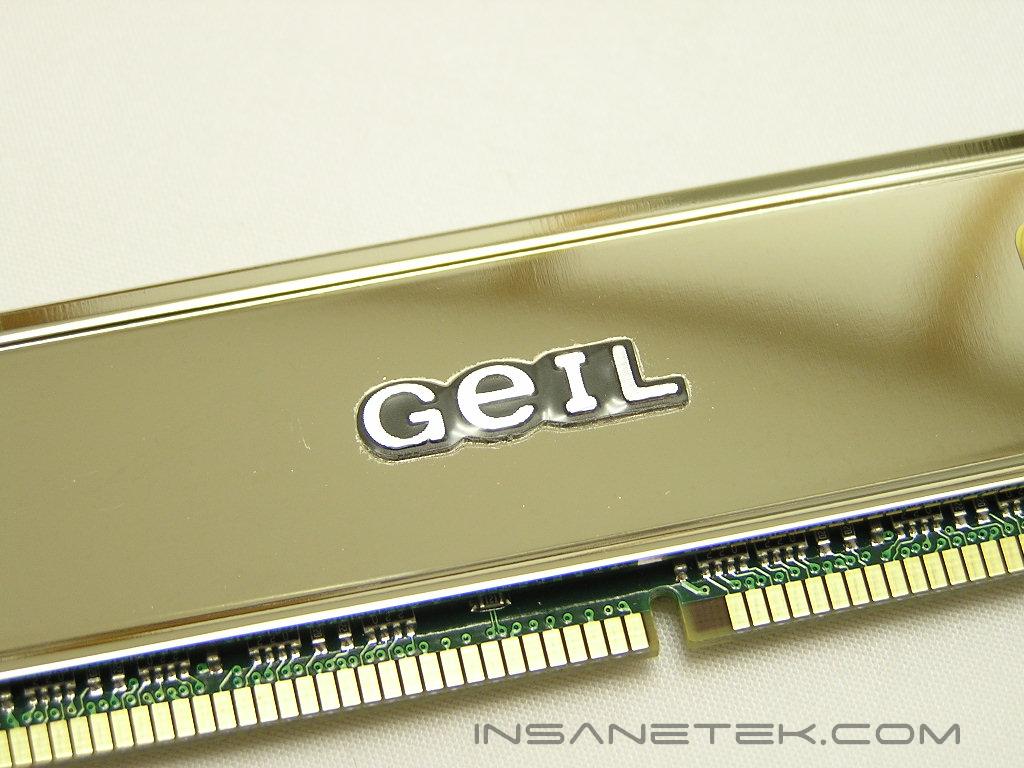
GeIL ONE PC4800
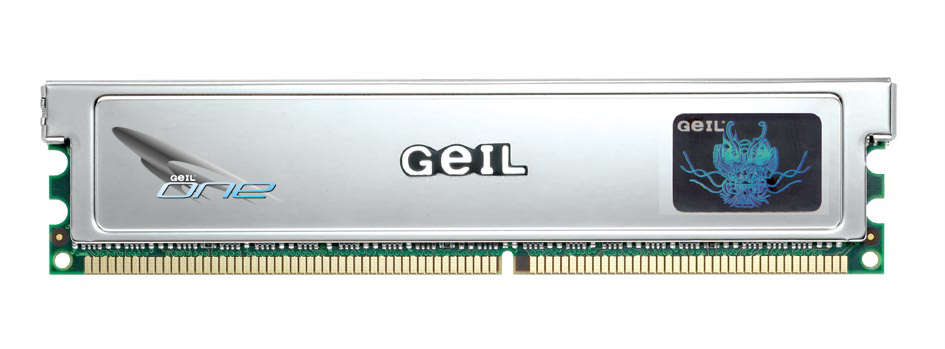
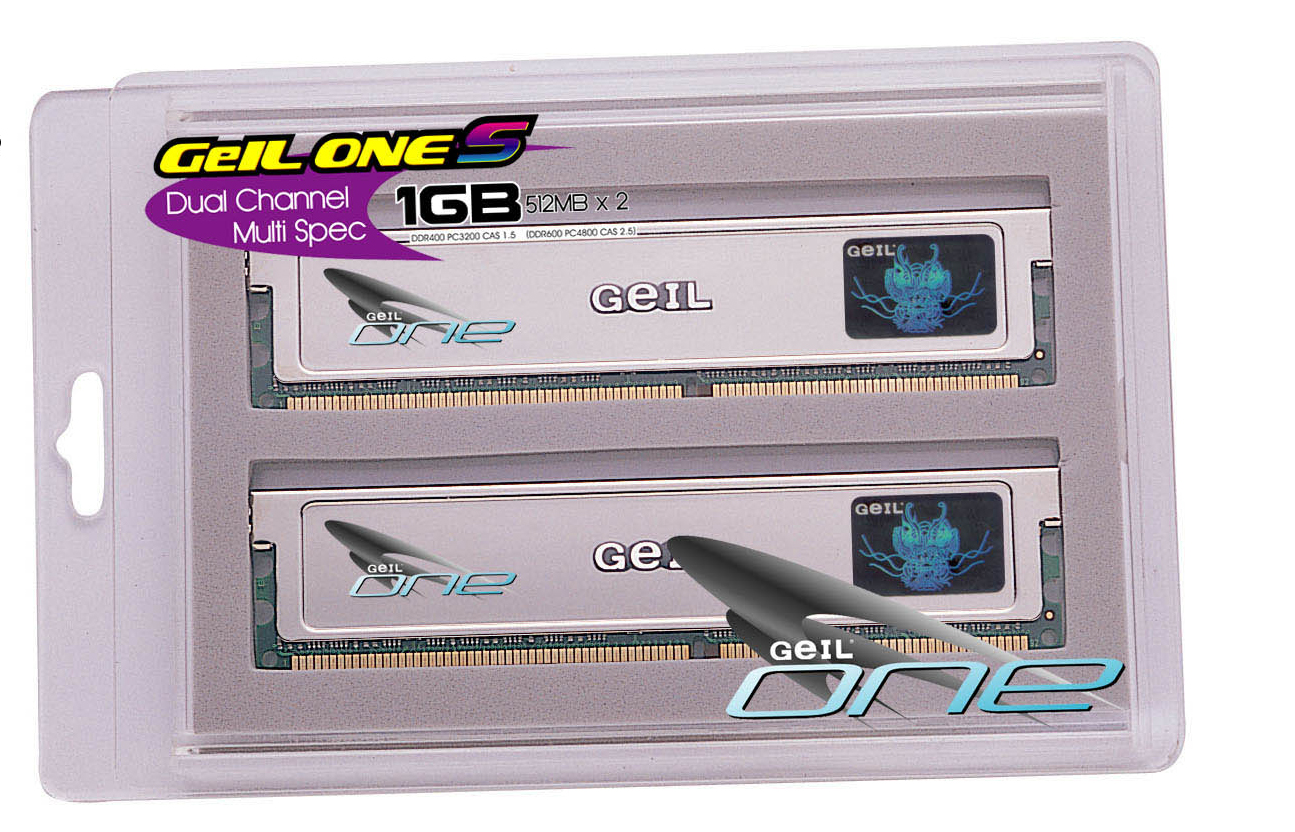
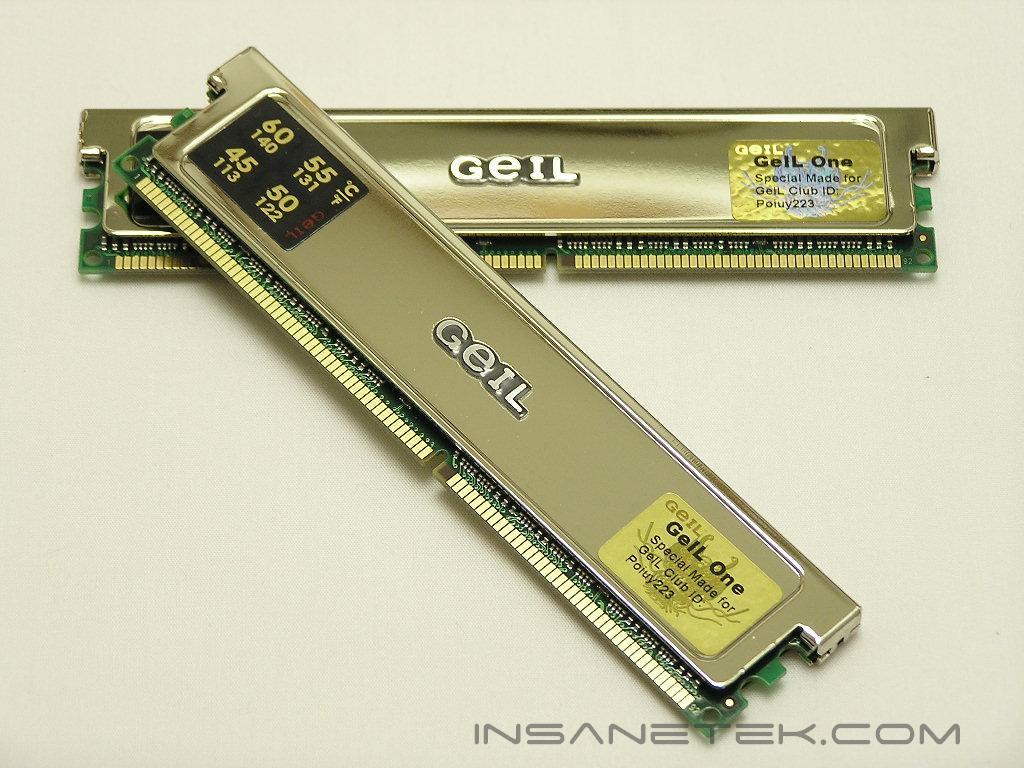
The sample I received is not how the GeIL ONE is supposed to look. It’s currently in production, so my sample’s heatspreaders didn’t come with the cool ONE series logo. It’s supposed to look like the picture below, with the finished packaging.
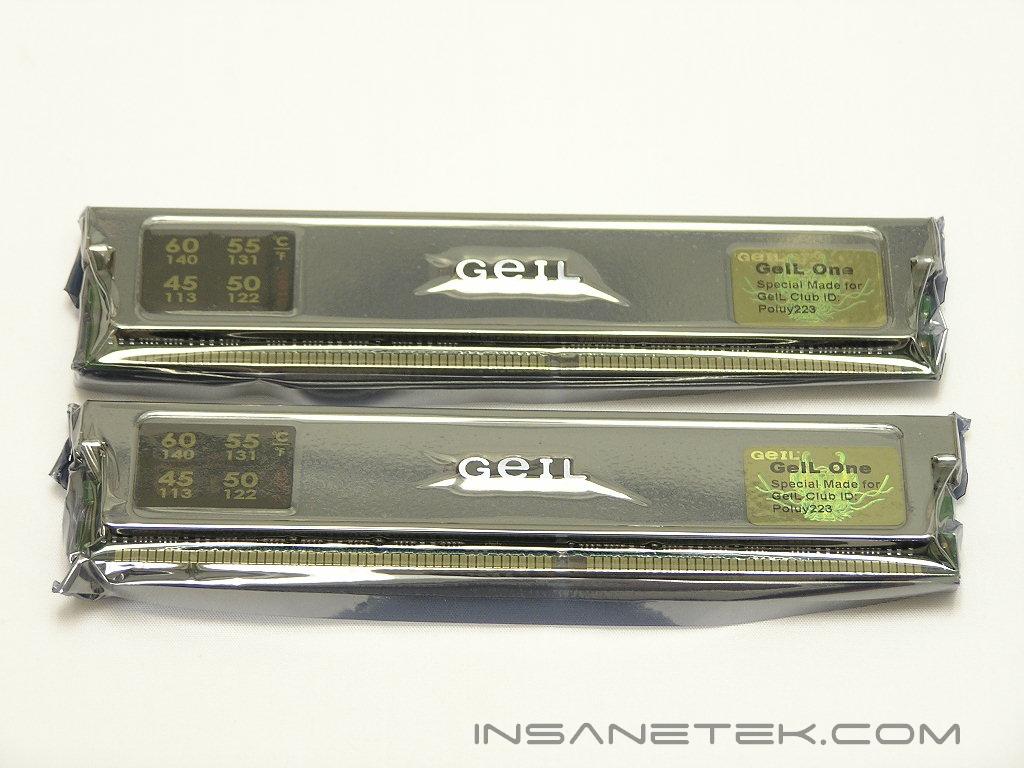
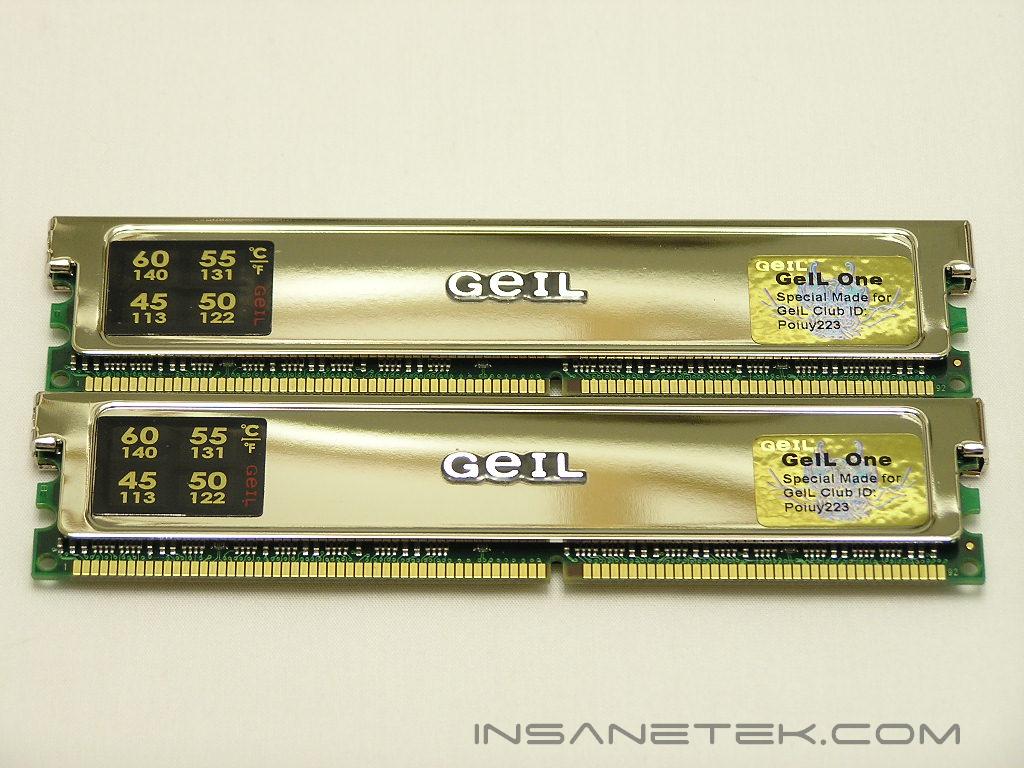
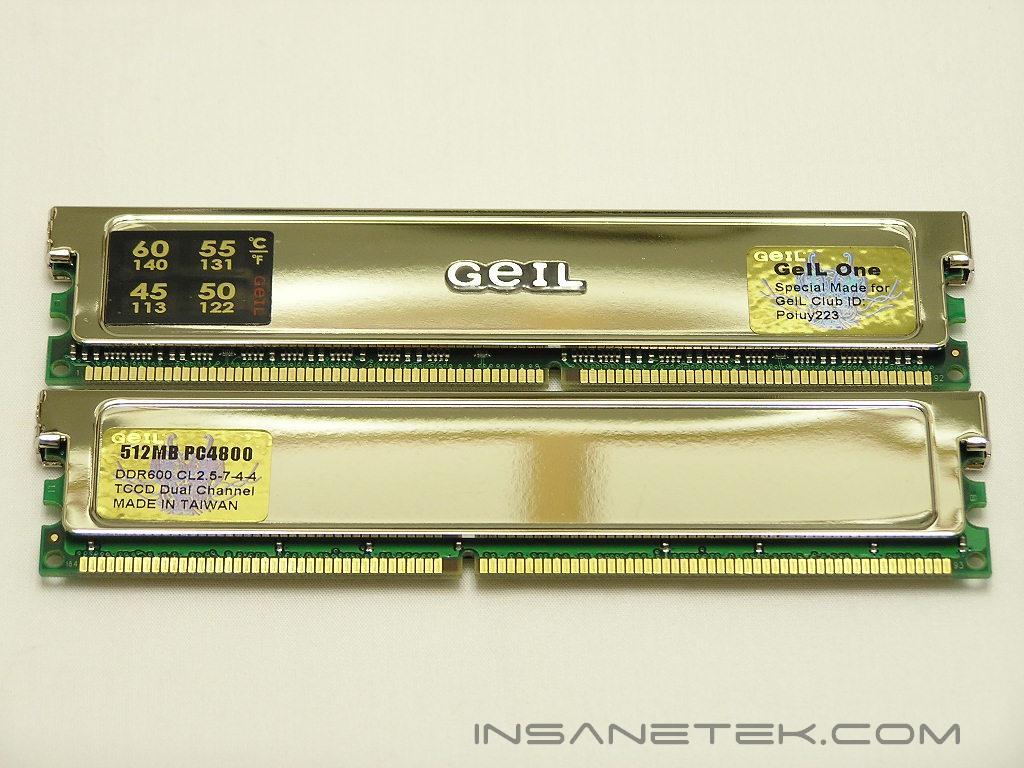
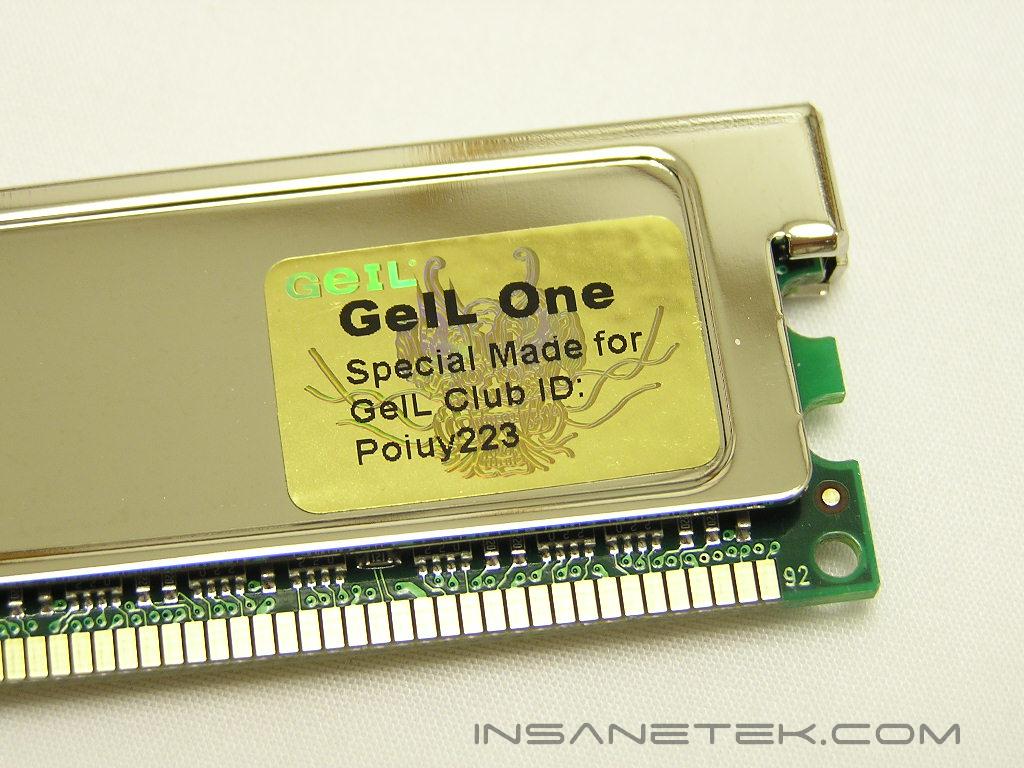
Becoming one of the few selected members of the GeIL “power users” club is an extraordinary honor. We receive special treatment, such as early review samples and a cool personalized sticker on the memory. On the other side is the sticker with information about the memory.
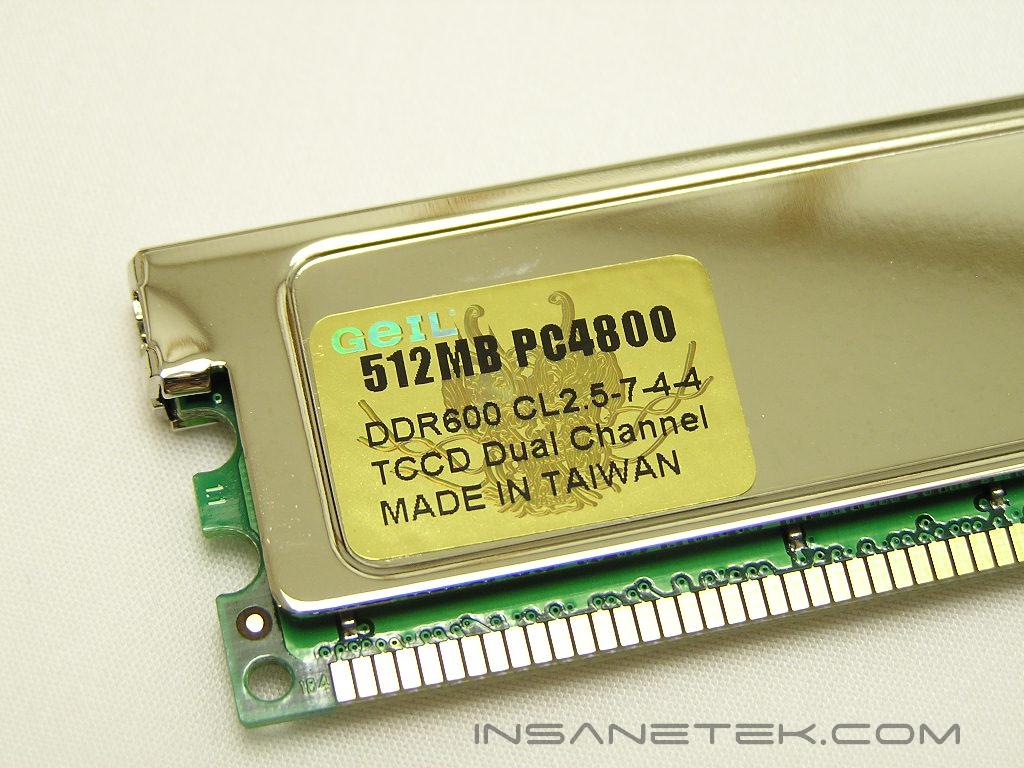
It’s time that I go into details about the GeIL ONE series. There are two kinds of GeIL ONE memory. One is based on Samsung TCCD and the other based on Winbond UTT. The Samsung is rated to run 200MHZ 1.5-2-2-5, or 300MHZ 2.5-4-4-7, with a voltage rating of 2.55v-2.85v. The Winbond UTT based stick is rated to run 200MHZ 1.5-2-2-5, or 250MHZ 2-2-2-5, with a voltage rating of 2.55v-3.6v. Wow, 3.6v! GeIL must be proud of their UTT based stuff to give it such a high voltage warranty. Below are the shots of how you would differentiate the ONE series. The “S” stands for Samsung while the “W” stands for Winbond. Both of the ONE series utilizes the popular Brainpower 808 PCB for superior overclocking headroom.

Test System and Overclocking
Test System:
- AMD Athlon 64 3000+ Venice
- DFI LANParty UT nF4 Ultra-D
- 2 x 512MB GeIL ONE PC4800 TCCD
- Sapphire Radeon X800
- Arctic Cooling Freezer 64
- Thermaltake PurePower 680W
Overclocking:
Keep in mind that during overclocking, the latencies are as follows: CAS-TRCD-TRP-TRAS
The overclocking process starts with the low CAS latency of 1.5 at 200MHZ. With just 2.8v, the memory ran fine at 1.5-2-2-5. Maintaining the low 2.8v, the TCCD ONE went as high as 225HTT. That result was extremely surprising. Most of the TCCD I’ve encountered top out at 215MHZ when low latencies are kept. I increased the voltage to 3.0v and reached a maximum of 230HTT 1.5-2-2-5. The results are not too shabby. I tried a higher voltage of 3.2v, but it didn’t help. 3.2v is the maximum I would pump into TCCD IC’s. It’s not like Winbond, where 3.6v would still be considered safe; going beyond 3.2v would be entering dangerous territory.
Next up is to test the memory with looser latencies. Everyone knows that TCCD scales extremely high with timings of 2.5-3-3 and 2.5-4-3. Since the TCCD ONE is rated at PC4800, running it at anything less would be quite pointless. With a low voltage of 2.6v and decent timings of 2.5-3-3-7, the ONE pushed to 265HTT. It’s not the greatest, but still considered very good for new TCCD IC’s. Keep in mind that newer week TCCD’s just can’t overclock as well as older week TCCD’s. If you have week 431, 437, or 440 TCCD’s in your hands, you better not let them go. Those are the TCCD gems. With slightly looser timings of 2.5-4-3-7, the ONE pushed to the rated speed of 300HTT with just 2.6v. I tried increasing the voltages, but didn’t improve the results. The highest speed to finish Super PI 1M was 315HTT 2.5-4-3-7, but that would fail Memtest, Windows Memtest, and Super PI 32M. This just goes to show that Super PI 1M is not a good stability testing. You can check my Super PI time HERE.
I was disappointed with the overclocking results, but I was quite satisfied that it ran the rated speed with lower latencies.
Overclocking Results:
- 200HTT 2.0-2-2-5 1T 2.6v
- 200HTT 1.5-2-2-5 1T 2.8v
- 225HTT 1.5-2-2-5 1T 2.8v
- 230HTT 1.5-2-2-5 1T 3.0v
- 265HTT 2.5-3-3-7 1T 2.6v
- 300HTT 2.5-4-3-7 1T 2.6v
Results
A series of memory intensive benchmarks will be run to test the performance of our sample. The other tests will be based on common benchmark programs, such as 3DMark and PCMark. Real life performance differences will be tested through current games, such as Far Cry and UT2004. Memory bandwidth benchmarks will be based off of SiSoft Sandra and Everest Home Edition. Super PI and PiFast will also be used to test memory performance, as the benchmark benefits largely from FSB increases.
Throughout all tests, the multiplier has been kept at 8x to reduce any possible CPU bottleneck.
SiSoft Sandra Memory Bandwidth
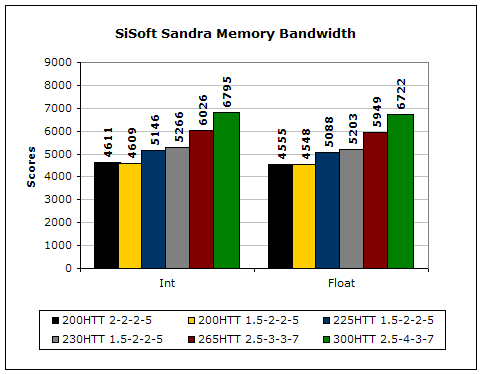
SiSoft Sandra is the most widely used memory bandwidth test. It can tell you the increase in performance from just lowering the latency timings.
Everest Home Edition
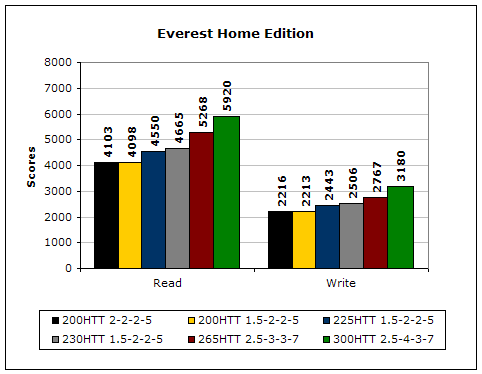
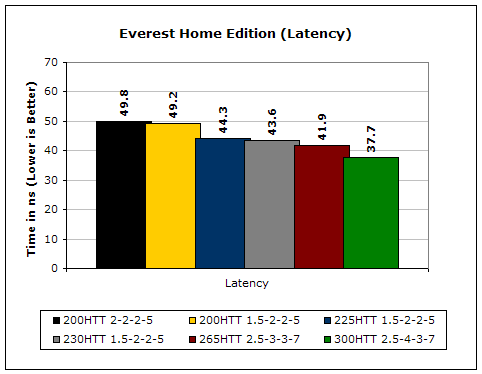
Much like Sandra, Everest Home Edition tests the memory’s ability to read and write data in large chunks. The results show that the lower latencies seem to help just a little with performance.
3DMark2001SE
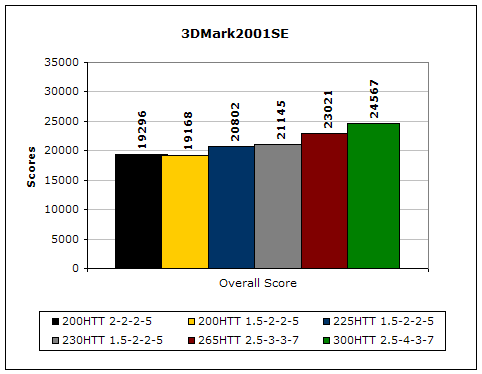
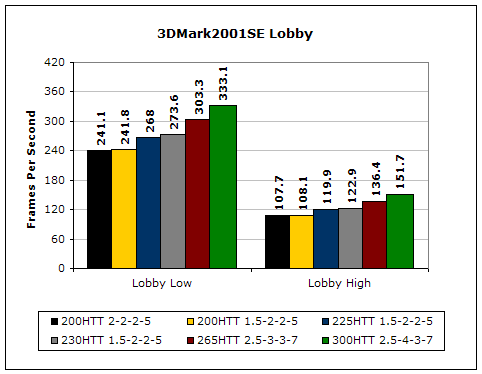
3DMark is likely the overclocker’s favorite benchmark. Unlike 3DMark2003, which stresses mainly the video card, 3DMark2001SE tests all of the system’s main components. Increasing the CPU speed, memory speed, and video card speeds will result in higher results in the final score.
Results Continued
Far Cry
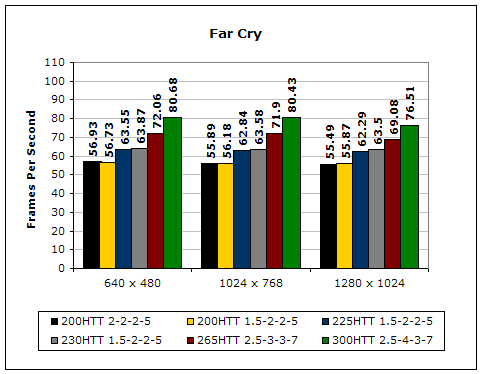
Since Far Cry is a game, the performance results will be very similar to 3dMark2001. I ran the benchmark at 640x480, so the benchmark would not be too GPU dependent. The tests under 1024x768 and 1280x1024 are an approximation of what kind of frames you’ll be getting. While the results are similar to 3dMark2001 in performance, this benchmark will give more significant results, because Far Cry is extremely demanding.
Unreal Tournament 2004
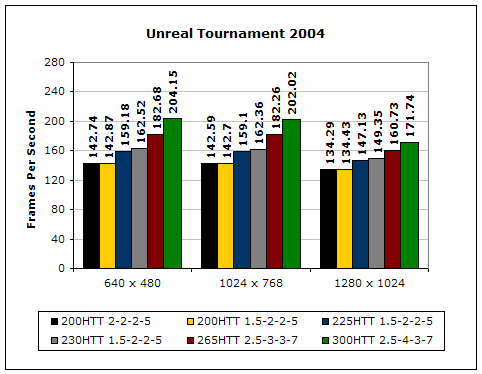
Unreal Tournament is another popular game engine to test overall system performance. Here, we can see the same results as Far Cry and 3dMark2001. Like Far Cry, UT2004 was also run at 640x480 to limit GPU dependency. The other resolutions provide an approximation of actual gameplay performance.
PCMark2002
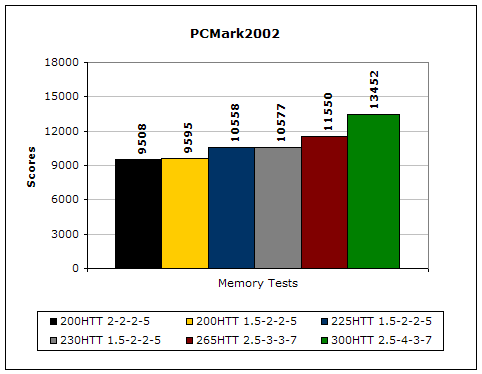
PCMark is another benchmark created by Futuremark. It tests the memory compression and decompression speeds in small to large chunks of data.
Super PI
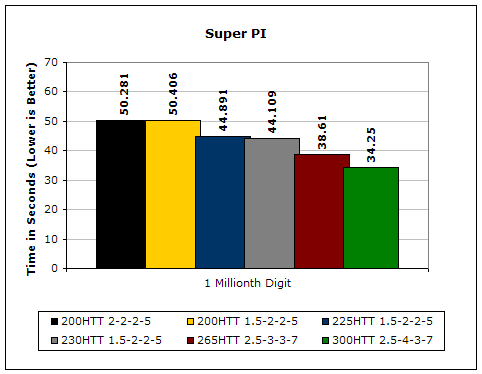
Since the value of PI is an infinite value, Super PI is a speed test to find the digit you’re looking for. In this case, we chose the millionth digit. Super PI benefits greatly from higher FSB, as well as low latencies.
PiFast
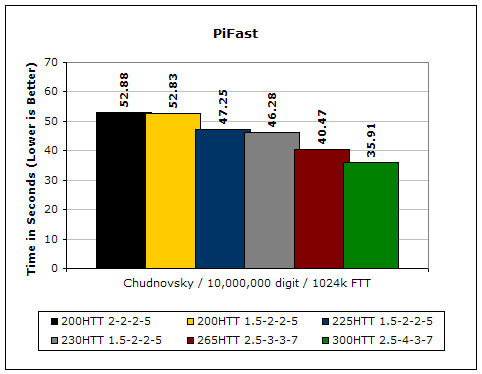
PiFast is similar to Super PI. The results can be greatly affected by a slight adjustment to the memory megahertz and latency.
Conclusion and Thoughts
GeIL’s new marketing strategy in their TCCD based memory will certainly turn heads. Running Winbond UTT at CAS 1.5 is quite common, but for enthusiasts to be able to run their TCCD at CAS 1.5 is new territory. I’d bet that the majority of the TCCD’s out there will also be capable of such a feat. Yet, does running CAS 1.5 over CAS 2 net any performance increases? The answer is a tough one. You do get performance increases, but the increase is so small that it’s negligible.
The TCCD based ONE series is what GeIL advertises it to be; extremely versatile. It allows enthusiasts to choose between running at very low latencies or looser latencies at high frequencies. The best part of the GeIL ONE series is their speed-binning process. They have machines that can pre-screen IC’s to pick out the top 30% of the lot they purchase. Both of the TCCD and UTT based ONE series utilize special top 30% handpicked chips. This means that you are getting the best of the best. Most companies build the modules first, then speed-bin the sticks. This means that you are guaranteed quality and performance when you decide to make a purchase for their ONE series. The only downside is you’ll pay a premium for the ONE series. If you want a Ferrari, you’re going to have to pay for it. The increase in price should be minimal. The ONE series should still be very affordable, considering DRAM prices are ridiculously low.
Our look at the GeIL ONE has been nothing but satisfactory. The memory performs very well and overclocks very well. It doesn’t hit the highest overclock, but it does overclock amazingly well with a low voltage of just 2.6v. The versatility of their speed-binned TCCD’s can fill the stomachs of both low latency enthusiasts and high frequency enthusiasts. This review should also have negated any thoughts of GeIL sending a reviewer handpicked modules for reviewing purposes. That’s far from true. These modules were built with the same top 30% of the IC’s they speed-bin for retail modules. The modules merely have a special sticker with my name on it. That’s all there is to these sticks. Heck, you’ll probably get better ONE modules than mine. My ONE modules will go great in my Fatal1ty AN8, a motherboard that overclocks well but doesn’t provide the high VDIMM. 300HTT with just 2.6v sounds good to me.
Pros:
- Beautiful platinum finish copper heatspreaders
- Versatile speed options
- Runs CAS 1.5 with just 2.8v
- Runs 300HTT 2.5-4-3-7 with just 2.6v
- Runs lower latencies than rated
- All IC’s in ONE series are top 30%
Cons:
- Not yet available
- Will be a little more expensive

We would like to thank GeIL for providing the sample and giving me a special sticker. If you have any questions or comments, feel free to hit us up in the forums. You can also check out more of our latest reviews on the front page.