

Wintec Amp-X PC2-5400 1GB Dual Channel Kit
Introduction
Over the past few months, there have been many new faces in the enthusiast memory crowd. It used to be just Corsair, Kingston, OCZ, GeIL, and Mushkin being the key players in the “overclocking” memory business. All of a sudden, quiet memory manufacturers released their own line of enthusiast memory. Crucial started their Ballistix line; PDP started their Patriot line; Centon started their Advanced Gemini; PQI started their Turbo line; and a near non-existent G.Skill even showed their faces. There’s just so many choices available now that it’s hard to find the memory you want. Most of the time enthusiasts tend to go with the company they’ve been most comfortable with in the past. Today we introduce another player in the enthusiast memory circle–Wintec’s AMP-X.
To give you a little introduction on Wintec Industries, they’re a large OEM supplier of memory modules. I guess that’s the reason why the majority of you will have no clue on who they are. They’ve been in the business since 1988, when I was just a wee lad. Their AMP-X line caters towards overclocking and gaming enthusiasts who look for high performance memory to get the most out of their system. Like all other companies, they’re opening up a new field to get some name recognition. Currently they’re pushing for DDR2, which is excellent memory but on a poor performing platform. Just wait until AMD starts using DDR2. Believe me, it’ll be one kickass combination.
Today we have Wintec’s flagship DDR2 PC2-5400. Even with the dropped prices on DDR2 memory, AMP-X still comes at a lower price than the big boys. We’ll have a go and see whether such low prices mean bad performance.
Wintec AMP-X PC2-5400
The AMP-X kit we received is a dual channel kit. Currently, Newegg sells these sticks individually, but I’m sure that dual channel kits can be found and purchased. I just couldn’t find it. Like all enthusiast memory, the AMP-X comes with nice looking heatspreaders. In this case they’re black. I do like the look of their AMP-X logo.
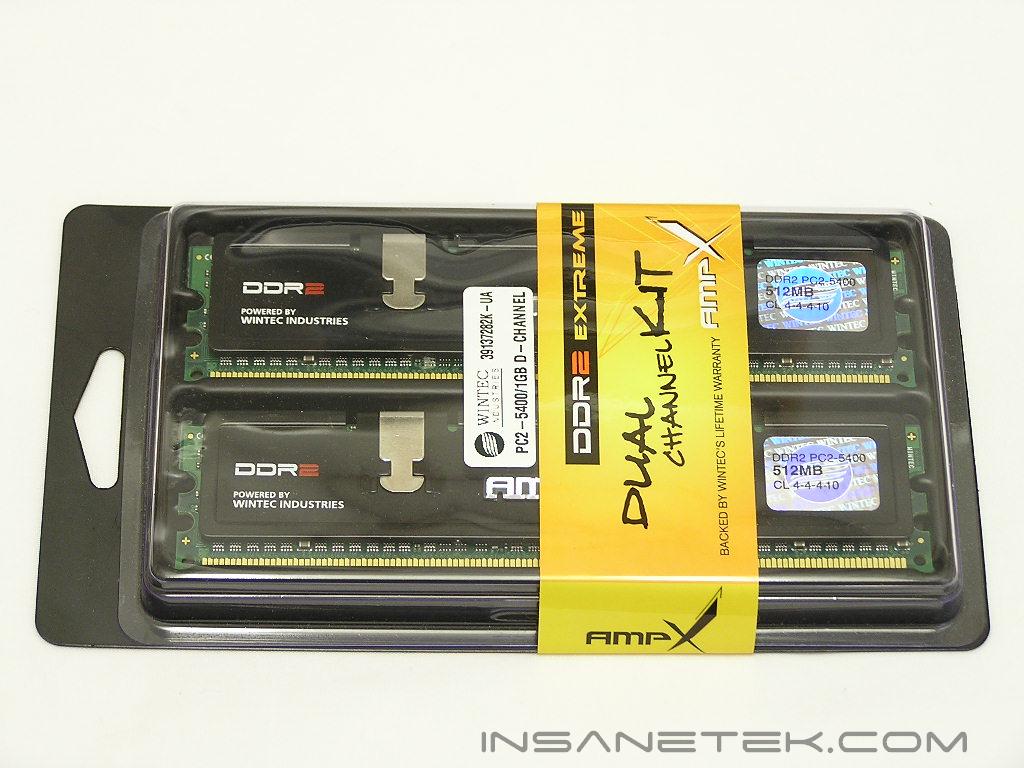
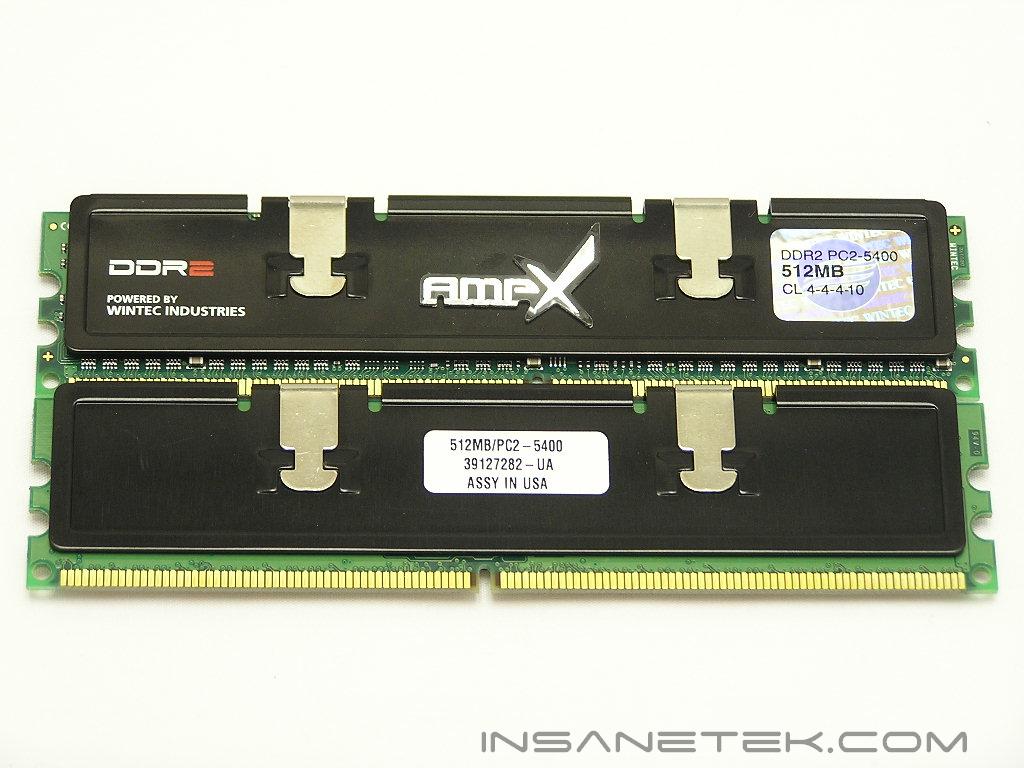
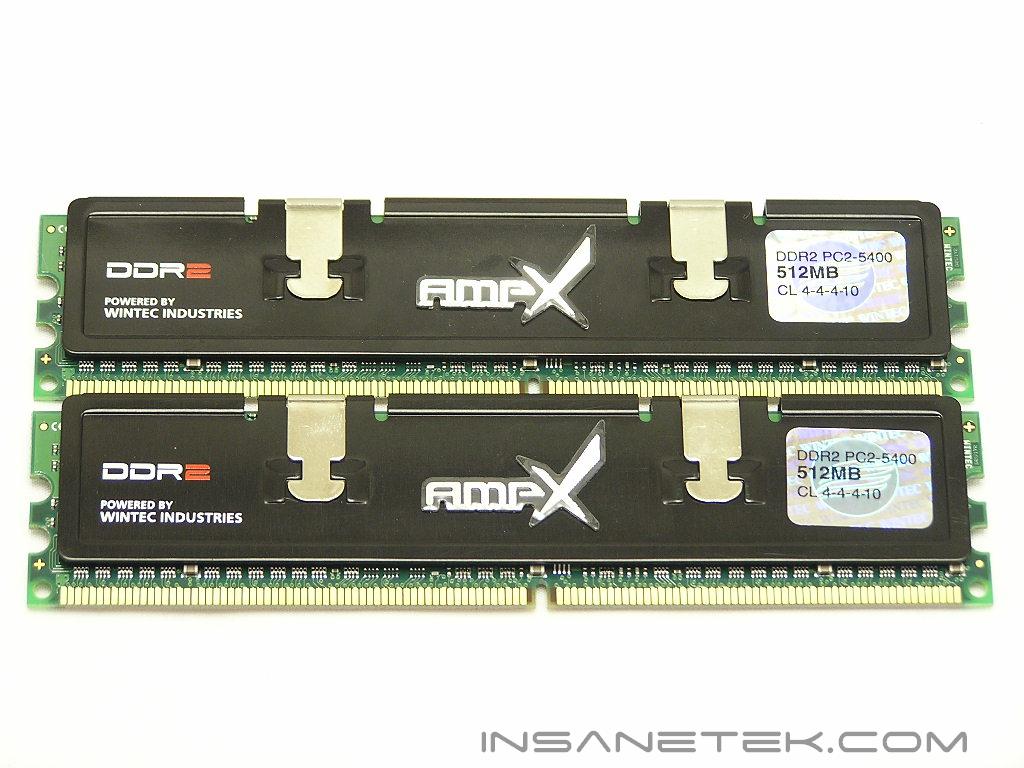
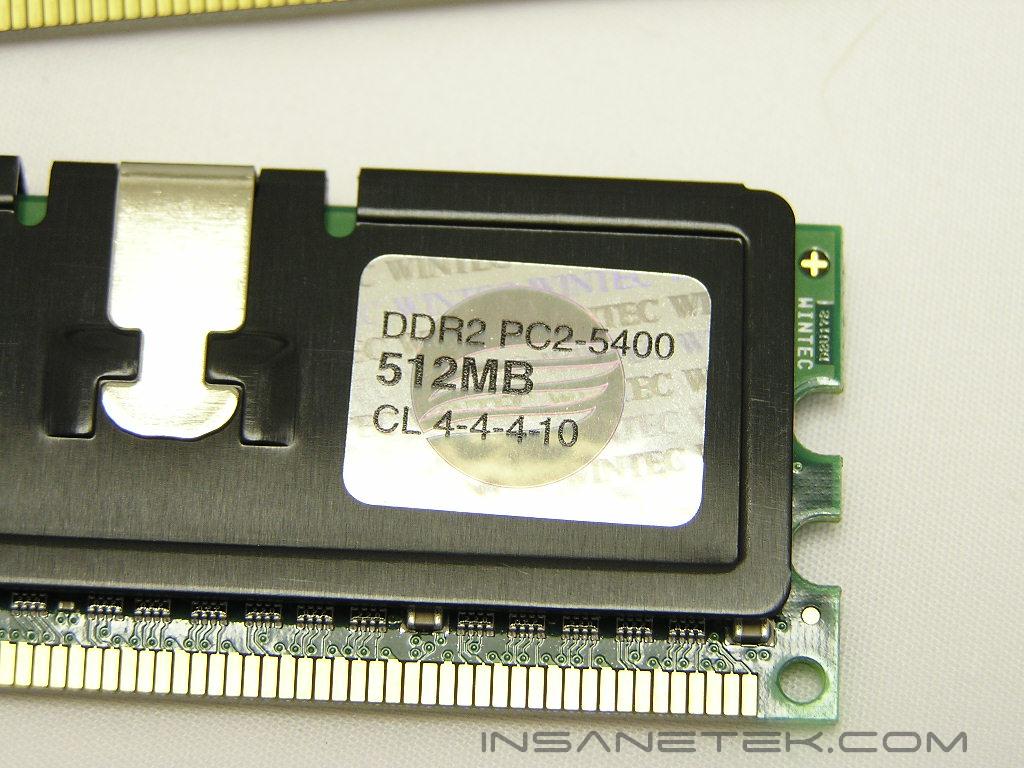
Peeking under the heatspreaders, I found that the AMP-X PC2-5400 uses Micron’s “fatty” chips. While you can’t really tell 100% by the physical looks, as Elpida chips look similar, testing it at low latencies proved me correct. The use of the Micron’s “fatty” chips allow for low latency operations of 3-2-2-5, which is great for benchmarkers. The PC2-5400 is rated to run at 337MHZ with latencies of 4-4-4-10. The ratings are rather conservative because the chips are capable of so much more. If you’ve read our experience with the Corsair XMS2 PC2-4300 Pro, you’ll see that these chips can provide some amazing results.
Test System and Overclocking
Test System:
- Intel Pentium 4 560 3.6GHZ
- Abit Fatal1ty AA8XE
- 2 x 512MB Wintec AMP-X PC2-5400
- ATI Radeon X800 (400/490)
- Enermax Noisetaker 470W
- Arctic Cooling Freezer 7
The proper method of testing DDR2 requires a CPU with low multiplier options. Unfortunately, Intel locks their CPU’s, so the only processor that allows low multipliers would be their Extreme Editions. Because the Extreme Edition processors are outrageously priced, I can’t afford one for my testbed. Thus the lowest multiplier available is 14x, from the Pentium 4 520 2.8GHZ processor. The Pentium 4 560 3.6GHZ processor I’ll be using today provides a range of multipliers from 14x-18x. For testing, the 14x multiplier is used for all benchmarks and tests.
The Abit Fatal1ty AA8XE is one of the best overclocking motherboards available. It can reach an extremely high FSB without any modifications. The motherboard also allows high VDIMM options of up to 2.5v. The stock voltage of DDR2 modules is 1.8v. For those who are not familiar with voltage scaling of DDR2, 2.5v to DDR2 would be the same as pumping 3.2v to DDR. All overclocking tests will be conducted with 2.3v, which is the highest VDIMM the majority of quality LGA775 motherboards provide. Anything beyond 2.3v will be too much for DDR2 memory anyway.
Overclocking:
Keep in mind that during overclocking, the latencies are as follows: CAS-TRCD-TRP-TRAS. A memory ratio of 3:4 and CPU multiplier of 14x are used throughout all tests.
I ran the memory at the lowest latencies of 3-2-2-5 at 266MHZ. As I predicted, it ran without a hiccup. This proved that the chips were Micron “fatty” chips. No other memory IC can run these low latencies. With the low latencies, I pushed further to 245FSB, resulting with 327MHZ. While this wasn’t as great as the Corsair XMS2 PC2-4300 Pro, it was still pretty good. The looser timings of 3-3-3-8 didn’t help anything, but timings of 4-3-3-10 took me all the way to my CPU bottleneck of 275FSB. I really need to find a good CPU with a lower multiplier of at least 12x to get rid this bottleneck.
- 200FSB 3:4 266MHZ 3-2-2-5
- 245FSB 3:4 327MHZ 3-2-2-5
- 252FSB 3:4 337MHZ 4-3-3-10
- 275FSB 3:4 367MHZ 4-3-3-10
- 252FSB 3:4 337MHZ 4-4-4-10
Results
A series of memory intensive benchmarks will be run to test the performance of our sample. The other tests will be based on common benchmark programs, such as 3DMark and PCMark. Real life performance differences will be tested through current games, such as Far Cry and UT2004. Memory bandwidth benchmarks will be based off of SiSoft Sandra and Everest Home Edition. Super PI and PiFast will also be used to test memory performance, as the benchmark benefits largely from FSB increases.
SiSoft Sandra Memory Bandwidth
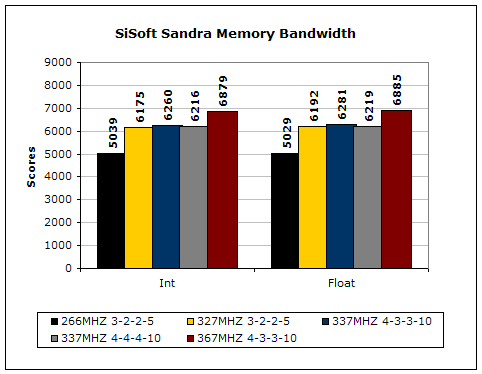
SiSoft Sandra is the most widely used memory bandwidth test. At the same rated speed, the lower latencies did not help memory bandwidth all that much. SiSoft Sandra seems to favor the higher frequencies when it comes to DDR2 memory.
Everest Home Edition
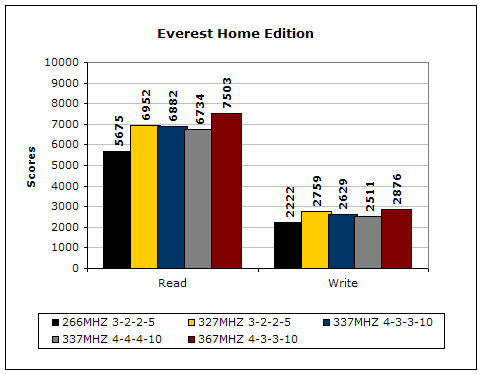
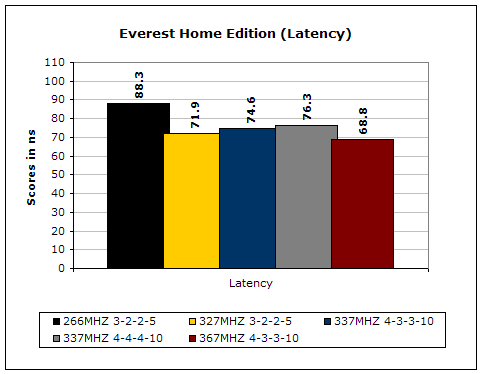
Much like Sandra, Everest Home Edition tests the memory’s ability to read and write data in large chunks. The results show that the lower latencies seem to help just a little with performance.
3DMark2001SE
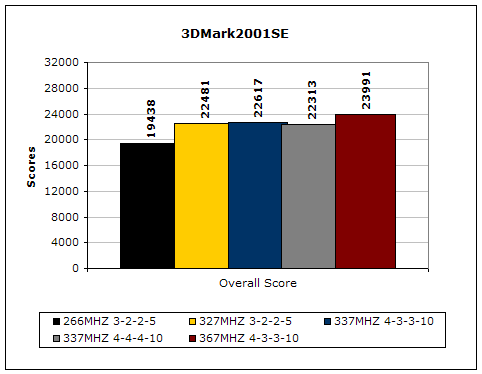
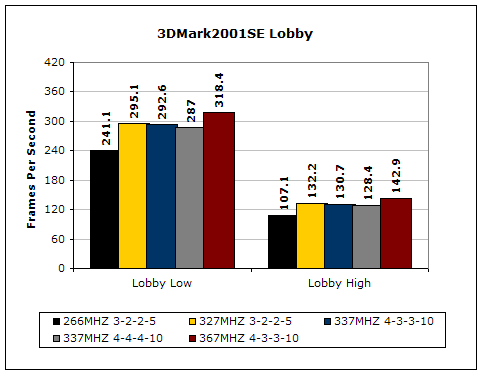
3DMark is probably the overclocker’s favorite benchmark. Unlike 3DMark2003, which stresses mainly the video card, 3DMark2001SE tests all of the system’s main components. Increasing the CPU speed, memory speed, and video card speeds will result in higher results in the final score.
Results Continued
Far Cry
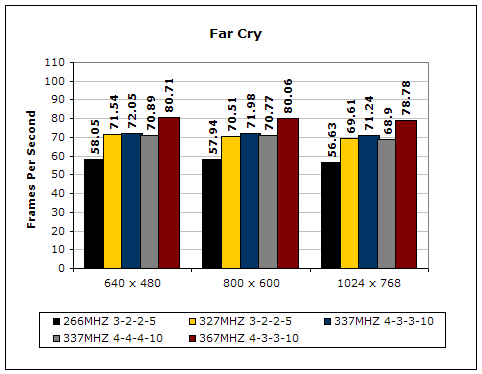
Since Far Cry is a game, the performance results will be very similar to 3dMark2001. I ran the benchmark at 640x480 so the benchmark would not be too GPU dependent. The tests under 1024x768 and 1280x1024 are there to show an approximate of what kind of frames you’ll be getting. While the results are similar to 3dMark2001 in performance, this benchmark will give more significant results, because Far Cry is extremely demanding.
Unreal Tournament 2004
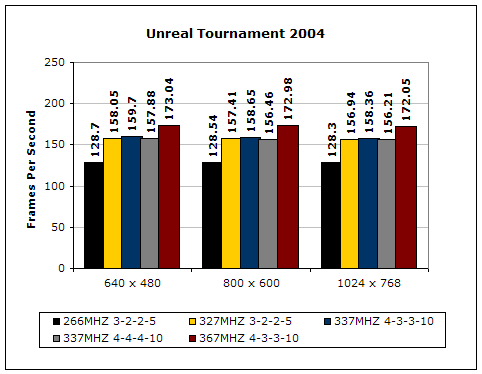
Unreal Tournament is another popular game engine to test overall system performance. Here, we can see the same results as Far Cry and 3dMark2001. Like Far Cry, UT2004 was also run at 640x480 to limit GPU dependency. The other resolutions are to give an approximate of actual gameplay performance.
PCMark2002
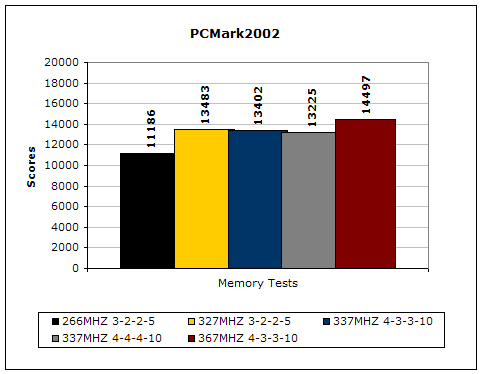
PCMark is another benchmark created by Futuremark. It tests the memory compression and decompression speeds in small to large chunks of data.
Super PI
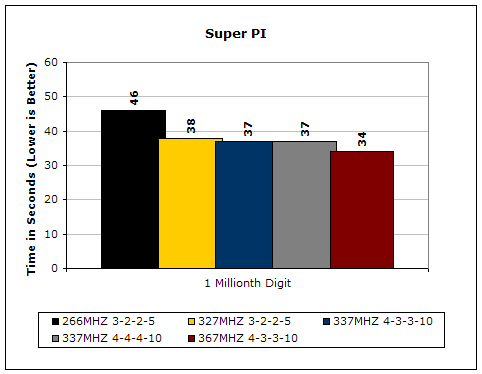
Since the value of PI is an infinite value, Super PI is a speed test to find the digit you’re looking for. In this case, we chose the millionth digit. Super PI benefits greatly from higher FSB as well as low latencies.
PiFast
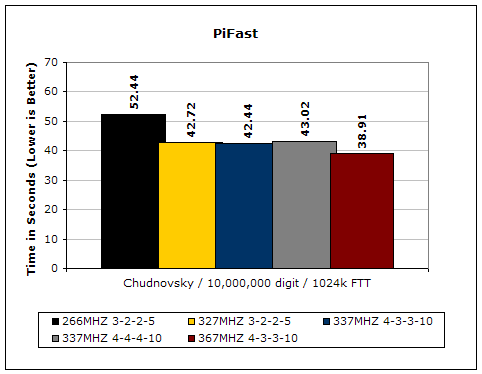
PiFast is similar to Super PI and the results can be greatly affected by a slight adjustment to the memory megahertz and latency.
Conclusion and Thoughts
From the results, we’ve learned two things. Low latency DDR2 does provide better performance, but not the big difference you’ll see with DDR memory. Additionally, Wintec’s AMP-X line is pretty darn good. Although it doesn’t overclock as well with low latencies as the Corsair XMS2 PC2-4300 Pro, it still managed to provide a good yield. Of course with the Corsair, you do get what you pay for. It’s much more expensive than the AMP-X we have today. Speaking of price, the AMP-X PC2-5400 1GB kit (or two separate sticks of 512MB) comes in well under $200. That’s extremely affordable for DDR2 memory and cheaper than what enthusiast DDR run for. Most of the DDR2 under $200 will get you only decent performance, and certainly not low latencies. If you’re looking for some good DDR2 memory and are on a tight budget, these sticks won’t do you wrong. This is a good first step for Wintec into the enthusiast crowd. We’ll see if they can continue that with the more popular DDR soon enough.
Pros:
- Great price
- Runs lowest latencies
- Overclocks very well
- Nice black heatspreaders
Cons:
- Nothing really, but their 1GB kit couldn’t be found

We would like to thank Wintec for providing us the sample. If you have any questions or comments, feel free to hit us up in the forums. You can also check out more of our latest reviews on the front page.