

TeamGroup Xtreem PC4800 1GB Dual Channel Kit
Introduction
When someone mentions memory, who do you think of first? I can name quite a few off the top of my head without hesitation–OCZ, Centon, Corsair, Patriot, GeIL, Crucial, Mushkin, and G.Skill are just a few from the long list of trustworthy enthusiast memory manufacturers. When I first mentioned A-DATA, everyone thought they were a newcomer to the enthusiast crowd. Little did they know, A-DATA has been in the memory game for quite some time and has a huge reputation in Asia.
Today we introduce another well known memory manufacturer in the Asian community. TeamGroup is a fairly new company established in Taiwan in 1994, but they quickly gained reputation as a leading enthusiast memory provider. When they first contacted me, they were in the middle stages of finalizing a good DDR 2GB solution. We all know that the current craze is finding a good 2GB kit that will allow great overclocking with great timings. My current favorite continues to be the Crucial Ballistix, although the OCZ Platinum PC4000 EB does provide better timings. It is just a shame that we can’t ever have the best of both worlds–latency and frequency wise. Before we get a chance to look at their 2GB offering, we first look at their PC4800 solution.
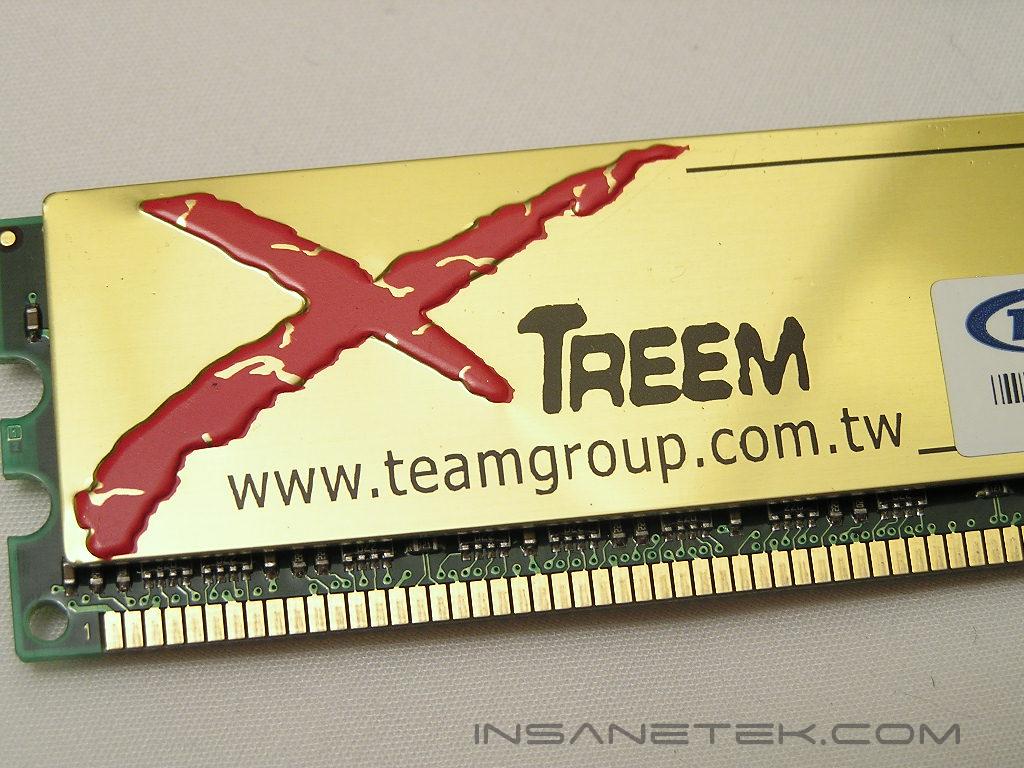
TeamGroup Xtreem PC4800
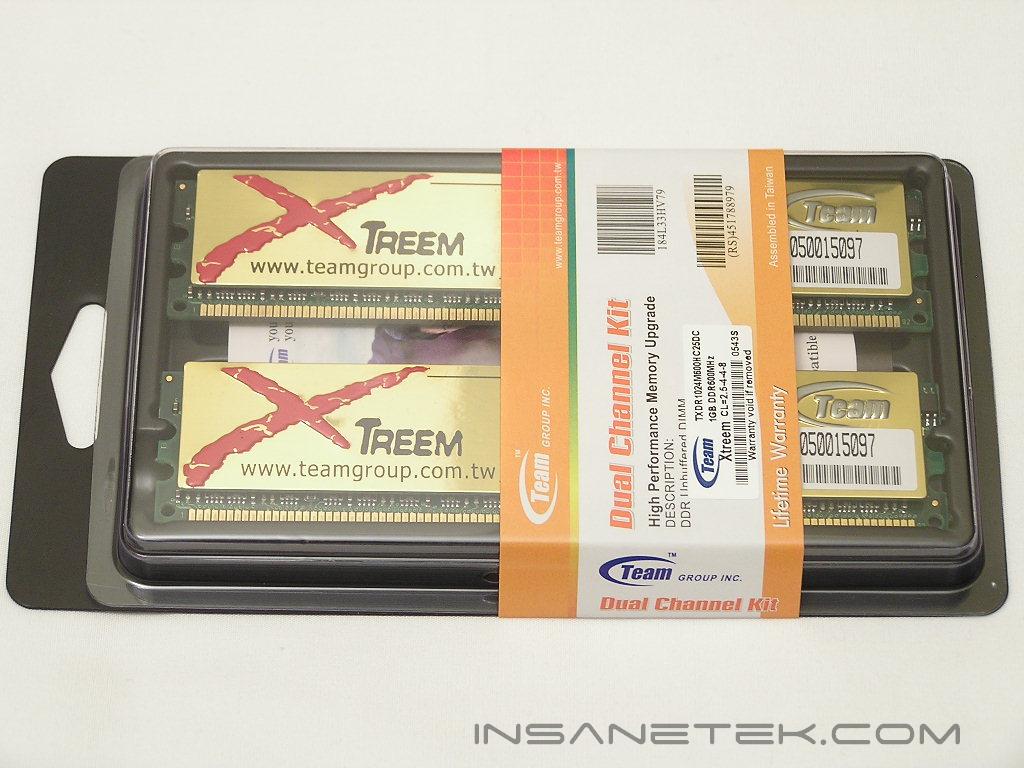
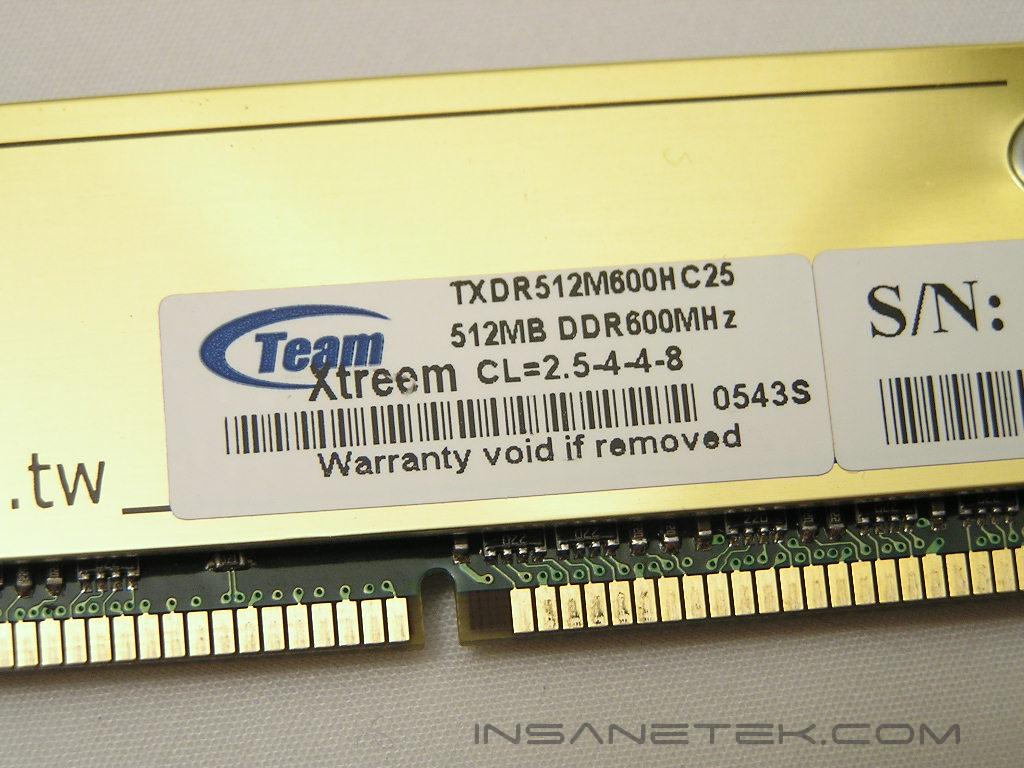
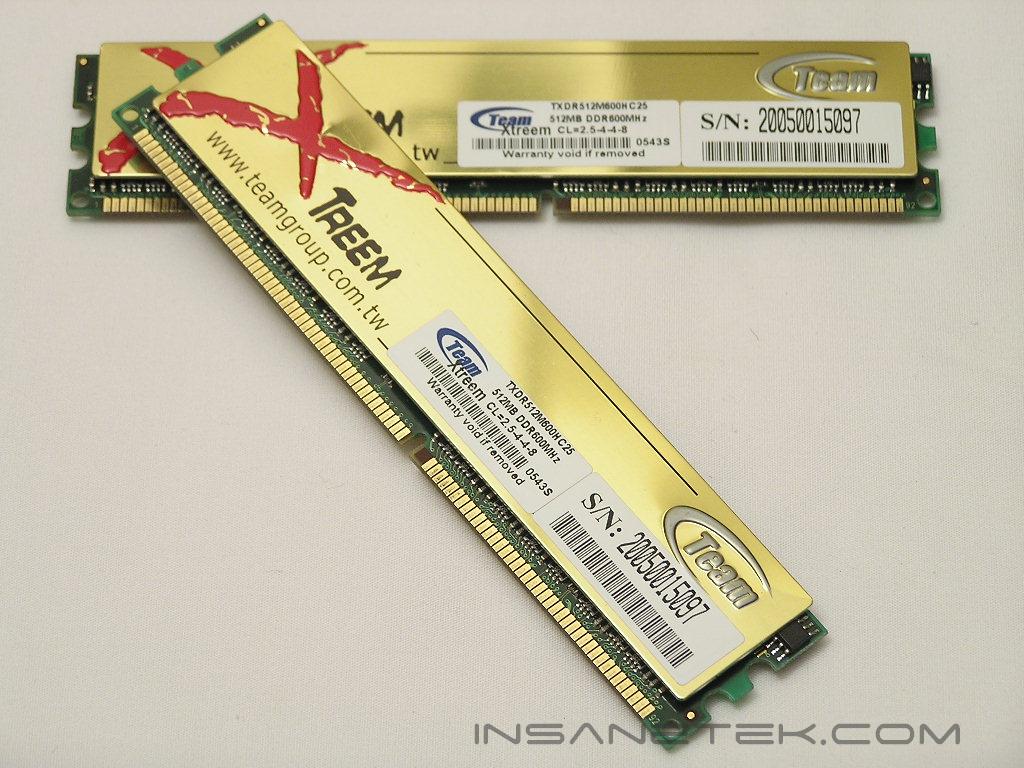
The Xtreem PC4800 comes packaged in a hip tray with a simple user’s manual. The heatspreaders used on the Xtreem PC4800 are aluminum with a gold color mirror finish. I have seen their silver finish heatspreaders and I must say that the silver ones look much better. The aluminum is rather light and feels quite “cheap”. Although heatspreaders pretty much do nothing in terms of cooling, I believe that copper should have been used to make the memory “feel” more “high class”. The heatspreaders do not use clips for attachment; they use thick thermal pads to bond to the modules. The heatspreaders are similar to the ones found on Patriot’s new memory heatsinks.
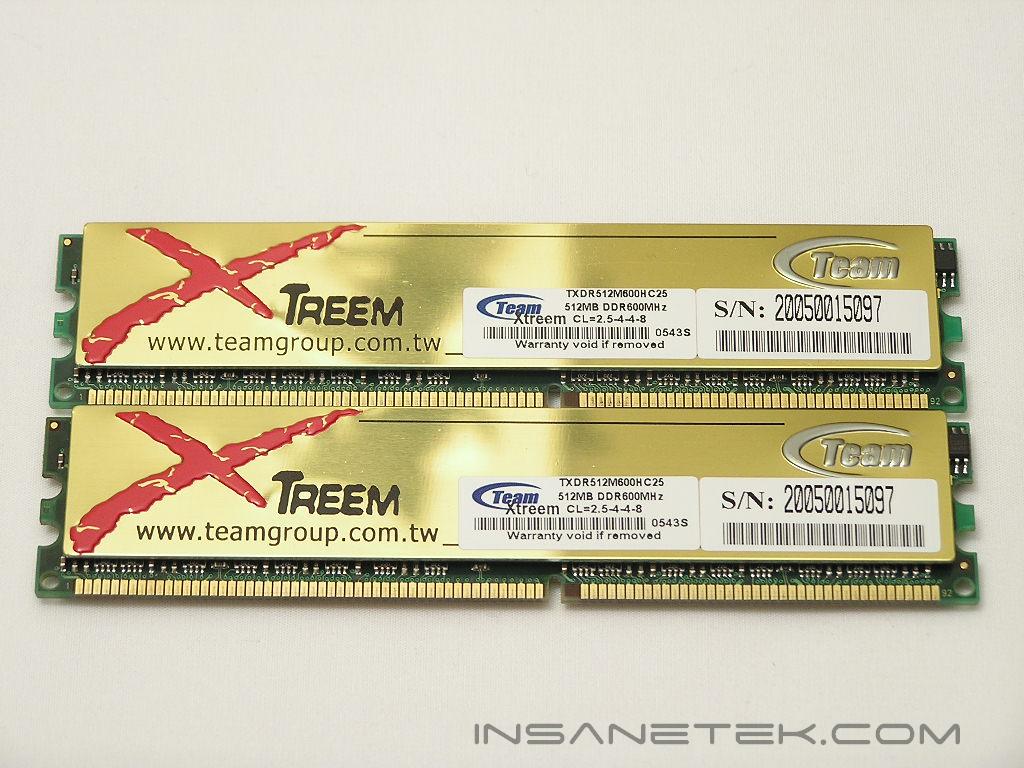
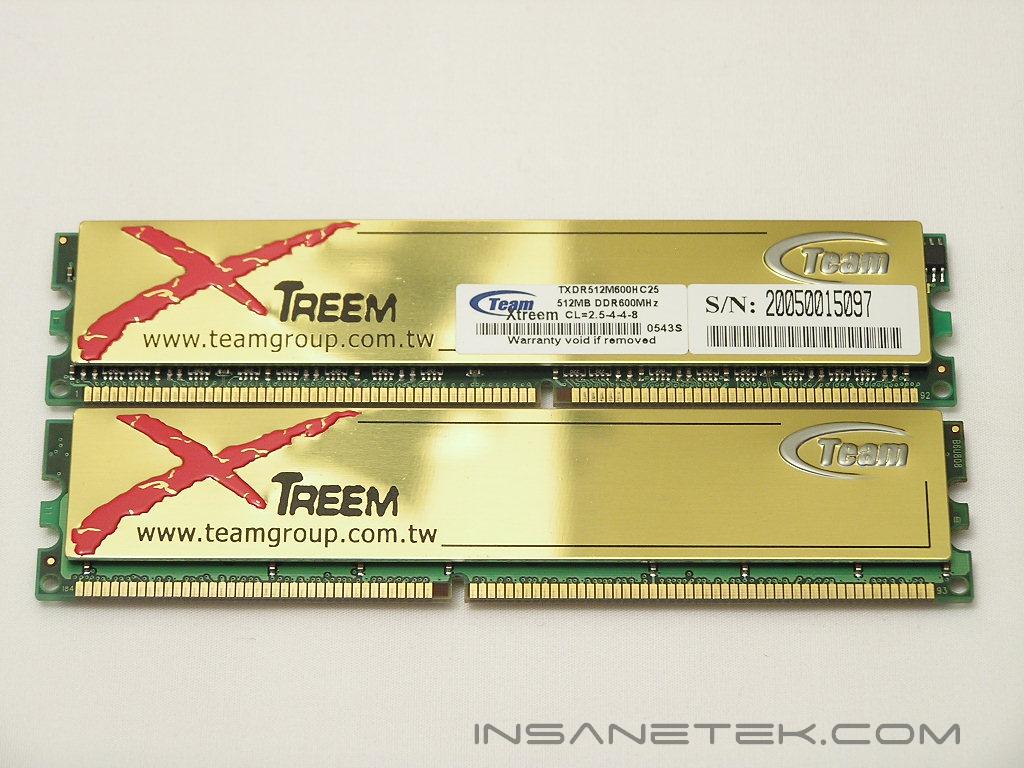
The Xtreem PC4800 uses none other than the infamous Samsung TCCD ICs. The sample I received came with date code of 513. I was hoping to receive some 519 TCCDs since they are known to be better in terms of overclocking, but we will see how these 513 chips hold up. The green PCB is also another familiar face–Brainpower 808. It sure looks like all memory manufacturers are going the same path with TCCD ICs and Brainpower PCB. I guess the only difference will be their speed binning process and overclocking results. TeamGroup rates the Xtreem PC4800 at 300MHz with timings of 2.5-4-4-8. The voltage rating is to be 2.8v or lower, depending on your system setup.
Test System and Overclocking
Test Setup:
- AMD Athlon 64 3700+ San Diego
- DFI LANParty UT nF4 Ultra-D
- 2 x 512MB TeamGroup Xtreem PC4800
- ATI Radeon X800XT
- Arctic Cooling Freezer 64
- SilverStone ST65ZF
- BIOS 623-3 and orange slots
Overclocking:
Keep in mind that during overclocking, the latencies are as follows: CAS-TRCD-TRP-TRAS
The CPU multiplier has been kept consistent at 8x to avoid CPU bottleneck and to maintain consistency through performance scaling. Changing the CPU multiplier in an attempt to keep the CPU speed consistent to test memory performance is hard, not to mention that the CPU multiplier also affects memory performance.
One thing to know about Samsung TCCD ICs is that they do not always run at timings of 2-2-2-5 at 200MHz. The majority of them will, but not 100%. It can be seen from our Gigaram PC3700 review. I began the test just to see if it would run 200MHz with timings of 2-2-2-5. With just 2.6v, the memory was perfectly stable throughout all stress testing. For the next step, I immediately jumped the gun to timings of 2.5-3-3-7 to see how high the memory would go. This is because Samsung TCCD excels in achieving high frequencies with average latencies. I did not get too far with 2.6v, but with a bump to 2.8v, the memory went up to 280MHz. Any additional increase in voltage only resulted in unnecessary errors. I was hoping to hit 300MHz with timings of 2.5-3-3, but it looks like the samples I received were not the best of the best. I proceeded to loosen the TRCD to 4 and kept the voltage at 2.8v. From there, I hit a wall at 315MHz. The results are not too bad if I have to say so myself. I tried looser timings of 2.5-4-4-8, but the memory would error when the frequency was bumped up.
Overclocking Results:
- 200MHz 2.0-2-2-5 1T 2.6v
- 280MHz 2.5-3-3-7 1T 2.8v
- 315MHz 2.5-4-3-7 1T 2.8v
Results
A series of memory intensive benchmarks will be run to test the performance of our sample. The other tests will be based on common benchmark programs, such as 3DMark and PCMark. Real life performance differences will be tested through current games, such as Far Cry and UT2004. Memory bandwidth benchmarks will be based off of SiSoft Sandra and Everest Home Edition. Super PI and PiFast will also be used to test memory performance, as the benchmark benefits largely from FSB increases.
SiSoft Sandra Memory Bandwidth
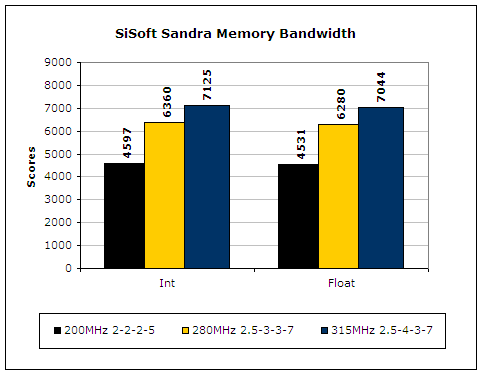
SiSoft Sandra is the most widely used memory bandwidth test. It can tell you the increase in performance from just lowering the latency timings.
Everest Home Edition
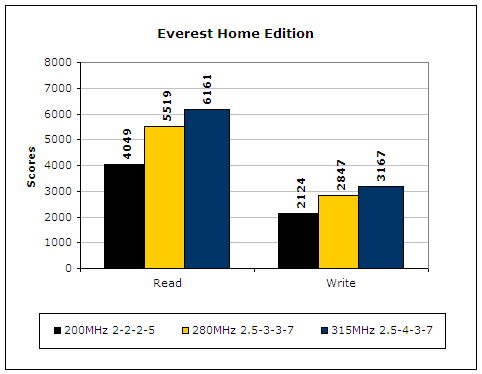
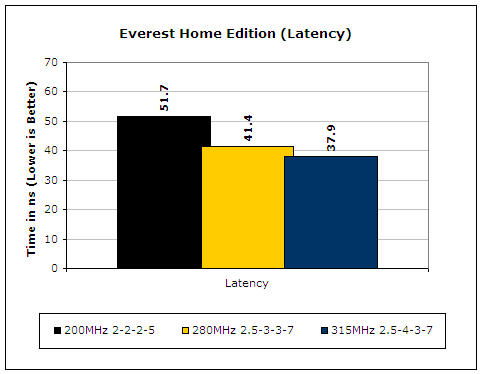
Much like Sandra, Everest Home Edition tests the memory’s ability to read and write data in large chunks. The results show that the lower latencies seem to help just a little with performance.
3DMark2001SE
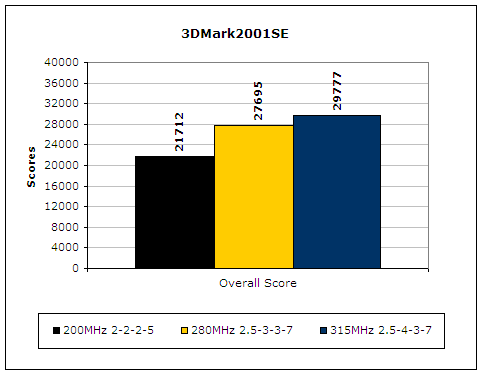
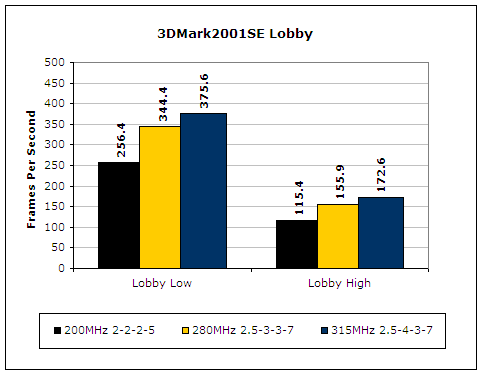
3DMark is likely the overclocker’s favorite benchmark. Unlike 3DMark2003, which stresses mainly the video card, 3DMark2001SE tests all of the system’s main components. Increasing the CPU speed, memory speed, and video card speeds will result in higher results in the final score.
Results Continued
Far Cry
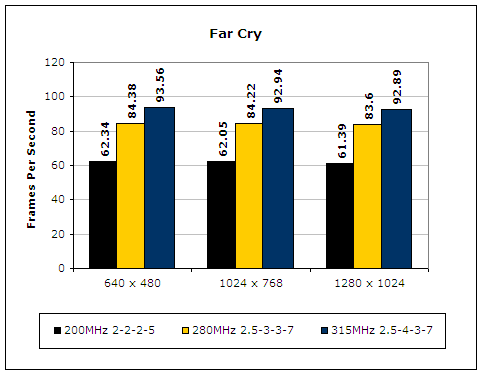
Since Far Cry is a game, the performance results will be very similar to 3dMark2001. I ran the benchmark at 640x480, so the benchmark would not be too GPU dependent. The tests under 1024x768 and 1280x1024 are an approximation of what kind of frames you’ll be getting. While the results are similar to 3dMark2001 in performance, this benchmark will give more significant results, because Far Cry is a lot more demanding.
Unreal Tournament 2004
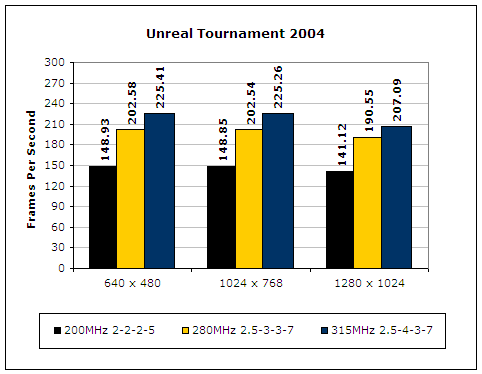
Unreal Tournament is another popular game engine to test overall system performance. Here, we can see the same results as Far Cry and 3dMark2001. Like Far Cry, UT2004 was also run at 640x480 to limit GPU dependency. The other resolutions provide an approximation of actual game play performance.
PCMark2002
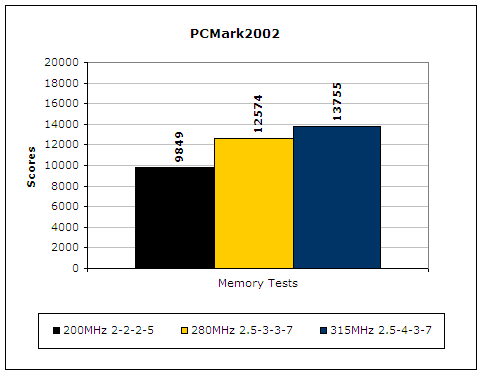
PCMark is another benchmark created by Futuremark. It tests the memory compression and decompression speeds in small to large chunks of data.
Super PI
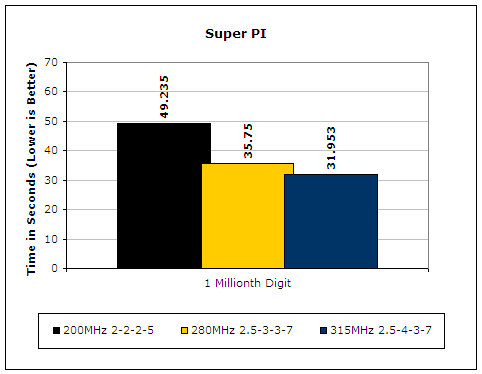
Since the value of PI is an infinite value, Super PI is a speed test to find the digit you’re looking for. In this case, we chose the millionth digit. Super PI benefits greatly from higher FSB, as well as low latencies.
PiFast
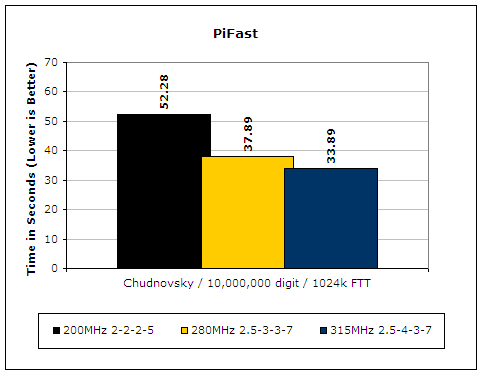
PiFast is similar to Super PI. The results can be greatly affected by a slight adjustment to the memory megahertz and latency.
Conclusion and Thoughts
TeamGroup has shown that they are definitely capable of competing with the more well known players in the enthusiast crowd. The Taiwan based company is looking to come into the US market and they certainly have the products for it. I am sure that all you enthusiasts out there only care about what they have to offer. Their Xtreem PC4800 may not break any world record or even run 300MHz 2.5-3-3-6, but their DDR600 memory does indeed do what it was intended to with a little more. It overclocked very well with lower than rated latencies and only required 2.8v. With the Xtreem PC4800, TeamGroup has shown that they can compete in the 1GB DDR department. Now the question is whether they will be able to hang with the big boys in the 2GB department.
Pros:
- Overclocks very well with just 2.8v
- Attractive heatspreaders (although silver ones look better)
- Able to run 2-2-2-5 at 200MHz
Cons:
- Availability in the US

We would like to thank TeamGroup for providing us the sample. If you have any questions or comments, feel free to hit us up in the forums. You can also check out more of our latest reviews on the front page.