

PQI Turbo PC3200 DPU 1GB Dual Channel Kit
Introduction
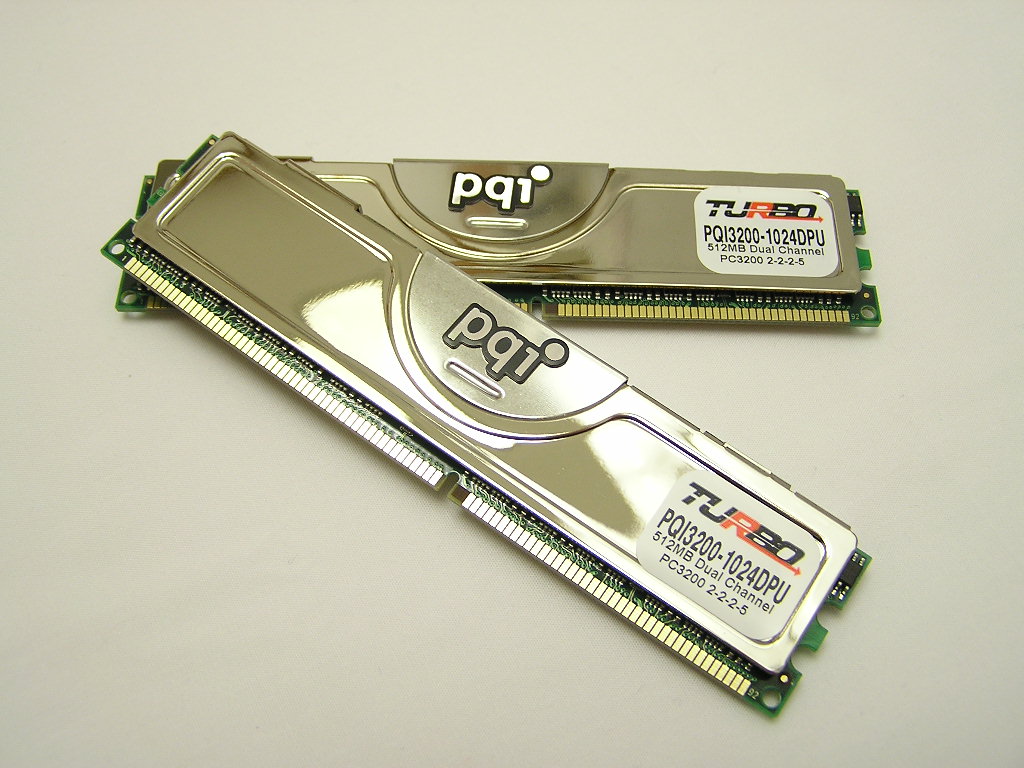
PQI or PMI? A few years ago, PMI entered the enthusiast memory market, providing all of the distinctive ingredients that constitute high performance memory: mirror-finished copper heatspreaders, good choice of memory chips, aggressive timings, and excellent overclocking potential. I thought PMI would soon have a strong presence in the market, but they quickly disappeared. It turns out that PMI merged with PQI to focus more on producing high quality overclocking memory. Now we are seeing all of those same exact ingredients that make up high performance memory in PQI’s products. They even improved the look of the heatspreaders by adding their own distinctive design, arguably creating the best-looking heatspreaders in the memory market.
Today, we have the honor of reviewing one of PQI’s best products of their famous Turbo line: the dual channel PC3200 low latency platinum edition. Like many of the low latency modules that we have recently reviewed here at InsaneTek, PQI also utilizes the Samsung TCCD chips in their PC3200 Turbo modules. Whether or not these memory modules separate themselves from the rest of the TCCD pack will be revealed…so read on.
PQI Turbo PC3200 DPU
PQI’s Turbo was sealed and well-protected in a rather large plastic shell, which made opening the package rather annoying. Besides the modules themselves, PQI also includes a small manual that describes the specifications and warranty of this item. The PQI heatspreaders are of exceptional quality. The heatspreaders are heavy, indicating that these are made of copper. The heatspreader’s plates are connected by a half-circle clip, decorated with the “PQI” logo. With a mirror-like platinum finish, these heatspreaders grabbed my attention unlike any other set of heatspreaders since the OCZ Platinums.
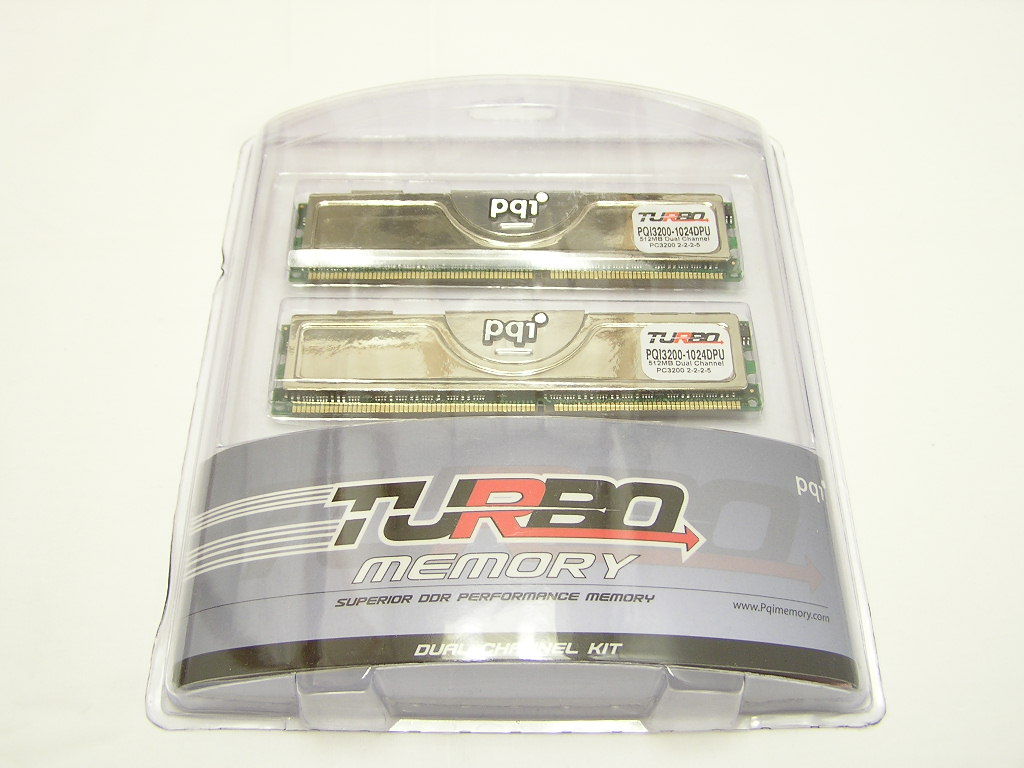
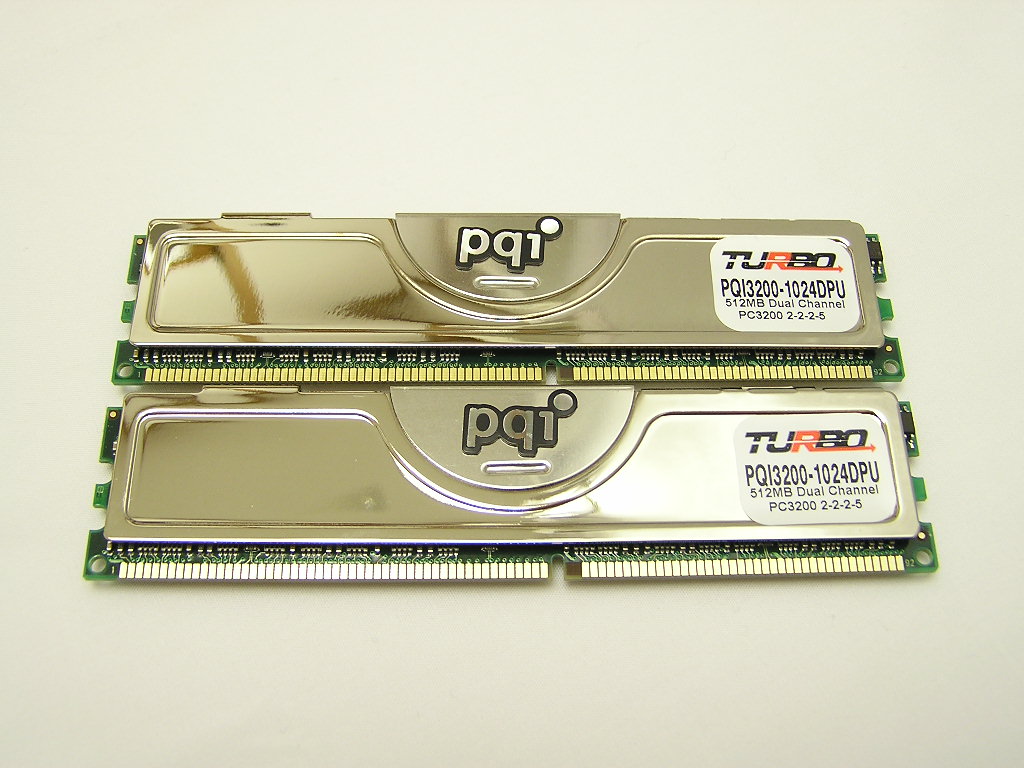
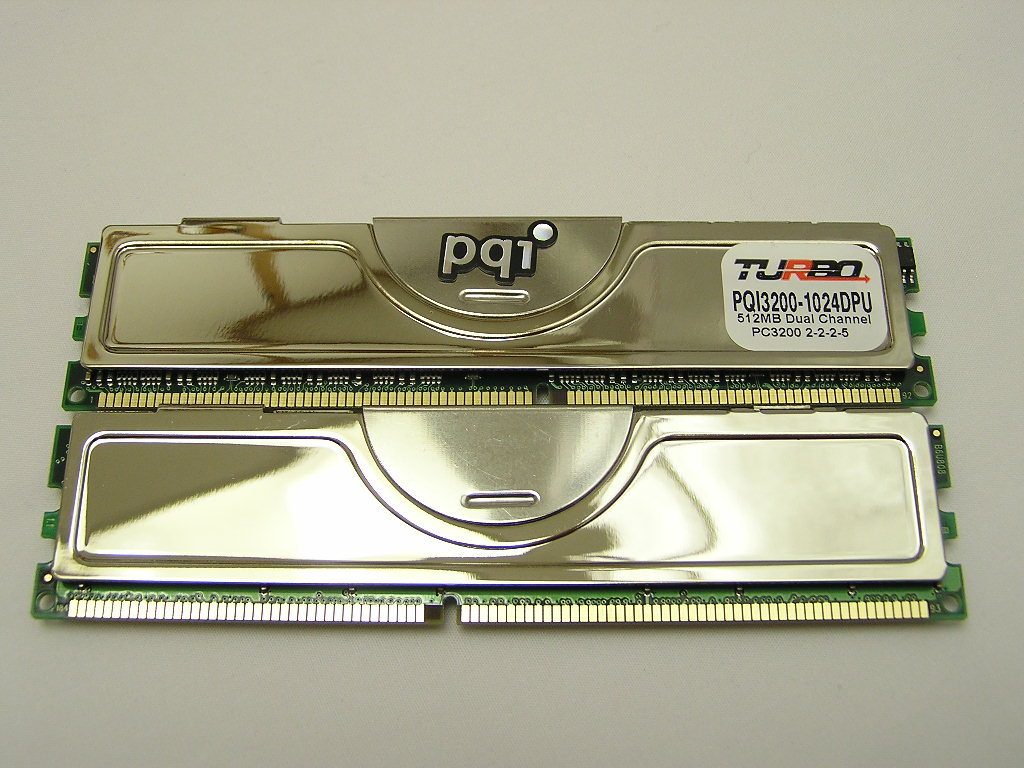
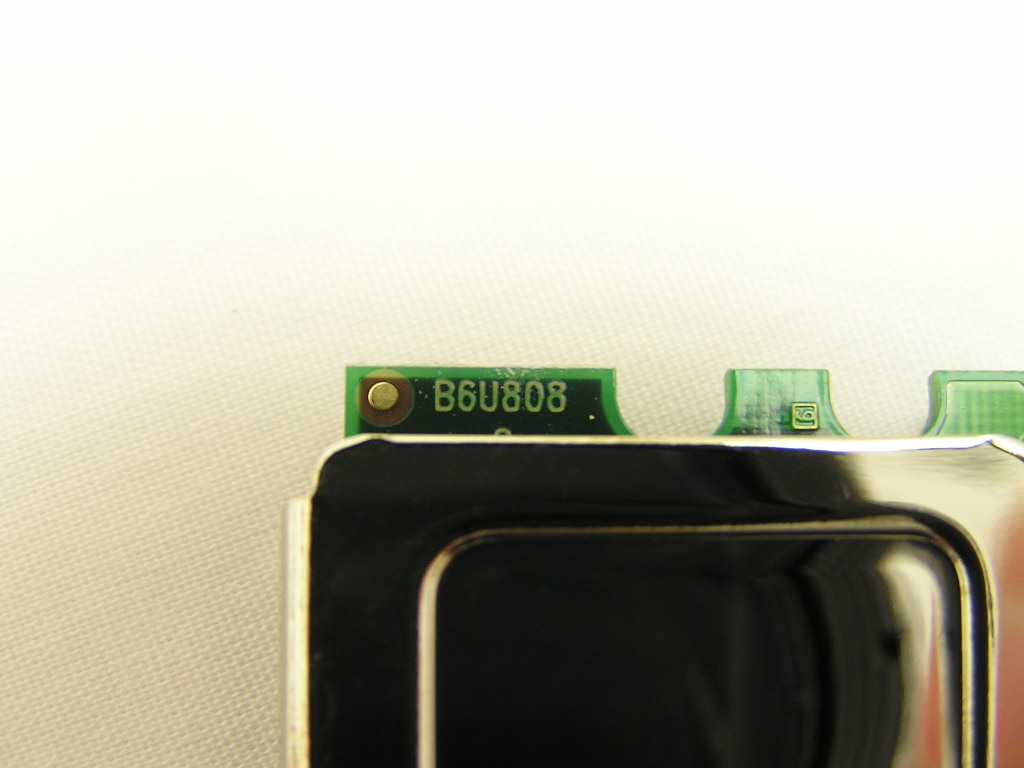
Like most TCCD memory modules, PQI’s PC3200 are rated for the lowest timings of 2-2-2-5. TCCD chips are actually rated for 250Mhz with higher timings, meaning companies are already running their TCCD modules well beyond specifications. Taking off the heatspreaders, the TCCD chips are 431 F-die ICs on the highly praised 808 Brainpower PCBs. Many end users with TCCD modules from various manufacturers have attained some of the best results with TCCD ICs on the 808 BP PCB. Nonetheless, I was expecting performance to be similar to that of the Corsair modules that I reviewed earlier, which used their own Brainpower PCB.
Test System and Overclocking
Test System:
- Athlon64 3000+ (0440SPMW) Winchester
- MSI K8N Neo2 (Korean) nForce3 Ultra
- PNY 6800
- Western Digital 120GB Hard drive
- OCZ DDR Booster
- OCZ 600 Watt PowerStream
* Keep in mind that I set AGP to 1.65v, HTT frequency to 3x, CPU VID to 1.55v, AGP frequency to 67, and kept all memory tests at 1T.
The Athlon64 is different in determining results for memory overclocks and this disclaimer from a past review describes it best.
“Although I could use a Pentium 4, the Athlon64 allows unlockable lower multipliers that are useful in determining the highest possible memory frequency. The Athlon64 also has an amazing memory controller directly on the CPU that can produce amazing bandwidth scores. The drawbacks is that it is tricky to obtain linear results because of the on-die memory controller. On a Pentium 4, memory clocked at 250 MHZ will produce somewhat similar Sandra bandwidth scores regardless of the multiplier. On an Athlon64, a larger multiplier at the same memory frequency will greatly increase bandwidth scores. Raising both the CPU and memory frequency can thus increase your memory performance, which makes memory analysis more tedious. So when looking at the various gaming benchmarks, always assume that the increase in memory frequency is also an increase in 1:1 with the CPU, although for analysis I have included some tests that do not run 1:1.”
Overclocking:
I always find memory stability by first giving a quick test with benching Super PI to the millionth digit. If that passes, I then loop Memtest86 3 times and Prime 95 for 4 hours. I use Prime95 as my last test, because I have found it to be much more overclock sensitive then Memtest86.
I first tested stability at 200 MHZ, at the PQI Turbo rated timings of 2-2-2-5. After finding that to be stable, I proceeded to up the HTT to 215Mhz, to match the low latency overclock of the Corsair PC4400’s. Unfortunately, the overclock failed and I had to reduce the HTT to 210Mhz. I then relaxed the Ras to Cas to 3, which brought my overclock to 225Mhz, This is the same overclock as the Corsair PC4400’s. With those timings, anything above 225Mhz resulted in failure in Prime. I then set the timings to 2.5-3-3-7, perhaps the best timings for TCCD modules, and found out that I could only top the memory out at 266Mhz or PC4200. Although not bad for an overclock, I expected at most a 5 percent difference from the 275Mhz the Corsair’s PC4400’s reached. Although they do clock much higher on the Brainpower boards, TCCD chips are still too inconsistent to guarantee similar overclocks.
Overclocking Results all in Dual Channel (1T):
- 200MHZ 2.0-2-2-5 2.65v
- 210MHZ 2.0-2-2-5 2.80v
- 225MHZ 2.0-3-2-6 2.85v
- 266MHZ 2.5-3-3-7 2.80v
- 280MHZ 2.5-4-4-8 2.80v
Results
A series of memory intensive benchmarks will be run to test the performance of our sample. The following tests will be based on common benchmark programs such as 3DMark2001. Real life performance differences will be tested through current games such as Far Cry and Half-Life 2. Memory bandwidth benchmarks will be based off of SiSoft Sandra and Aida32. Super PI will also be used to test memory performance, as the benchmark benefits largely from FSB increases.
SiSoft Sandra
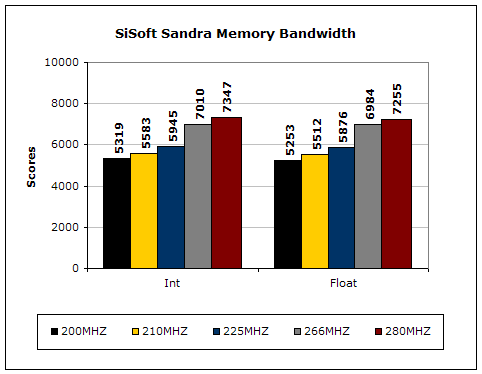
SiSoft Sandra is the most widely used memory bandwidth test. It even responds to changes in only latency timings.
Everest Home Edition
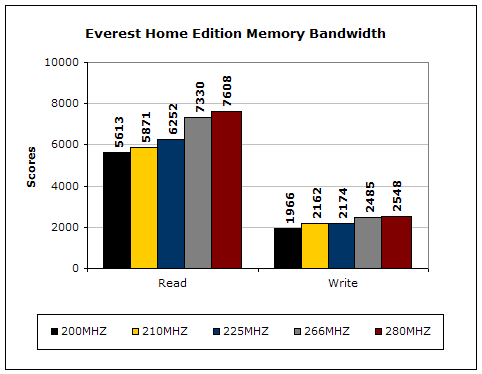
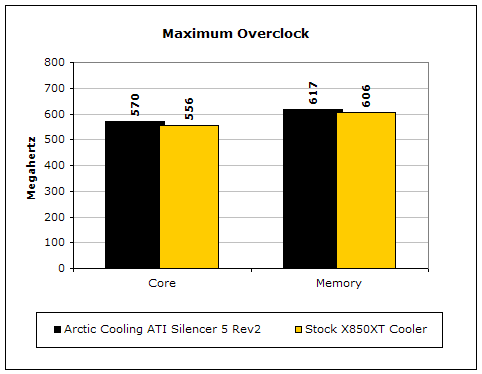
Much like Sandra, Everest Home Edition tests the memory’s ability to read and write data in large chunks. The results are similar to the results in Sandra. Everest Home Edition also includes a latency benchmark. The Athlon64’s performance with various latencies is also dependent upon its increase in CPU speed.
3DMark2001SE
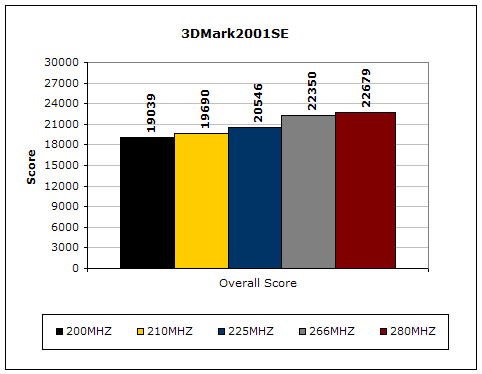
3dMark2001 is an excellent benchmark for determining overall system speed. It uses older DirectX technology, which allows the benchmark not be GPU dependent. A small increase in memory or CPU performance will result in a significant increase in scoring.
Results Continued
Far Cry
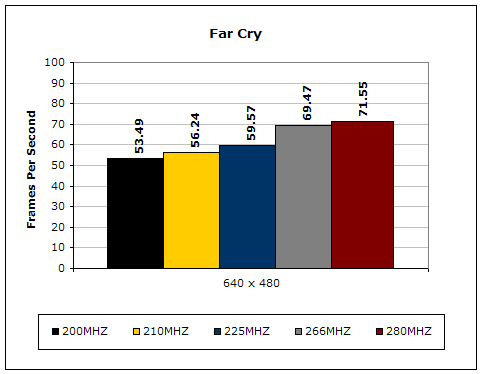
Since Far Cry is a game, the performance results will be very similar to 3dMark2001. I ran the benchmark at 640x480 so the benchmark would not be too GPU dependent. This benchmark will give more significant results than 3DMark2001, because Far Cry is extremely demanding.
Unreal Tournament 2004
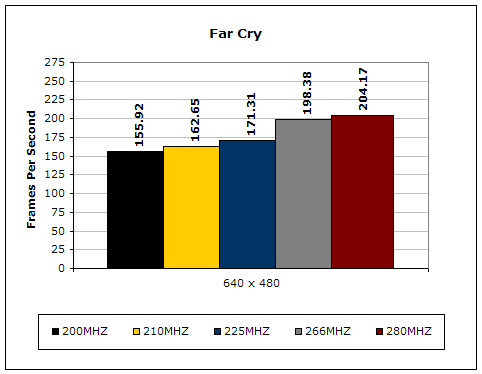
Unreal Tournament is another popular game engine to test overall system performance. Here, we can see the same results as Far Cry and 3dMark2001. UT2004 was also run at 640x480 to limit GPU dependency.
Half Life 2
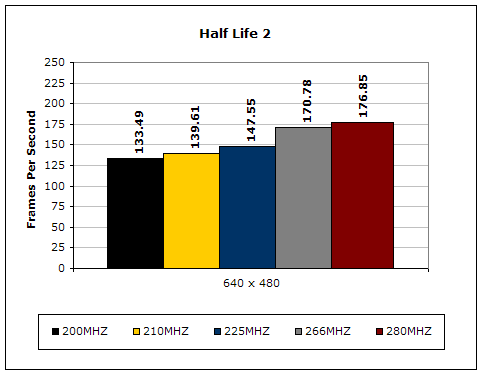
At 640x480, the results are similar to 3dMark2001, Far Cry, and UT2004.
Super PI
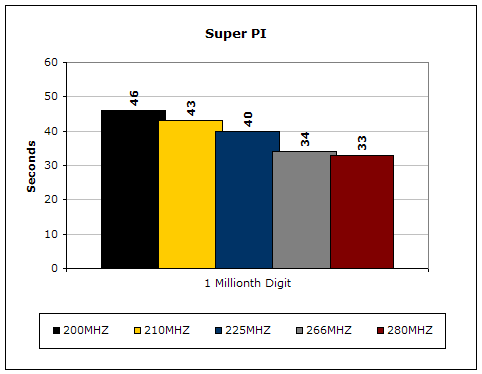
Super PI is my favorite benchmark, which calculates Pi. I chose to calculate Pi to the one millionth digit, which is the most popular digit. An increase in both memory and CPU speed displays an increase in speed in Super PI.
Conclusion and Thoughts
For their first venture into the overclocking scene, PQI has succeeded in delivering a memory module that encompasses everything an overclocker needs. Their Turbo series contains the most ideal IC (TCCD) for high performance memory, the most popular PCB, and some unique mirror-finished heatspreaders that are sure to grab any enthusiast’s attention. Best of all, none of these features comes with a hefty price. The PQI Turbos will run for a little less than 250 dollars, about 30 dollars less than the average price for TCCD modules. While the price was right for these modules, they did not overclock as well as some of the other TCCD sticks I have tested. For a pair of sticks that are only rated to run at DD400, these modules are amazing for their price and performance. For these reasons, we give the PQI’s Turbo series the InsaneTek “Recommended” award.
Pros:
- Some of the best looking heatspreaders I have ever seen…
- Built on 808 Brainpower PCB
- Good overclocking potential at 1T
- Awesome for both low and high timings
- Affordable
Cons:
- Nothing really
- Highest overclock with 2.5-3-3-7 is lower than competitors with same chip and PCB

We would like to thank PQI for providing us the sample. If you have any questions or comments, feel free to hit us up in the forums. You can also check out more of our latest reviews on the front page.