

Patriot PC2-5600+XBLK 1GB Dual Channel Kit
Introduction
DDR2’s reputation has always been plagued by high latencies in exchange for high bandwidth. When DDR2 was first announced, the latencies were rated 4-4-4-12 at speeds of 266MHz. That is just terrible. Fortunately, memory companies were able to find good ICs that are capable of doing extreme low latencies of 3-2-2. Currently the only memory IC that is capable of extreme low latencies would be the Micron fatbody, “fatty”, D9s. There have been talks that Micron discontinued the die revision but memory companies are still capable of finding these great ICs. It is all the better for us right?
Patriot is no longer a common name in the enthusiast crowd. Their reputation of having high quality enthusiast memory spread as fast as a nasty rash, which in this case, is a very good thing. Their XBL line of memory targets overclockers and hardware enthusiasts. For a long time I have wondered what it stood for and now I know. XBL stands for eXtreme Bandwidth and Latency. Currently Patriot has two DDR models that fall under the XBL series–the PC3200 and the PC4800. Intel fans need not fret when it comes to DDR2 memory. Patriot has also released an XBL series for low latency DDR2 memory. The memory is exactly what is in store for us today, the PC2-5600.
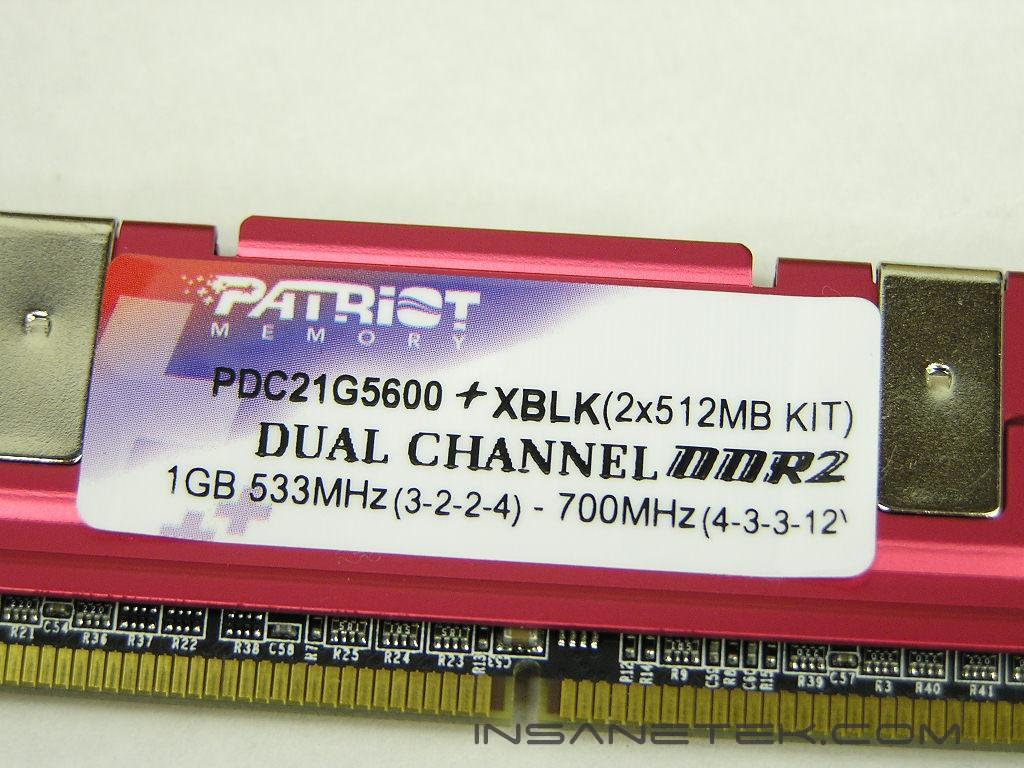
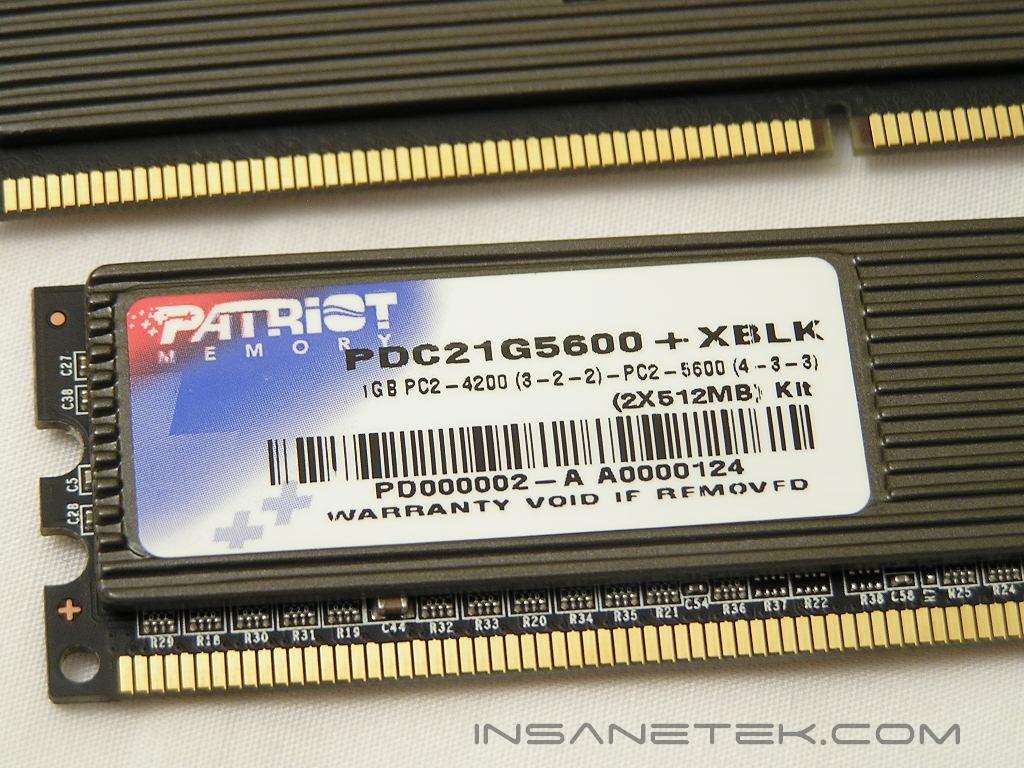
Patriot PC2-5600+XBLK
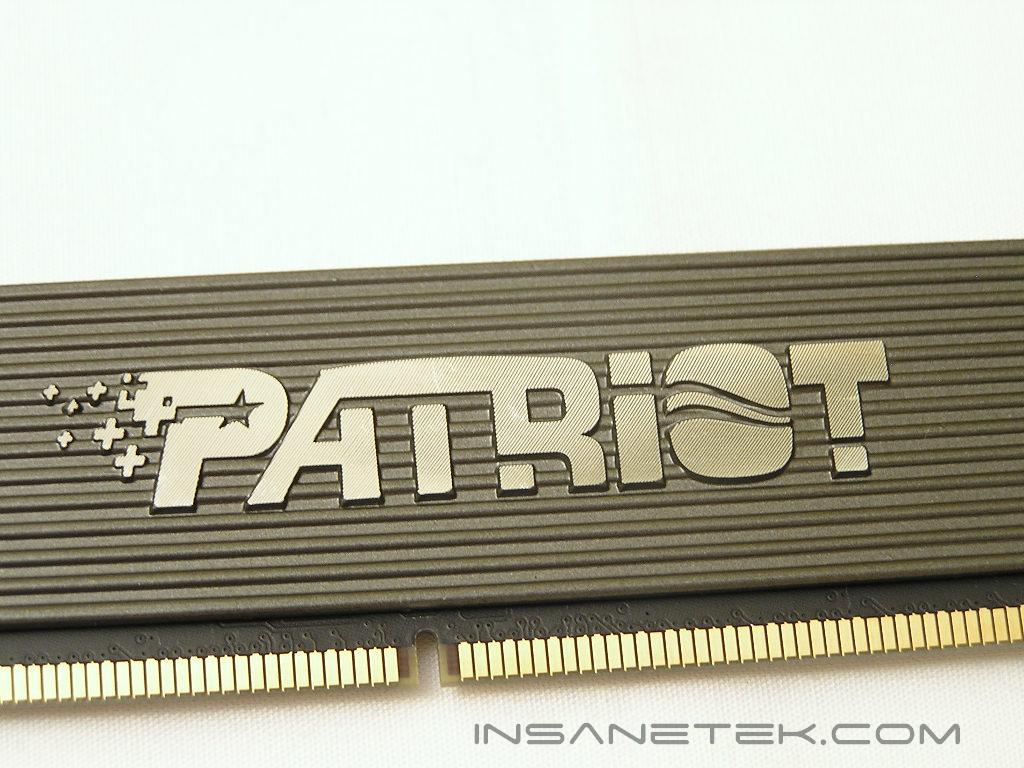
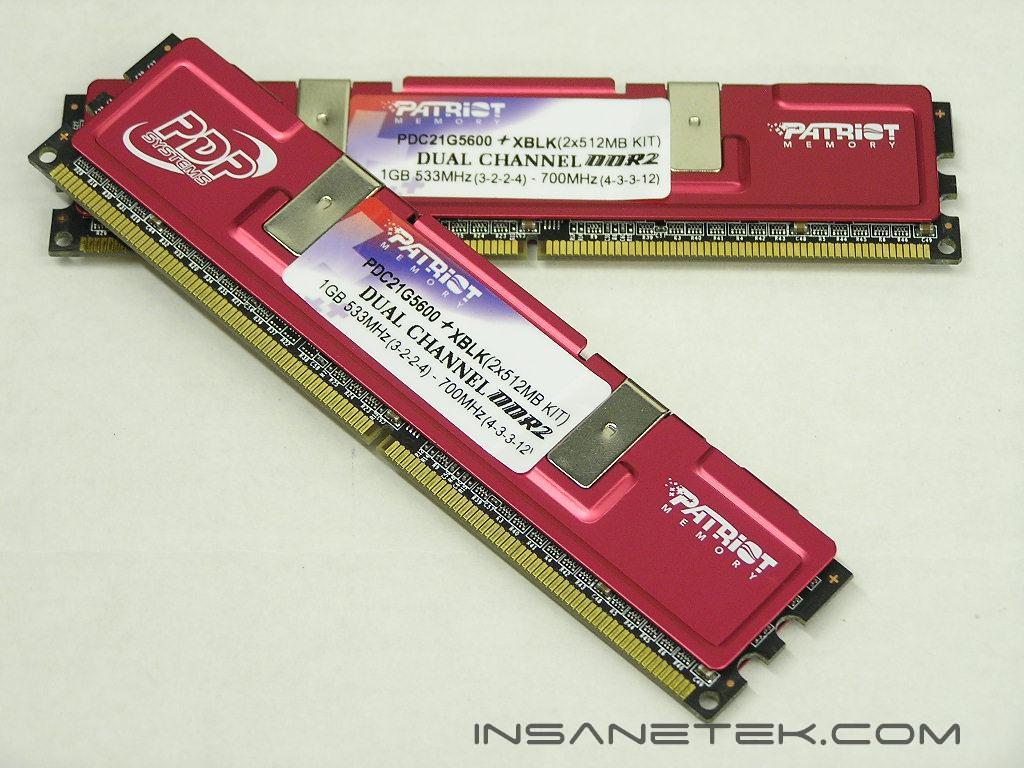
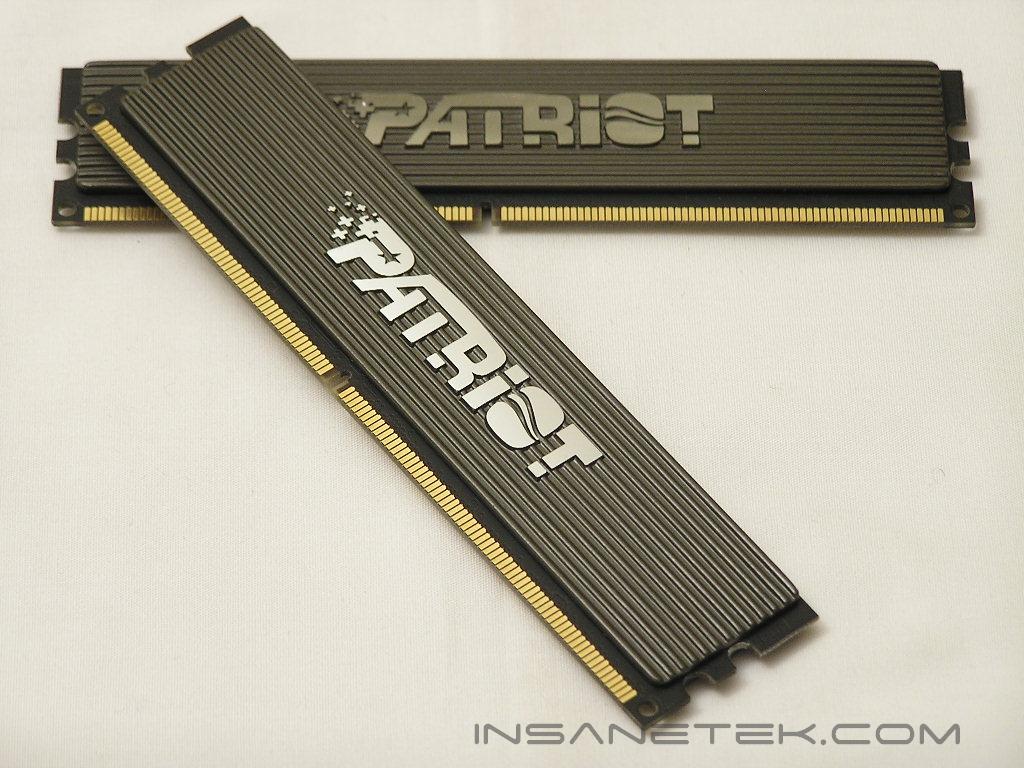
The very first kit of PC2-5600 I received did not come with Patriot’s new high quality premium heatspreaders. The original ones came with their red heatspreaders that used two clips. Here is a lesson to be learned folks: Do NOT attempt to remove the heatspreaders from DDR2 memory. BGA memory chips have weaker bonds when soldered to the PCB so they come off very easily. If the heatspreaders have strong thermal tape, you will end up pulling the chips right off the PCB. It is possible to pull it off if you are extremely careful, but it is just wiser that you leave the heatspreaders on. I was curious to see the exact stepping of the D9 IC so I removed the heatspreaders, and some chips came off with it. I wanted to bash my head into the wall for being so careless. Anyway, the first kit of PC2-5600 I received had Micron D9CRZ ICs. One thing you must know is that not all Micron fatbody D9 ICs perform the same. There are various steppings that yield various overclocking results. They all can run low latencies but they scale differently when it comes to high frequencies. So far I have encountered three different D9 steppings–D9CRZ, D9DQW, and D9DQT. D9CRZ is the lowest scaling fatbody D9 and reaches around 850MHz-900MHz. D9DQW comes in second and reaches around 900MHz-1000MHz. D9DQT is the best and overclocks the highest, easily breaking the 1GHz barrier. The replacement kit (by the way, you void all warranties when removing the heatspreaders and damaging the memory) I received came with Patriot’s new premium heatspreaders that act like heatsinks. They are held on by thermal tape and the bond is very strong. The black heatspreaders on black PCB is so sexy.
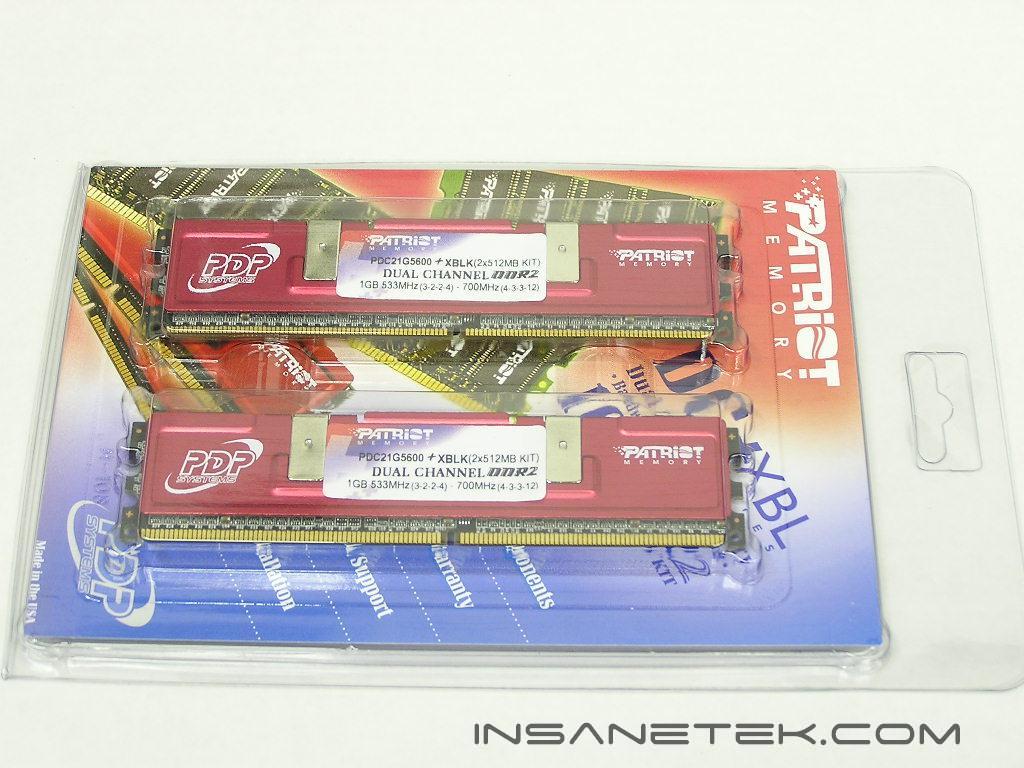
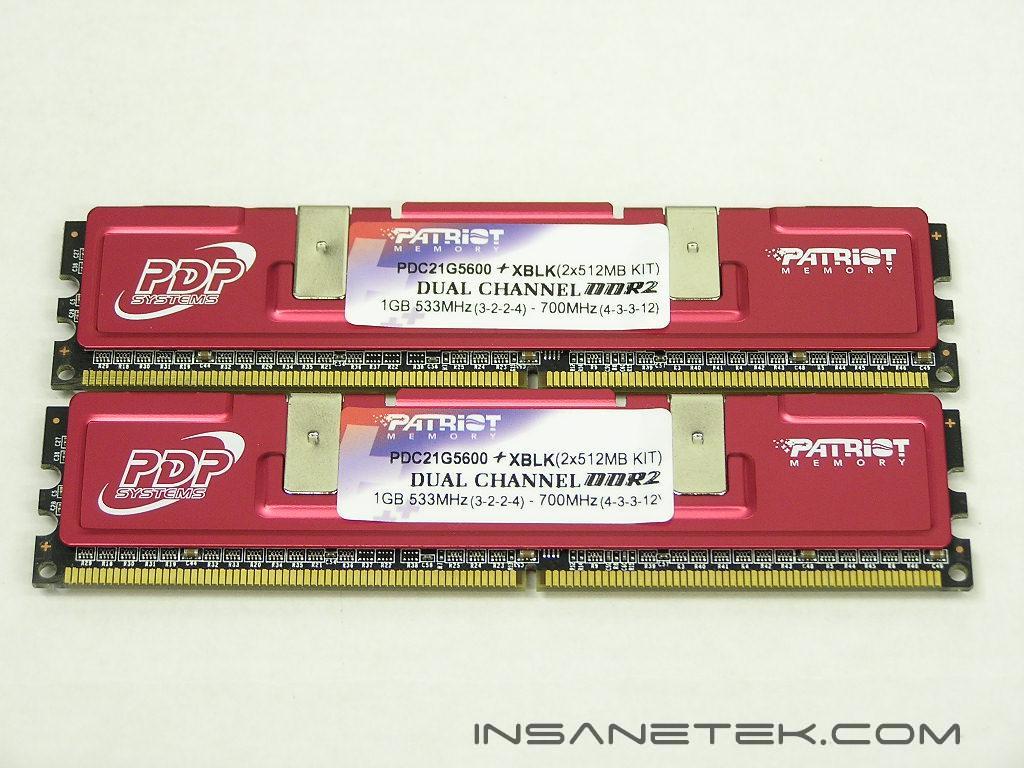
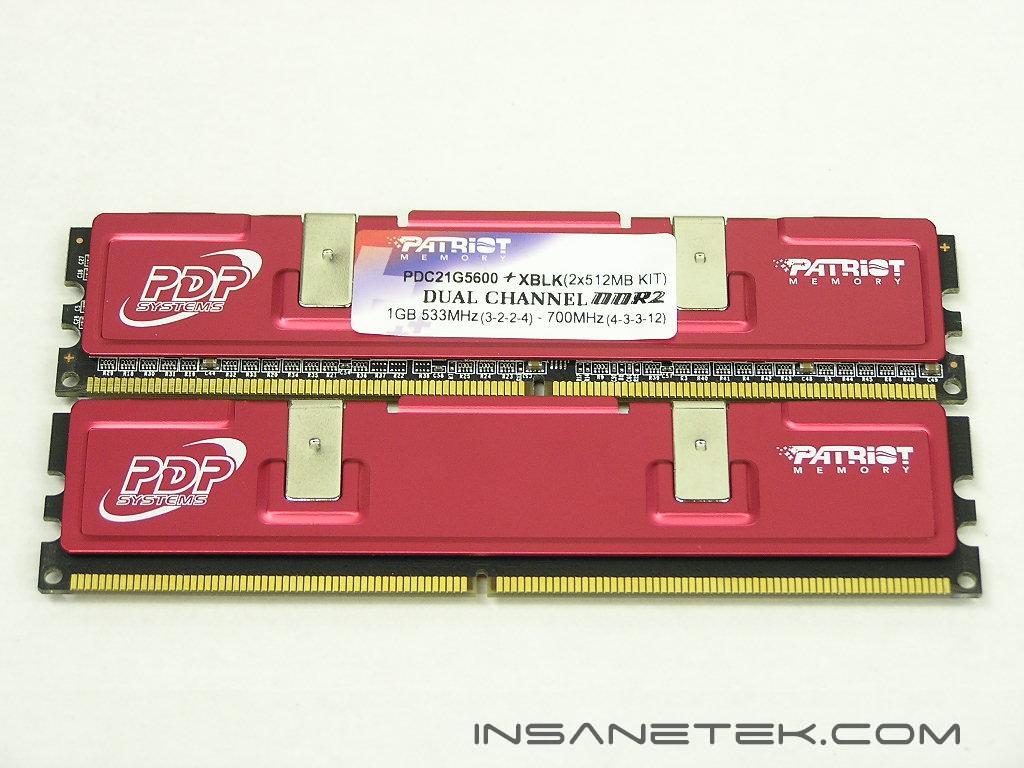
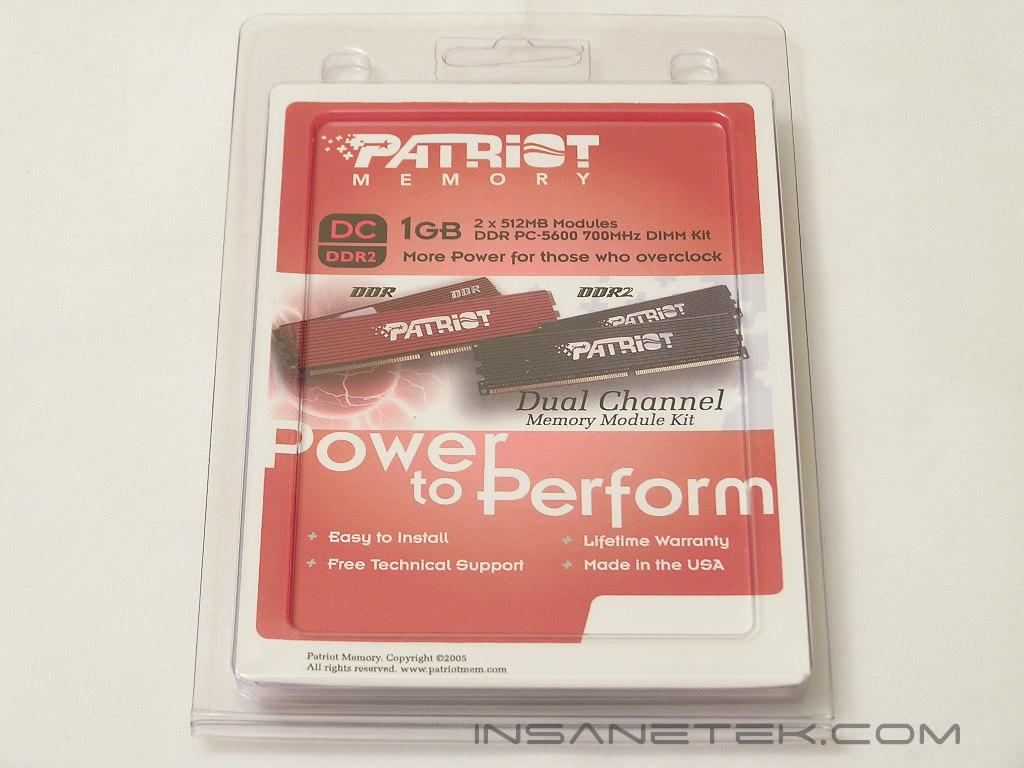
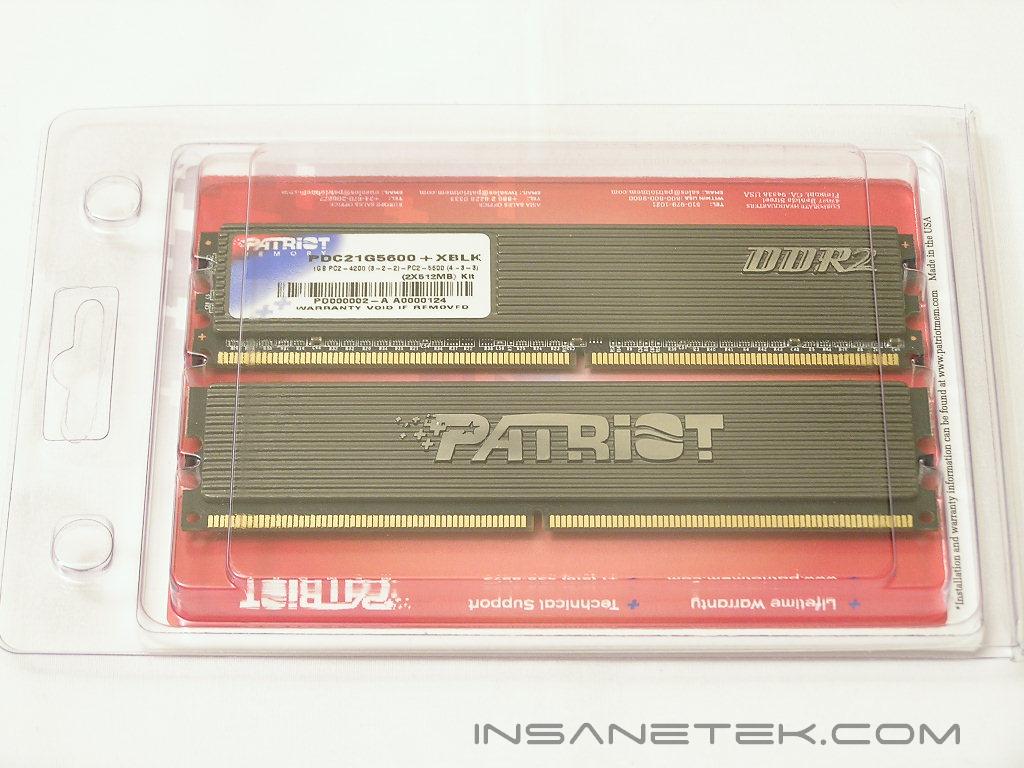
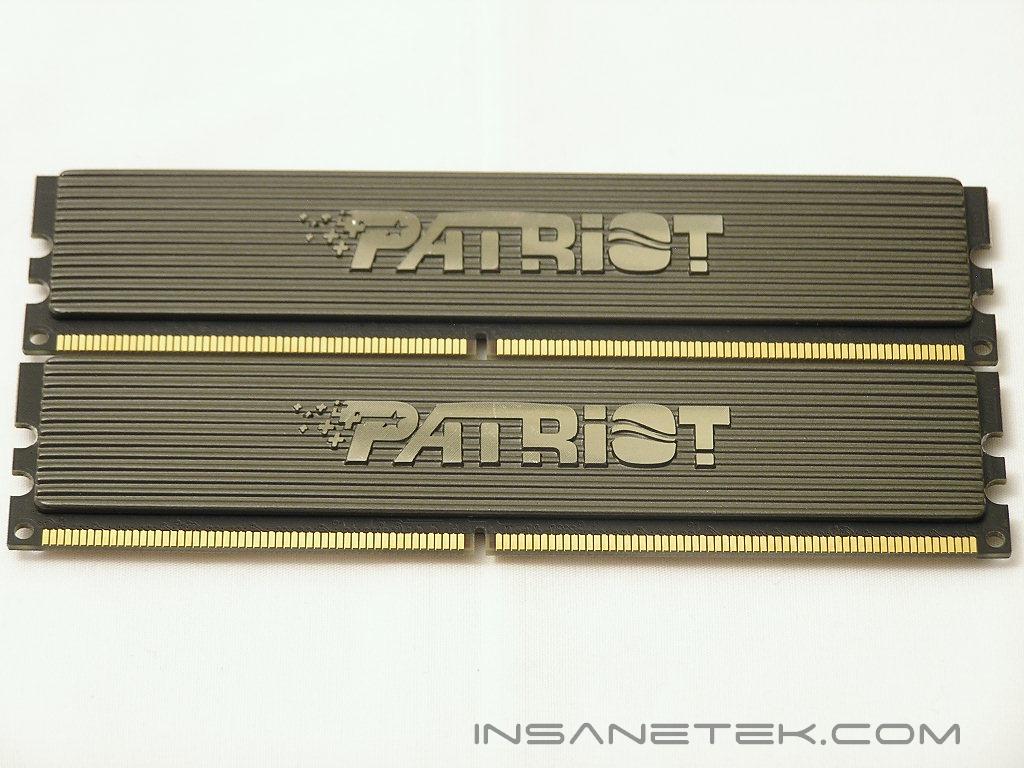
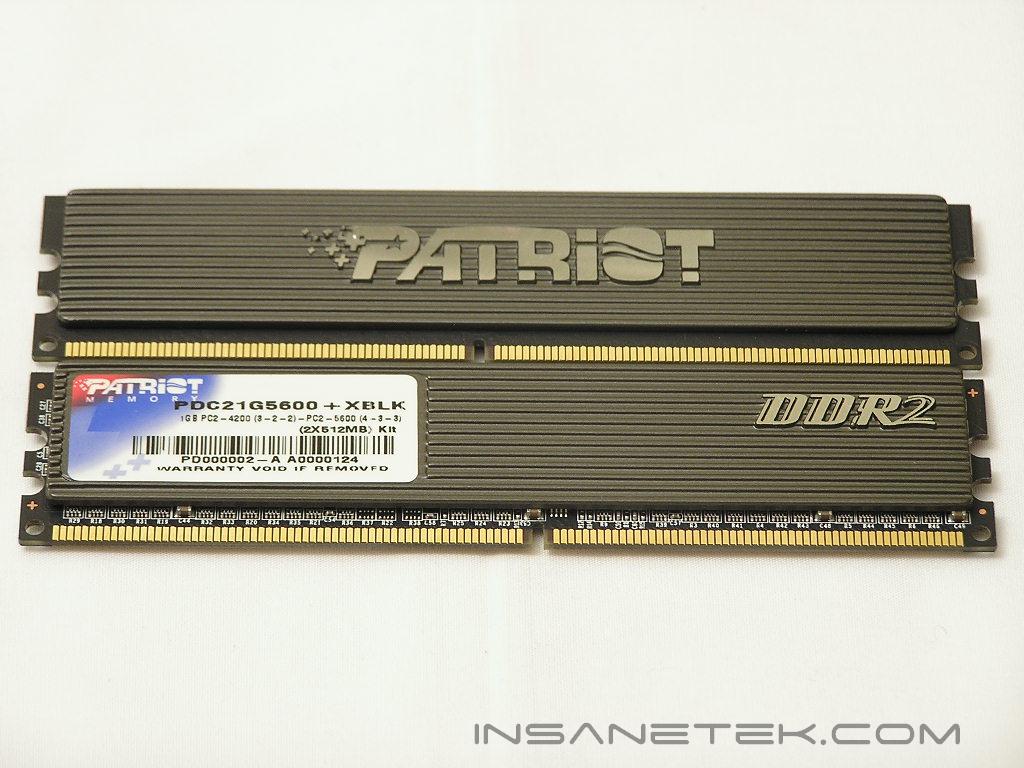
Like a lot of Patriot XBL memory, the PC2-5600 comes with dual speed ratings. At a common stock speed of 266MHz, the PC2-5600 can run low latencies of 3-2-2. With some overclocking, the PC2-5600 guarantees a speed of 350MHz, or DDR2-700, with timings of 4-3-3. It is always nice to see dual ratings because additional guarantees of running certain speeds with certain timings are always a plus.
Test System and Overclocking
Test System:
- Intel Pentium D 840 3.2GHz
- Asus P5WD2 Premium
- 2 x 512MB Patriot PC2-5600+XBLK
- Sapphire Radeon X800
- Arctic Freezer 7
- Thermaltake PurePower 680W
Overclocking:
Keep in mind that during overclocking, the latencies are as follows: CAS-TRCD-TRP-TRAS
Throughout all tests, the multiplier has been kept at 14x to reduce any possible CPU bottleneck.
The first test began with verifying that the memory runs at the rated speed of 266MHz and timings of 3-2-2 with just 1.8v. The memory ran like a charm. Micron fatbody D9 ICs love voltage and respond very well when more voltages are provided. For that reason, I left the memory voltage at 2.3v, the maximum supplied by the Asus P5WD2. I kept the extreme low latencies of 3-2-2-5 and reached all the way to 335MHz, or DDR2-670. I loosened the CAS to 4 and TRAS to 8 and proceeded to reach 375MHz, or DDR2-750. Certainly not too shabby of an overclock! I loosened TRCD to 3, but kept TRP at 2 and the memory took off to 440MHz, or DDR2-880. If your motherboard provides a 1:2 divider and you are hesitant to overclock your system FSB, you’ll be happy to know that these sticks are very well capable of running DDR2-800 with low latencies of 4-3-2-8. I loosened TRP to 3 but the memory did not have much of a reaction. I had to loosen the timings to 5-3-3-9 before these sticks reached a ceiling of 484MHz, or DDR2-968. Excellent results indeed! These results were obtained with the second set of memory I received. I was informed that the PC2-5600 uses two types of Micron fatbody D9 ICs–D9CRZ and D9DQW. The first kit I had with D9CRZ reached a ceiling of 433MHz, or DDR2-866, before I “accidentally” ruined it. This D9DQW kit with looser timings of 5-5-5-12 did not help me overclock any higher.
Overclocking Results
- 200FSB 3:4 266MHz 3-2-2-5 2.3v
- 200FSB 3:5 333MHz 3-2-2-5 2.3v
- 200FSB 1:2 400MHz 4-3-2-8 2.3v
- 201FSB 3:5 335MHz 3-2-2-5 2.3v
- 225FSB 3:5 375MHz 4-2-2-8 2.3v
- 220FSB 1:2 440MHz 4-3-2-8 2.3v
- 242FSB 1:2 484MHz 5-3-3-9 2.3v
Results
A series of memory intensive benchmarks will be run to test the performance of our sample. The other tests will be based on common benchmark programs, such as 3DMark and PCMark. Real life performance differences will be tested through current games, such as Far Cry and UT2004. Memory bandwidth benchmarks will be based off of SiSoft Sandra and Everest Home Edition. Super PI and PiFast will also be used to test memory performance, as the benchmark benefits largely from FSB increases.
SiSoft Sandra Memory Bandwidth
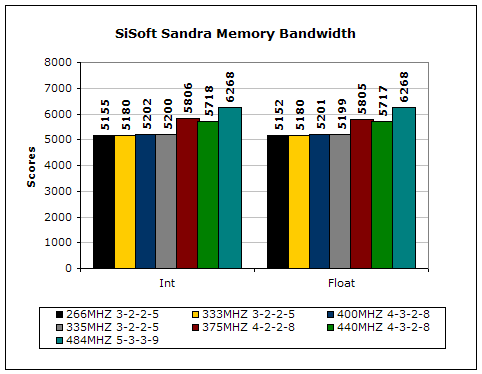
SiSoft Sandra is the most widely used memory bandwidth test. It can tell you the increase in performance from just lowering the latency timings.
Everest Home Edition
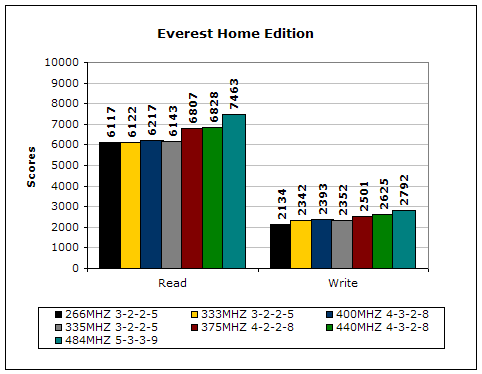
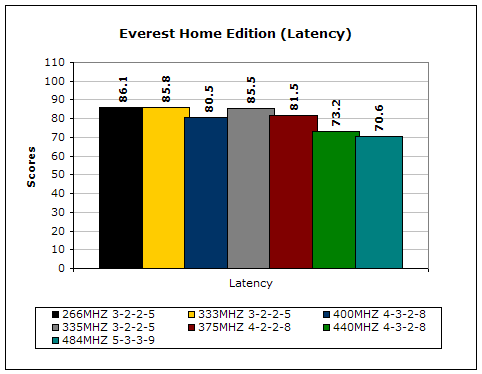
Much like Sandra, Everest Home Edition tests the memory’s ability to read and write data in large chunks. The results show that the lower latencies seem to help just a little with performance.
3DMark2001SE
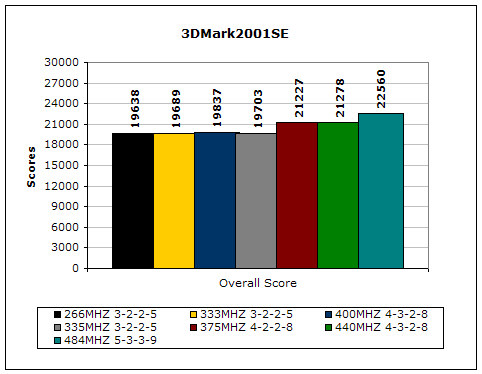
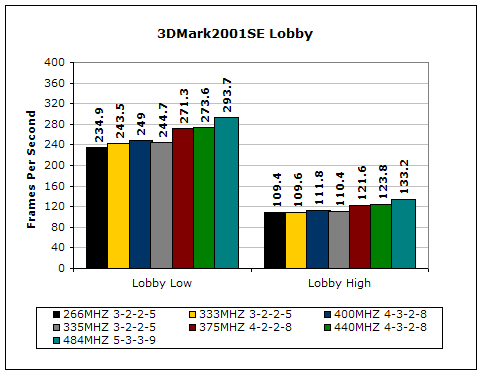
3DMark is likely the overclocker’s favorite benchmark. Unlike 3DMark2003, which stresses mainly the video card, 3DMark2001SE tests all of the system’s main components. Increasing the CPU speed, memory speed, and video card speeds will result in higher results in the final score.
Results Continued
Far Cry
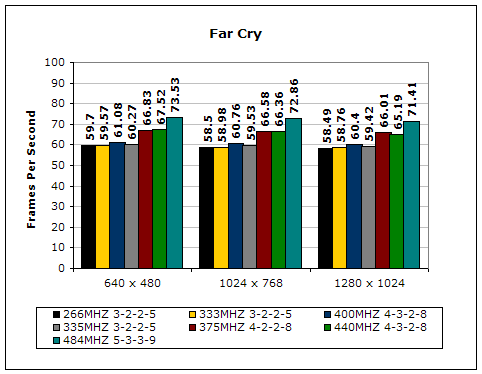
Since Far Cry is a game, the performance results will be very similar to 3dMark2001. I ran the benchmark at 640x480, so the benchmark would not be too GPU dependent. The tests under 1024x768 and 1280x1024 are an approximation of what kind of frames you’ll be getting. While the results are similar to 3dMark2001 in performance, this benchmark will give more significant results, because Far Cry is extremely demanding.
Unreal Tournament 2004
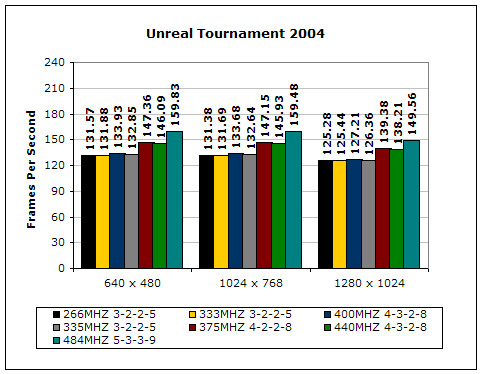
Unreal Tournament is another popular game engine to test overall system performance. Here, we can see the same results as Far Cry and 3dMark2001. Like Far Cry, UT2004 was also run at 640x480 to limit GPU dependency. The other resolutions provide an approximation of actual gameplay performance.
PCMark2002
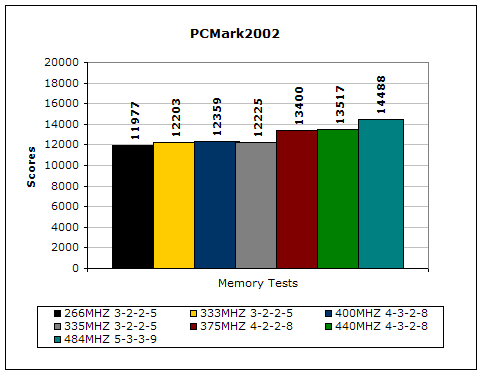
PCMark is another benchmark created by Futuremark. It tests the memory compression and decompression speeds in small to large chunks of data.
Super PI
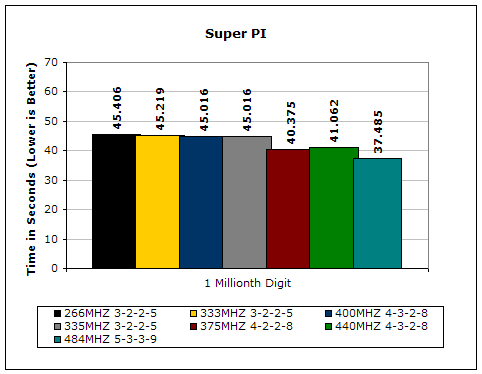
Since the value of PI is an infinite value, Super PI is a speed test to find the digit you’re looking for. In this case, we chose the millionth digit. Super PI benefits greatly from higher FSB, as well as low latencies.
PiFast
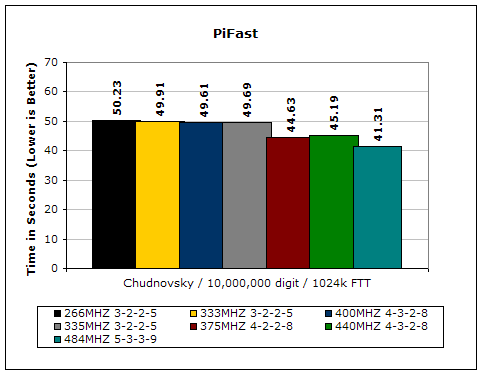
PiFast is similar to Super PI. The results can be greatly affected by a slight adjustment to the memory megahertz and latency.
Conclusion and Thoughts
Patriot not only makes great DDR memory, but great DDR2 memory as well. The PC2-5600+XBLK kit does exactly what their XBL line is supposed to do–provide low latency operations and great bandwidth. As with any system, system bandwidth really benefits from having low latency memory. The PC2-5600 does just that and a lot more. Don’t be fooled by the second rating of DDR2-700 with 4-3-3. The memory has a lot more headroom left. The only possible gripe that I have will be the random use of fatbody D9 ICs. It is obviously very understandable that two different stepping types are used for meeting the demands. The memory is extremely affordable and performs like a champ. Who wouldn’t want to buy these? It will be very hard to keep up with the sales if only one choice of D9 IC was used. It will be like a gamble though when you buy this kit, just like when you purchase AMD processors looking for specific week/date codes. Either way, it is a win-win situation, with one winning more than the other. You will end up with great low latency DDR2 memory for a very low price. Although the PC2-5600+XBLK won’t reach stunning high frequencies like the Corsair PC2-8000UL, it is still worth every last penny you have. The price difference between the two is roughly $100 and to some, the extra $100 won’t be worth it. If you are looking for real low latency DDR2 memory that won’t break your bank, this is it. There is no other out there that can compete for the same price.
Pros:
- Runs extreme low latencies
- Overclocks very well
- Extremely affordable
- Premium heatspreaders look awesome
Cons:
- Two types of Micron fatbody D9 ICs used (even though both are good, one is better than the other)

We would like to thank Patriot for providing us the sample. If you have any questions or comments, feel free to hit us up in the forums. You can also check out more of our latest reviews on the front page.