

OCZ Value Pro PC2-4200 2GB Dual Channel Kit
Introduction
DRAM prices are going back up just a bit, but 1GB dual channel kits are still very affordable. If you are an enthusiast and do not have 1GB of system memory, shame on you. Every self built computer, gaming computer, or high end workstations should have at least 1GB of system memory. Windows XP loves it and performs very well with the additional space. Much like all advancements in technology, having 1GB of system memory will no longer be sufficient in the future. The rumored specifications for Microsoft’s Vista operating system says that it will require 2GB of system memory! Wowzers!
Everyone knows that AMD wears the crown when it comes to gaming performance. There are only a few games available that really take advantage of the increased system memory, i.e., Battlefield 2 and some MMORPG’s. Intel platforms are known to excel at office productivity and multitasking workstations. These systems really take advantage of increased system memory, hence the need to go to 2GB or more. What we have here today will be OCZ’s 2GB DDR2 Value Pro solution. It is aimed at budget enthusiasts who need the extra RAM for a smooth ride.
OCZ Value Pro PC2-4200 2GB
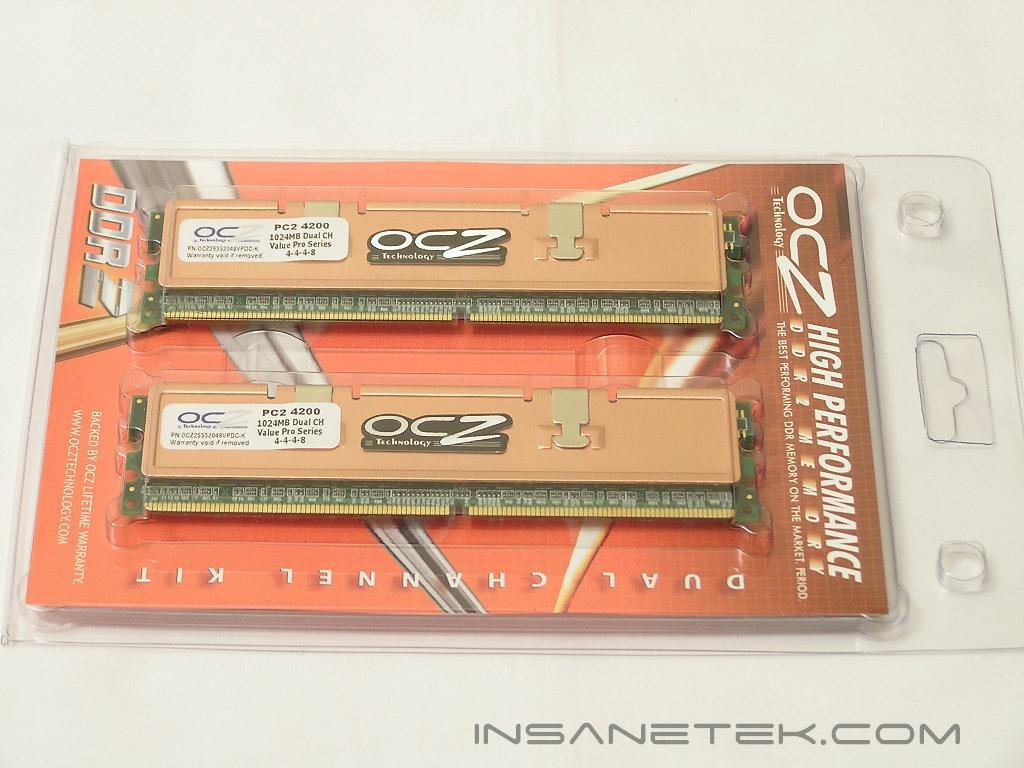
The package of the Value Pro is the same with all other OCZ packages we have encountered. The back of the orange insert has the InsaneTek award and quote on there!
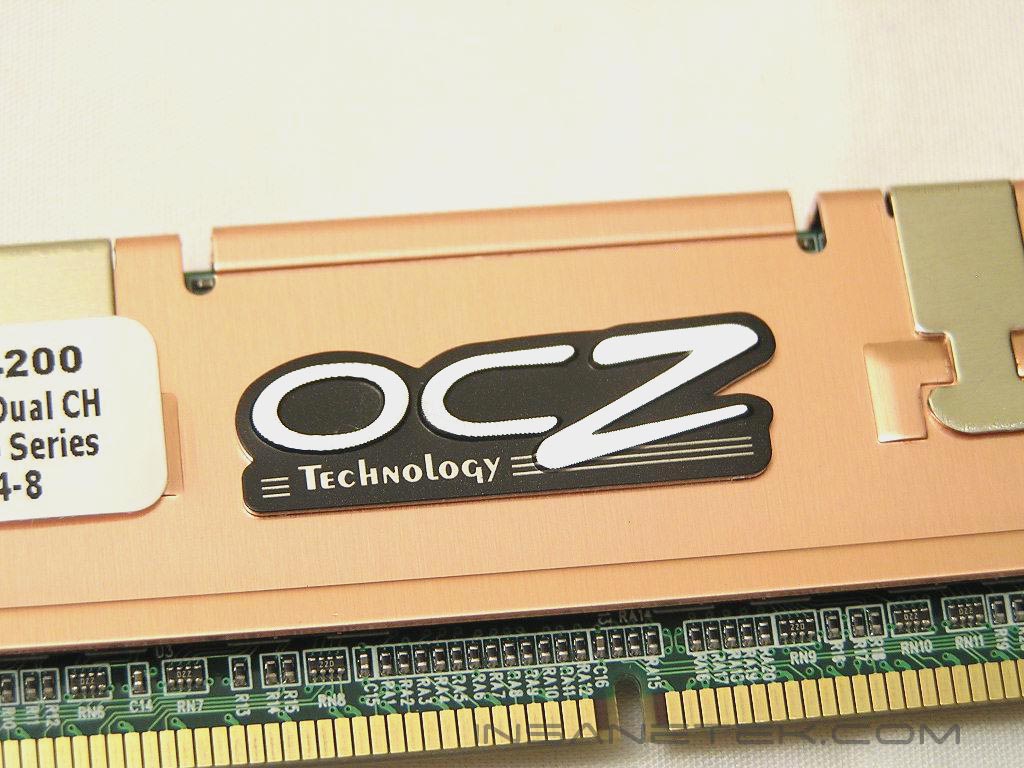
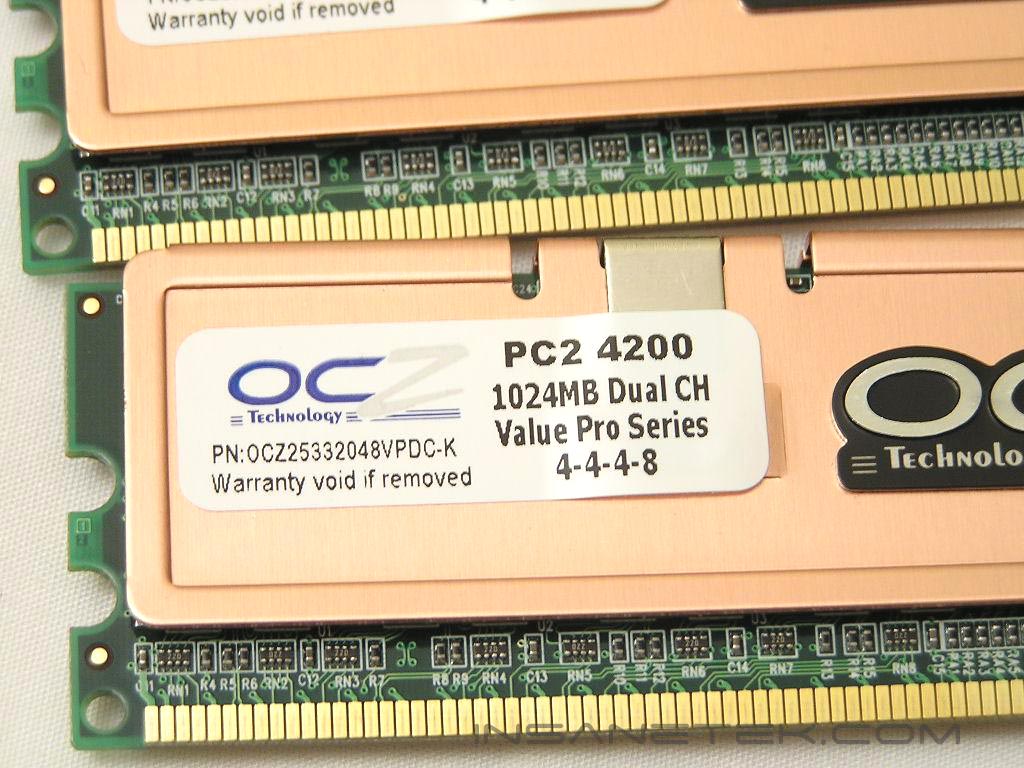
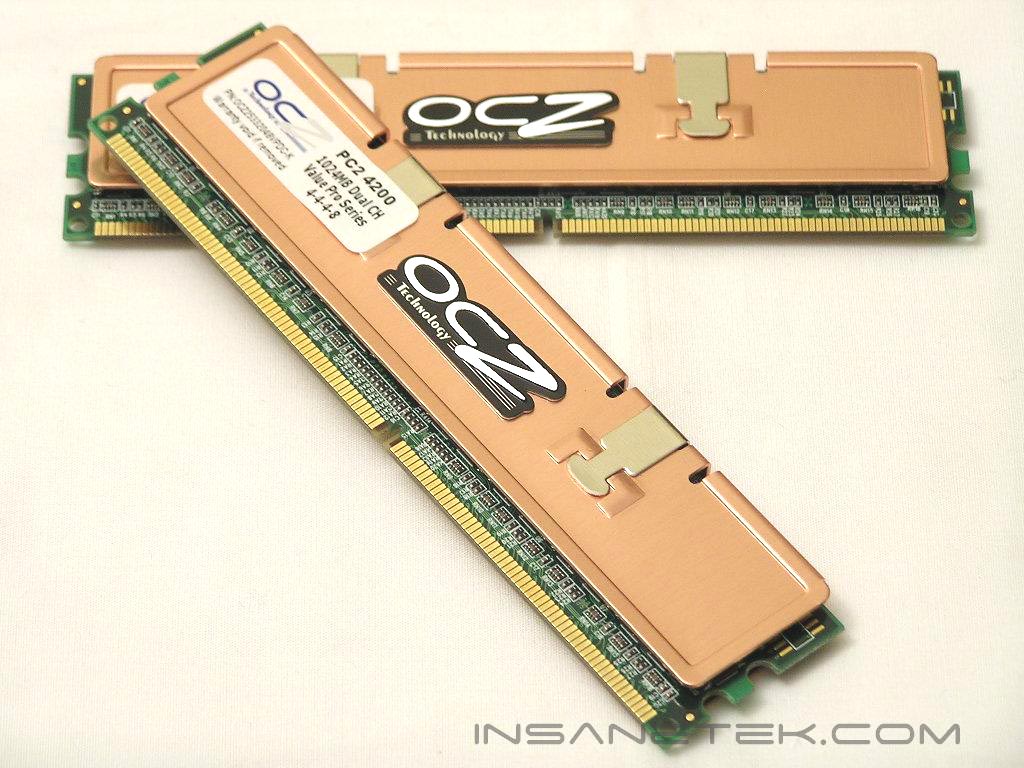
The Value Pro series comes with regular copper heatspreaders. Regular copper heatspreaders are used to separate the different class levels of OCZ memory. The Platinum represents low latency memory; the Gold represents gaming memory; and the regular Copper represents mainstream enthusiast memory that are better than typical value memory.
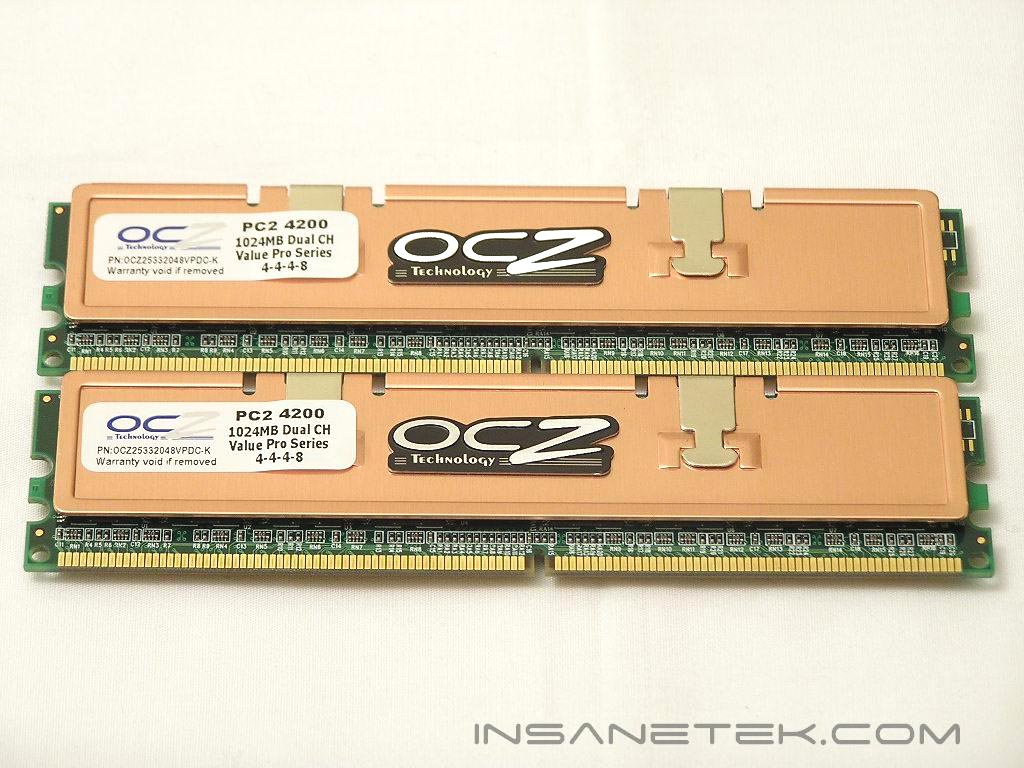
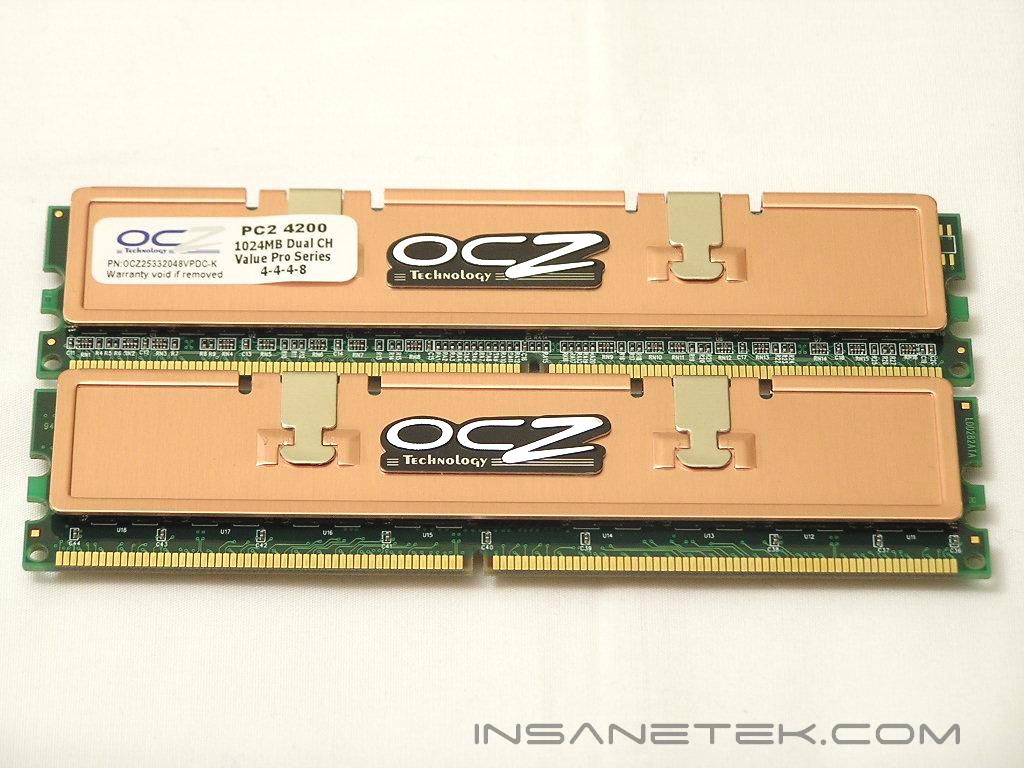
We all know that DDR2 uses BGA chips because it has low voltage requirements and low heat output. The interesting thing about the Value Pro PC2-4200 is that it uses TSOP memory chips. This is certainly the first time I have ever seen any memory company use TSOP IC’s for DDR2 memory. I peeked under the heatspreaders to check the markings on the IC’s and only found the chips to be marked with OCZ part numbers. There were no information given on the specific IC die used. The Value Pro PC2-4200 is rated at 266MHz with timings of 4-4-4-8 with just 1.8v. The timings are not the greatest, but are far better than value memory that runs at 5-5-5. Also, keep in mind that higher density memory IC’s increases memory latencies.
Test System and Overclocking
Test System:
- Intel Pentium D 840 3.2GHz
- Asus P5WD2 Premium
- 2 x 512MB OCZ Value Pro PC2-4200
- ATI Radeon X800XT
- Arctic Freezer 7
- Thermaltake PurePower 680W
Overclocking:
Keep in mind that during overclocking, the latencies are as follows: CAS-TRCD-TRP-TRAS
Throughout all tests, the multiplier has been kept at 14x to reduce any possible CPU bottleneck.
The initial test begins with finding the lowest latencies the memory would run with a stock voltage of 1.8v. With the FSB set at 200MHz and using a 3:4 divider, the memory runs at 266MHz. The lowest timings I was able to reach was 3-3-3-8. I was surprised at the drop from the rated 4-4-4-8. The timings of 3-3-3-8 are the timings for their Gold PC2-4200 memory. If you plan on leaving your system at default speed of 200FSB and memory at 266MHz, these are certainly a great choice. I kept the voltage a 1.8v and proceeded to find the highest frequency the memory would run with the latencies at 3-3-3-8. After increasing 8FSB, I reached 277MHz, or DDR2-554. The result here was not very exciting, but every little bit counts right? I pumped up the voltage to see if it would help stabilize speeds and 2.2v was the highest the memory would allow. Jumping the gun to 2.3v only creating additional unnecessary problems. With 2.2v and timings of 3-3-3-8, the memory skipped happily to 297MHz, or DDR2-594. Considering that the majority of LGA775 motherboard provide additional VDIMM, this is certainly a great jump for mainstream enthusiast memory. Knowing that the ceiling has been reached with timings of 3-3-3-8, I proceeded to timings of 4-3-3-8 and even 4-4-3-8. Any of these timings did not help increase the overclock. I had to loosen to the rated timings of 4-4-4-8 to overclock any further. With 2.2v and timings of 4-4-4-8, the memory walled at 368MHz, or DDR2-736. For the majority who will run the memory with a 3:4 divider, this overclock means that your FSB will be running at 276MHz, which isn’t too bad for an overclocked system. I tried loosening the timings even more to 5-5-5, but it provided no help.
- 200FSB 3:4 266MHz 3-3-3-8 1.8v
- 208FSB 3:4 277MHz 3-3-3-8 1.8v
- 223FSB 3:4 297MHz 3-3-3-8 2.2v
- 276FSB 3:4 368MHz 4-4-4-8 2.2v
Results
A series of memory intensive benchmarks will be run to test the performance of our sample. The other tests will be based on common benchmark programs, such as 3DMark and PCMark. Real life performance differences will be tested through current games, such as Far Cry and UT2004. Memory bandwidth benchmarks will be based off of SiSoft Sandra and Everest Home Edition. Super PI and PiFast will also be used to test memory performance, as the benchmark benefits largely from FSB increases.
SiSoft Sandra Memory Bandwidth
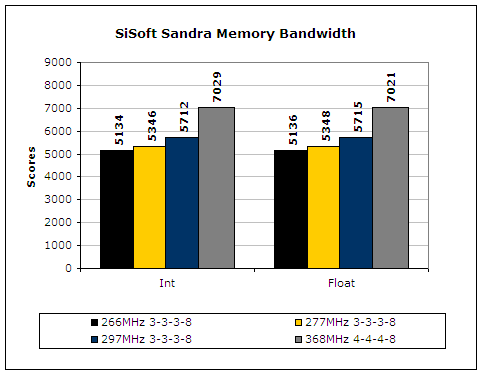
SiSoft Sandra is the most widely used memory bandwidth test. It can tell you the increase in performance from just lowering the latency timings.
Everest Home Edition
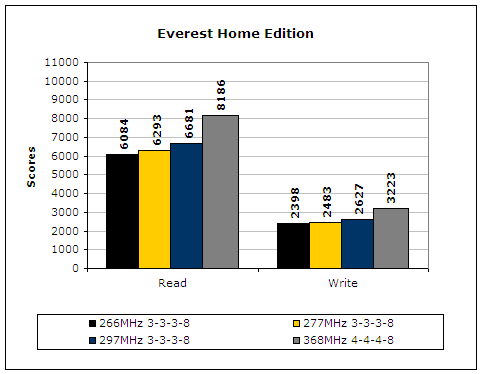
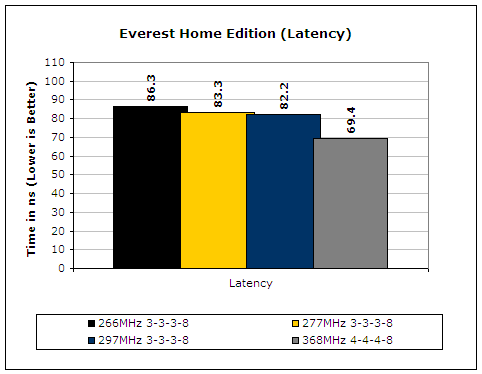
Much like Sandra, Everest Home Edition tests the memory’s ability to read and write data in large chunks. The results show that the lower latencies seem to help just a little with performance.
3DMark2001SE
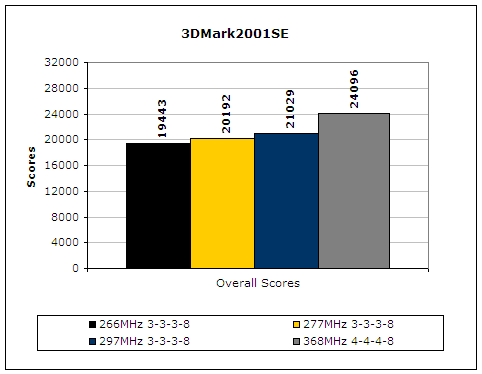
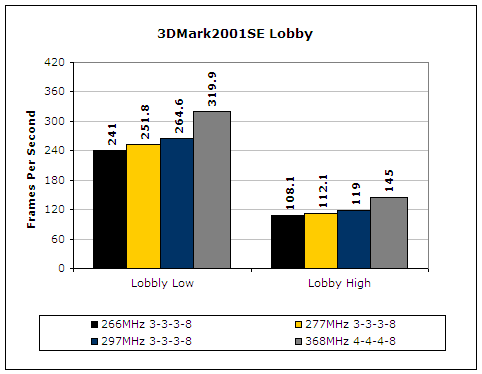
3DMark is likely the overclocker’s favorite benchmark. Unlike 3DMark2003, which stresses mainly the video card, 3DMark2001SE tests all of the system’s main components. Increasing the CPU speed, memory speed, and video card speeds will result in higher results in the final score.
Results Continued
Far Cry
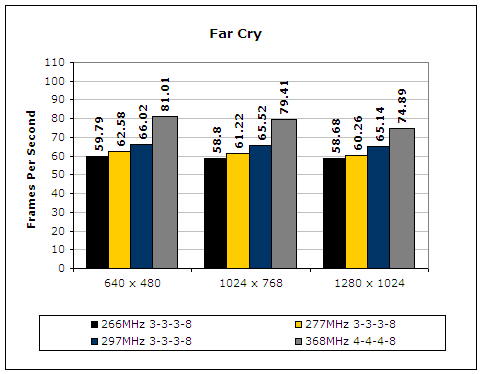
Since Far Cry is a game, the performance results will be very similar to 3dMark2001. I ran the benchmark at 640x480, so the benchmark would not be too GPU dependent. The tests under 1024x768 and 1280x1024 are an approximation of what kind of frames you’ll be getting. While the results are similar to 3dMark2001 in performance, this benchmark will give more significant results because Far Cry is extremely demanding.
Unreal Tournament 2004
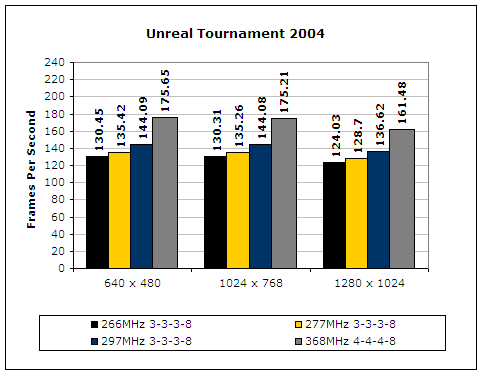
Unreal Tournament is another popular game engine to test overall system performance. Here, we can see the same results as Far Cry and 3dMark2001. Like Far Cry, UT2004 was also run at 640x480 to limit GPU dependency. The other resolutions provide an approximation of actual game play performance.
PCMark2002
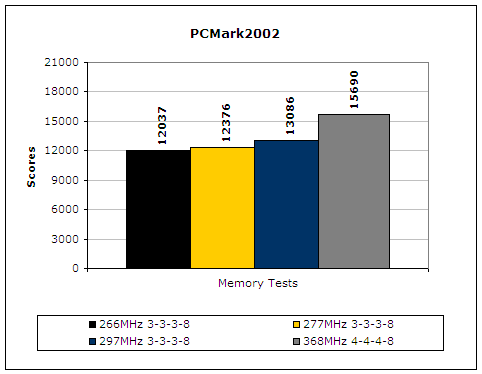
PCMark is another benchmark created by Futuremark. It tests the memory compression and decompression speeds in small to large chunks of data.
Super PI
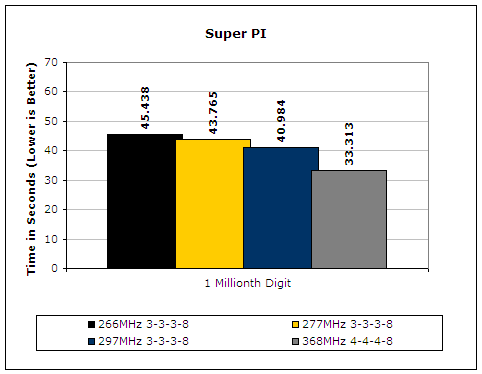
Since the value of PI is an infinite value, Super PI is a speed test to find the digit you’re looking for. In this case, we chose the millionth digit. Super PI benefits greatly from higher FSB, as well as low latencies.
PiFast
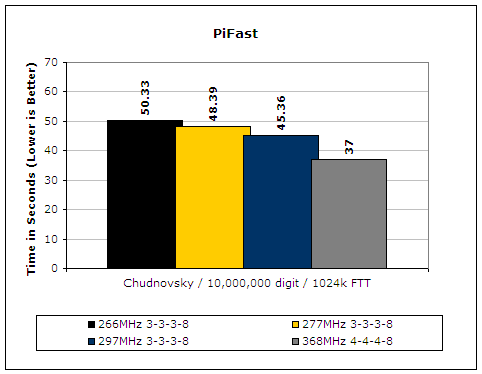
PiFast is similar to Super PI. The results can be greatly affected by a slight adjustment to the memory megahertz and latency.
Conclusion and Thoughts
Overclocking does not ALWAYS mean you need the latest and greatest hardware. For those who want a simple build and squeeze some extra performance out of the system, they will be happy with a mainstream enthusiast hardware. On the memory side, OCZ’s Value Pro PC2-4200 does a great job at that. It is nothing extreme and will not get you the gigahertz memory frequency, but it will be sufficient when you plan to push your system just a tad. It might seem strange that enthusiasts would only want to do minor overclocking, but there are actually a lot of enthusiasts who are scared to push the system too much. The price tag of the memory is nothing to complain about either. 2GB memory kits are becoming intensely popular and more and more enthusiasts have been upgrading recently. A 2GB kit of Value Pro PC2-4200 comes in roughly at $199. That is about the price of some good 1GB kits! The price/performance ratio of the Value Pro PC2-4200 is awesome. If you are running an Intel system and are looking for some good 2GB mainstream memory, be sure to put this on top of your list.
Pros:
- Runs at very low voltages
- Overclocks well with increased voltages
- Extremely affordable
Cons:
- Nothing really

We would like to thank OCZ for providing us the sample. If you have any questions or comments, feel free to hit us up in the forums. You can also check out more of our latest reviews on the front page.