

OCZ Platinum PC5000 DFI nF4 Special 1GB Dual Channel Kit
Introduction
PC5000 DDR memory? Who in the world has PC5000 DDR memory? OCZ does, and they are the first to release such a high end high performance memory for the power hungry enthusiasts. When it was first announced, I found it interesting to see that such a speed was only catered towards DFI nF4 users. We all know that the DFI nF4 series motherboards are the best overclocking motherboards available. It’s the only motherboard that allows high HTT headroom and a wide variety of voltage options. This allows overclockers to really push their system to the max. With that, OCZ was able to handpick out all their high end quality sticks and release true high end memory for those who don’t wish to take their chance and start the “random” tests. As I mentioned in the OCZ Platinum PC4800 article, there are definitely many other choices out there that are capable of reaching insanely high speeds at a lower cost. What’s the point for the PC5000? It’s not released simply to charge more; these sticks are guaranteed (notice the keyword “guaranteed”) to run the insanely high speeds. One major reason for overclocking is the fun while testing and the trial-and-error, so some enthusiasts might not be too fond of such high rated memory. To me, I’d rather save that trial-and-error process and spend time squeezing even more out of these sticks.
The OCZ Platinum PC4800 was already outstanding and performed better than I had imagined. With a marketing gimmick behind the Platinum PC5000, can OCZ impress me even further? You should be interested to hear the results.
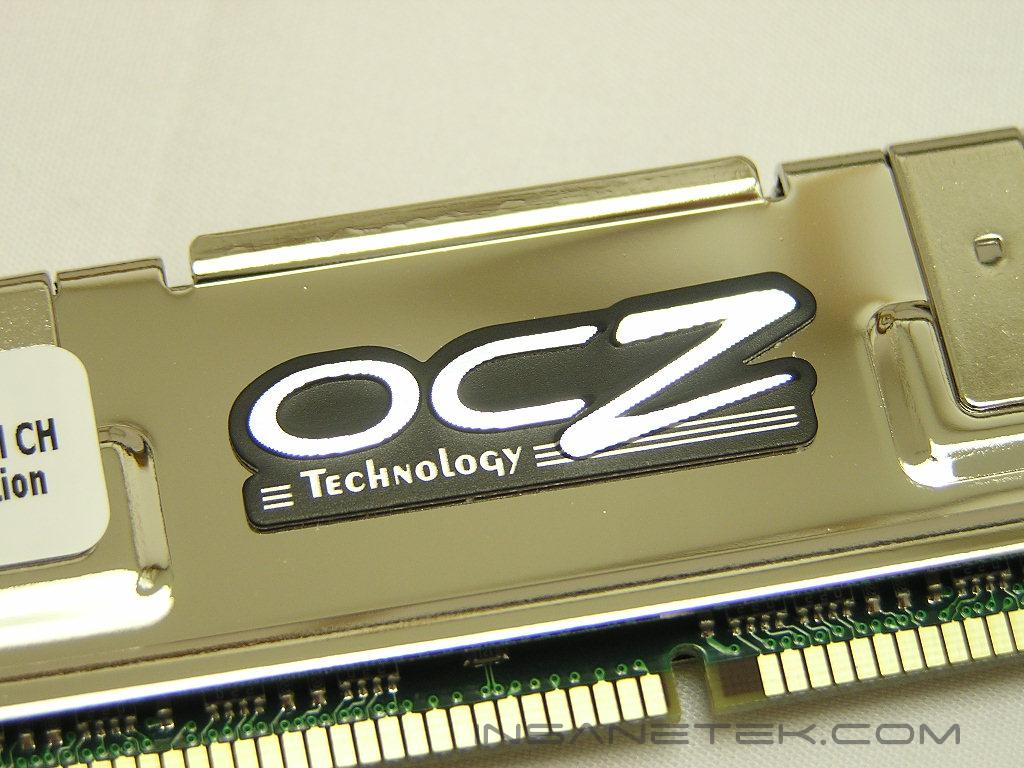
OCZ Platinum PC5000 DFI nF4 Special
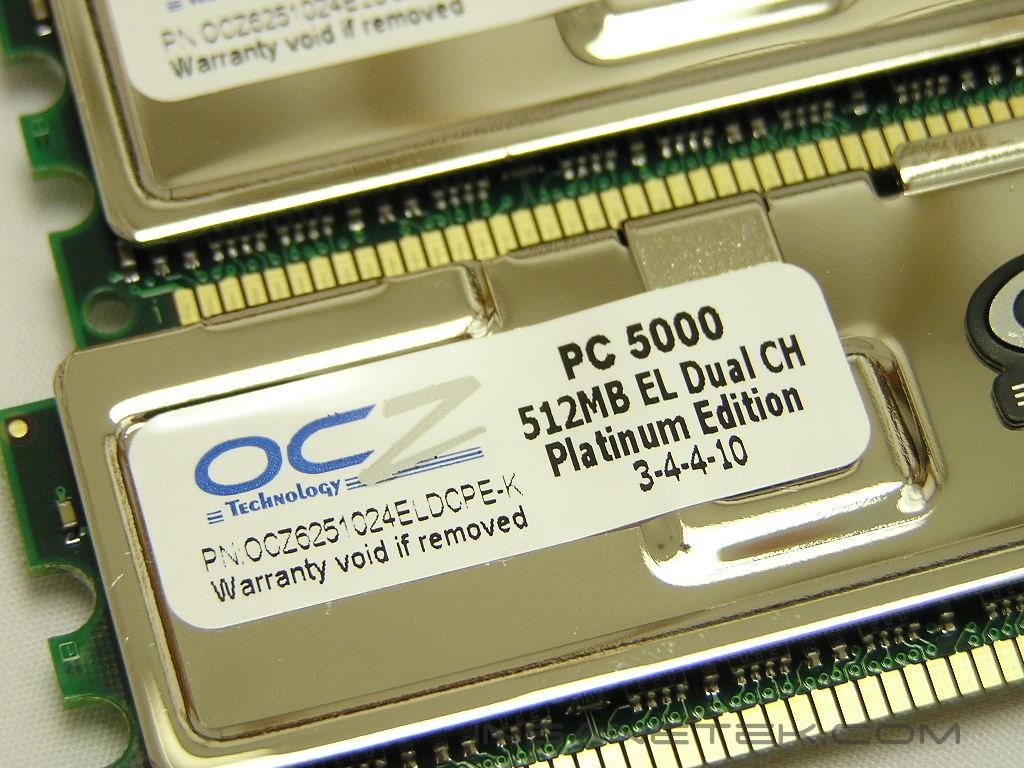
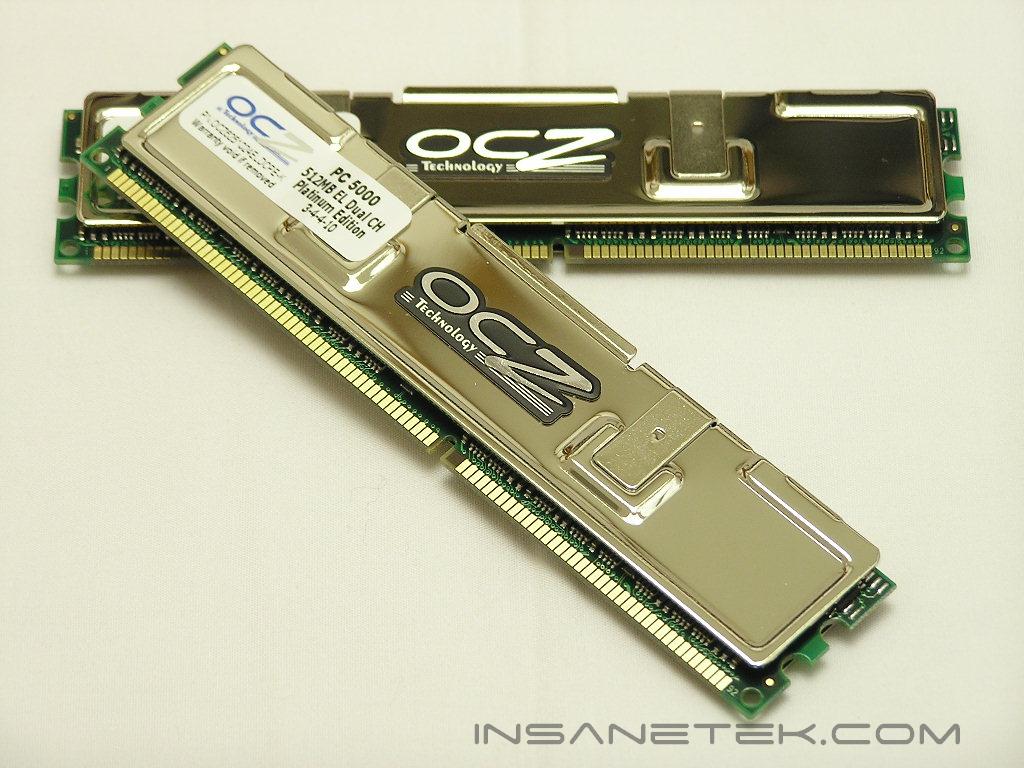
Yes, I know that is one really long name, but that’s no biggie. It’s not confusing at all; it’s straightforward and let’s consumers know exactly what they’re buying. As usual, the OCZ Platinum line features the shiny mirror reflection of the platinum finish copper heatspreaders. We’ve had a little discussion in the forums about which memory aesthetics were most favorable and OCZ’s Platinum finish is pretty much the winner. The only bad thing everyone didn’t like was the sticker logo. Everyone thought that the etched/engraved logo looked better.
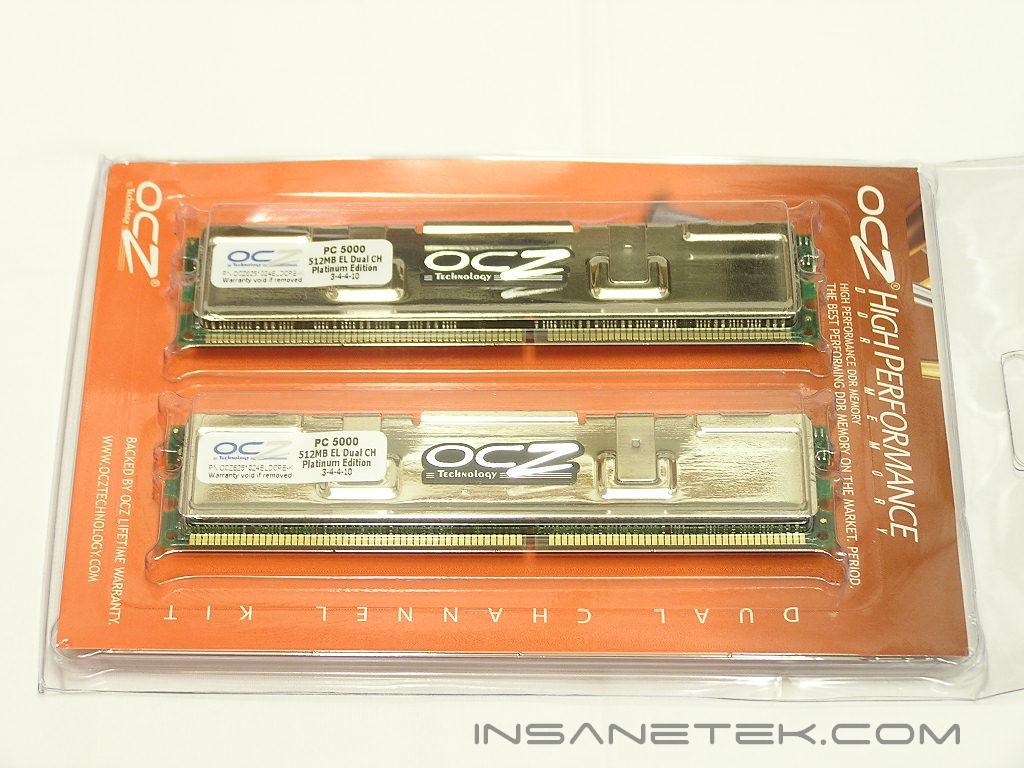
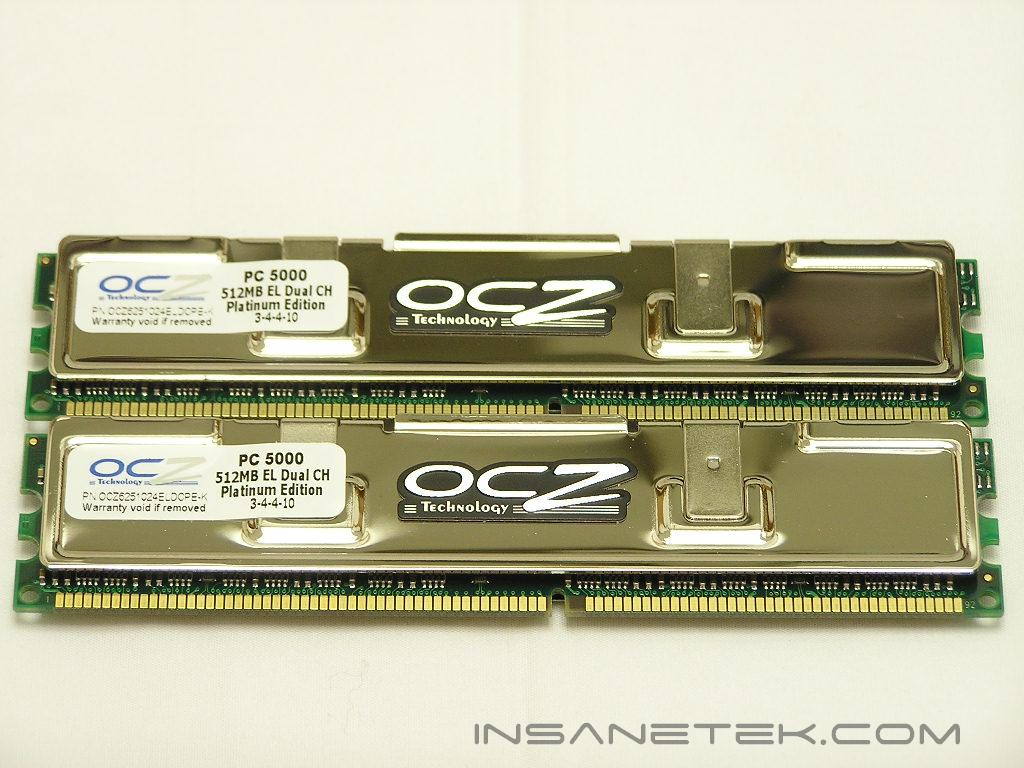
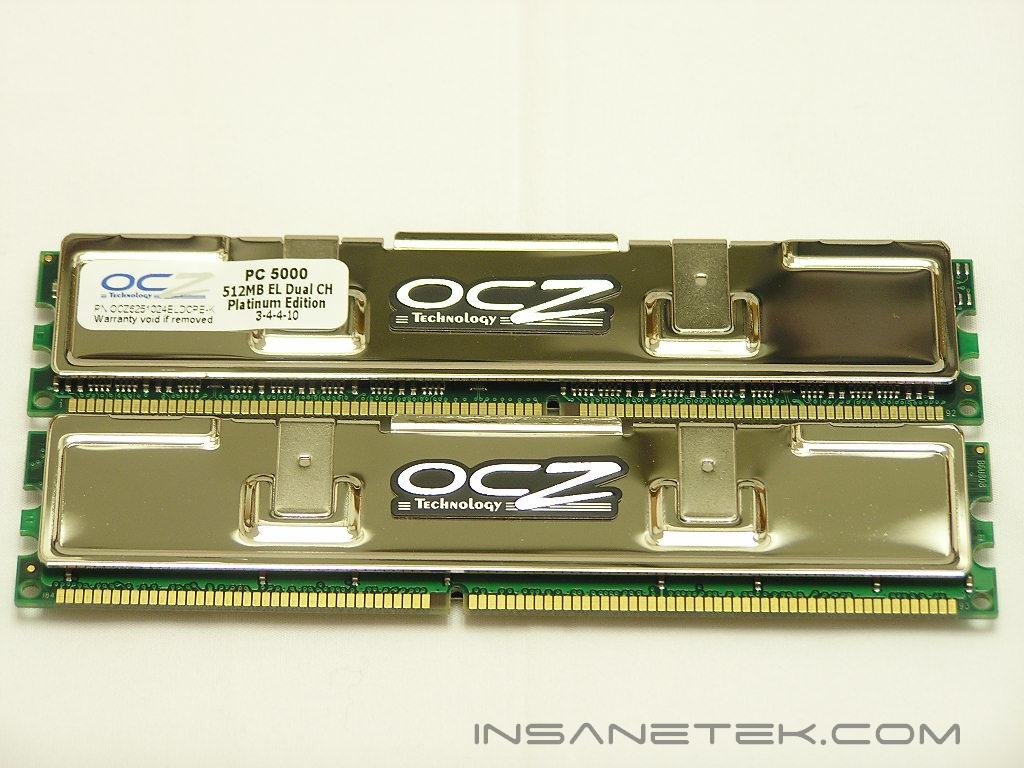
Memory gurus should pose one interesting question. With Samsung TCCD IC’s being discontinued, how is OCZ going to maintain the Platinum TCCD line? Well that question can be answered with yet another Samsung solution–TCC5 chips. That’s right. The TCC5 chips that are mainly used for registered or server memory (or so I’ve been told) have been found and chosen to replace TCCD parts. Don’t look down upon it, though. TCC5 chips are very well capable of performing at extreme levels. I’ve seen some TCC5 chips do over 300HTT easily at 2.5-4-3-7. It just goes to show that TCC5 is not just some cheaper TCCD variation. I peeked underneath the heatspreaders to find TCC5 chips with a week of 516. The PC5000 rating translates to 312.5MHZ, or to round that off, 313MHZ with timings of 3-4-4-10. The voltage rating is at 2.85v, but can withstand 3.0v without invalidating the warranty.
Test System and Overclocking
Test System:
- AMD Athlon 64 3000+ Venice
- DFI LANParty UT nF4 Ultra-D
- 2 x 512MB OCZ Platinum PC5000 DFI nF4 Special
- Nvidia Geforce 6800GT PCI-E
- Cooler Master Real Power 550W
Overclocking:
Keep in mind that during overclocking, the latencies are as follows: CAS-TRCD-TRP-TRAS
To begin with, I found the highest overclock possible. It required 3.0v to maintain stability, so all tests will be conducted with 3.0v. Like I mentioned in the PC4800 review, the PC5000 shouldn’t be wasted on petty slow megahertz below the 300MHZ threshold. Anything below that and you’re just wasting all the great potential of the sticks. This is a man’s man kind of deal. Your system has to be capable of keeping up with such high quality goods. Anyways, I ran the memory at 200HTT 2-2-2-5 just to prove that it’s still good for low latencies, for those who want to spend the money but not overclock. Next step was jumping the gun to 2.5-3-3-7, the latencies that allow Samsung chips to shine. With 3.0v and a huge overclocking headroom, these TCC5 chips soared to 310HTT. For those of you who don’t know what a great accomplishment this is, just know for a fact that reaching 300HTT 2.5-3-3-7 is already pretty impressive. There are people who can achieve this with their TCCD sticks, but you won’t find too many of them. Reaching 300HTT 2.5-4-3-7 is quite common and many can prove their results. But to know that these sticks were able to hit 310HTT with 2.5-3-3-7 is simply astonishing. Furthermore, these aren’t even the “better quality” TCCD chips; they’re TCC5! I immediately told Andy at OCZ, a great fellow overclocker who provides great OCZ technical support, and even he was impressed with the results of these sticks. That must say a lot, don’t you think? Unfortunately, that speed of 310HTT 2.5-3-3-7 was only stable in Memtest. It would boot into Windows fine but wouldn’t finish Super PI. This brings me to another topic (sorry that I’m digressing). What do you consider stable? Both Andy and I have had experiences with memory that would be Memtest error free for hours on end at Test 5 and Test 8, but would crash booting into Windows or failing Super PI. That wouldn’t be considered stable, since it won’t even let you operate normally under Windows. What if Windows is stable, Super PI 32M passes, and gaming hours on end is fine, but Memtest fails miserably? I’ve asked around countless times and no one has been able to really agree on anything.
Sorry, I’ll get back on topic. I backed it down to 290HTT 2.5-3-3-7 and finally got stability. It’s not as astonishing as 310HTT but still very decent, considering it’s lower quality TCC5 chips. I loosened the timings to 2.5-4-4-8 and hit a maximum of 313HTT, reaching the rated speed of these Platinum PC5000 sticks, but with lower latencies. Any looser and the memory would fail to go higher. The memory controller on my Venice isn’t holding me back; it’s able to go well beyond 325HTT with a lowered multiplier.
Overclocking Results:
- 200HTT 2.0-2-2-5 1T 3.0v
- 290HTT 2.5-3-3-7 1T 3.0v
- 313HTT 2.5-4-4-8 1T 3.0v
Results
A series of memory intensive benchmarks will be run to test the performance of our sample. The other tests will be based on common benchmark programs such as 3DMark and PCMark. Real life performance differences will be tested through current games such as Far Cry and UT2004. Memory bandwidth benchmarks will be based off of SiSoft Sandra and Everest Home Edition. Super PI and PiFast will also be used to test memory performance, as the benchmark benefits largely from FSB increases.
Throughout all tests, the CPU multiplier has been kept at 9x.
SiSoft Sandra Memory Bandwidth
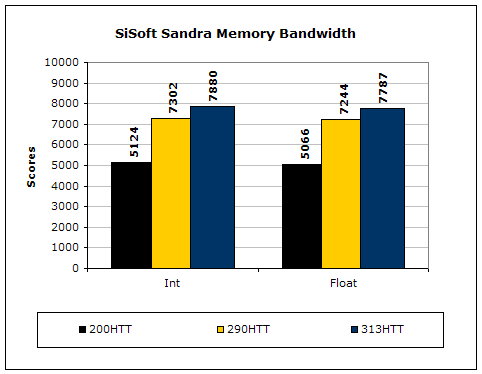
SiSoft Sandra is the most widely used memory bandwidth test. It can tell you the increase in performance from just lowering the latency timings.
Everest Home Edition
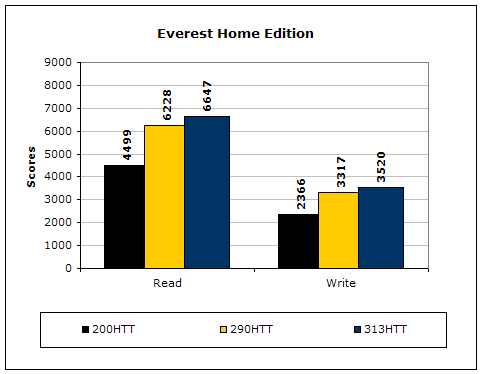
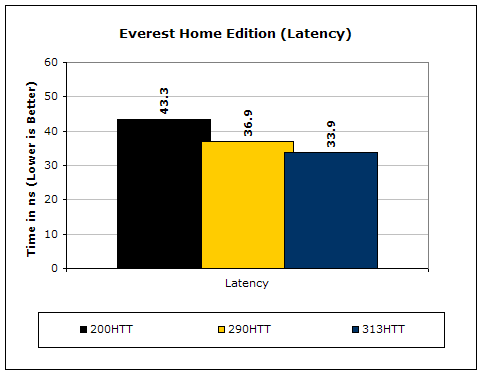
Much like Sandra, Everest Home Edition tests the memory’s ability to read and write data in large chunks. The results show that the lower latencies seem to help just a little with performance.
3DMark2001SE
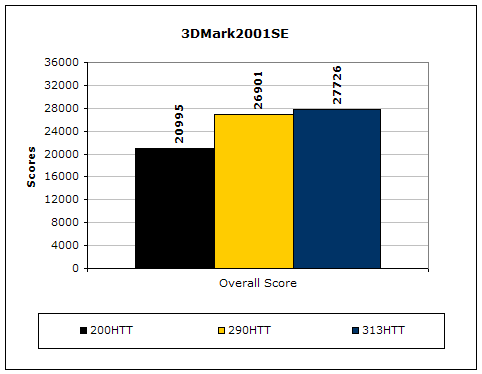
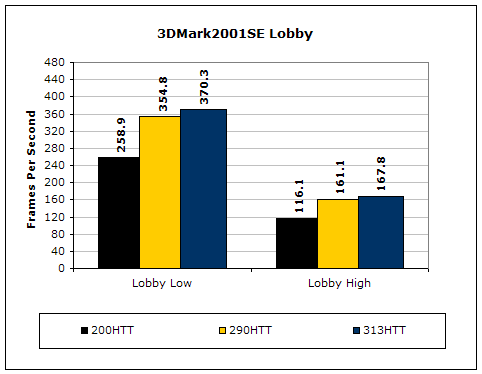
3DMark is probably the overclocker’s favorite benchmark. Unlike 3DMark2003, which stresses mainly the video card, 3DMark2001SE tests all of the system’s main components. Increasing the CPU speed, memory speed, and video card speeds will result in higher results in the final score.
Results Continued
Far Cry
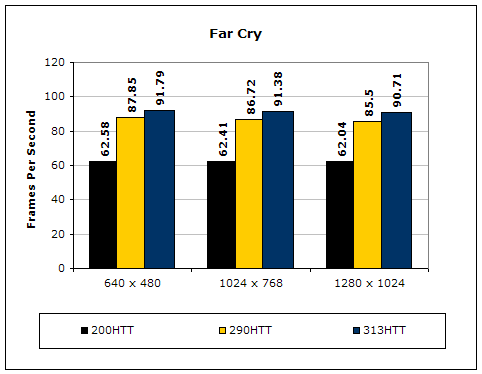
Since Far Cry is a game, the performance results will be very similar to 3dMark2001. I ran the benchmark at 640x480 so the benchmark would not be too GPU dependent. The tests under 1024x768 and 1280x1024 are an approximation of what kind of frames you’ll be getting. While the results are similar to 3dMark2001 in performance, this benchmark will give more significant results because Far Cry is extremely demanding.
Unreal Tournament 2004
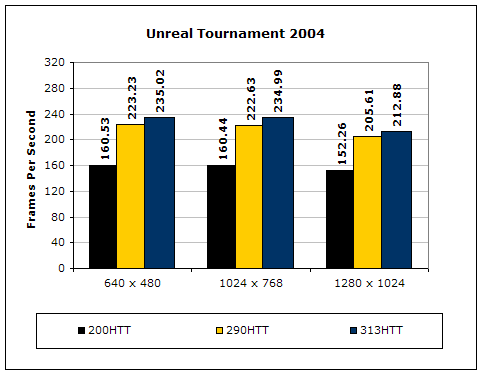
Unreal Tournament is another popular game engine to test overall system performance. Here, we can see the same results as Far Cry and 3dMark2001. Like Far Cry, UT2004 was also run at 640x480 to limit GPU dependency. The other resolutions are to give an approximation of actual gameplay performance.
PCMark2002
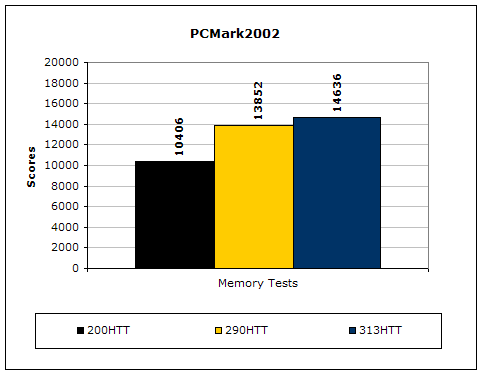
PCMark is another benchmark created by Futuremark. It tests the memory compression and decompression speeds in small to large chunks of data.
Super PI
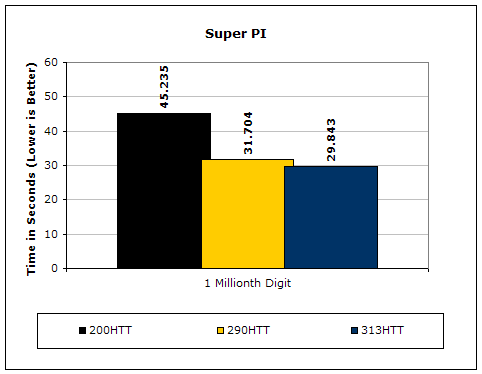
Since the value of PI is an infinite value, Super PI is a speed test to find the digit you’re looking for. In this case, we chose the millionth digit. Super PI benefits greatly from higher FSB as well as low latencies.
PiFast
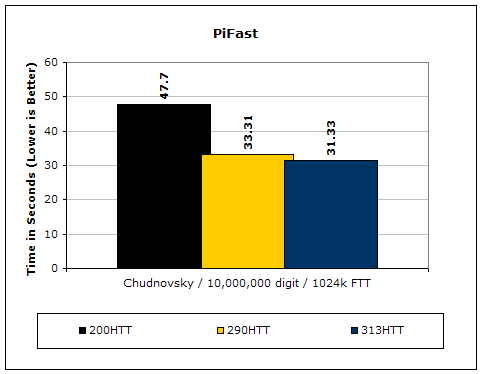
PiFast is similar to Super PI and the results can be greatly affected by a slight adjustment to the memory megahertz and latency.
The results are awesome. It’s the first time I’ve been able to reach lower than 30 seconds in Super PI. w00t w00t!
Conclusion and Thoughts
With the Samsung TCCD hitting EOL (End of Life), OCZ continues their high end Platinum line with TCC5’s as replacements. Note that TCC5 is going to replace TCCD based Platinum memory, which means the regular PC3200 Platinum non-Rev2 probably won’t use it. But for the rest of the Platinum stuff, PC3200 Rev2, PC3700, PC4200, and PC4800, you should be seeing them equipped with TCC5 chips. Is the replacement any good? Definitely yes, because it’s still good stuff.
The Platinum PC5000 DFI nF4 Special is great memory and allows high overclocking headroom. To me, it’s more of a marketing scheme proving real potential. If you do own a DFI nF4 Special and a high clocking CPU with a good memory controller, you should definitely consider these. My personal opinion is that the PC4800 would be a better choice. The PC4800 still overclocks great and provides excellent performance, but is also lower in price. While the PC5000 easily wins the best overclocking results over here at InsaneTek, there are a few concerns in telling everyone to go out and get it. First, the memory is close to maxed out right out of the package. Second, the price is still a little high for these. With DRAM prices at an ultimate low like Bush’s IQ, it’s quite hard to really persuade someone to spend an extra $120 for higher rated stuff. True that your memory overclock will be guaranteed, but I personally can’t find the price to justify it. Lastly, the sample I received required 3.0v. Without the use of a DDR Booster, not many motherboards can provide 3.0v. Of course, end user results will always vary. Yet, from what I’ve experienced with the PC4800 and the PC5000, I find that the PC4800 is a wiser and overall better choice. Still, the Platinum PC5000 deserves a recommendation for a stunning high overclock. My personal bias still leans toward the PC4800. The PC4800 is number one in my book, with the PC5000 at a close second.
Pros:
- Beautiful mirror platinum finish
- Overclocks extremely well
- Runs better than specified timings
- Extreme performance
- Guaranteed to run 313MHZ…but only with DFI
Cons:
- Needed 3.0v
- Premium price
- PC4800 still an overall better choice…in terms of price/performance
- Guaranteed to run 313MHZ…but only with DFI

We would like to thank OCZ for providing us the sample. If you have any questions or comments, feel free to hit us up in the forums. You can also check out more of our latest reviews on the front page.