

OCZ Platinum PC2-6400 EB 1GB Dual Channel Kit
Introduction
OCZ has been a bit quiet in the DDR2 department lately. Their DDR2 Gold series is gaining popularity, but the lack of low latencies for hardcore enthusiasts has been causing OCZ to lose their DDR2 reputation to their competitors. This can be due to the fact that Micron fatbody D9s are a little hard to come by. Corsair seems to have a big load of them and Mushkin is keeping up with stock here and there. OCZ, however, has been out of the loop. I guess it cannot really be considered an extremely bad thing since the DDR2 demand has yet to reach the peak, but Intel users who are also OCZ fans are left out in the dark. Fortunately for us, OCZ works hard to keep us pleased and now they are back and ready to attack full on with their Platinum DDR2 memory.
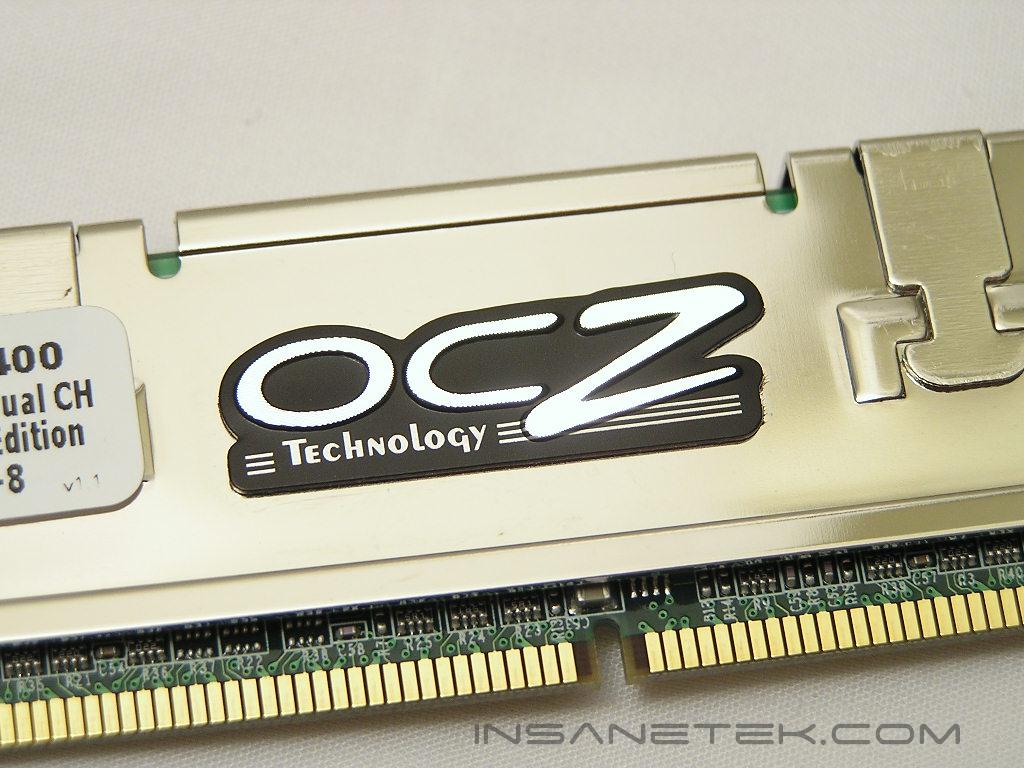
OCZ Platinum PC2-6400
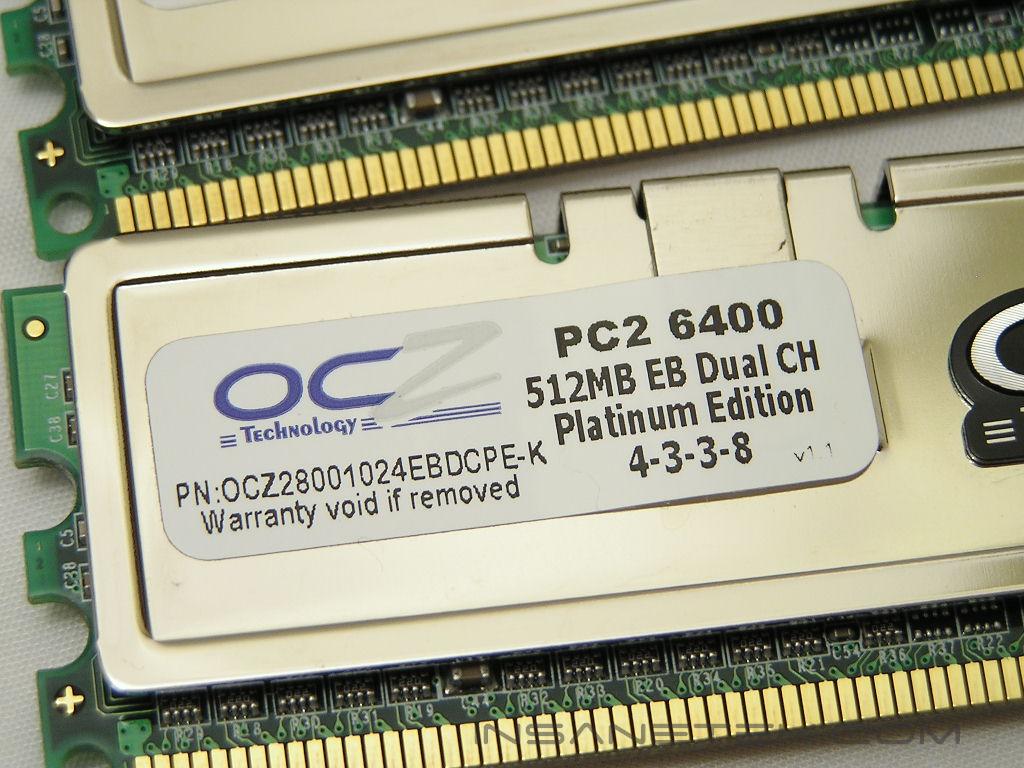
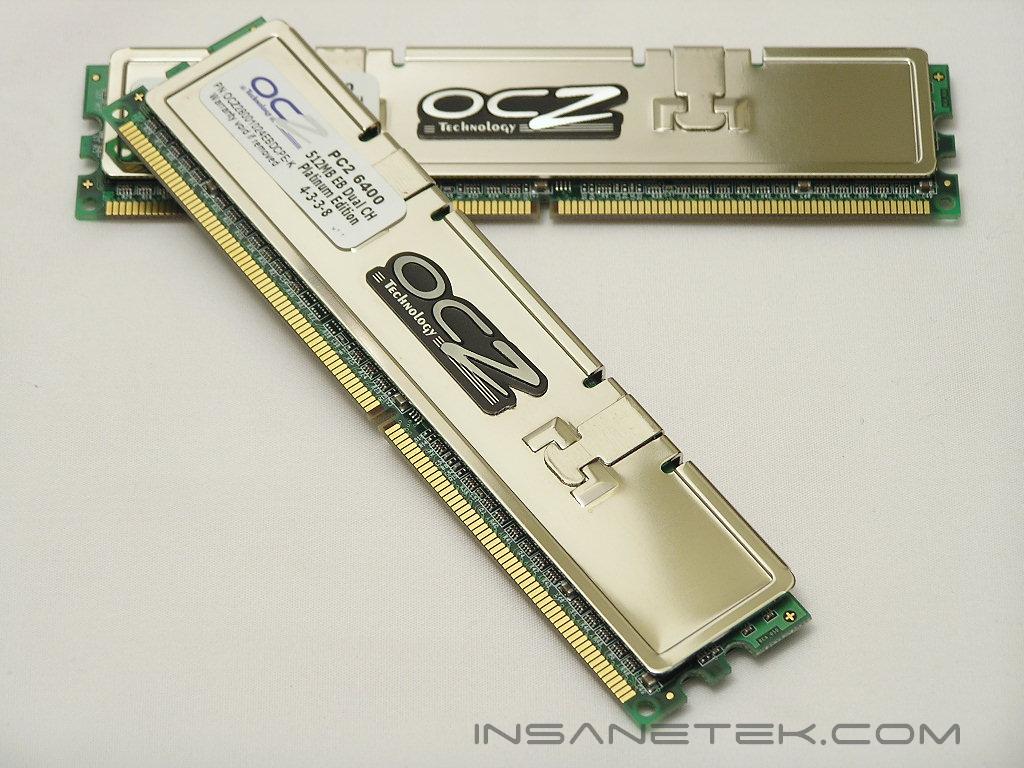
It is obvious that the Platinum PC2-6400 comes in shiny copper heatspreaders with a platinum mirror finish. I just love how these things look. They look absolutely fantastic. Platinum all the way!
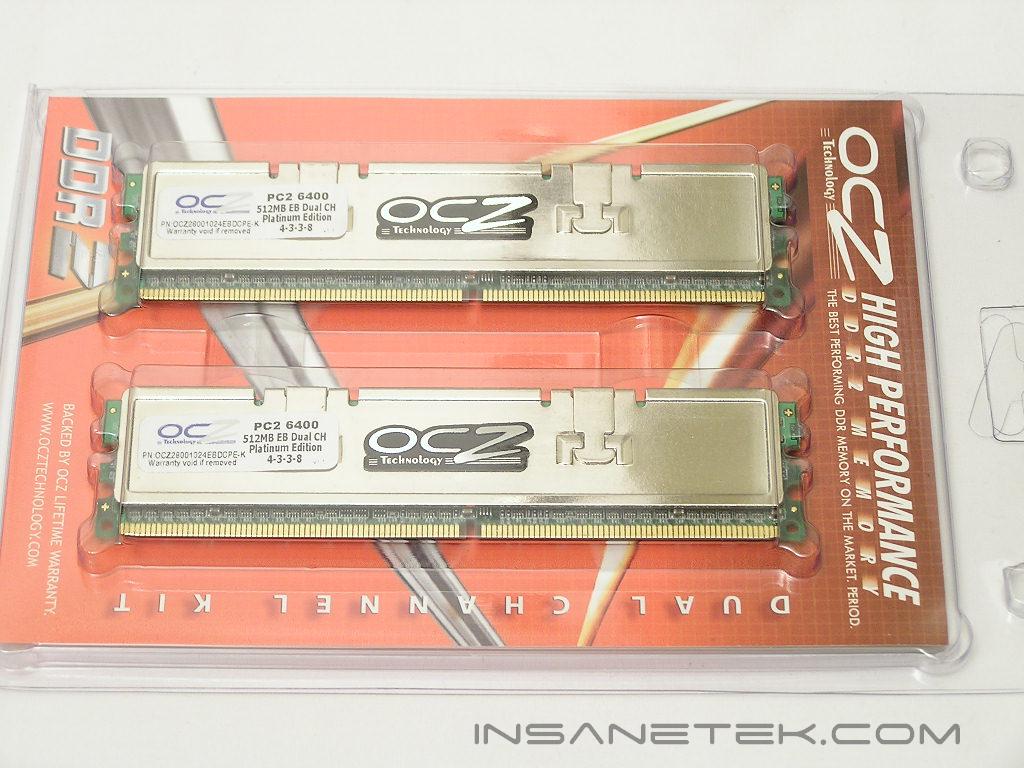
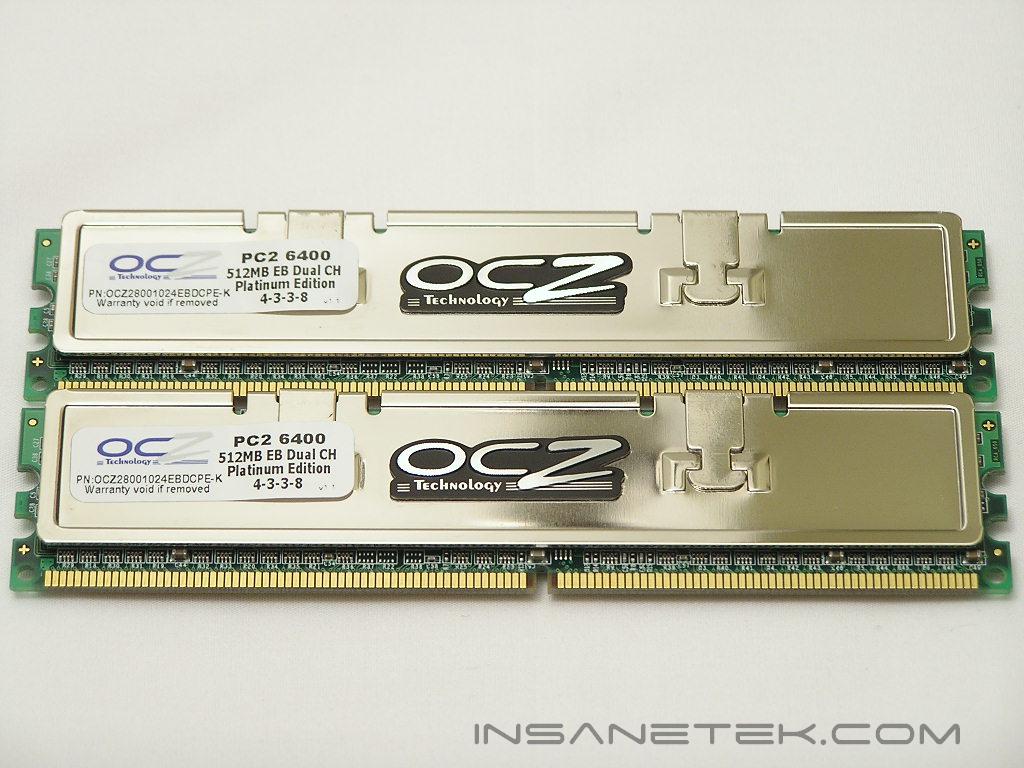
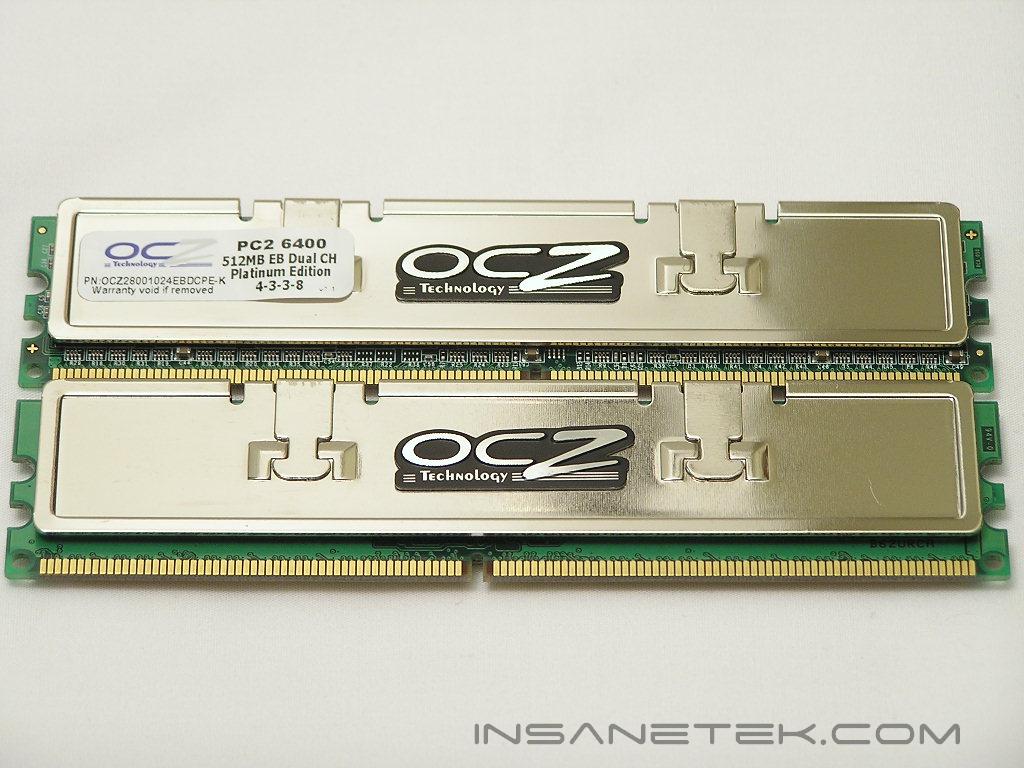
This particular memory is classified under the Platinum series due to the low latencies. The Gold PC2-6400 comes with timings of 5-5-5-10 while this Platinum comes with much tighter timings of 4-3-3-8. The specified voltage requirement to run at a speed of 400MHz, or DDR2-800, with these low latencies is 2.1v. The ICs used for the Platinum PC2-6400 is none other than the powerful Micron fatbody D9s. I did not lift up the heatspreaders to check for the exact stepping of the D9s since I made a big boo boo in the past and I have learned from my careless ways.
Test System and Overclocking
Test System:
- Intel Pentium D 840 3.2GHz
- Asus P5WD2 Premium
- 2 x 512MB OCZ Platinum PC2-6400
- ATI Radeon X800XT
- Arctic Freezer 7
- SilverStone ST65ZF
Overclocking:
Keep in mind that during overclocking, the latencies are as follows: CAS-TRCD-TRP-TRAS
Throughout all tests, the multiplier has been kept at 14x to reduce any possible CPU bottleneck.
Since the memory comes with Micron fatbody D9s that respond well to increased voltages, I maxed out the VDIMM to 2.3v for all tests, the highest the majority of good overclocking motherboards would allow. Although the Platinum PC2-6400 is rated to run timings of 4-3-3-8, I had no doubts that it would do low latencies at lower speeds. To begin the testing, I started off with 266MHz, the stock memory frequency when FSB is set at 200MHz. Timings were tightened to 3-2-2-5. Sure enough the memory ran like a champ. In fact, the timings held up all the way to 340MHz, or DDR2-680. I loosened the timings to 4-2-2-8 in hopes to gain some more megahertz, but the memory only allowed an additional 5MHz to 345MHz. I then reverted the CAS latency back to 3 and loosened the TRCD to 3. This set of latencies did not help the overclocking results at all. I loosened to 4-3-2-8 and proceeded to hit a maximum of 460MHz, or DDR2-920. This means that with the rated speed of 400MHz, the memory can operate with slightly tighter timings. I loosened TRP to 3, resulting with timings of 4-3-3-8, and received no additional speed increase. I let loose the timings to 5-3-3-9 and was able to hit the ceiling of 496MHz, or DDR2-992. It was so close and yet so far from the 1GHz barrier.
Overclocking Results:
- 200FSB 3:4 266MHz 3-2-2-5 2.3v
- 204FSB 3:5 340MHz 3-2-2-5 2.3v
- 207FSB 3:5 345MHz 4-2-2-8 2.3v
- 230FSB 1:2 460MHz 4-3-2-8 2.3v
- 248FSB 1:2 496MHz 5-3-3-9 2.3v
Results
A series of memory intensive benchmarks will be run to test the performance of our sample. The other tests will be based on common benchmark programs, such as 3DMark and PCMark. Real life performance differences will be tested through current games, such as Far Cry and UT2004. Memory bandwidth benchmarks will be based off of SiSoft Sandra and Everest Home Edition. Super PI and PiFast will also be used to test memory performance, as the benchmark benefits largely from FSB increases.
SiSoft Sandra Memory Bandwidth
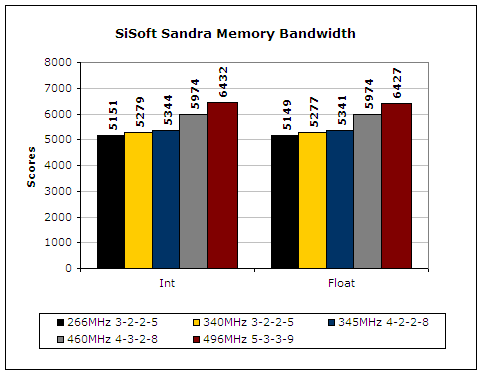
SiSoft Sandra is the most widely used memory bandwidth test. It can tell you the increase in performance from just lowering the latency timings.
Everest Home Edition
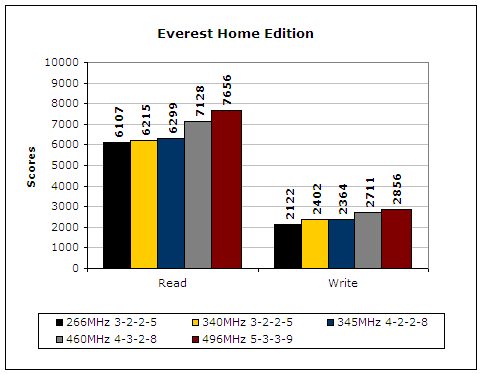
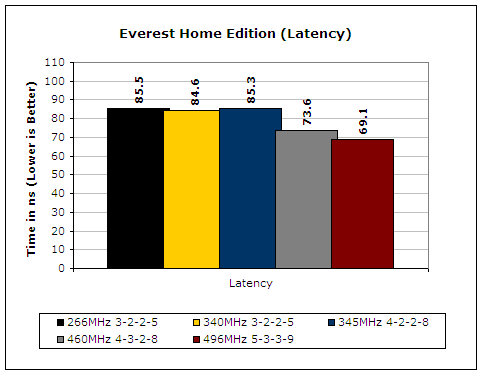
Much like Sandra, Everest Home Edition tests the memory’s ability to read and write data in large chunks. The results show that the lower latencies seem to help just a little with performance.
3DMark2001SE
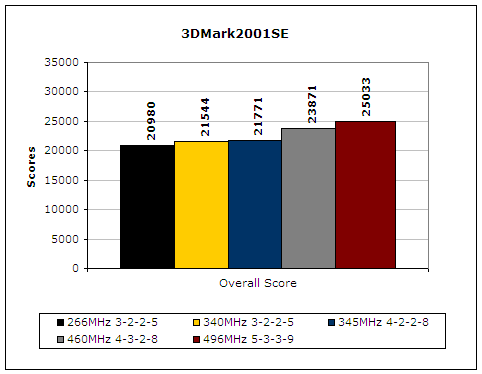
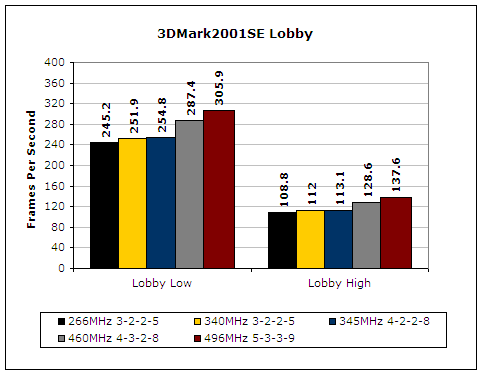
3DMark is likely the overclocker’s favorite benchmark. Unlike 3DMark2003, which stresses mainly the video card, 3DMark2001SE tests all of the system’s main components. Increasing the CPU speed, memory speed, and video card speeds will result in higher results in the final score.
Results Continued
Far Cry
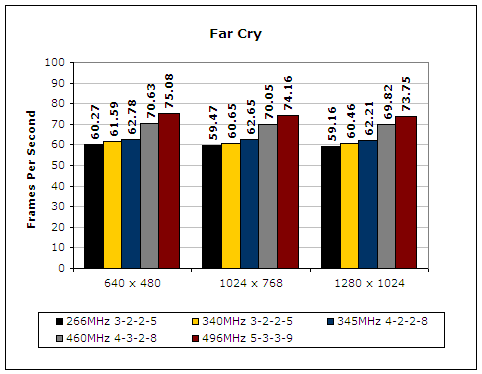
Since Far Cry is a game, the performance results will be very similar to 3dMark2001. I ran the benchmark at 640x480, so the benchmark would not be too GPU dependent. The tests under 1024x768 and 1280x1024 are an approximation of what kind of frames you’ll be getting. While the results are similar to 3dMark2001 in performance, this benchmark will give more significant results, because Far Cry is extremely demanding.
Unreal Tournament 2004
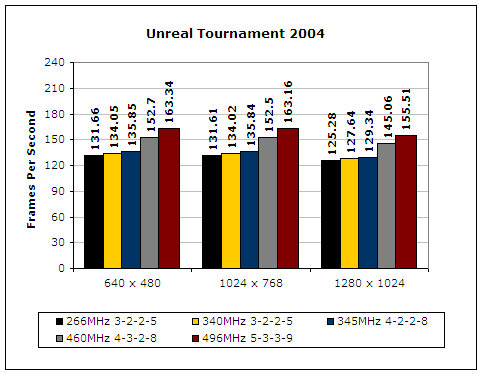
Unreal Tournament is another popular game engine to test overall system performance. Here, we can see the same results as Far Cry and 3dMark2001. Like Far Cry, UT2004 was also run at 640x480 to limit GPU dependency. The other resolutions provide an approximation of actual gameplay performance.
PCMark2002
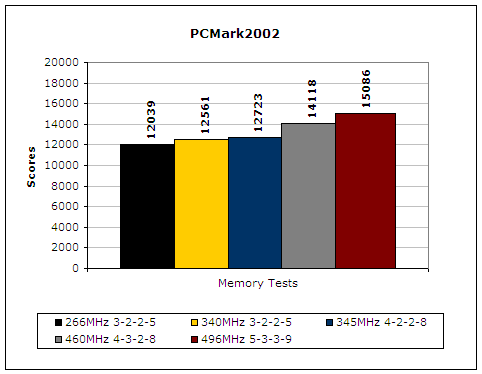
PCMark is another benchmark created by Futuremark. It tests the memory compression and decompression speeds in small to large chunks of data.
Super PI
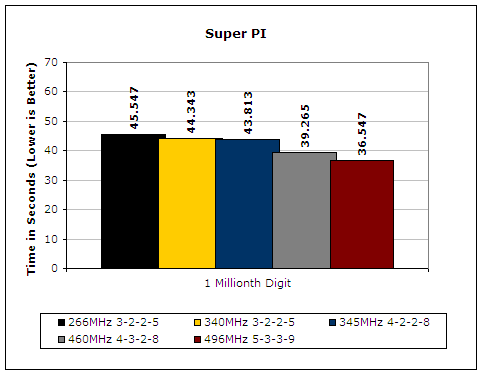
Since the value of PI is an infinite value, Super PI is a speed test to find the digit you’re looking for. In this case, we chose the millionth digit. Super PI benefits greatly from higher FSB, as well as low latencies.
PiFast
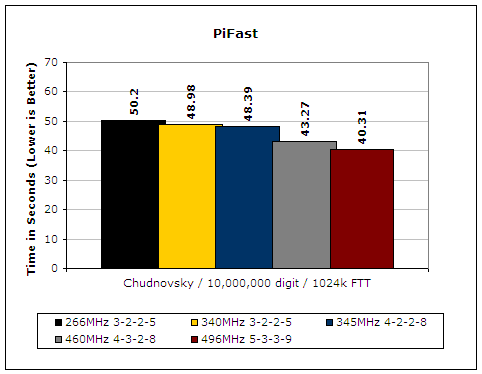
PiFast is similar to Super PI. The results can be greatly affected by a slight adjustment to the memory megahertz and latency.
Conclusion and Thoughts
OCZ has finally provided some competitive DDR2 solutions that can run low latencies while overclocking to high speeds. The Platinum PC2-6400 comes with good overclocking headroom and provides some great performance, but unfortunately it did not break the 1GHz barrier. This is most likely due to the model of the fatbody D9s that were used. If you can recall from the Patriot PC2-5600 review, the stepping of the fatbody D9s does matter. OCZ fans who are currently running Intel platforms finally have something to be happy about. From past experiences, Corsair has better DDR2 solutions in terms of highest overclocking headroom. The PC2-8000UL is still currently the reigning champ here at InsaneTek and the PC2-5400UL follows closely behind. OCZ will have to work a little harder in order to beat out Corsair’s 1GHz-barrier-breakers. I love the Platinum PC2-6400, but personally, I know OCZ can do much better. I am just anticipating their mass production of the Platinum PC2-8000 part.
Pros:
- Beautiful platinum finish copper heatspreaders
- Decent price
- Overclocking results are good
Cons:
- Nothing really
- Couldn’t break the 1GHz barrier (and I’m nitpicking here)

We would like to thank OCZ for providing us the sample. If you have any questions or comments, feel free to hit us up in the forums. You can also check out more of our latest reviews on the front page.