

OCZ Gold PC3500 GX 1GB Dual Channel Kit
Introduction
It’s only recently that OCZ started to target their memory for different users. With the Platinum and Gold lines, the focus was on overclocking. The Platinum pushed for low latency, while the Gold aimed for high memory speeds. That has been changed now. OCZ realizes the importance in including gamers as a main target group and is now pushing their Gold memory to gamers. The Platinum now focuses purely on hardware enthusiasts, like overclockers, and the Titanium pushes for mission critical systems that need reliable memory.
One important aspect of the OCZ Gold memory is the low price tag. Not every gamer can afford top of the line computer hardware. With so many gamers in the world, good memory is necessary to keep frames high and systems lag free. Additionally, not every gamer is an overclocker. This means that not every gamer would even attempt to overclock. Gamers are most likely to plug in the memory and start fragging. The new OCZ Gold PC3500 GX, which stands for Gamer eXtreme, is the memory gamers need. It provides low latency operations for gamers who need cutting edge performance and provides a little headroom for gamers that overclock.
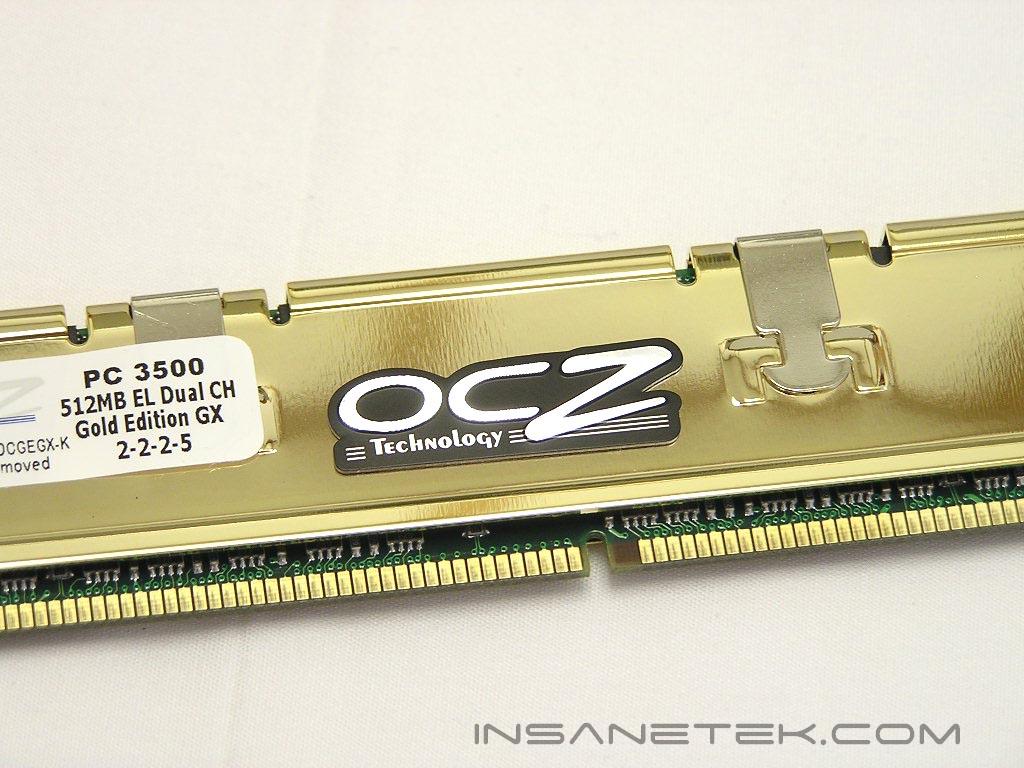
OCZ Gold PC3500 GX
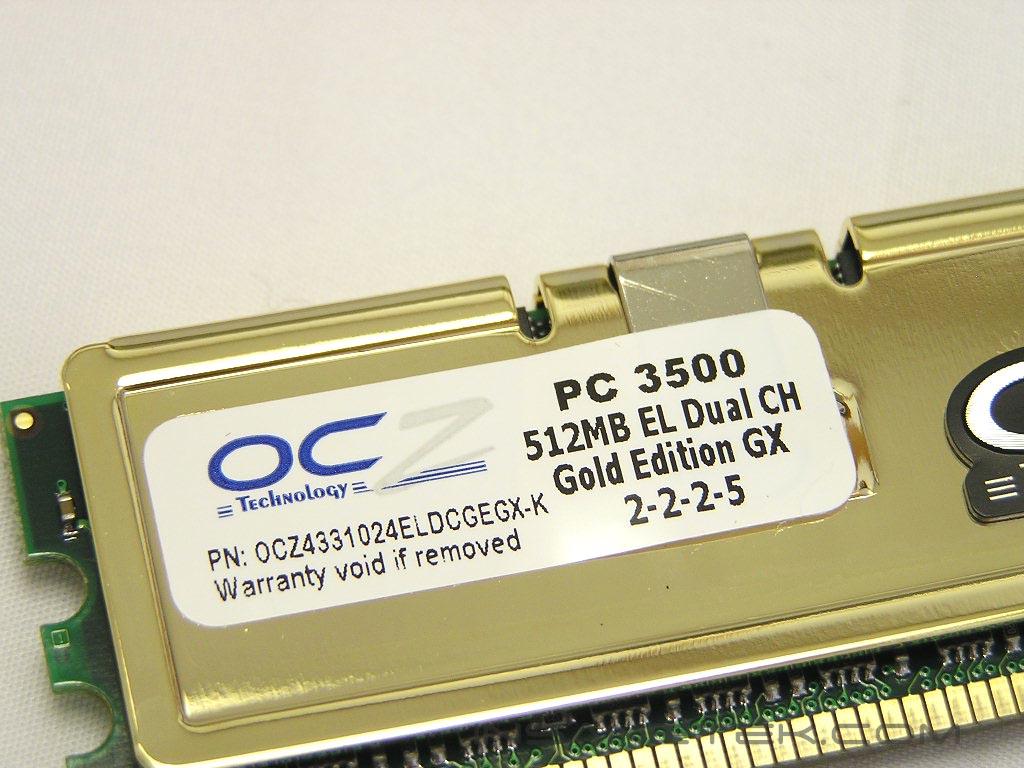
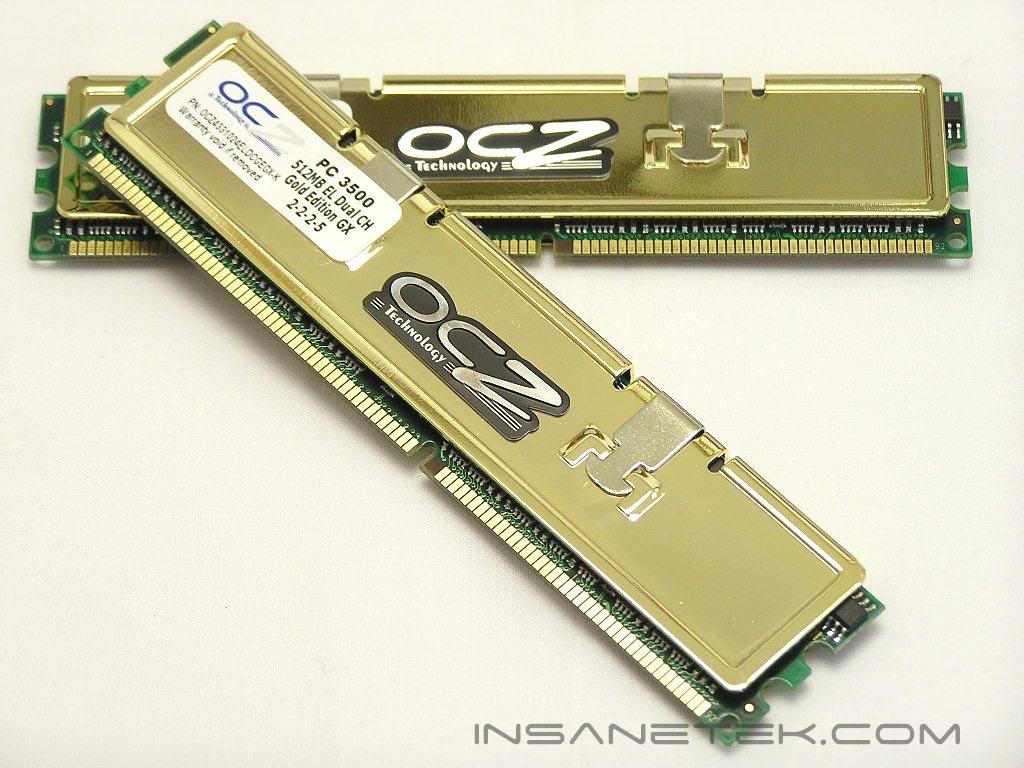
As usual, the PC3500 GX came in OCZ’s signature orange packaging. The Gold PC3500 GX uses copper heatspreaders with a gold mirror finish, of course. The unusual thing is that the heatspreaders are the same ones found on the Titanium PC3200. I actually like these heatspreaders more. They’re a little more curvy and provide a better cover.
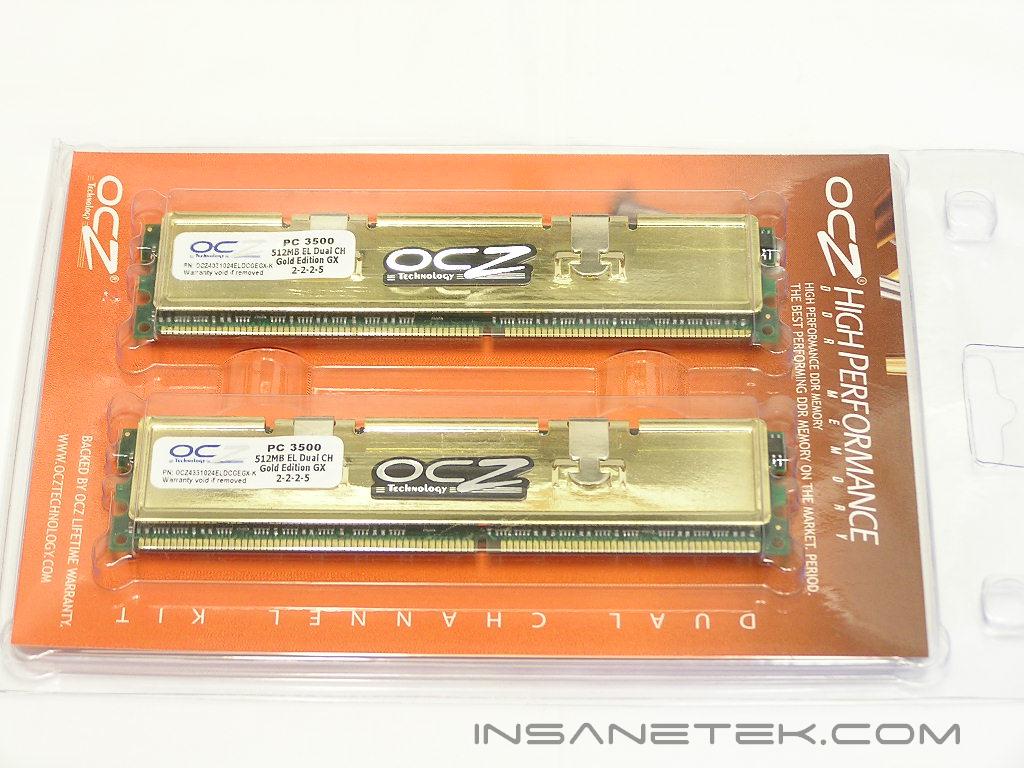
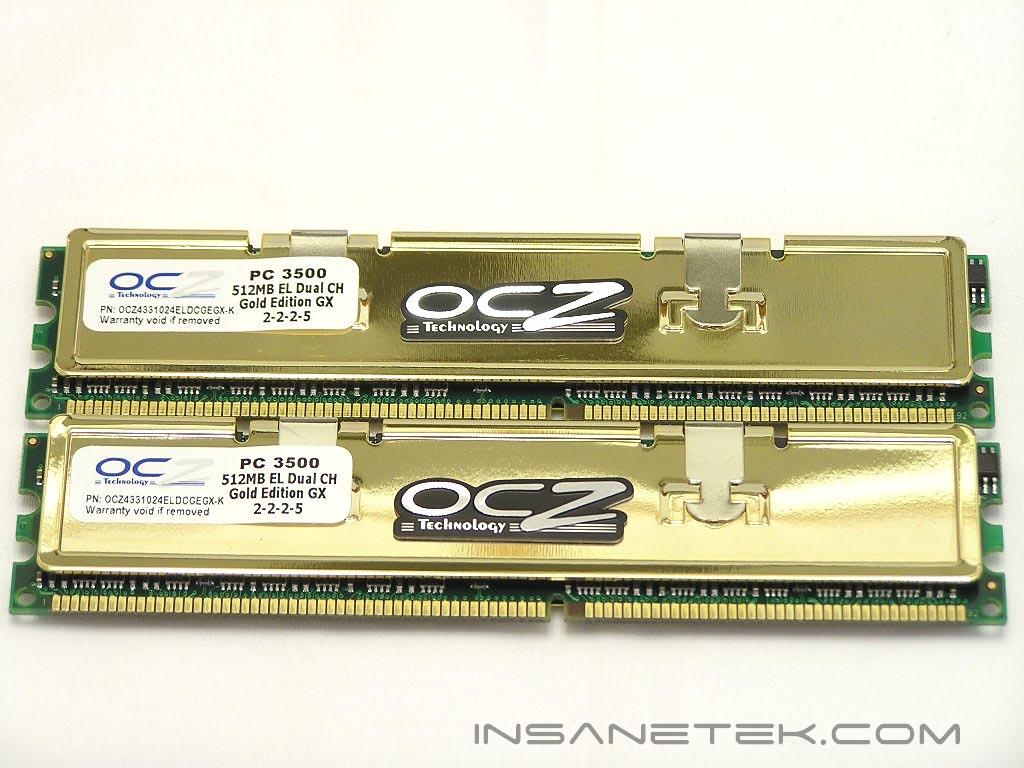
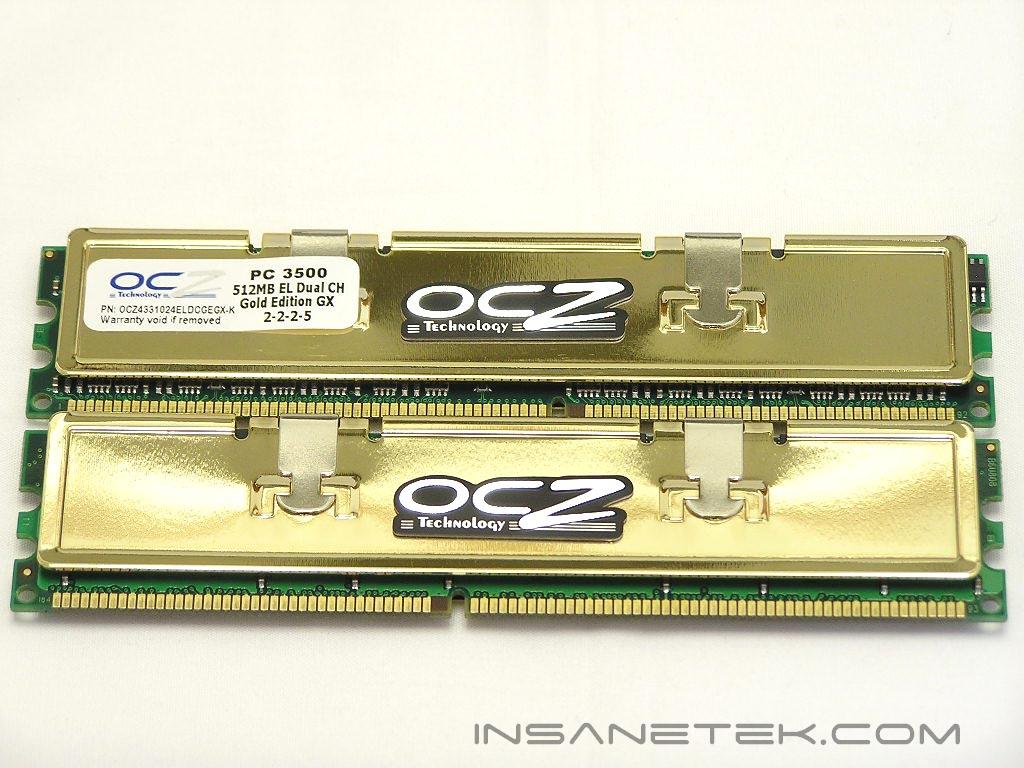
The Gold PC3500 GX is rated for operations of 217MHZ with timings of 2-2-2-5 at 2.8v. The low voltage rating is outstanding, because not many motherboards provide voltages beyond 2.8v. Rather than just 200MHZ, the memory can push 217MHZ, providing gamers additional headroom. A close inspection of the PC3500 GX reveals Winbond UTT IC’s. It’s the only available solution that runs low latencies with a low price tag. Surprisingly, the PC3500 GX only warrants users up to 3.1v. We all know Winbond UTT is capable of handling more voltage, but this is OCZ’s way of playing it safe when it comes to gamers who don’t know what they’re doing in the BIOS.
Test System and Overclocking
Test System:
- AMD Athlon 64 3000+ Venice
- DFI LANParty UT nF4 Ultra-D
- 2 x 512MB OCZ Gold PC3500 GX
- Sapphire Radeon X800
- Arctic Freezer 64
- Thermaltake PurePower 680W
Overclocking:
Keep in mind that during overclocking, the latencies are as follows: CAS-TRCD-TRP-TRAS
Throughout all tests, the multiplier has been kept at 9x. BIOS is flashed to the 510-2 and yellow DIMM slots were used.
One thing to keep in mind with the PC3500 GX is that it is not designed to be an awesome overclocker. These are speed binned to run at 217MHZ 2-2-2-5 with just 2.8v. Not all Winbond UTT can run that speed and timings with just 2.8v. I’m sure that all you hardware enthusiasts are very familiar with the process of speed binning. There are two different kinds of speed binning. The first and most well known is the process of finding the fastest memory frequency possible, i.e., the OCZ Platinum PC5000. The other kind is looking for the lowest latencies at the lowest voltage requirement. The Gold PC3500 GX is the result of the second type of speed binning process.
Since Winbond UTT IC’s are used, the memory latencies during the overclocking process will be kept at 2-2-2-5. I began the initial test at 200HTT and set out to find the lowest voltage needed. I was pleasantly surprised that the memory only needed 2.5v for standard PC3200 operations. The next stop was to find the voltage requirement for the rated speeds and timings. 2.8v turned out to be the required voltage. I kept the voltage at 2.8v and proceeded to find the maximum overclock that the memory would allow. It only pushed a measly 3MHZ more to 220HTT.
Because we know that the PC3500 GX uses Winbond UTT IC’s and that the IC’s love voltage, it’s time to really push things with increased voltages. With 3.0v, I managed to obtain an extra 15MHZ out of the memory, stopping at 235HTT. I upped the voltage a bit more to 3.2v and only gained 5MHZ to reach 240HTT. I was quite surprised that pumping 0.2v more would only yield a mere 5MHZ. Going even further to 3.4v allowed the memory to shine again. It reached 255HTT without a hiccup and allowed smooth operation of all benchmarks and memory stress testing. Since the DFI nF4 Ultra-D allows up to 4.0v, I pushed even more to 3.5v and received another 5MHZ, reaching the ceiling at 260HTT. Increasing voltages did not provide any additional help.
Overclocking Results:
- 200HTT 2.0-2-2-5 1T 2.5v
- 217HTT 2.0-2-2-5 1T 2.8v
- 220HTT 2.0-2-2-5 1T 2.8v
- 235HTT 2.0-2-2-5 1T 3.0v
- 240HTT 2.0-2-2-5 1T 3.2v
- 255HTT 2.0-2-2-5 1T 3.4v
- 260HTT 2.0-2-2-5 1T 3.5v
Results
A series of memory intensive benchmarks will be run to test the performance of our sample. The other tests will be based on common benchmark programs, such as 3DMark and PCMark. Real life performance differences will be tested through current games, such as Far Cry and UT2004. Memory bandwidth benchmarks will be based off of SiSoft Sandra and Everest Home Edition. Super PI and PiFast will also be used to test memory performance, as the benchmark benefits largely from FSB increases.
SiSoft Sandra Memory Bandwidth
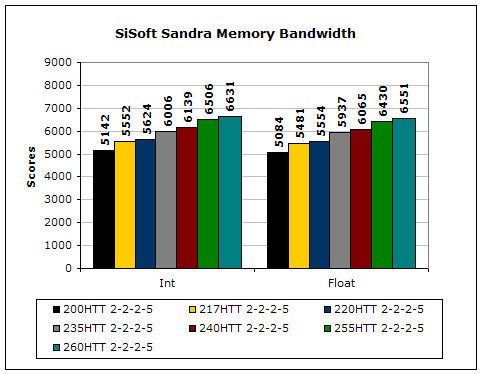
SiSoft Sandra is the most widely used memory bandwidth test. It can tell you the increase in performance from just lowering the latency timings.
Everest Home Edition
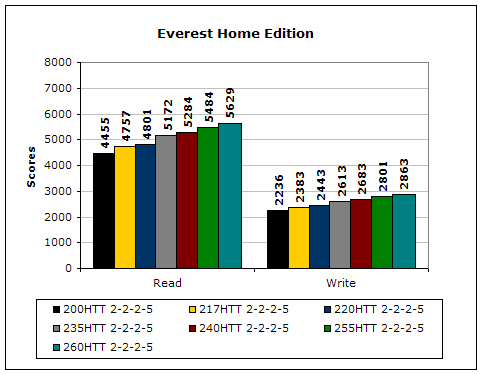
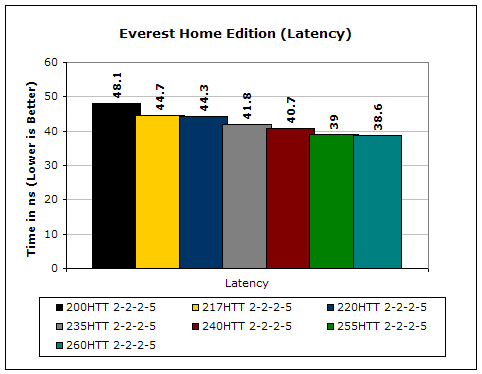
Much like Sandra, Everest Home Edition tests the memory’s ability to read and write data in large chunks. The results show that the lower latencies seem to help just a little with performance.
3DMark2001SE
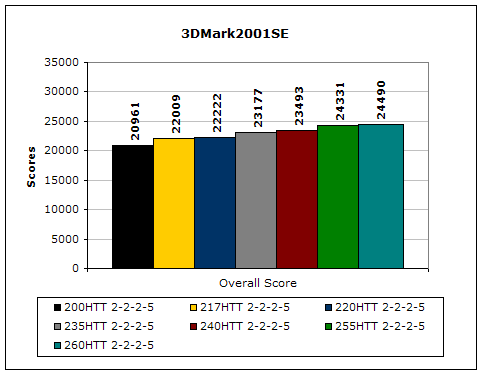
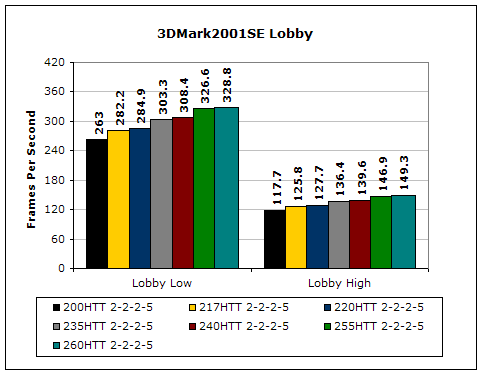
3DMark is likely the overclocker’s favorite benchmark. Unlike 3DMark2003, which stresses mainly the video card, 3DMark2001SE tests all of the system’s main components. Increasing the CPU speed, memory speed, and video card speeds will result in higher results in the final score.
Results Continued
Far Cry
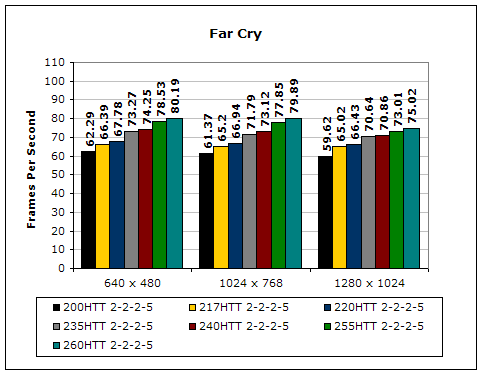
Since Far Cry is a game, the performance results will be very similar to 3dMark2001. I ran the benchmark at 640x480, so the benchmark would not be too GPU dependent. The tests under 1024x768 and 1280x1024 are an approximation of what kind of frames you’ll be getting. While the results are similar to 3dMark2001 in performance, this benchmark will give more significant results, because Far Cry is extremely demanding.
Unreal Tournament 2004
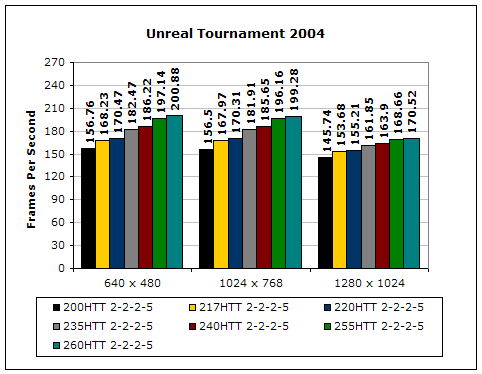
Unreal Tournament is another popular game engine to test overall system performance. Here, we can see the same results as Far Cry and 3dMark2001. Like Far Cry, UT2004 was also run at 640x480 to limit GPU dependency. The other resolutions provide an approximation of actual gameplay performance.
PCMark2002
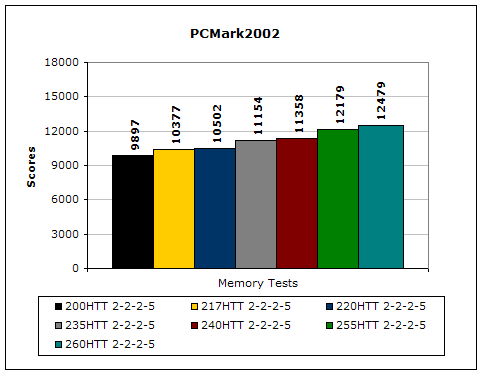
PCMark is another benchmark created by Futuremark. It tests the memory compression and decompression speeds in small to large chunks of data.
Super PI
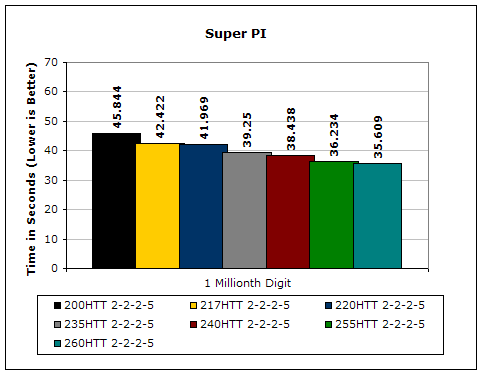
Since the value of PI is an infinite value, Super PI is a speed test to find the digit you’re looking for. In this case, we chose the millionth digit. Super PI benefits greatly from higher FSB, as well as low latencies.
PiFast
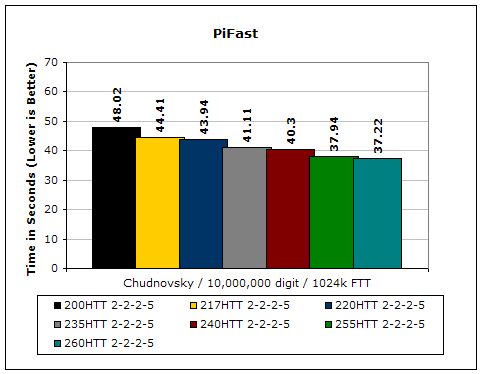
PiFast is similar to Super PI. The results can be greatly affected by a slight adjustment to the memory megahertz and latency.
Conclusion and Thoughts
OCZ’s targeting of gamers with the Gold PC3500 GX has succeeded. The memory allows low latency operations at 2.5v! That’s extremely appealing for gamers who don’t overclock. For the gamers who aren’t scared to take the risk, the memory allows a little headroom while maintaining a low 2.8v. For the gamers who push the limits, be glad to know that it’ll take you quite far. The PC3500 GX isn’t designed and dedicated for the extreme overclocks, but it was still capable of reaching high levels of performance. The performance results of the PC3500 GX compare seeing a dollar bill on the ground, but as you reach to pick it up, you find that it’s actually a ten dollar bill. It’s awesome stuff. At a price point of just $180, the memory is very affordable and won’t create a black hole in your wallet. Note that it’s priced similarly as the Mushkin Redline XP3500, which also uses Winbond UTT IC’s. Either choice would be great, but I’m already loving my PC3500 GX. It pairs very well with my DFI nF4 Ultra-D motherboard.
Pros:
- Gold mirror finish copper heatspreaders
- Low voltage requirements to run 217MHZ 2-2-2-5
- Low voltage needed for just 200MHZ 2-2-2-5
- Has great headroom for overclocking
Cons:
- Nothing really…

We would like to thank OCZ for providing us the sample. If you have any questions or comments, feel free to hit us up in the forums. You can also check out more of our latest reviews on the front page.