

OCZ Gold PC3200 1GB Dual Channel Kit
Introduction
Is it just me, or is OCZ always releasing some crazy overclocking memory? I remember when they announced the Gold PC3200 VX and everyone went nuts trying to figure out what chips were used. I had an idea that it would be Winbond, but since Winbond officially announced they were leaving the DRAM market, I threw that guess out the window. It turned out that Winbond chips really were used underneath those shiny gold heatspreaders. Although the Gold PC3200 VX is rated to run 2-3-3-8 with 2.6v, many overclockers have found that it was able to scale rather nicely with increased voltage. With the DFI Ultra-D motherboard, many have pumped as much as 3.6v into those sticks and hit beyond 250MHZ. What’s really interesting is that the die inside the IC’s are based on the same processing as the old CH5 chips. These new ones are called Winbond UTT CH5. We know that the Gold VX are great overclockers if you can supply the voltage, so what’s the point of the new release of the Gold PC3200?
The newly released Gold PC3200 also features Winbond chips and is rated at a low 2-2-2-5 at 200MHZ. The difference between the VX and the non-VX is the kind of Winbond chips used. These sticks feature the new BH5 chips, called Winbond UTT BH5. One reason why OCZ recommended 3.2v on the VX to run timings of 2-2-2 is because CH5 chips needed higher voltage than BH5’s to achieve the same results. These new BH5’s don’t actually need as much voltage just to run low latencies, but we all know that Winbond chips just love high voltage. Equipped with the high voltage pumping DFI Ultra-D, these pretty OCZ Gold PC3200 sticks will go through one wild rollercoaster ride.
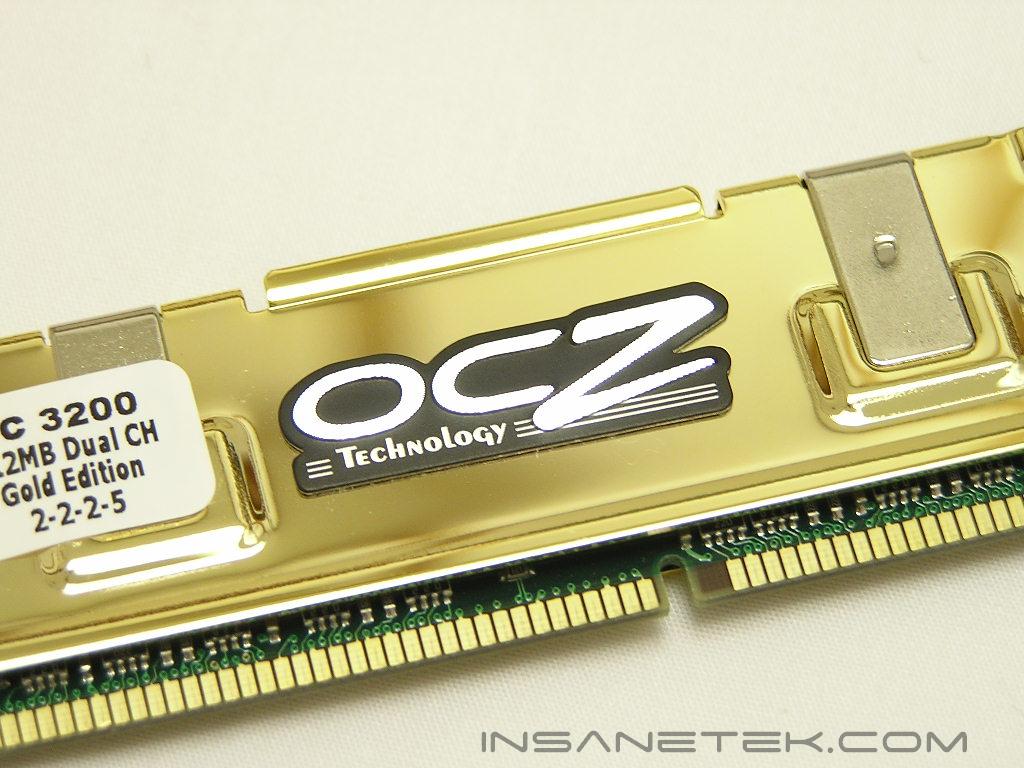
OCZ Gold PC3200
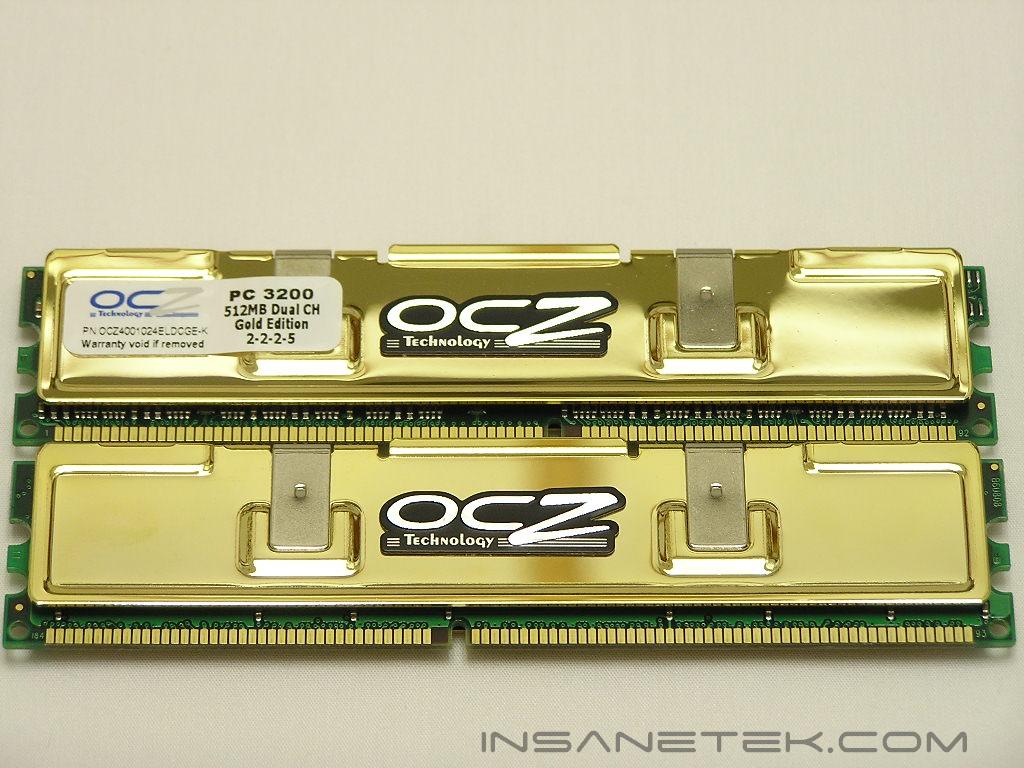
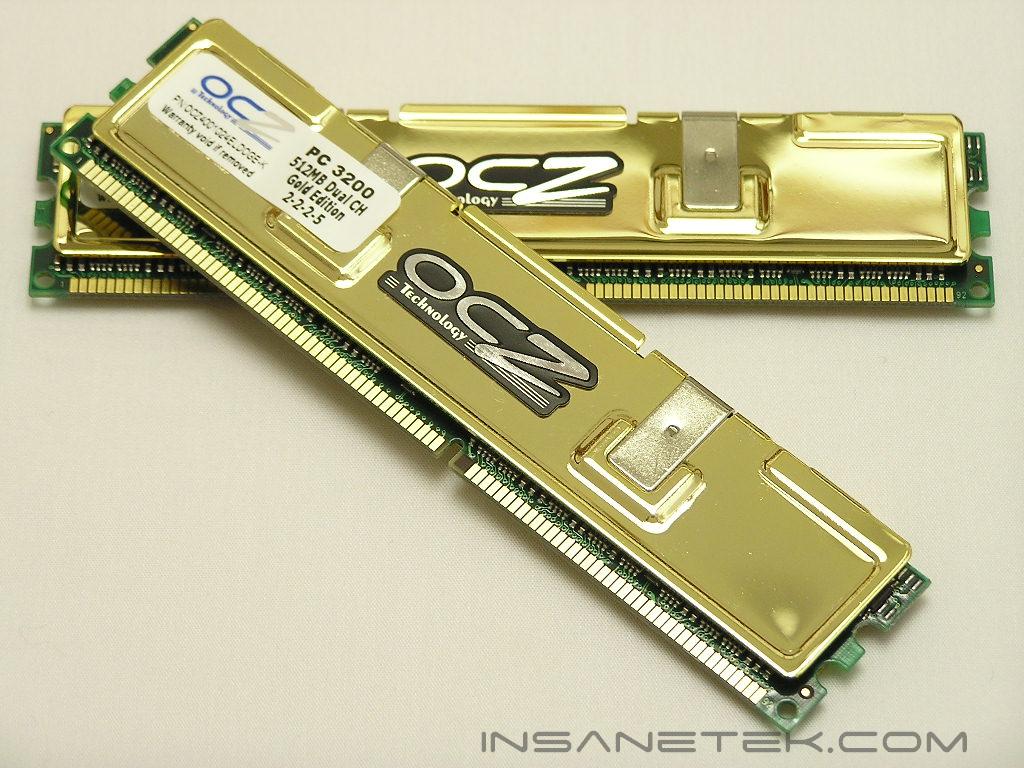
As mentioned earlier, the OCZ Gold PC3200 is NOT the same as the OCZ Gold PC3200 VX. Please don’t get it confused. I’ll mention this again–the VX uses Winbond UTT CH5 while the non-VX uses Winbond UTT BH5. The memory is rated to run 200MHZ with latencies of 2-2-2-5 at 2.8v. That’s certainly not too shabby right? The majority of the motherboards out there provide at least 2.8v to VDIMM.
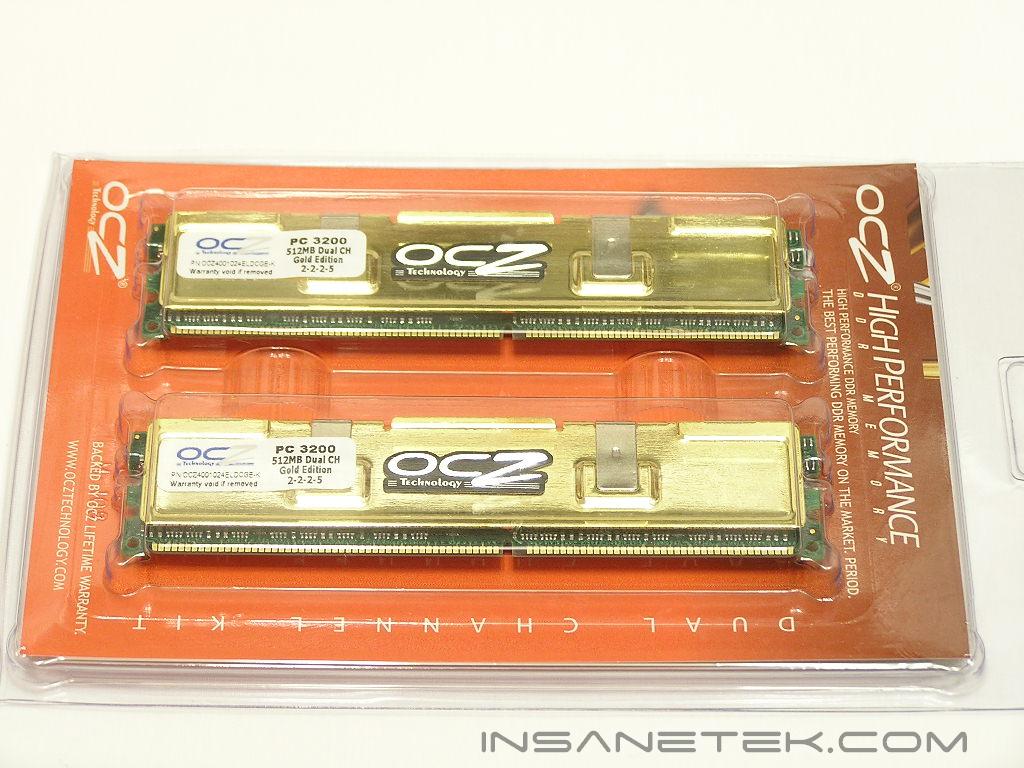
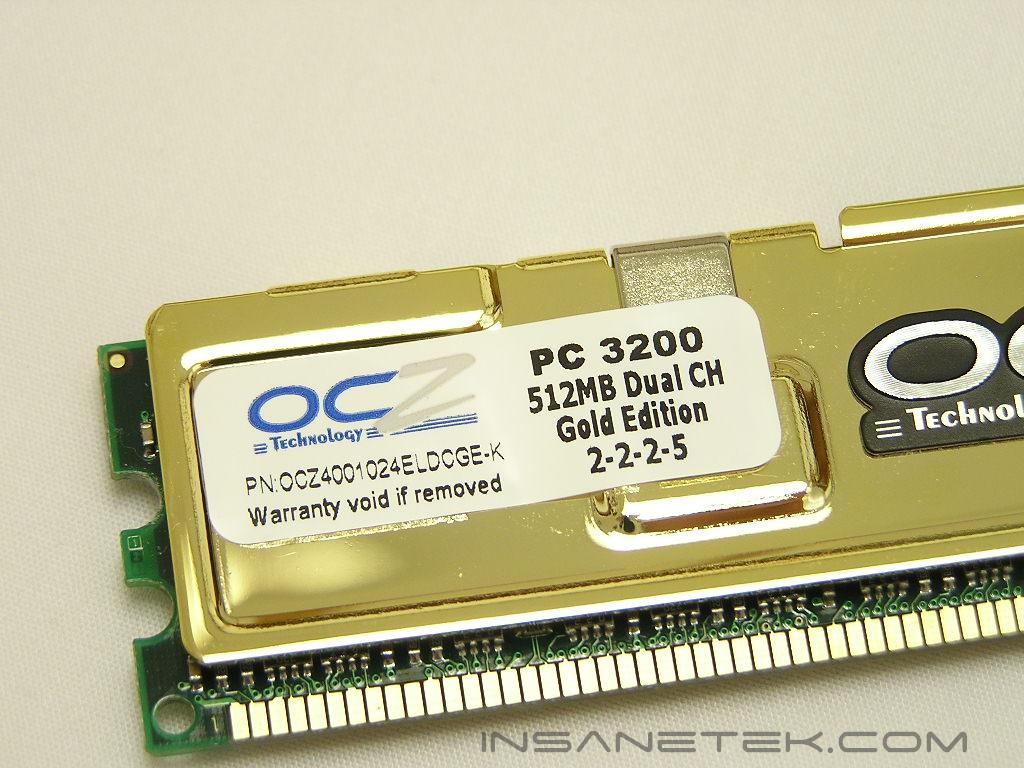
What I found interesting about these sticks is that they’re under OCZ’s Gold line of memory. From what I gather, OCZ’s Gold line has always catered to high frequency memory. The Platinum line was geared towards low latency operations. Ever since the TCCD’s came out, it seems like the two got switched. The Platinum is still their low latency section, but you see high speed stuff like the Platinum PC4800. But no matter, it’s not really important anyway. All we care about is quality stuff, right?
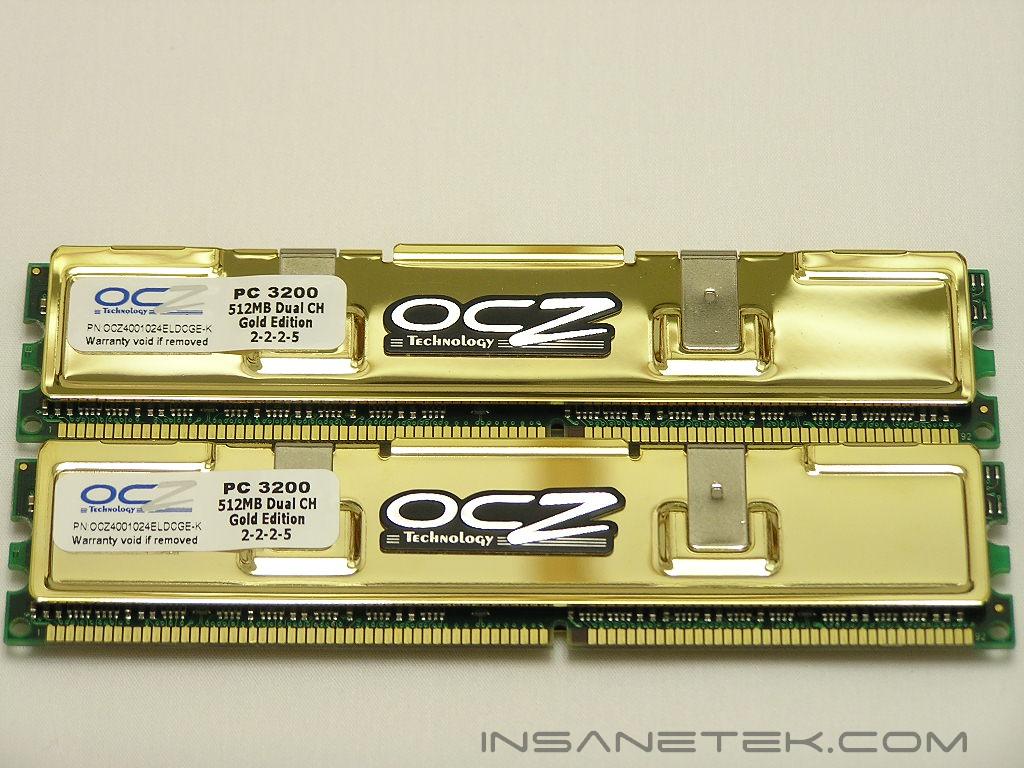
Test System and Overclocking
Test System:
- AMD Athlon64 3000+ Winchester
- DFI LANParty UT nF4 Ultra-D
- 2 x 512MB OCZ Gold PC3200
- ATI Radeon X800 (400/490)
- Enermax Noisetaker 470W
- Arctic Freezer 64
Overclocking:
Keep in mind that during overclocking, the latencies are as follows: CAS-TRCD-TRP-TRAS
Because the memory focuses on low latency, all tests will be conducted with timings of 2-2-2-5. There isn’t really a point in checking speeds at looser timings, because that’s where TCCD shines. If enthusiasts wanted looser timings, they wouldn’t have paid up to $400 for old BH5’s a year ago. Testing will focus on speeds at different voltages. The DFI Ultra-D can supply up to 4v to memory, so we won’t have any bottlenecks in this department.
While the memory is rated to need 2.8v, I proceeded to find the lowest voltage it actually needed. With just 2.6v, the Gold PC3200 was able to run the rated speed and timings. Unfortunately, it didn’t overclock very well with such low voltage. A slight bump to the rated 2.8v allowed operations at 220HTT. That’s a pretty decent result. Enthusiasts limited to 2.8v will get a small overclock. The next jump in voltage was 3.2v, which is generally the highest VDIMM a motherboard allows. The results went up another 15MHZ to 235HTT. Not too shabby. Although it isn’t stunning like the old BH5’s, it’s still great, considering that the memory did not go through a burn-in period. We all know that BH5 chips can obtain better results after some serious burn-in, but this review can’t wait that long. Another jump in voltage to 3.4v resulted with another 10MHZ increase to 245HTT. 3.4v is generally the motherboard limit when enthusiasts decide to use the OCZ DDR Booster. With no barriers, I gave the memory as much juice as I could. For some reason, the motherboard goes flaky after 3.6v, and so the highest VDIMM supplied was 3.6v. The memory reached its limit in my system and provided a great low latency frequency of 255HTT. I knew it was the limit because I have other sticks of Winbond UTT BH5 chips that were able to do 265HTT with 3.6v. Granted those were lower in chip density, but it proved that nothing in my test system was a bottleneck.
If you would like to see low latency results compared to the high frequency TCCD, check out Randy’s review of the OCZ Gold PC4000 VX, which are based on Winbond UTT CH5. In there, he compares the performance of low latency at a divider against the TCCD at 1:1 ratio, both with the same exact CPU speed. Remember that 300MHZ TCCD at good timings are quite hard to find, and these Winbond UTT chips are being mass produced. Although TCCD is still the better performer at 1:1 ratio, these low latency chips can certainly keep up with a divider.
Overclocking Results:
- 200HTT 2-2-2-5 1T 2.6v
- 220HTT 2-2-2-5 1T 2.8v
- 235HTT 2-2-2-5 1T 3.2v
- 245HTT 2-2-2-5 1T 3.4v
- 255HTT 2-2-2-5 1T 3.6v
Results
A series of memory intensive benchmarks will be run to test the performance of our sample. The other tests will be based on common benchmark programs such as 3DMark and PCMark. Real life performance differences will be tested through current games such as Far Cry and UT2004. Memory bandwidth benchmarks will be based off of SiSoft Sandra and Everest Home Edition. Super PI and PiFast will also be used to test memory performance, as the benchmark benefits largely from FSB increases.
SiSoft Sandra Memory Bandwidth
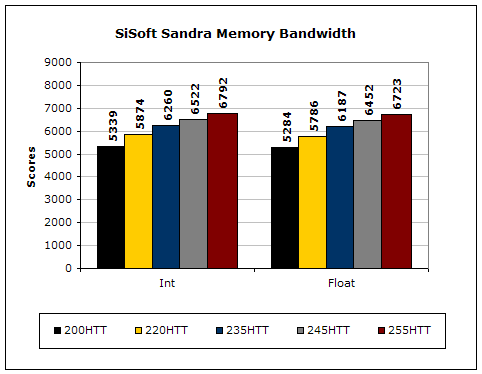
SiSoft Sandra is the most widely used memory bandwidth test and can distinguish increases in performance from lower latency timings.
Everest Home Edition
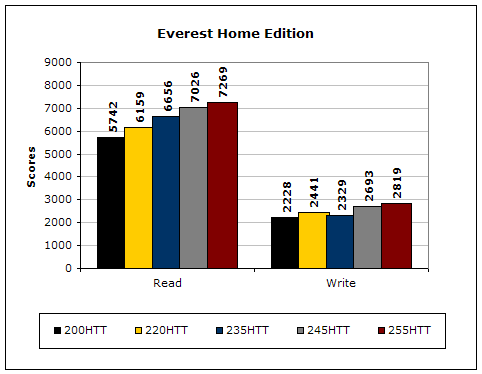
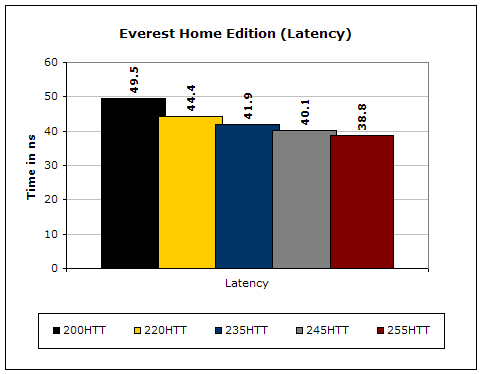
Much like Sandra, Everest Home Edition tests the memory’s ability to read and write data in large chunks. The results reveal the lower latencies helping just a little with performance.
3DMark2001SE
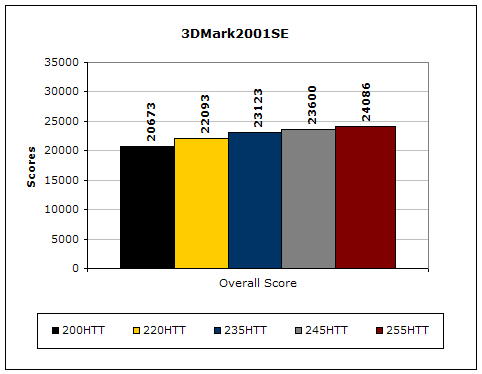
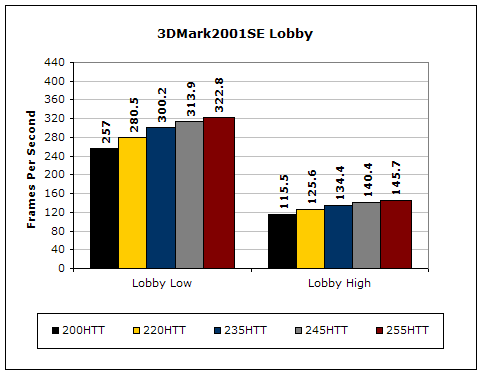
3DMark is probably the overclocker’s favorite benchmark. Unlike 3DMark2003, which stresses mainly the video card, 3DMark2001SE tests all of the system’s main components. Increasing the CPU speed, memory speed, and video card speeds will result in higher results in the final score.
Results Continued
Far Cry
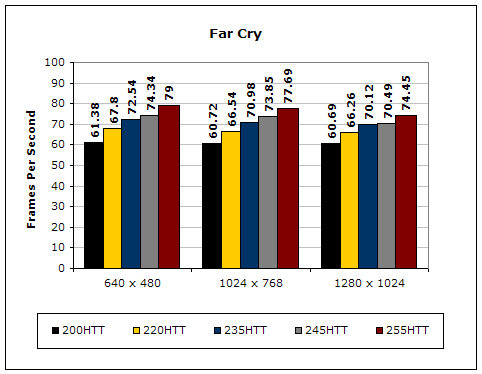
Since Far Cry is a game, the performance results will be very similar to 3dMark2001. I ran the benchmark at 640x480 so the benchmark would not be too GPU dependent. The tests under 1024x768 and 1280x1024 are an approximation of what kind of frames you’ll be getting. While the results are similar to 3dMark2001 in performance, this benchmark will give more significant results because Far Cry is extremely demanding.
Unreal Tournament 2004
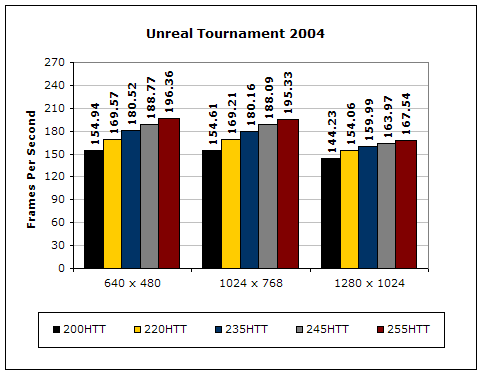
Unreal Tournament is another popular game engine to test overall system performance. Here, we can see the same results as Far Cry and 3dMark2001. Like Far Cry, UT2004 was also run at 640x480 to limit GPU dependency. The other resolutions are to give an approximation of actual gameplay performance.
PCMark2002
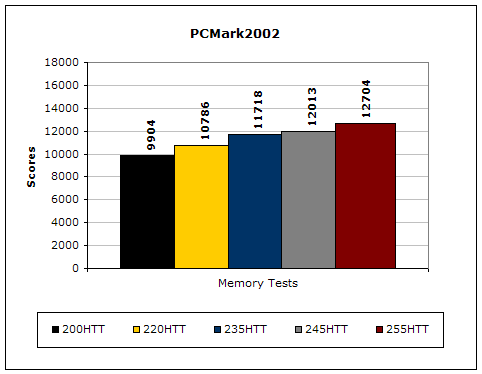
PCMark is another benchmark created by Futuremark. It tests the memory compression and decompression speeds in small to large chunks of data.
Super PI
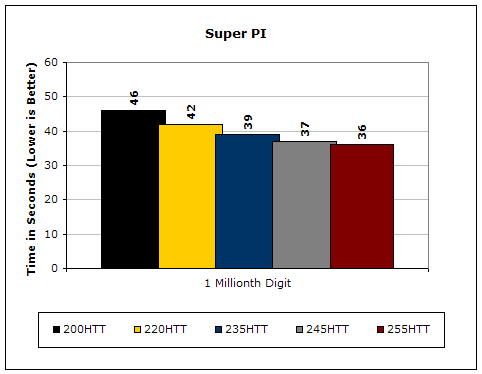
Since the value of PI is an infinite value, Super PI is a speed test to find the digit you’re looking for. In this case, we chose the millionth digit. Super PI benefits greatly from higher FSB as well as low latencies.
PiFast
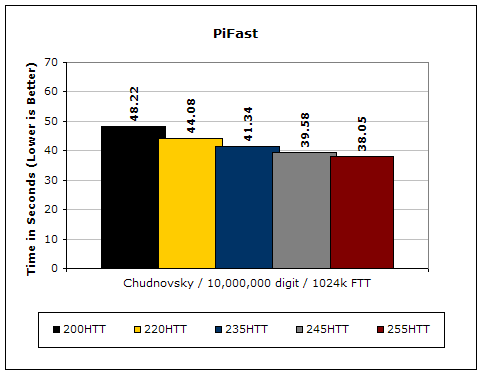
PiFast is similar to Super PI and the results can be greatly affected by a slight adjustment to the memory megahertz and latency.
Conclusion and Thoughts
With the resurrection of Winbond BH5 chips, overclockers can finally operate with both low latencies and fairly high frequencies. All the available voltage options in the DFI Ultra-D won’t go to waste. Overclockers can finally start pumping the juice to get the most out of their systems. Although the overclocking results with the Gold PC3200 weren’t exactly spectacular (255MHZ was achievable with the old BH5 with less than 3.6v), you have to keep in mind that these chips like a burn-in stage. They actually overclock better over time. But right out of the box, 255MHZ isn’t too shabby. What’s interesting is that Winbond UTT CH5 and Winbond UTT BH5 are now similar. They both respond very well to voltage and actually overclock to around the same speeds with the same voltage. Our previously reviewed OCZ Gold PC4000 VX, based on Winbond UTT CH5, overclocked higher than these Winbond UTT BH5 Gold PC3200. I remember a year ago when everyone loved BH5 more than CH5 because the chips overclocked better with slightly lower voltage. That’s certainly not the case anymore. They’re both practically the same. To me, it doesn’t matter which chip is used. You’ll get excellent results either way. But strangely, the UTT BH5 version comes in at a lower price than the UTT CH5 version. That can only mean good news for enthusiasts.
Pros:
- Winbond UTT BH5!
- Extreme low latencies even during high overclocking
- Responds very well to voltage
- Gold finish heatspreaders
- $175 for a dual channel 1GB kit!
Cons:
- May require burn-in stage
- Requires really high voltage for great results

We would like to thank OCZ for providing us the sample. If you have any questions or comments, feel free to hit us up in the forums. You can also check out more of our latest reviews on the front page.