

Mushkin Redline XP4000 1GB Dual Channel Kit
Introduction
Mushkin’s BH-5 memory is likely the most legendary set of memory modules in the history of overclocking. The modules were so popular that 1GB dual channel kits being sold for 400 dollars months after they were released. With the ability to withstand excess amounts of voltage, these sticks quickly climbed the ranks as THE modules to have. I remember John used to purchase multiple kits from Newegg and sell them on Ebay and various forums. In fact, I met John in a forum when I used to sell Corsair BH-5’s while he sold Mushkin’s BH-5’s. Since Mushkin’s Black Level kits were more favored, he took away all my business opportunities. I wanted to find and destroy this online mystery man named “poiuy223”. Then I actually met John in real life through a mutual friend and we fell in love… with hardware of course. You can say that Mushkin brought me and John together at InsaneTek, due to the reputation Mushkin has built as innovators of the most legendary overclocking memory. Nonetheless, Mushkin is attempting to attract the same crowd of voltage hungry overclockers with the introduction of their Redline series.
Although Mushkin’s current reputation as the premiere overclocking memory manufacturer seems to have weakened, they have penetrated the market at a time when UTT’s are becoming the most hyped form of overclocking memory. Mushkin’s Redline series utilize some of the best UTT IC’s in the industry. With the same clocking characteristics as Mushkin’s legendary BH-5, enthusiasts from all over the web are raving about how Mushkin’s Redlines may be the fastest memory on the market today. I just hope the hype can match the performance.
Mushkin Redline XP4000
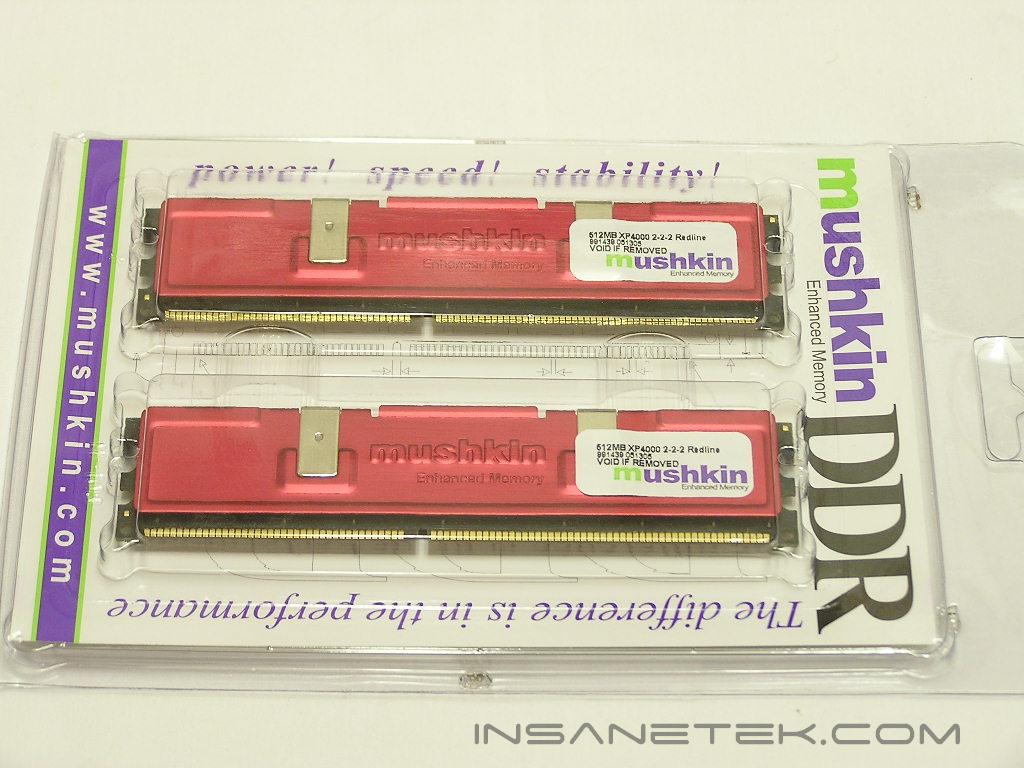
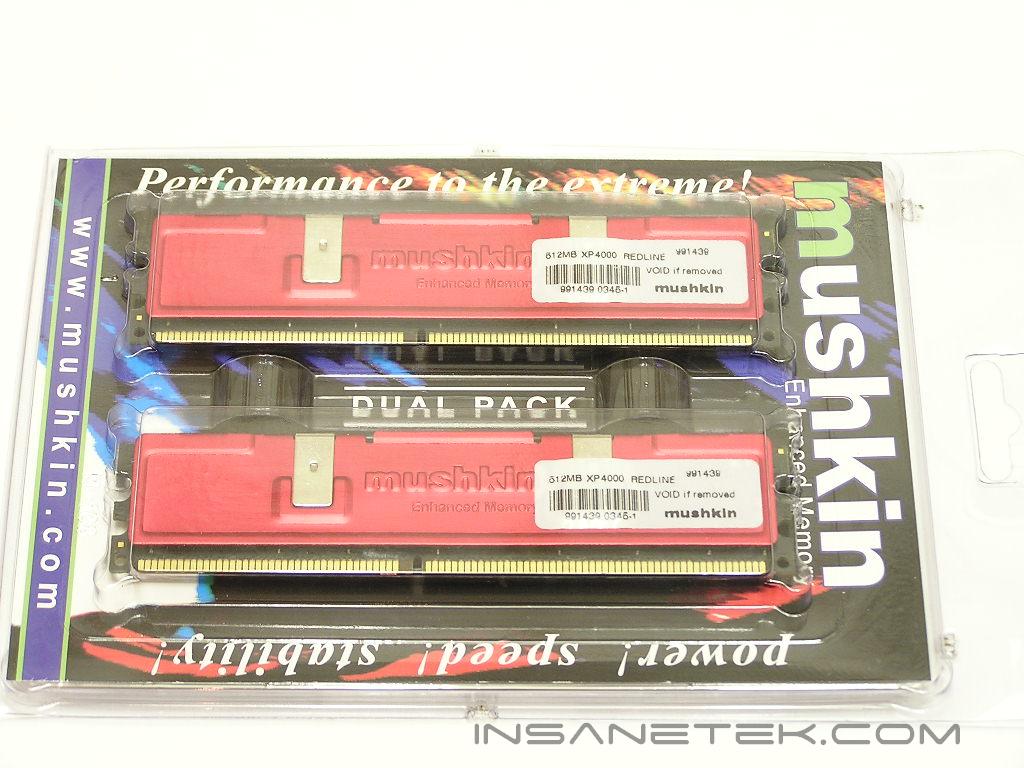
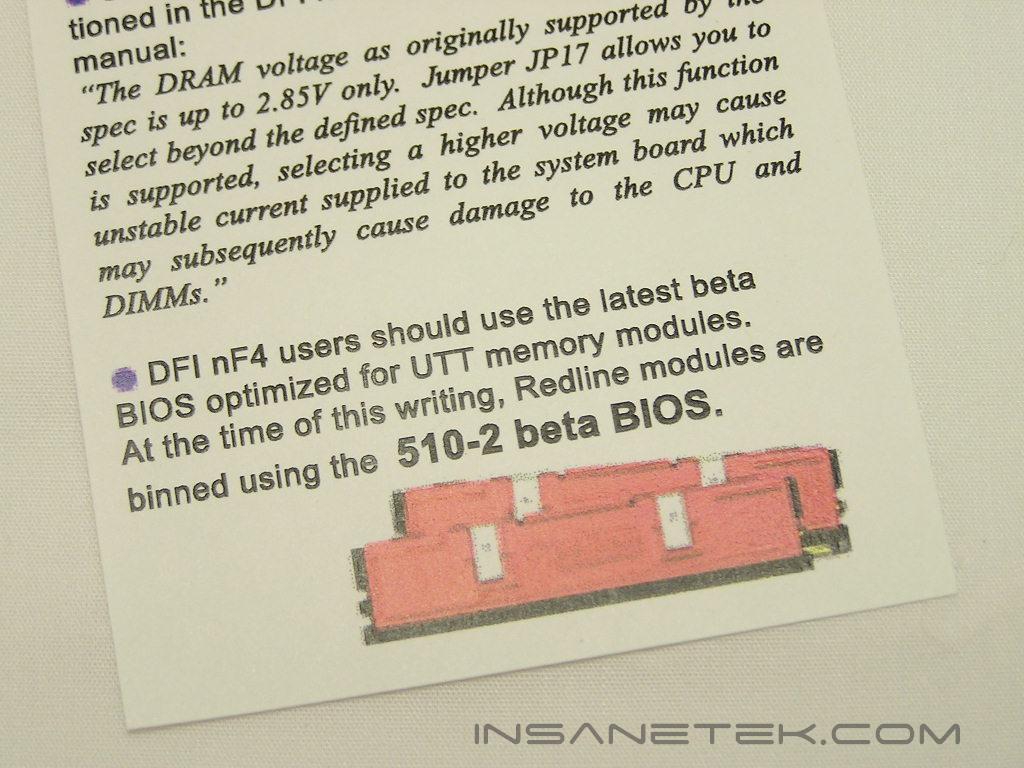
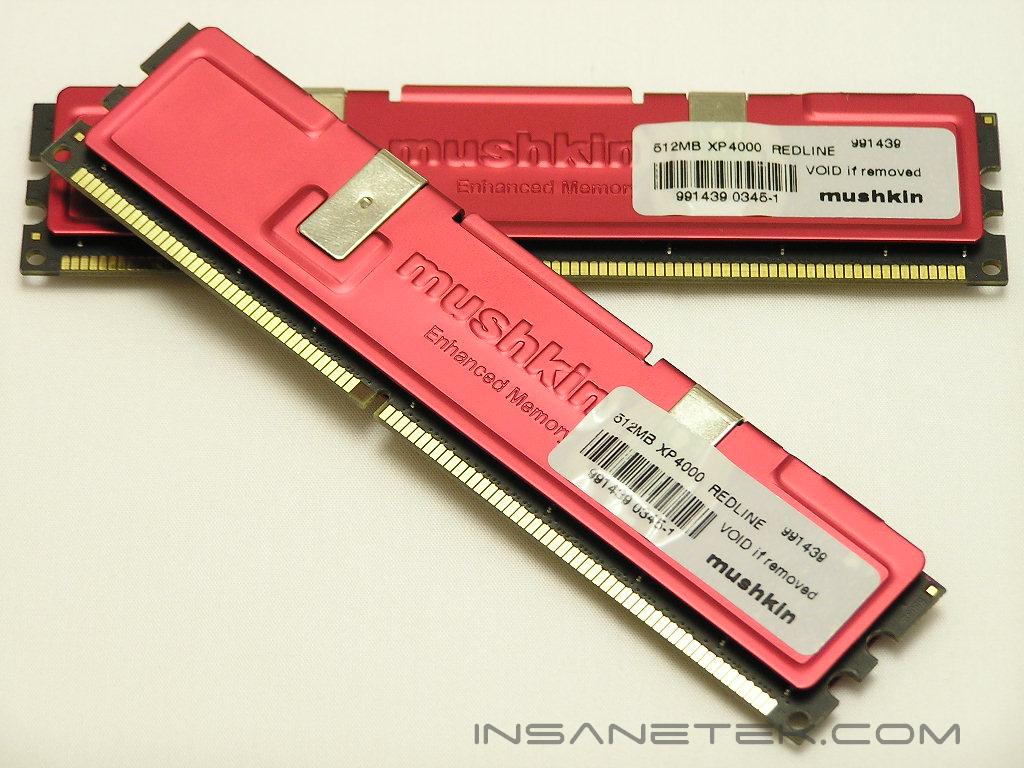
Mushkin’s advertising team has been diligently developing new graphics and packaging for a new and stylized look. The black version is the finalized packaging for Redline, which utilizes new stickers and a different styled clamshell. In addition, the new packaging includes a detailed instructions sheet on the appropriate method for overclocking with the 4v jumper enabled on the DFI NF4 boards. Mushkin understands the need to assist their customers in an era of high failure rate amongst UTT’s and NF4’s. Their dedication in assisting customers is the major driving force behind their success as a company. Maybe these directions are also a nice way of saying, “Please don’t burn these sticks! We can’t afford RMA’s!” Mushkin warns the user that active cooling is required for these modules. In order to assist in cooling, Mushkin still includes their unique heatspreaders.
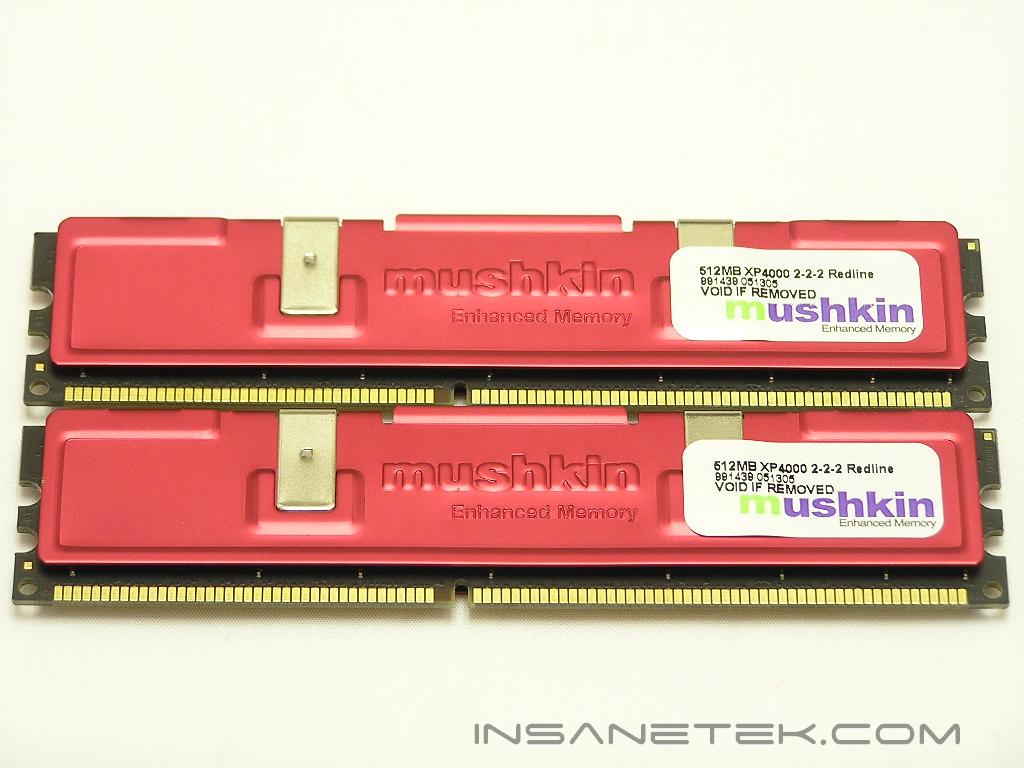
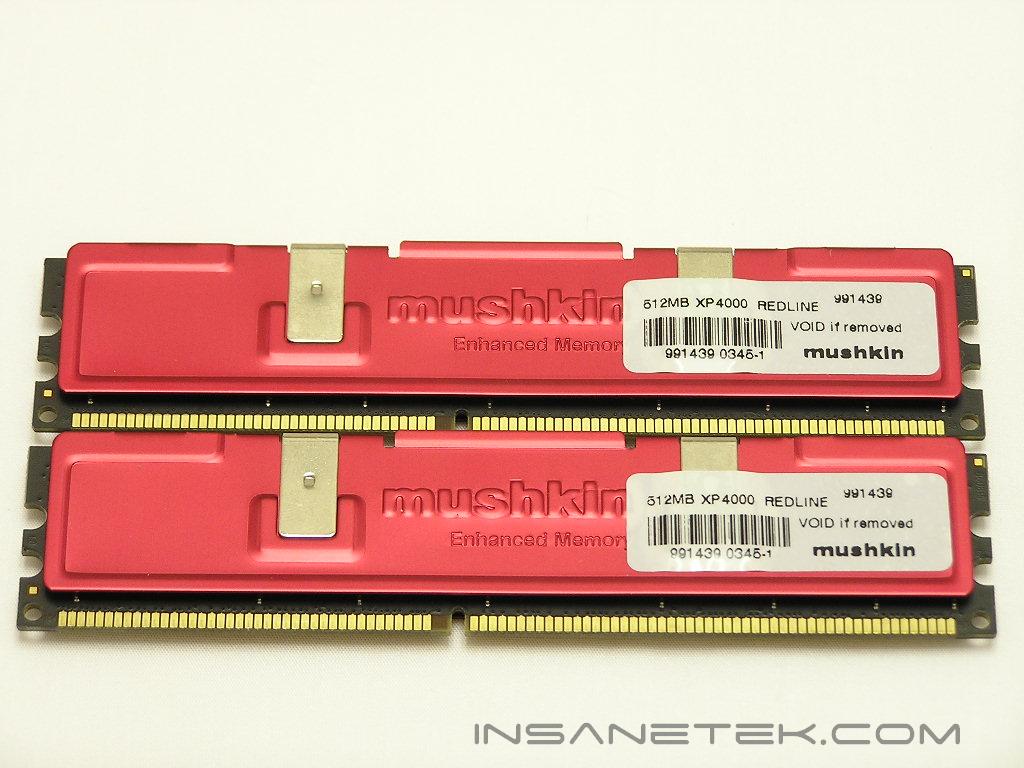
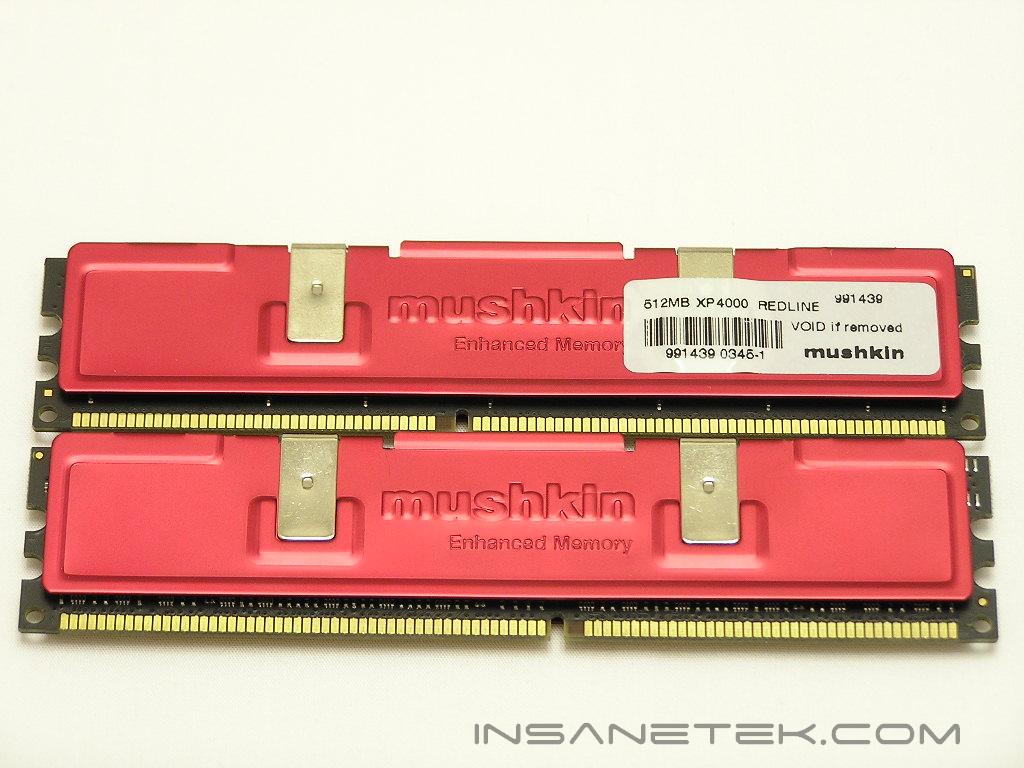
Mushkin’s heatspreaders have always been a favorite of mine. Utilizing the same two-clip concept of most memory companies, Mushkin deviates from the flashy emblems and platinum finishes to keep their look simple with a clean “Mushkin” stamp and a laser-etched “Enhanced Memory.” You know something is wrong when your memory looks better than your car or when your girlfriend thinks your memory receives more looks from you than her. An even better aesthetic choice is Mushkin’s decision to incorporate a black PCB.
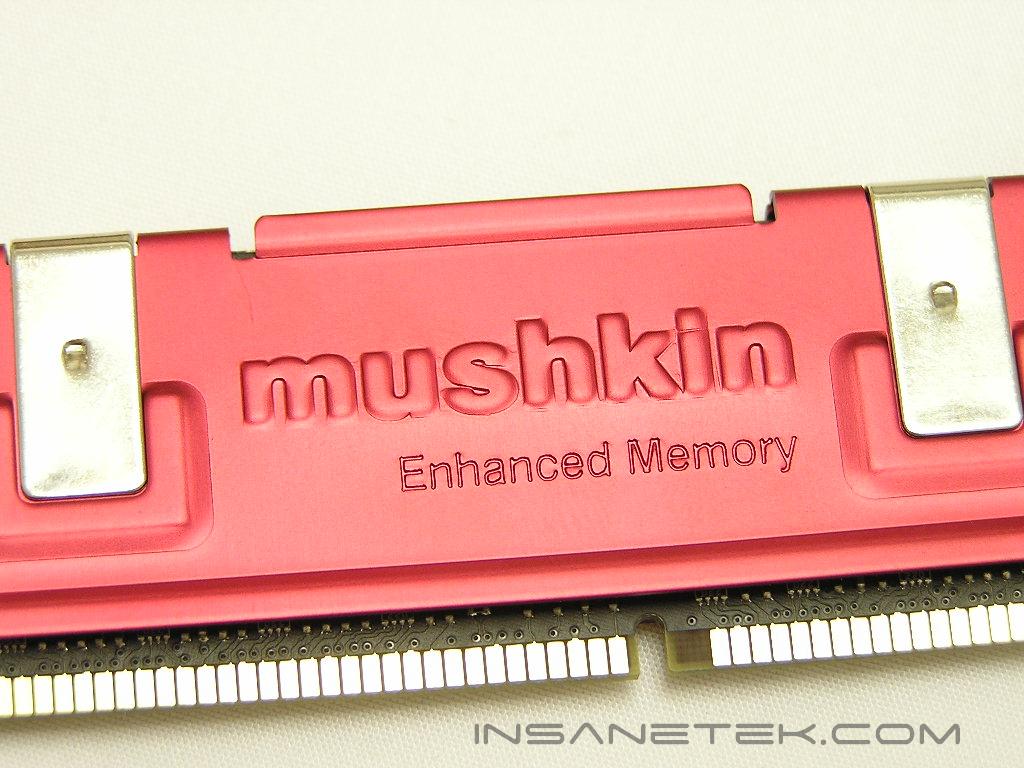
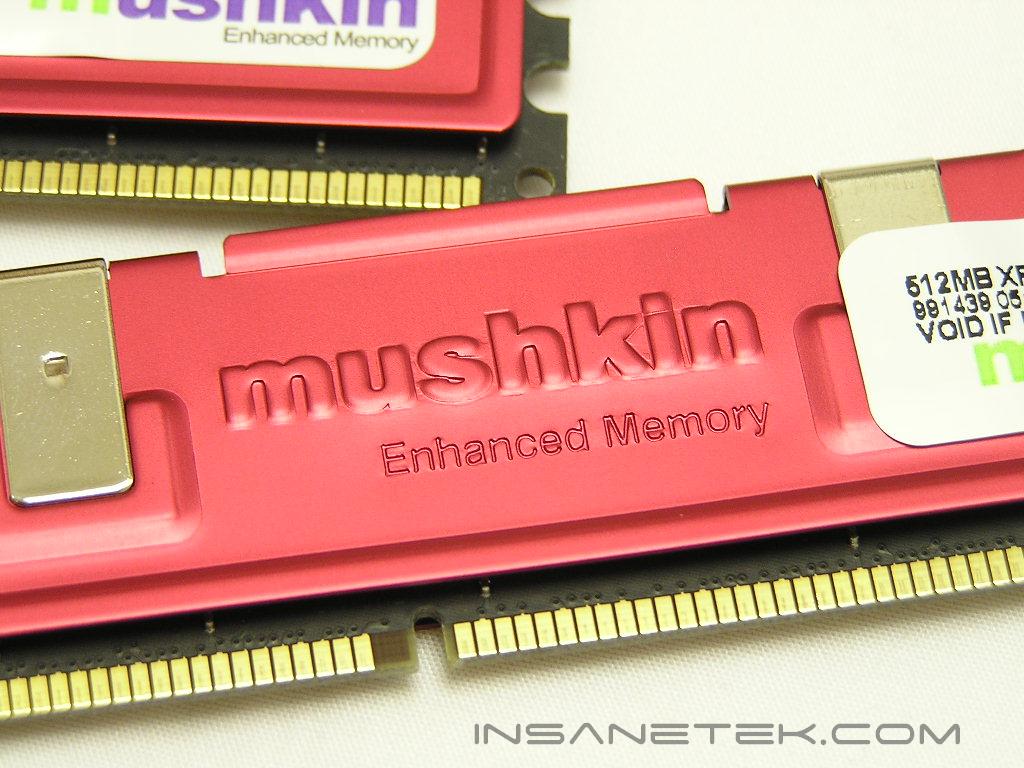
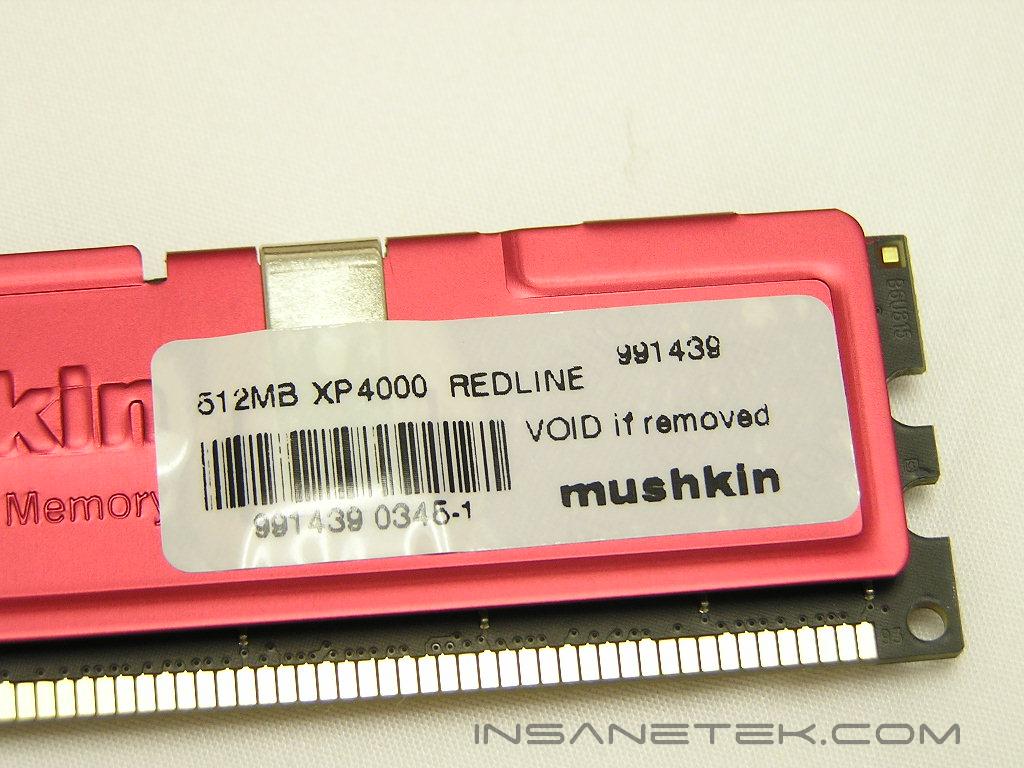
Mushkin’s use of a black PCB easily distinguishes them amongst the crowd. While utilizing the popular 6-layered Brainpower 815 PCB, Mushkin is listening to the needs of enthusiasts, incorporating both design and functionality into their modules. One aspect I disliked about Mushkin’s Redline is that they tend to look more burgundy rather than pure red. While I understand the need to differentiate themselves from A-DATA or Buffalo, I believe a hot red may have been a better look for a state-of-the-art product. Then again, Mushkin tries to keep their products simple. The choice of a much more neutral red over a flashy red may have been their design preference.
Test System and Overclocking
Test System:
- AMD Athlon64 3000+ Winchester
- DFI LANParty UT nF4 Ultra-D (4V Jumper Enabled)
- ATI Radeon X800XL 256MB
- Sytrin 460W Power Supply
Installation and Overclocking Guidelines:
The latencies are as follows: CAS-TRCD-TRP-TRAS
Currently, the only well-known motherboard in the market to supply enough voltage to support UTT-based memory is the DFI NF4. While another alternative exists from Abit, the results don’t exist to justify choosing Abit’s board over the NF4. Since the NF4 users are the primary target market of Mushkin, Mushkin included NF4 specific procedures in an extra sheet with the packaging. Mushkin recommends the following procedures and tips when using the DFI NF4 board.
- When installing or removing the memory modules, disconnect the machine from AC power then push the power button to unload the capacitors.
- When using two Redline modules, install them in the yellow DIMM slots.
- Strictly follow the 4v jumper guidelines mentioned in the DFI nF4 series motherboard manual
- DFI nF4 users should use the latest beta BIOS optimized for UTT memory modules. At the time of this writing, Redline modules are binned using the 510-2 beta BIOS.
Mushkin includes procedures that even I have never followed. I never considered pressing the power button to unload the capacitors before switching memory. Mushkin understands the need to market their memory to ALL consumers. Including the necessary information to get your average consumer started on clocking is a definite step in the right direction.
For Mushkin’s Redlines, I am keeping all timings at 2-2-2-5 and/or below, considering these sticks are marketed towards providing low latencies of up to 500MHZ. I also kept the command rate at 1T because Athlon64 platforms take a performance hit with 2T. I also kept the multiplier for the Winchester at 8x because our CPU was incapable of clocking at high CPU speeds. The onboard memory controller worked just fine, though. UTT’s do not act like TCCD’s that benefit from increasing latencies to increase overall MHZ. The Redlines benefit from increasing voltage to scale up to and past 250MHZ while remaining at the low latencies of 2-2-2-5. Sound similar to Mushkin’s legendary Black Level BH-5’s? While I don’t understand exactly the logistics behind the different builds of BH-5, such as the different number of transistors for CH-5 and BH-5, I know Mushkin’s Redline series is supposed to be using the latest true BH-5 IC’s. This fact ensures their stability at higher speeds and lower voltages. Using the latest BH-5 IC’s is reassuring news for people who are concerned with increasing voltage on their beloved NF4’s and UTT’s.
To test for maximum clocks, I use Memtest 86 Test #5 as a quick method in determining overclock results. Once I determine the max overclock on Test #5 at the lowest possible voltage, I proceed to Test #8. If Test #8 fails, I lower the clocks and continue to find the next stable speed. If Test #8 successfully passes, I continue to a full test of Memtest by looping the complete test for one hour. I then run all the game benches, Super Pi 32M, Prime95, and Sandra’s Memory Bandwidth score to ensure full stability. Once all of these tests are completed, I record the results and include them within this review.
Overclock Results:
- 3.4v 265HTT 2-2-2-5
- 3.4v 265HTT 1.5-2-2-5
- 3.3v 260HTT 2-2-2-5
- 3.2v 255HTT 2-2-2-5
- 3.0v 245HTT 2-2-2-5
Judging from the results, the Mushkin Redlines perform exceptionally at low voltages. At only 3.4v, I was able to hit 265HTT stable at both CAS 2 and CAS 1.5. For DFI NF4 concerned with enabling the 4v jumper, the Redlines ran stable at 255HTT with only 3.2v. I tried voltages above 3.4v, but anything higher did not affect overclockability.
Results
A series of memory intensive benchmarks will be run to test the performance of our sample. The other tests will be based on common benchmark programs such as 3DMark and PCMark. Real life performance differences will be tested through current games such as Far Cry and UT2004. Memory bandwidth benchmarks will be based off of SiSoft Sandra and Everest Home Edition. Super PI and PiFast will also be used to test memory performance, as the benchmark benefits largely from FSB increases.
Throughout all tests, the CPU multiplier has been kept at 8x.
SiSoft Sandra Memory Bandwidth
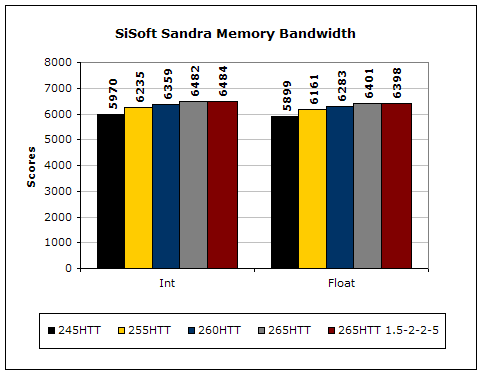
SiSoft Sandra is the most widely used memory bandwidth test. It can tell you the increase in performance from just lowering the latency timings.
Everest Home Edition
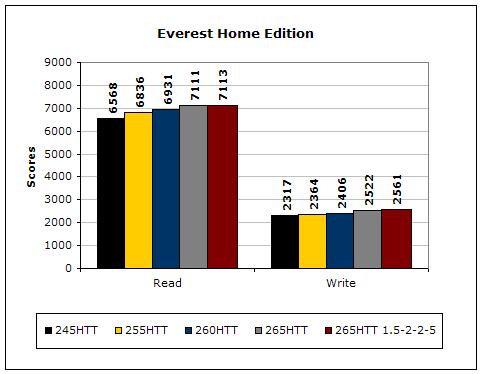
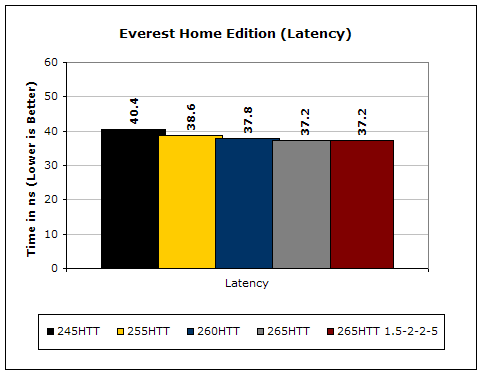
Much like Sandra, Everest Home Edition tests the memory’s ability to read and write data in large chunks. The results show that the lower latencies seem to help just a little with performance.
3DMark2001SE
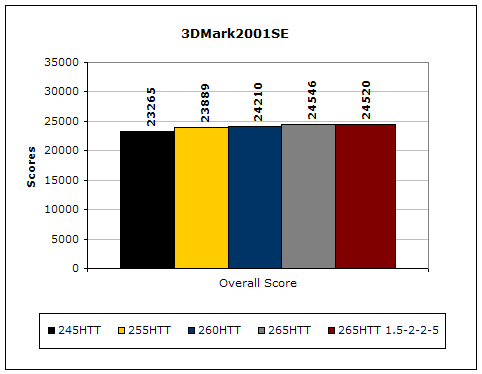
3DMark is probably the overclocker’s favorite benchmark. Unlike 3DMark2003, which stresses mainly the video card, 3DMark2001SE tests all of the system’s main components. Increasing the CPU speed, memory speed, and video card speeds will result in higher results in the final score.
Results Continued
Far Cry
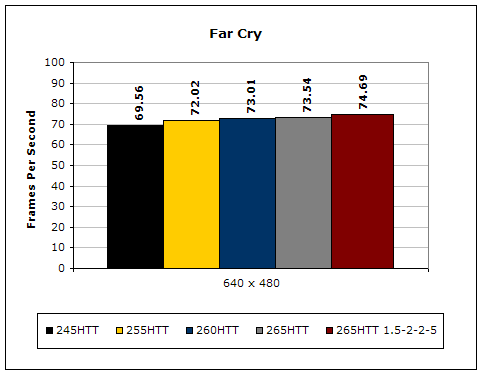
Since Far Cry is a game, the performance results will be very similar to 3dMark2001. I ran the benchmark at 640x480 so the benchmark would not be too GPU dependent. While the results are similar to 3dMark2001 in performance, this benchmark will give more significant results because Far Cry is extremely demanding.
Unreal Tournament 2004
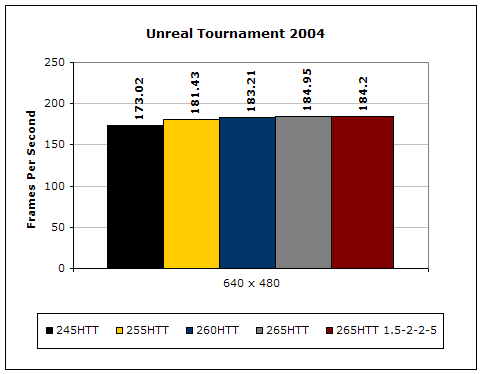
Unreal Tournament is another popular game engine to test overall system performance. Here, we can see the same results as Far Cry and 3dMark2001. Like Far Cry, UT2004 was also run at 640x480 to limit GPU dependency.
Half-Life 2
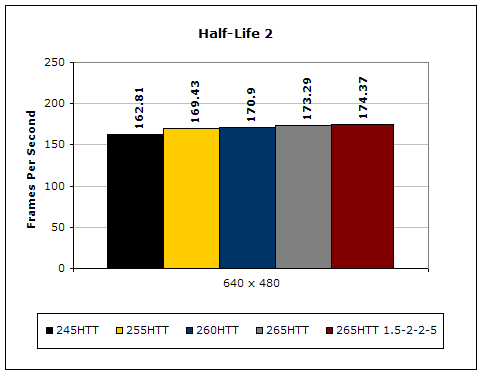
Half-Life 2 is another popular game that gamers love. The game is also very memory intensive and is a great indicator of memory performance increase. As usual, the game is run under the resolution of 640x480 to limit GPU dependency.
Super PI
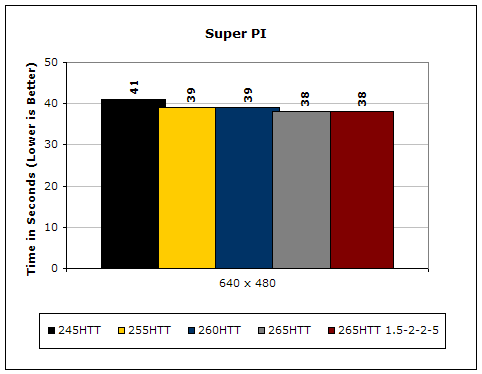
Since the value of PI is an infinite value, Super PI is a speed test to find the digit you’re looking for. In this case, we chose the millionth digit. Super PI benefits greatly from higher FSB as well as low latencies.
Conclusion and Thoughts
Considering the amount of UTT-based memory modules flooding the market, Mushkin’s Redlines were much easier to overclock at lower voltages than the competition. Besides OCZ, Mushkin is the only other manufacturer that sells UTT-based memory at PC4000 ratings. Mushkin’s Redlines are also the highest clocking UTT modules that InsaneTek has ever reviewed, because of the higher standards of speed binning. However, there are some issues involving these untested IC’s that I have seen throughout various forums on the web. The UTT/NF4 combination has generated a number of motherboard and module deaths, but I believe these deaths may be more user related than hardware related. Mushkin’s inclusion of an added instructions sheet may help alleviate the problem, but I only recommend this memory for the experienced user. UTT’s are like those lawyers assigned to you in court if you lack the money to hire your own; you almost feel like you can’t count on them, but when they finally end up working well for you, they can be the best inexpensive alternatives. Despite all of UTT’s’ shortcomings, Mushkin eliminates the ambiguity by providing a higher rated module with a maximum of 3.3v and a lifetime guarantee. Mushkin’s Redlines were capable of reaching high speeds at the lowest latencies possible. Combined with a price point that can be found for around 213 dollars, these modules earn InsaneTek’s “Highly Praised” award.
Pros:
- Excellent heatspreaders
- Unique black PCB
- Excellent overclocking capability
- Lifetime guarantee
- Excellent performance at CAS 1.5
- Included instructions manual for help with the NF4
Cons:
- Requires active cooling

We would like to thank Mushkin for providing us the sample. If you have any questions or comments, feel free to hit us up in the forums. You can also check out more of our latest reviews on the front page.