

Mushkin PC4400 1GB Dual Channel Kit
Introduction
Mushkin has been making RAM for a long time. Their fame comes from their BH-5 series memory. After Winbond discontinued BH-5, Mushkin faded into the background while other manufacturers scrambled to find a replacement. TCCD is the memory that most manufacturers chose to market and Mushkin has recently introduced their RAM based on the TCCD IC. It seems like every RAM company has at least one module based on TCCD. Although it is used by most companies as low latency DDR400, Mushkin rates this TCCD as high latency DDR550. This is nice because you are guaranteed a high FSB, but you can also tighten the timings if you don’t mind lowering the FSB. Mushkin also has a low latency DDR400 TCCD based RAM in their product lineup, which is a little less expensive, but is not guaranteed to run higher speeds.
Mushkin PC4400
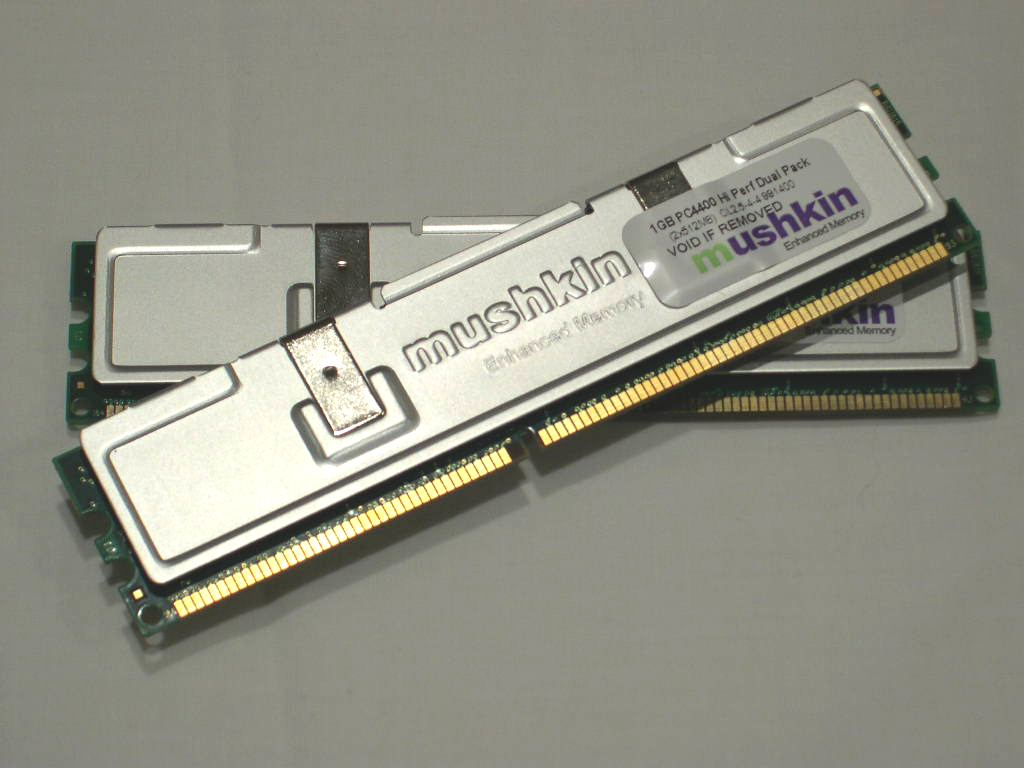
The inflated bubble that Mushkin uses is the neatest packaging I’ve ever seen used for memory. The RAM I received comes with attractive silver aluminum heatspreaders. Mushkin’s heatspreader color varies, so that is why their RAM is sometimes pictured in black, purple, and other colors. Heatspreaders are mostly for aesthetics, branding, and marketing. A lifetime warranty and live customer support add a lot to the value.
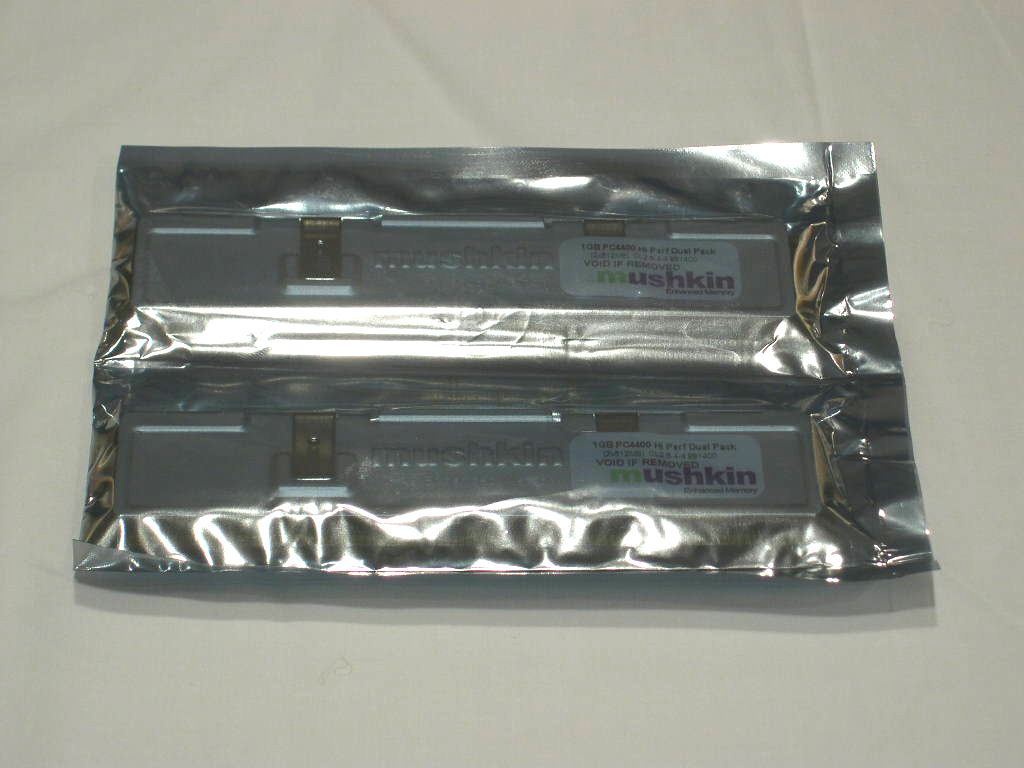
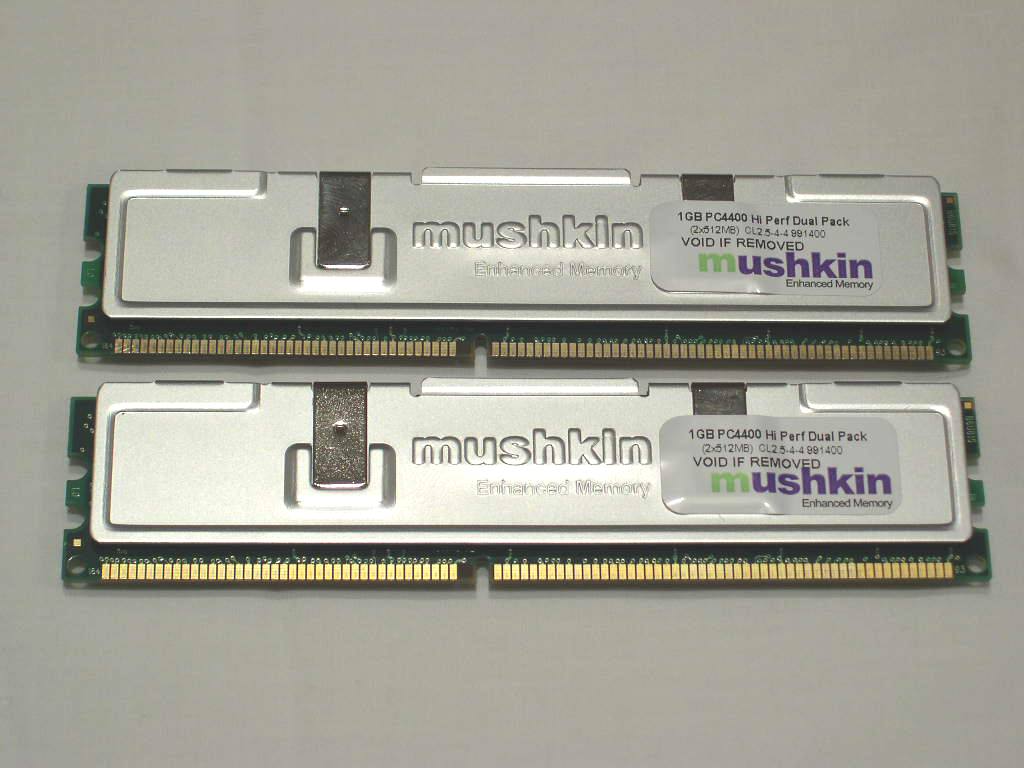
The great thing about this memory is that it scales well and doesn’t require a lot of voltage. There is a trade off, however, because TCCD can’t hold low latencies at high speeds. Mushkin rates this particular set of RAM at PC4400 2.5-4-4-8. It’s a long way from 2-2-2-5, but if raw FSB is what you need, this RAM will work nicely. Mushkin uses a Brainpower PCB that has been known to help overclocking on other brands of TCCD.
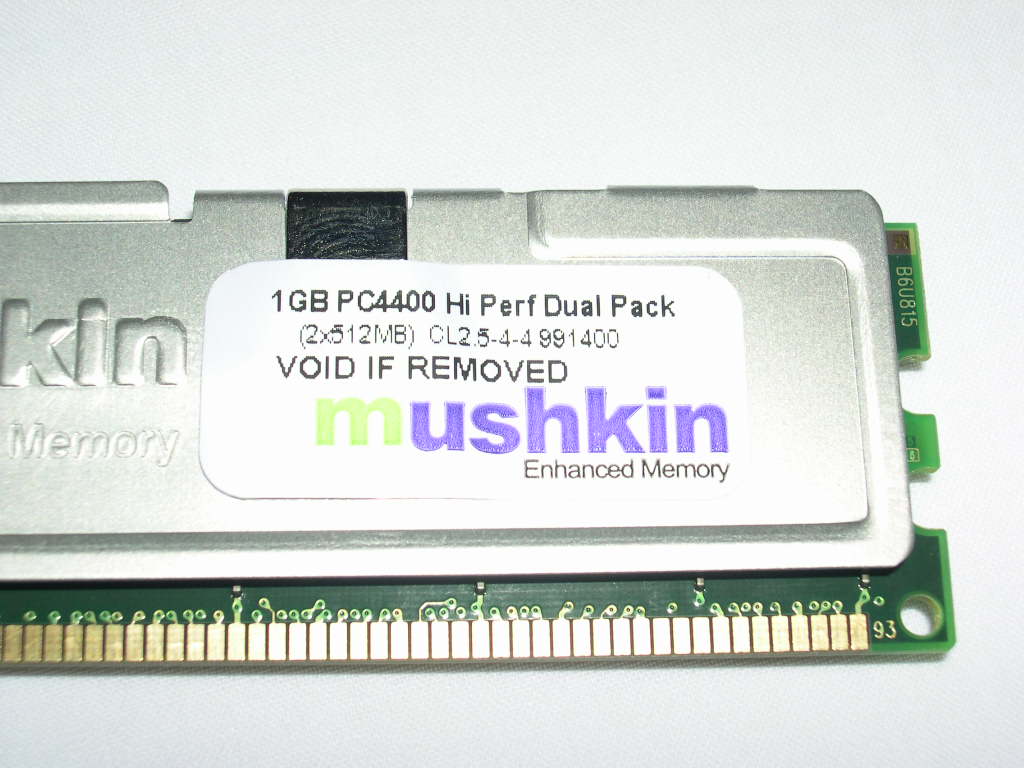
Mushkin’s Specifications:
CL2.5 @ 550MHz Double Bank 64Mx64 Module 32Mx8 chip density 6-Layer PCB Gold Contacts 184pin 2.5V - 2.8V Unbuffered Installed Heatspreader
Test System and Overclocking
Test System:
- AMD Athlon64 3000+ Winchester
- MSI K8N Neo2 Platinum
- 2 x 512MB Mushkin PC4400
- ATI Radeon 9500NP
- TTGI 450W
- Windows 2000
Benchmarks were run with these settings: 9x CPU Multi, 3x HTT, 1.65vagp, AGP 67Mhz, 1T, Dual Channel
Overclocking:
Keep in mind that during overclocking, the latencies are as follows: CAS-TRCD-TRP-TRAS
Overclocking is usually the main thing people look for when searching for the best RAM. Every overclock completed at least one pass of Memtest86. I started off at 200HTT 2-2-2-6, because that is what a lot of other TCCD RAM is rated at. I was only able to get up to 205HTT 2-2-2-6, any higher and I would receive errors in Memtest. I loosened the timings to 2-3-3-6 but this did not give me any FSB gain. Loosening the timings again to 2.5-3-3-6, I reached speeds up to 270HTT pass through Memtest. Unfortunately 270HTT 2.5-3-3-6 would not pass Super PI or PiFast in Windows. I had to reduce the speed to 250HTT 2.5-3-3-6 to gain stability through all tests. With stock timings I was unable to achieve any overclock from stock speeds. Voltage up to 3.2v did not help and neither did a replacement MSI K8N Neo2. I tried many different BIOS’s and manipulated every setting to no avail. It is disappointing that the RAM came maxed out of the box.
Highest overclock results: 9 x 275HTT
Overclocking Results:
- 205HTT 2.0-2-2-6 1T 2.7v
- 250HTT 2.5-3-3-6 1T 2.7v
- 275HTT 2.5-4-4-8 1T 2.7v
Results
A series of memory intensive benchmarks will be run to test the performance of our sample. The following tests will be based on common benchmark programs such as 3DMark. Real life performance differences will be tested through current games such as Counter-Strike: Source. Memory bandwidth benchmarks will be based off of SiSoft Sandra, Everest, and Aida32. Super PI and PiFast will also be used to test memory performance, as the benchmark benefits largely from FSB increases.
SiSoft Sandra
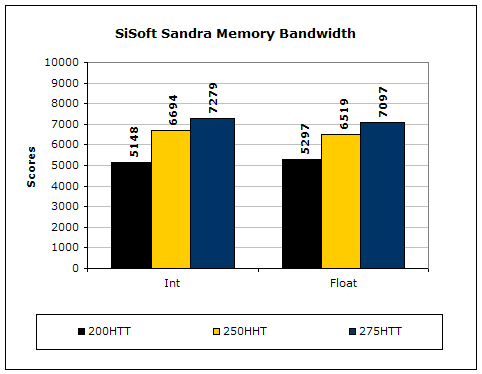
SiSoft Sandra is the most widely used memory bandwidth test. It can tell you the increase in performance from just lowering the latency timings. The results seem to scale linearly, despite the fact that the HyperTransport Bus is different when the overclock increases.
Aida32
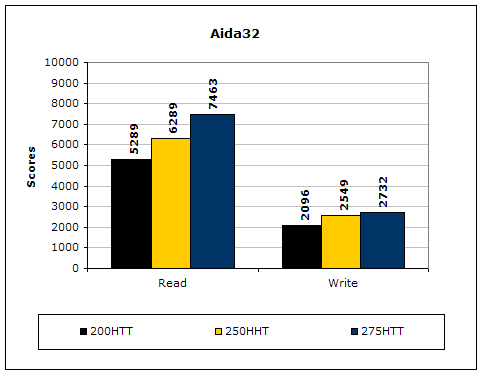
Much like Sandra, Aida32 tests the memory’s ability to read and write data in large chunks. The results are similar to the results in Sandra.
Everest Home Edition
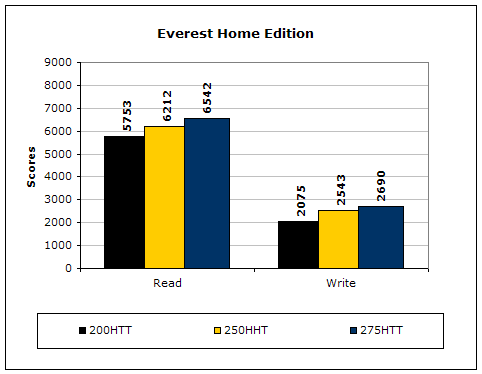
Everest Home Edition’s Memory Benchmarks are similar to Sandra’s.
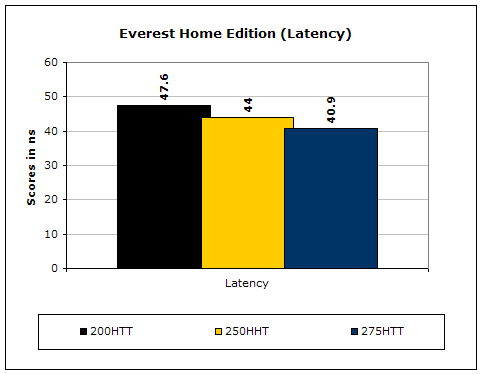
Everest Home Edition also includes a latency benchmark. The Athlon64’s performance with various latencies is also dependent upon its increase in CPU speed.
3DMark2001SE
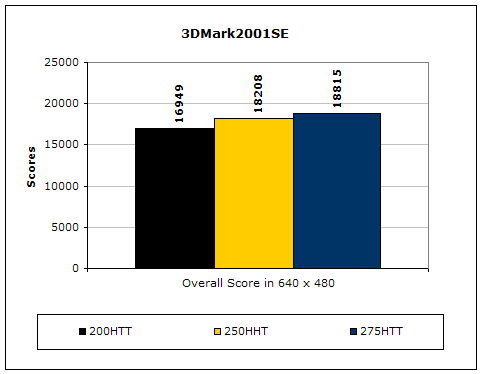
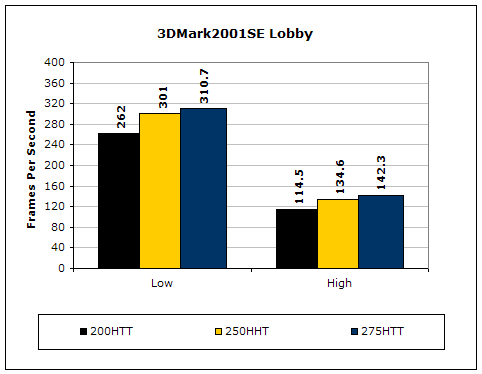
3DMark is probably the overclocker’s favorite benchmark. Unlike 3DMark2003, which stresses mainly the video card, 3DMark2001SE tests all of the system’s main components. Increasing the CPU speed, memory speed, and video card speeds will result in higher results in the final score.
Results Continued
PCMark
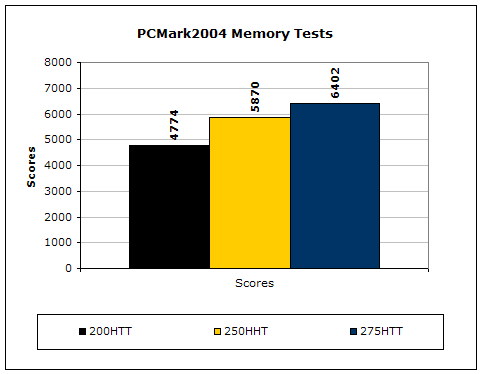
PCMark is another benchmark created by Futuremark. It tests the memory compression and decompression speeds in small to large chunks of data.
Counterstrike: Source
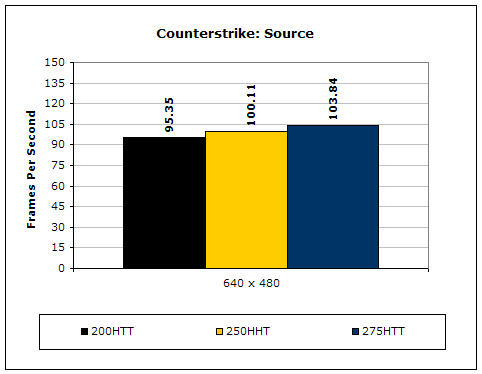
Counterstrike: Source is currently one of the most popular games and does a great job of taxing your system.
Super PI
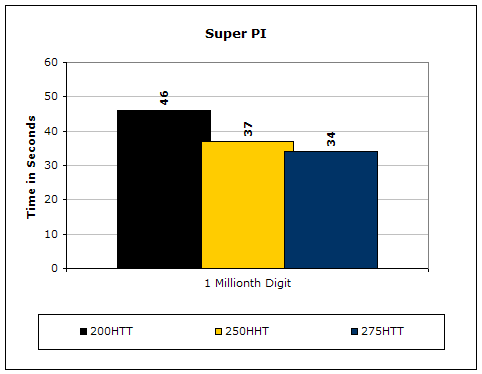
Since the value of PI is an infinite value, Super PI is a speed test to find the digit you’re looking for. In this case, we chose the millionth digit. Super PI benefits greatly from higher FSB as well as low latencies.
PiFast
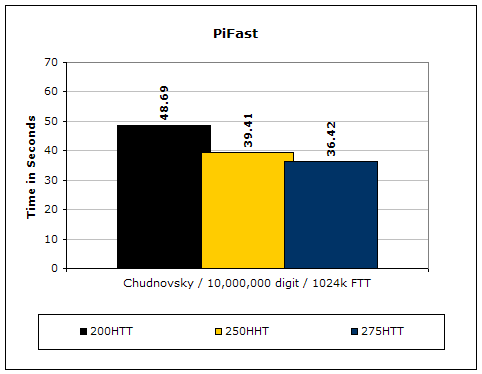
PiFast is similar to Super PI and the results can be greatly affected by a slight adjustment to the memory megahertz and latency.
Conclusion and Thoughts
I expected more from this RAM. This being Mushkin’s top of the line DDR RAM, I couldn’t believe that I wasn’t able to achieve any overclock. There is always a little luck that comes with overclocking and no overclock is guaranteed, but the RAM I received isn’t worth the chance when there are better alternatives at lower price points. If you aren’t looking for any overclocking results, then the price would be the only reason to not recommend it. Mushkin does include a great lifetime warranty and live tech support to soften the price. Hopefully Mushkin can improve the next time around and regain their overclocker friendly status.
John’s Addition:
I was a little disappointed after hearing Luke’s results so I decided to double check myself. Hardware-wise, he had everything set; a week 41 A64 3000+ Winchester and a MSI Neo2 form a great combination for an overclocking testbench. No matter what he did, he couldn’t get past 275HTT. I contacted Mushkin about the specifications on the PC4400 and found out that they use week 501 TCCD’s with Brainpower 815 PCB’s. I had Randy test the RAM in his DFI Ultra-D and his A64 4000+. We went through the usual overclocking testing and came up with a higher overall overclock. The end result was a good 290HTT 2.5-4-3-7 1T with 3.0v. I guess these sticks aren’t as bad as they seem. Although they’re priced quite high, Mushkin does have a $50 rebate going on right now that drops the overall price to about $250. Spending $250 on guaranteed memory is well worth it, in my opinion.
Pros:
- Live tech support
- Lifetime warranty
- Good performance
Cons:
- Overclocking potential seems to vary quite a bit
- Price (without rebate)

We would like to thank Mushkin for providing us the sample. If you have any questions or comments, feel free to hit us up in the forums. You can also check out more of our latest reviews on the front page.