

Kingston HyperX PC3200UL 1GB Dual Channel Kit
Introduction
We recently reviewed the Kingston HyperX PC4300 memory and were left a bit disappointed. The HyperX line is known to be one of the fastest and highly overclockable sticks of memory available. With all the recent hype about low latency memory, Kingston does not fail to join the crowd. With these new modules in my hand, I’m having high hopes that Kingston can once again prove themselves to be a great contender.
Kingston HyperX PC3200UL
The new HyperX PC3200 low latency has been labeled as KHX3200UL. The “UL” stands for “Ultra Latency”. Much like the majority of the new low latency memory, the KHX3200UL uses Samsung TCCD F die ICs that are rated to be 4ns. This means that the memory is rated to run 250FSB with 2.5-3-3-6 latencies. Manufacturers have found that the Samsung ICs were capable of running 2-2-2-5 at 200FSB, and proceeded to “underclock” the ICs and label it for PC3200. Of course running 200FSB at 2-2-2-5 is much better than the majority of the PC3200 at 2-3-2-6, but keep in mind that the ICs are rated to be 4ns and are underclocked. At first, it didn’t seem all that interesting. Everyone’s basically underclocking faster memory just to satisfy the low latency hunger. This is basically the same as using PC3200 and saying that it’s impressive to run 166FSB (PC2700) with 2-2-2-5 latencies. But then, I started thinking. With Winbond out of the memory competition, there’s no one out there that can run 200FSB with 2-2-2-5. Not only that, even high clocking Hynix chips can’t do 200FSB at 2-2-2-5. So I guess it’s not all that bad. Although these ICs are 4ns and should be fully capable of running 250FSB without any problems, none of the companies use these chips and label it as PC4000. You’ll soon find out why.
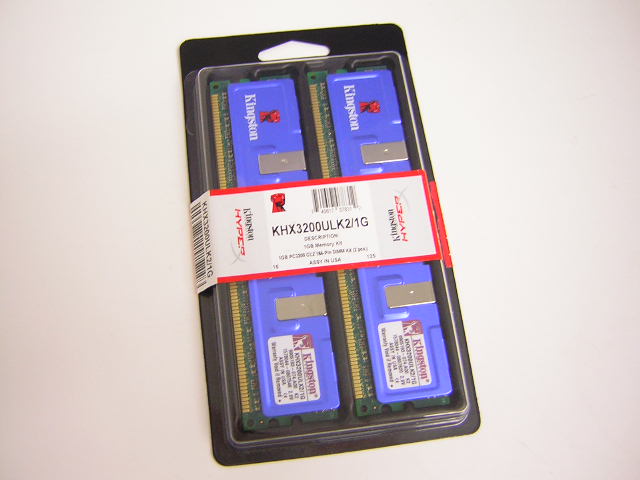
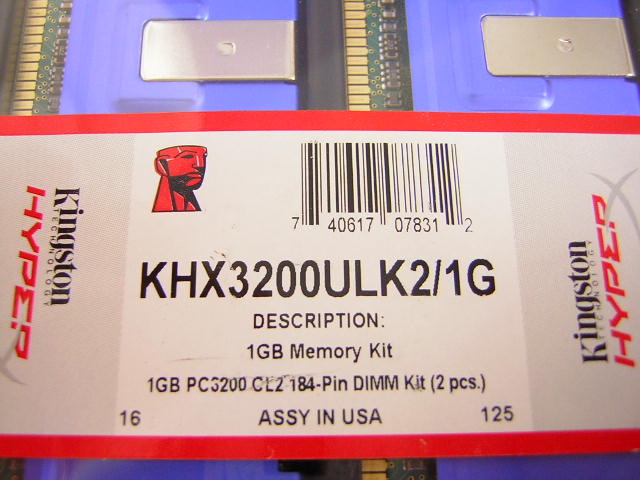
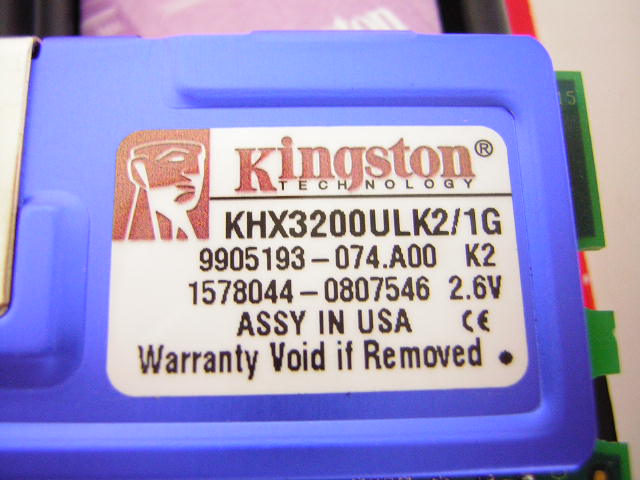
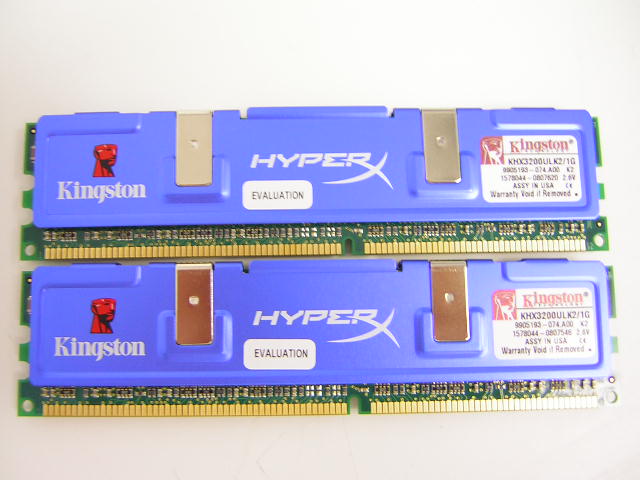
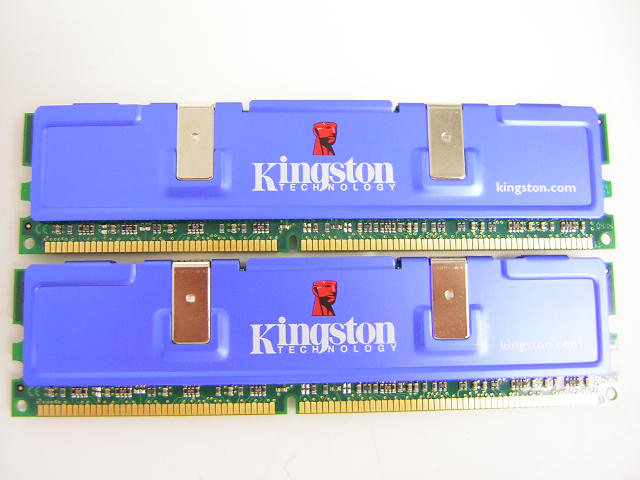
The memory kit is housed in Kingston’s typical plastic container. The blue heatspreaders have become Kingston’s trademark for their HyperX line. Blue is my favorite color so I’m a big fan of the way it looks. Like the dual channel kit of PC4300 we reviewed earlier, there was a simple instructions manual that included the warranty information. The sticker label shows that the memory is rated to run at 2.6v.
Test System and Overclocking
Test System:
- Intel 2.4C
- Asus P4C800-E (with droop mod)
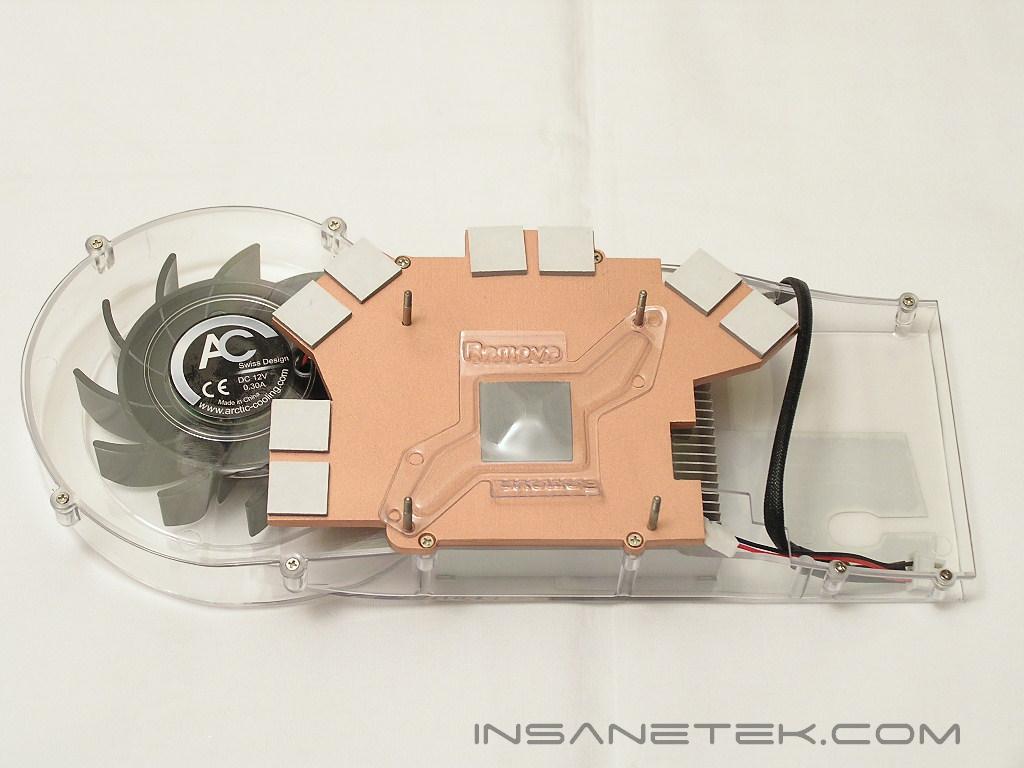
- BFG 6800GT (with NV Silencer 5)
- 2 x 512MB Kingston HyperX PC3200UL
- 2 x 512MB OCZ PC3200 Platinum Limited Edition (Winbond BH6)
- 2 x 512MB OCZ PC4000 Gold (Hynix BT-D5)
- OCZ DDR Voltage Booster
Overclocking:
Overclocking the memory was quite fun. Right from the start, I knew that the memory was capable of hitting at least 250FSB. There should be no reason why it wouldn’t run at 250FSB. It was just a matter of different configurations for frequencies between 200 and 250. From previous experience, Samsung chips are known to hate extra voltage. Most users would think that pumping extra juice would mean better results. That is wrong. Not all ICs can respond to voltage; and Samsung is the perfect example. With a bit of testing, I found 3.0v to be the highest the Samsung ICs would take. Any higher and the memory will error like a madman.
Keep in mind that during overclocking the latencies are as follows: CAS-TRCD-TRP-TRAS
My first run was to keep the timings as low as possible. Running 2-2-2-5 gave me the highest overclock of 220FSB. After a bit of researching, it seems these ICs tap out at around 215FSB, so 220FSB certainly wasn’t bad. I loosened the TRAS from 5 to 6 and gained no improvement. I proceeded to 2-3-2-6 and was able to gain an extra 5MHZ. I wasn’t all that impressed with the slight gain. Loosening the latencies again to 2-3-3-6 gave me much better results. I was able to run at 240FSB without any hiccups. Anything after 240FSB required me to run the latencies at 2.5-3-3-6. This is where Samsung chips fail to shine. The memory tapped out at 250FSB no matter what settings I used. I loosened to 3-4-4-8 and received no help. I increased voltage and didn’t get any further. My goal was to try to get 255FSB but failed no matter what I did. Once again, the Kingston memory was “considered” to be tapped out, leaving no extra headroom. The reason why I said it was considered to be tapped out is because of the labeling of the memory. As stated earlier, the ICs are supposed to run 250FSB 2.5-3-3-6. Manufacturers just label it to run 200FSB for the low latencies. So in the end, while the memory did overclock well past beyond the “labeled” speeds, it didn’t get any further from the “rated” speeds. Get my drift? This is definitely not aimed at Kingston, but to all manufacturers that use these Samsung ICs. This includes Corsair, OCZ, and Mushkin, to name a few.
Although these chips are supposed to run at 250FSB 2.5-3-3-6, I’ve been hearing many stories from people saying that they were not able to do so. Some claimed to have hit a good 270FSB while some couldn’t get past 230FSB. It’s just a matter of getting a good batch of Samsung chips. A quick chat with the Kingston Field Engineer revealed that the older batch of Samsung ICs were indeed better overclockers. The fortunate people who were able to get beyond 250FSB must be using these ICs. The newer chips weren’t as great and didn’t show much potential. This means that if you’re looking for memory such as this, you’d better get it fast before everyone starts to snatch up the good ones.
Overclocking Results:
- 200FSB 2.0-2-2-5 2.6v
- 220FSB 2.0-2-2-5 3.0v
- 225FSB 2.0-3-2-6 3.0v
- 240FSB 2.0-3-3-6 3.0v
- 250FSB 2.5-3-3-6 2.6v
Test Procedures and Methods:
A series of memory intensive benchmarks will be run to test the performance of our sample. The following tests will be based on common benchmark programs such as 3DMark and PCMark. Real life performance differences will be tested through current games such as Far Cry, UT2003, UT2004, and Halo. Memory bandwidth benchmarks will be based off of SiSoft Sandra and Aida32. Super PI will also be used to test memory performance, as the benchmark benefits largely from FSB increases.
Testing Setup:
Kingston HyperX PC3200UL:
- 200FSB 2.0-2-2-5 1:1
- 220FSB 2.0-2-2-5 1:1
- 225FSB 2.0-3-2-6 1:1
- 240FSB 2.0-3-3-6 1:1
- 250FSB 2.5-3-3-6 1:1
OCZ PC3200 Platinum Limited Edition:
- 200FSB 2.0-2-2-5 1:1
OCZ PC4000 Gold:
- 250FSB 2.5-4-4-7 1:1
Results
SiSoft Sandra

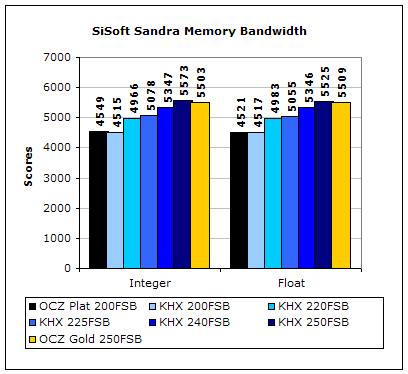
SiSoft Sandra is the most widely used memory bandwidth test. It can tell you the increase in performance from just lowering the latency timings. Looking from the graph above, you can see that the scores are similar between the notorious BH6 and the new Samsung F TCCD. Running it at the same speeds and latencies should yield similar scores. However, moving on to 250FSB, the Samsung F TCCD scores better than the highly overclockable Hynix chips. The slightly lower latencies helped to score a few extra points.
Aida32
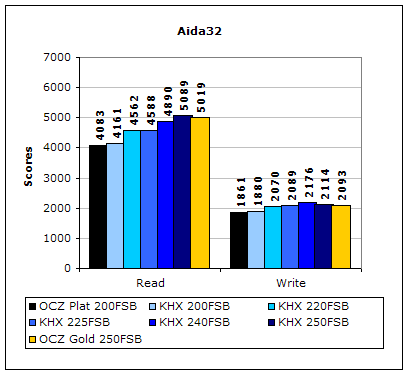
Much like Sandra, Aida32 tests the memory’s ability to read and write data in large chunks. The results are similar to the results in Sandra.
3DMark2001SE

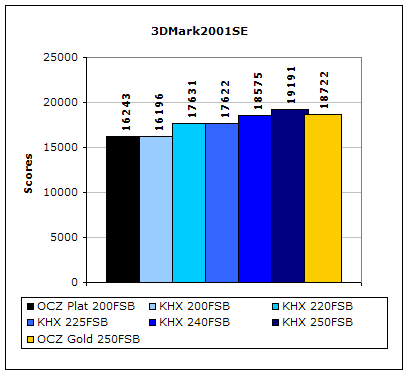
3DMark is probably the overclocker’s favorite benchmark. Unlike 3DMark2003, which stresses mainly the video card, 3DMark2001SE tests all of the system’s main components. Increasing the CPU speed, memory speed, and video card speeds will result in higher results in the final score. What is interesting is that running at 220FSB 2-2-2-5 yielded roughly the same score as running 240FSB 2-3-3-6. This shows that running tighter timings is really important as loosening TRCD and TRP to 3 required a boost in 20FSB to make up for the loss. Here we see that at 250FSB, the KHX3200UL scores higher than the Gold PC4000 due to tighter timings.
PCMark

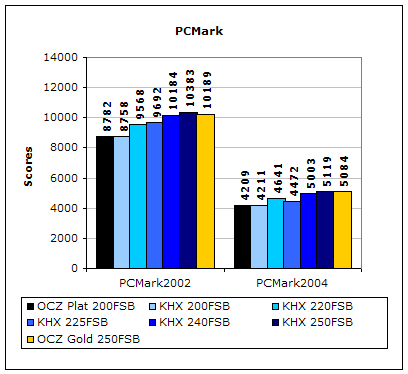
PCMark is another benchmark created by Futuremark. It tests the memory compression and decompression speeds in small to large chunks of data. As I predicted, the results follow the same pattern. The only thing worth mentioning is that the KHX3200UL scores better with 220FSB 2-2-2-5 than 240FSB 2-3-3-6. Once again, lower latencies provided better results. Other than that remark, there is nothing surprising here.
Results Continued
Far Cry
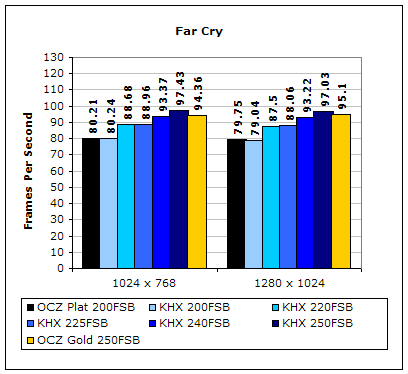
Far Cry is currently one of the most popular games and does a great job of taxing your system. Like the memory tests shown, the scores follow the same pattern. Running at 250FSB, the KHX3200UL produced an extra 2 frames per second due to the lower latencies. It’s certainly not bad. It’s also interesting to see that the frames per second obtained were similar in both resolutions. This just shows that my CPU is bottlenecking my video card.
Unreal Tournament 2004
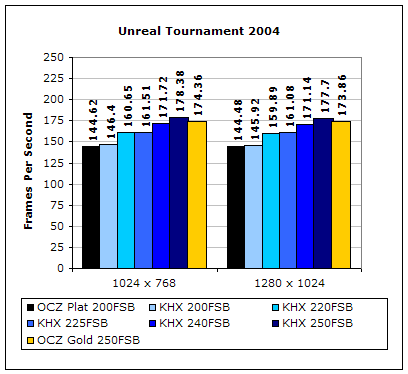
Unreal Tournament 2004 is another popular game that also doubles as a good benchmark. This game really likes memory bandwidth and it shows. The results were pretty much as expected.
Unreal Tournament 2003
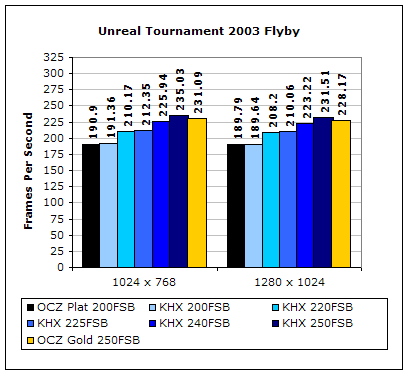
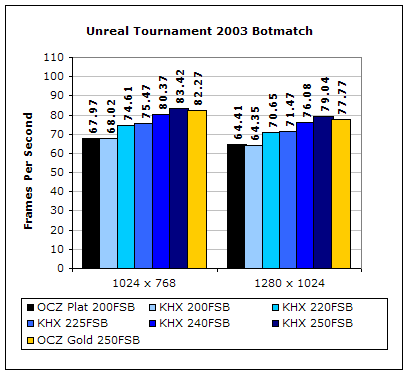
Although UT2K4 is out, UT2K3 is still a gamer’s choice and an overclocker’s benchmark. This game is more memory hungry than the younger brother. Much like the newer game, the performance results were similar.
Super PI
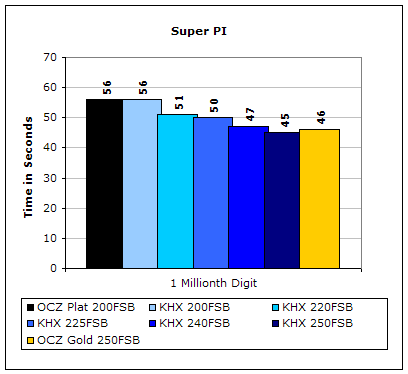
Since the value of PI is an infinite value, Super PI is a speed test to find the digit you’re looking for. In this case, we chose the millionth digit. Super PI benefits greatly from higher FSB as well as low latencies. Here you can see that the time continues to lower as FSB was raised. Once again at 250FSB, the KHX3200UL took the crown. The slightly lower latencies helped to earn a whole second over the OCZ Gold.
Conclusion and Thoughts
Kingston has done a great job at redeeming themselves from our last review. This new low latency memory proved itself to be a great performer. The performance was the same as the Winbond chips, and even better than the high clocking Hynix chips. Overclocking, on the other hand, is a different story. The Winbond chips were a must have for overclockers due to the fact that they were able to overclock high without the need to sacrifice the latencies, provided that you feed it enough voltage. The Hynix chips can achieve insanely high megahertz, provided that you loosen up the timings. The Samsung F TCCD story is that it sits in the middle of these two great chips. It can run low latencies at 200FSB like the Winbond, and can overclock high to 250FSB like the Hynix without much voltage. It brings in the best of both worlds. It’s just as good as Winbond at 200FSB, and just a little better than the Hynix at 250FSB. So why doesn’t this deserve the Must-Have award? The answer lies within the overclocking potential. You would think that a chip rated to run 4ns would yield pretty decent overclocking results, but I found it untrue. Unlike the Winbond chips, the Samsung F TCCD doesn’t respond well to increased voltage, and requires looser timings in order to increase FSB. Although running 2-3-3-6 is fairly good in a typical system, it’s not as great as running 2-2-2-5. Unlike the Hynix chips, the Samsung F TCCD doesn’t clock high when timings were loosened. The sample stopped at 250FSB no matter what I did. Loosening timings and increasing voltage didn’t help. The ICs were pretty much at their peak; but running 250FSB at 2.5-3-3-6 is definitely nothing to scoff at. To sum it up, the Samsung F TCCD doesn’t excel in any department in terms of overclocking. It brings in great performance when you sit between the 200-250FSB range. If the KHX3200UL was able to clock higher, it definitely would’ve deserved the Must-Have award.
Pros:
- Blue anodized aluminum heatspreaders
- Price is cheaper compared to competitors
- Runs great at 200FSB 2-2-2-5
- Able to keep CAS latency of 2 up to 240FSB
- Does not require high voltage to overclock
- Overclocks great past “labeled” speeds
- Excellent performance
Cons:
- No overclocking potential after “rated” IC speeds
- Unable to maintain low latencies of 2-2-2-5 after 220FSB

We would like to thank Kingston for providing us the sample. If you have any questions or comments, feel free to hit us up in the forums. You can also check out more of our latest reviews on the front page.