

Crucial Ballistix PC4000 2GB Dual Channel Kit
Introduction

Crucial has always been a key player in the memory industry and has provided exceptional memory for both the niche overclocking crowd and the general mass user. Their Ballistix line targets the enthusiasts who look for high performance from their memory modules. The Ballistix provides low latencies and also comes with great overclocking potential. While the Ballistix 1GB dual channel kit does not overclock as well as the more prominent TCCD based memory, it does provide some good competition. The Ballistix Tracer PC4000 was able to overclock very well and also came with flexible timings to allow different speed/latency combinations.
Much like everyone else, Crucial reacted quickly to the demand for 2GB system memory. They did not just release an initial part rating of PC3200. Instead, they released a high speed part with a PC4000 rating. Such a move from Crucial is considered a big step forward in the memory industry. Unlike other memory companies, Crucial ONLY uses Micron ICs for their memory. The fact that they can produce such high speed memory with certain high density chips from one IC maker is actually quite amazing. Knowing Crucial, such a feat should not have posed too much of a problem.
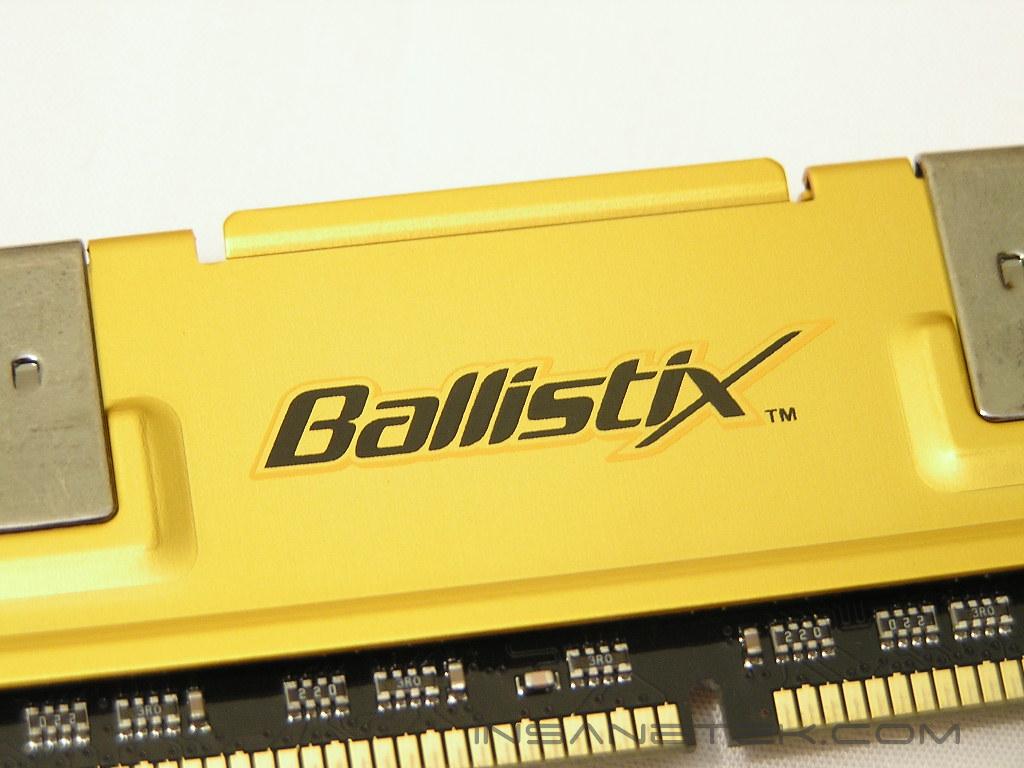
Crucial Ballistix PC4000 2GB
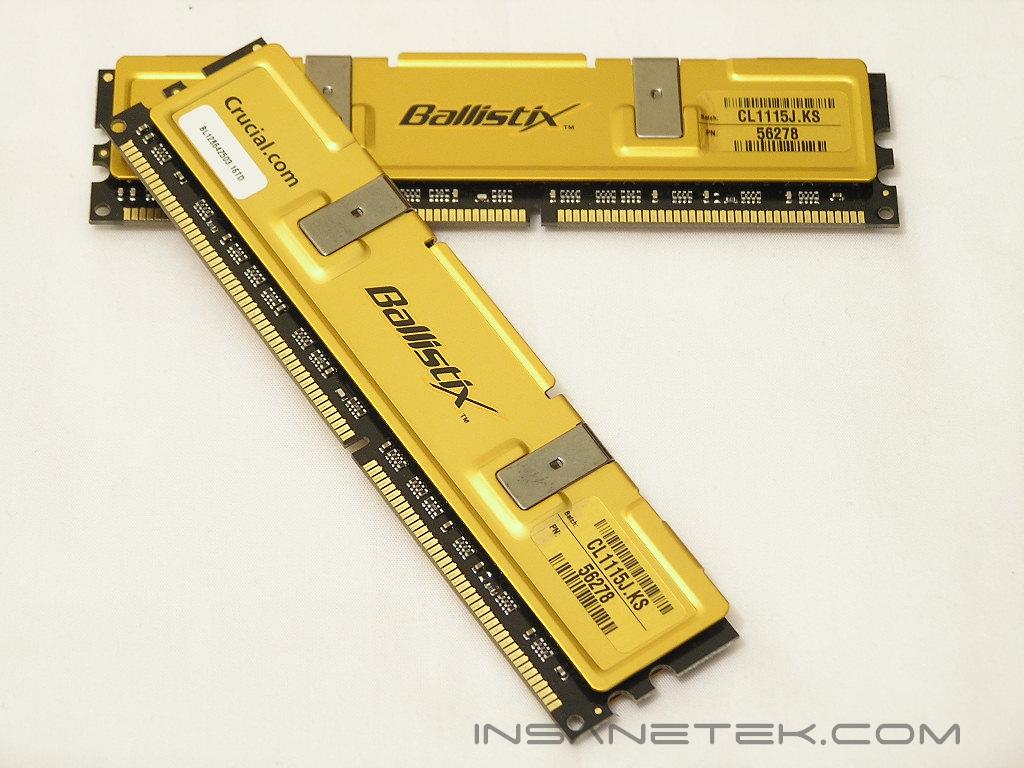
The Ballistix came packed in a simple anti-static bag and a cardboard box. There was no fancy artwork or packaging details. All that really matters is that the memory arrives safe and sound. Like the rest of the Ballistix memory, the PC4000 2GB comes with aluminum heatspreaders in a gold color finish. The color is dull and is not reflective like the OCZ Gold line of memory. The gold color heatspreader comes paired with attractive black PCB.
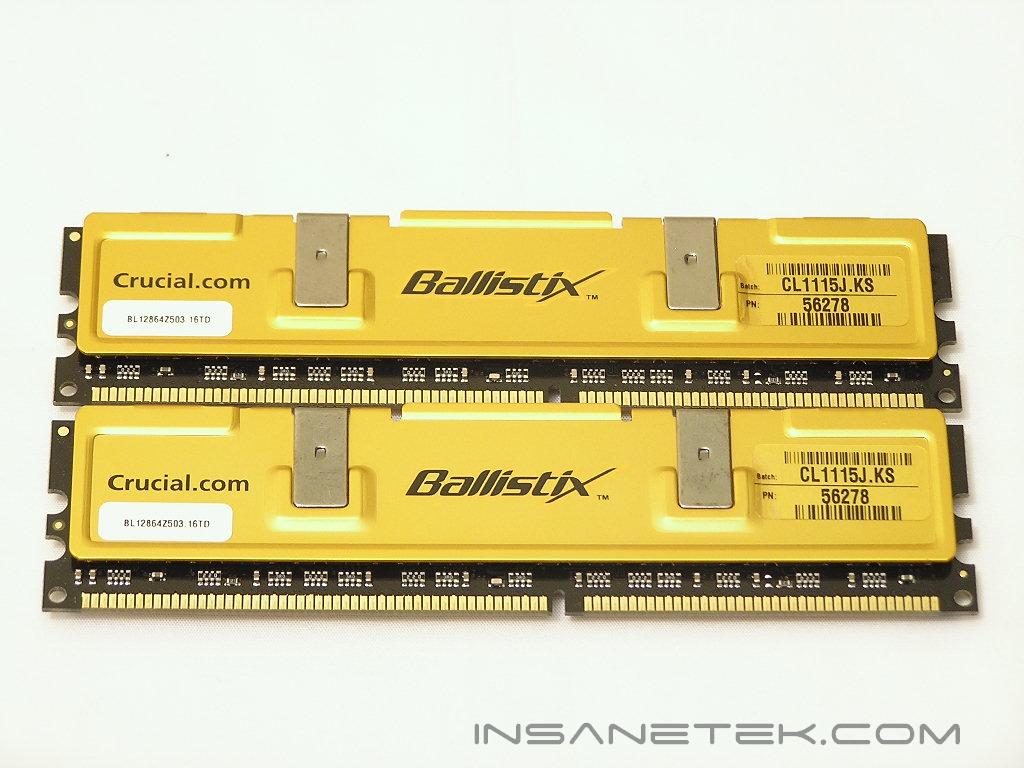
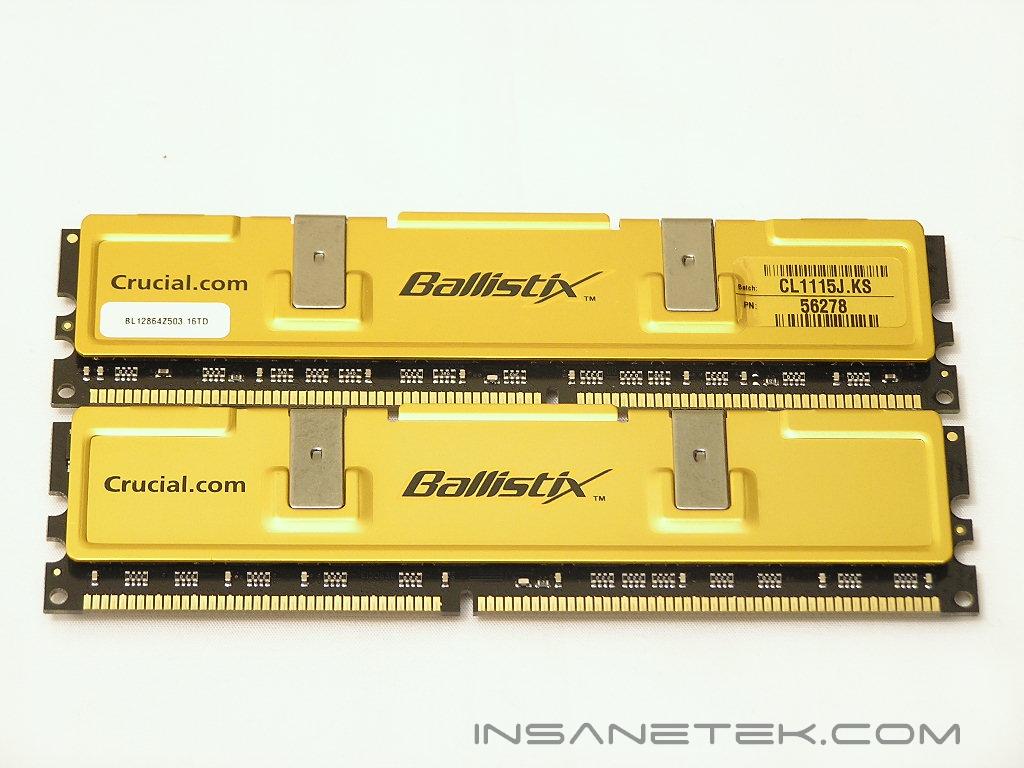
The Ballistix PC4000 2GB is rated to run 250MHz with timings of 3-4-4-8 and a voltage of 2.8v. The memory ICs used to power the high speed memory are none other than Micron’s -5b D chips. These chips have received a lot of praise lately due to their ability to overclock highly without excessive voltages. The sample I received had Z503 on the part number labels.
Test System and Overclocking
Test System:
- AMD Athlon 64 3000+ Venice
- DFI LANParty UT nF4 Ultra-D
- 2 x 1GB Crucial Ballistix PC4000 2GB
- ATI Radeon X800XT
- Arctic Cooling Freezer 64
- Thermaltake PurePower 680W
- BIOS 623-3 and orange slots
Overclocking:
Keep in mind that during overclocking, the latencies are as follows: CAS-TRCD-TRP-TRAS
As always, the first test begins with achieving the lowest latencies possible at 200MHz. Much to my surprise, the Ballistix PC4000 2GB was able to run extremely tight timings of 2-2-2-5 all with just 2.8v! This is definitely a first as the other 2GB solutions were only able to run as low as 2-3-2-5. I am already impressed. Sadly, the memory would not budge at all with these low latencies. I had to loosen to 2-3-2-6 before reaching 205MHz. Loosening the TRP to 3 did not help at all. I was stuck at 205MHz. With average latencies of 2.5-3-3-7, the memory jumped nicely to 240MHz. That is not the highest I have seen with average latencies, but it isn’t bad. It was only about 10MHz away from the rated speed of 250MHz. Next up was loosening the CAS to 3. With timings of 3-3-3-8, the memory soared like an eagle. It took off all the way to 295MHz. At this point I was drooling. I pushed further and reached a max of 300MHz. This required me to bump the voltage from 2.8v to 3.1v. 2GB memory modules running at 300MHz with great timings is just unheard of. I tried loosening the timings to 3-4-4-8 and did not receive additional gains. Honestly, who can complain about running 300MHz at 3-3-3-8???
Overclocking Results:
- 200MHz 2.0-2-2-5 1T 2.8v
- 205MHz 2.0-3-2-6 1T 2.8v
- 240MHz 2.5-3-3-7 1T 2.8v
- 295MHz 3.0-3-3-8 1T 2.8v
- 300MHz 3.0-3-3-8 1T 3.1v
Results
A series of memory intensive benchmarks will be run to test the performance of our sample. The other tests will be based on common benchmark programs, such as 3DMark and PCMark. Real life performance differences will be tested through current games, such as Far Cry and UT2004. Memory bandwidth benchmarks will be based off of SiSoft Sandra and Everest Home Edition. Super PI and PiFast will also be used to test memory performance, as the benchmark benefits largely from FSB increases.
SiSoft Sandra Memory Bandwidth
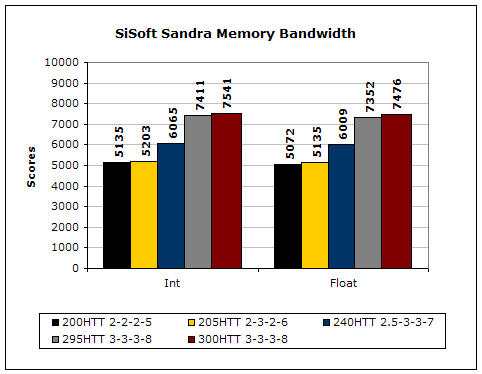
SiSoft Sandra is the most widely used memory bandwidth test. It can tell you the increase in performance from just lowering the latency timings.
Everest Home Edition
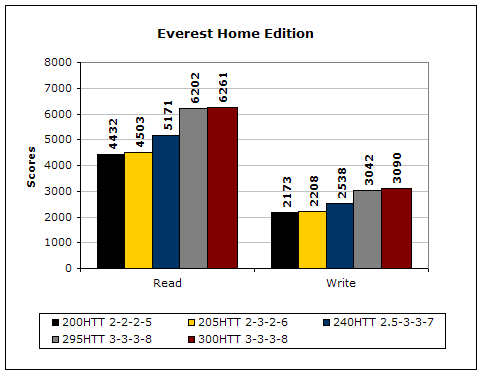
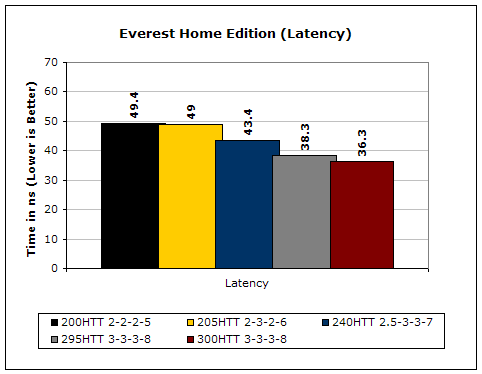
Much like Sandra, Everest Home Edition tests the memory’s ability to read and write data in large chunks. The results show that the lower latencies seem to help just a little with performance.
3DMark2001SE
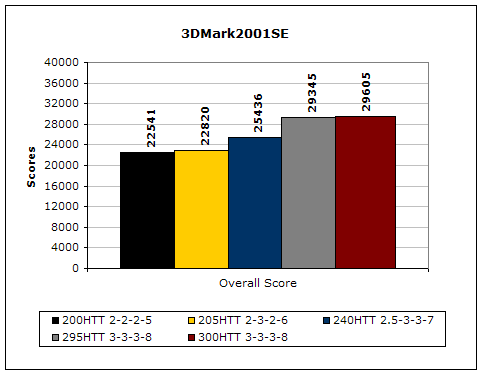
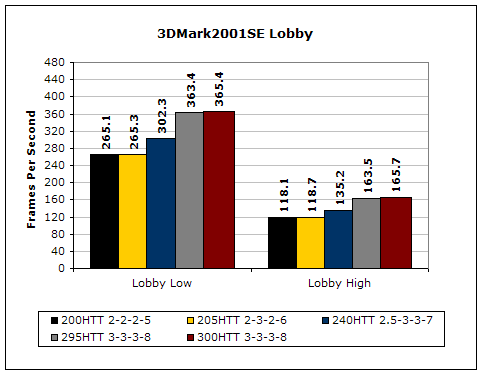
3DMark is likely the overclocker’s favorite benchmark. Unlike 3DMark2003, which stresses mainly the video card, 3DMark2001SE tests all of the system’s main components. Increasing the CPU speed, memory speed, and video card speeds will result in higher results in the final score.
Results Continued
Far Cry
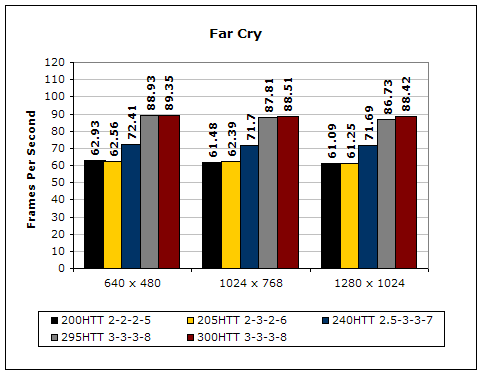
Since Far Cry is a game, the performance results will be very similar to 3dMark2001. I ran the benchmark at 640x480, so the benchmark would not be too GPU dependent. The tests under 1024x768 and 1280x1024 are an approximation of what kind of frames you’ll be getting. While the results are similar to 3dMark2001 in performance, this benchmark will give more significant results, because Far Cry is a lot more demanding.
Unreal Tournament 2004
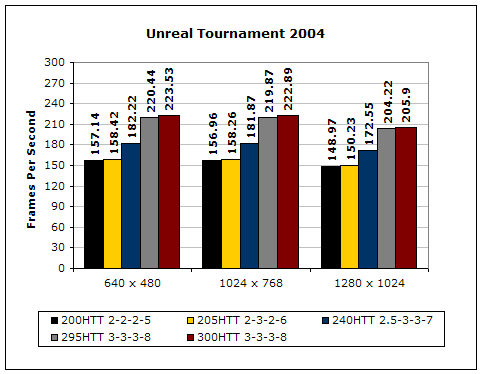
Unreal Tournament is another popular game engine to test overall system performance. Here, we can see the same results as Far Cry and 3dMark2001. Like Far Cry, UT2004 was also run at 640x480 to limit GPU dependency. The other resolutions provide an approximation of actual game play performance.
PCMark2002
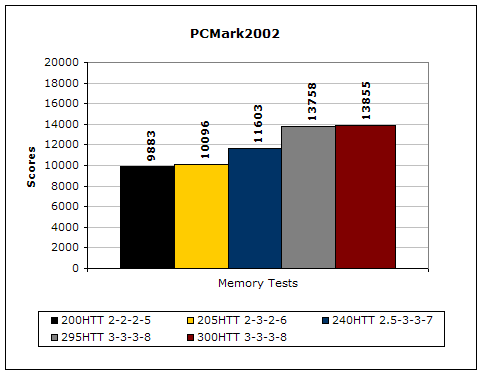
ark is another benchmark created by Futuremark. It tests the memory compression and decompression speeds in small to large chunks of data.
Super PI
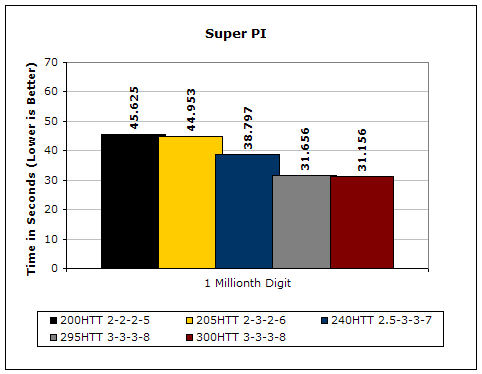
Since the value of PI is an infinite value, Super PI is a speed test to find the digit you’re looking for. In this case, we chose the millionth digit. Super PI benefits greatly from higher FSB, as well as low latencies.
PiFast
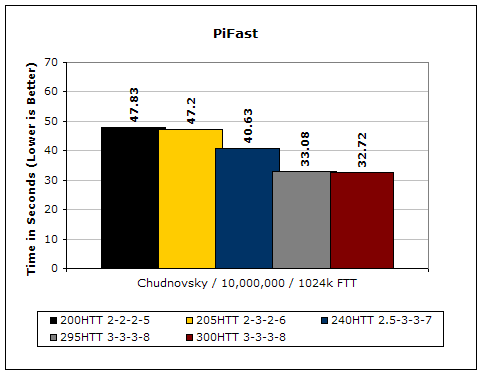
PiFast is similar to Super PI. The results can be greatly affected by a slight adjustment to the memory megahertz and latency.
Conclusion and Thoughts
This conclusion might seem a bit short, but that’s because these Ballistix PC4000 2GB left me speechless. In a good way. These sticks are simply amazing. The memory is the first 2GB kit that I’ve seen that was capable of overclocking to the 300MHz barrier, and it got there with ease. Perhaps the only downside to these modules is that a slightly higher voltage is required for extreme overclocking. Even if your motherboard does not supply above 2.8v, you can still end up with screaming fast speeds. Crucial has blown me away with their 2GB solution. The rest of the competitors can hardly come close to what Crucial has to offer. There is no reason for you to purchase anything else. The price tag of this kit is hangs around the $300 mark, making it only a bit more expensive than high speed 1GB kits. What else are you waiting for? Go out there and get these NOW. Congratulations Crucial. You have done an exceptional job in meeting the needs of the enthusiasts. I am proud to announce you as our first winner of our Essential Award.
Pros:
- Attractive black PCB
- Runs extreme low latencies of 2-2-2-5 at 200MHz
- AMAZING overclocking potential, even with just 2.8v
- Very affordable
Cons:
- Requires a little bit more voltage to reach maximum overclock

We would like to thank Crucial for providing us the sample. If you have any questions or comments, feel free to hit us up in the forums. You can also check out more of our latest reviews on the front page.