

Crucial Ballistix PC2-5300 1GB Dual Channel Kit

Introduction
Not many people are aware that Crucial Technology is a sub-division of Micron Technology. Micron is an extremely popular memory chip manufacturer, providing chips with excellent performance and stability. Crucial Technology takes those chips and implements them on a PCB to make great memory. Crucial never targeted gamers until now. Rather, their focus was stability and compatibility. With the release of their new Ballistix line, Crucial is reaching out to gamers. Additionally, Ballistix is available in DDR and DDR2. Many enthusiasts were forced to jump to Intel to get the new PCI-E performance, which offers no real distinguished performance increase right now. To compensate for the “slow” processing performance, DDR2 was necessary. It’s true that DDR2 comes with high latencies, but it does provide great bandwidth. Like the recently reviewed Kingston HyperX PC2-5400, the Ballistix offers the lowest latencies available at ultra high frequencies.
Crucial Ballistix PC2-5300
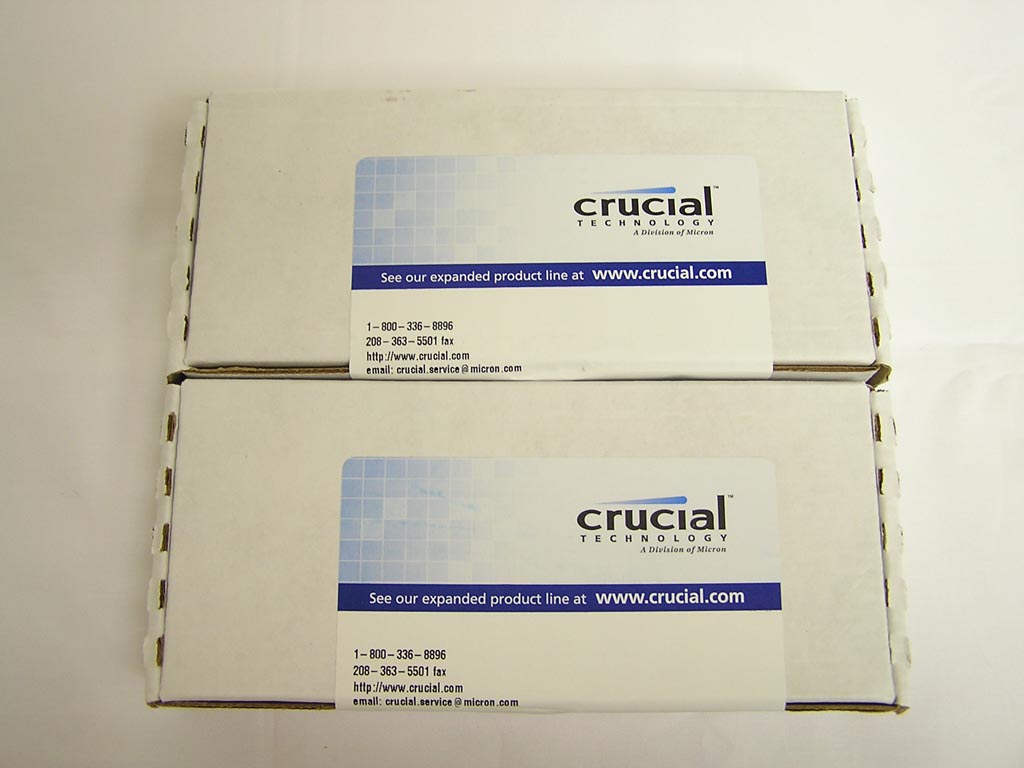
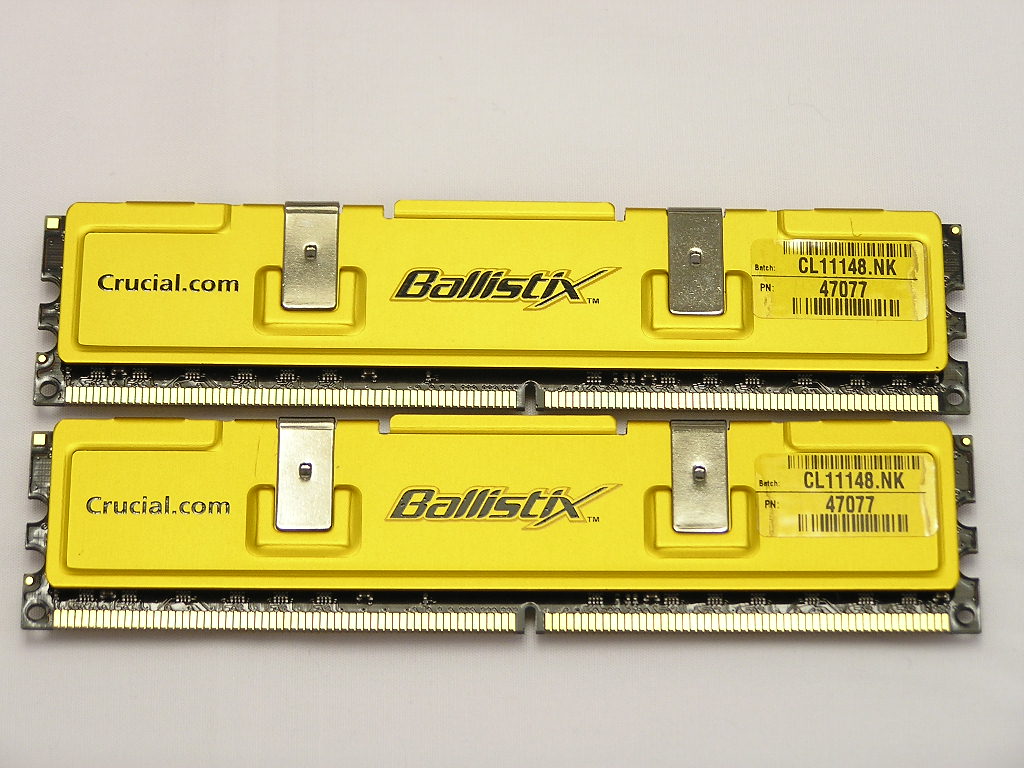
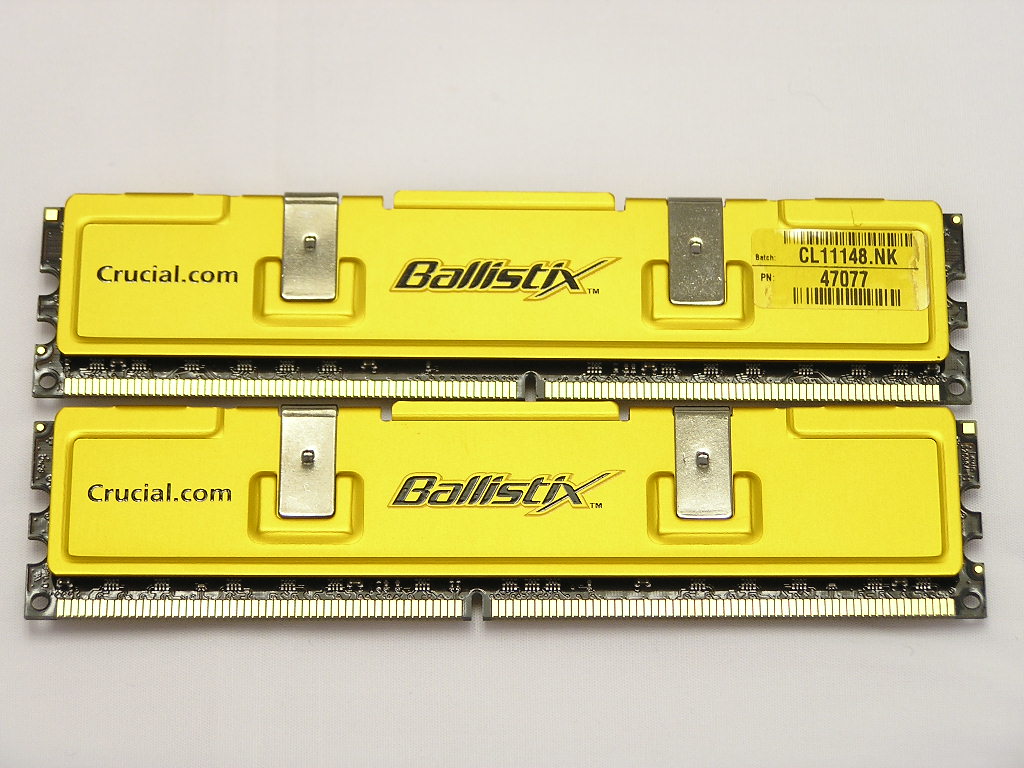
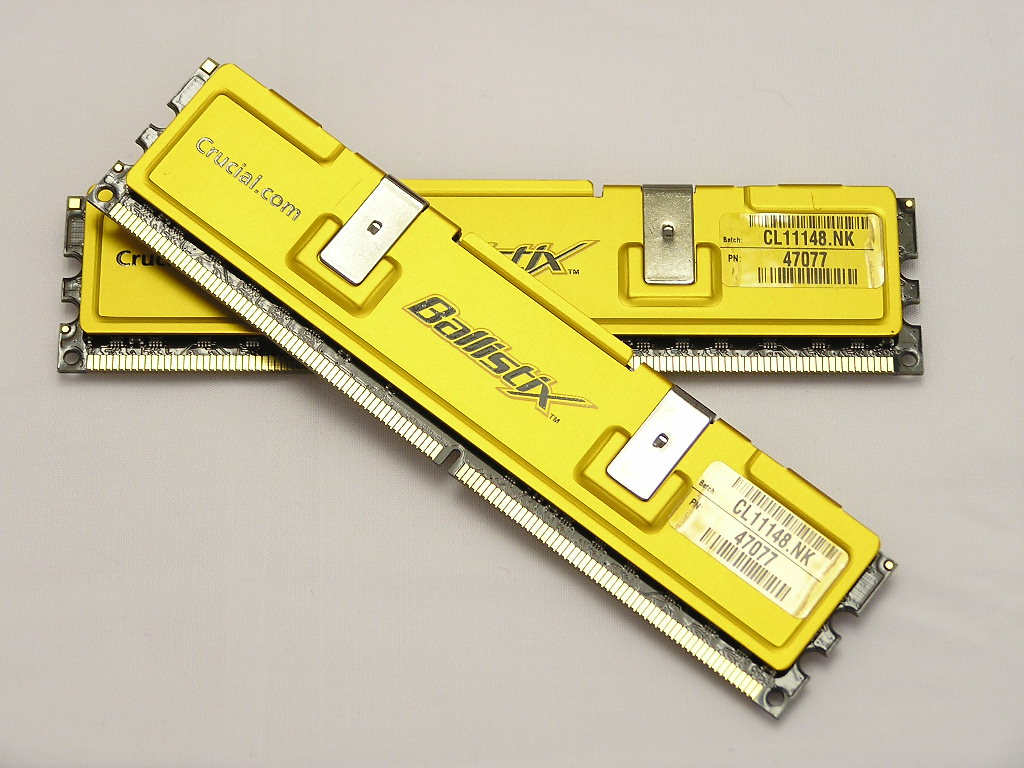
The Ballistix comes in the usual Crucial packaging of a cardboard box and static bag. Currently, most memory ships with plastic packaging that provides no protection from static. Like the regular Ballistix DDR, the Ballistix DDR2 comes with yellow aluminum heatspreaders and black PCB. Black PCB is a nice change from the plain looking green PCB that we’re all used to. Motherboards have gone from the old sand color to vibrant colors like blue, red, black, and even purple. Why can’t they do the same for memory? There’s certainly less PCB to cover.
The Ballistix PC2-5300 comes rated a little slower than the Kingston HyperX PC2-5400 and the Corsair XMS2-5400PRO. With a rating of PC2-5300, the frequency of the memory is rated at DDR663 or 331MHZ. Just like the Kingston HyperX PC2-5400, the latencies are rated to be 4-4-4-10 but require 1.9v. From the start, the Ballistix is already behind. Unlike the KHX2, the Ballistix2 (a name I made up for Ballistix DDR2, just like KHX2) does not come in single sided memory configuration. Single sided memory is preferable for overclockers. According to my sources, there are three kinds of DDR2 chips floating around. There are three physical sizes; A standard BGA (the same size as the BGA chips found on graphic card memory), long rectangular, and slightly wider and thicker “fatty” chips. The “fatty” chips are actually the best chips because they are capable of running latencies as low as 3-2-2-5 at 266MHZ. These “fatty” chips are manufactured by Micron, and I was hopeful that the Ballistix2 would use these chips. Unfortunately, the Ballistix2 came with regular Micron chips that were smaller in size. Sources say that the “fatty” Micron chips will be discontinued due to the push for smaller form factors. It’s really a shame.
Note that Crucial does not offer dual channel kits. Dual channel is motherboard dependent and making a purchase of 2 separate sticks will enable dual channel. Buying dual channel kits only ensures compatibility, but Crucial only uses Micron chips. You’ll run into no problems whatsoever.
Test System and Overclocking
Test System:
- Intel Pentium 4 520 2.8GHZ
- Abit AA8-Duramax
- 2 x 512MB Crucial Ballistix DDR2 PC2-5300
- 2 x 512MB Kingston HyperX DDR2 PC2-5400
- ATI X800XT PCI-E
- Ultra Products 600W
Overclocking:
Keep in mind that during overclocking, the latencies are as follows: CAS-TRCD-TRP-TRAS
From the recent review of the Kingston HyperX2, we can see that the limiting factor is the motherboard. However, 265FSB is nothing to scoff at. As usual, I started out by finding the lowest timings the memory would allow. At 266MHZ, PC2-4200 speeds, the lowest timings allowed were 3-3-3-8. These are the same results as the Crucial Ballistix2 PC2-4200, with the Ballistix2 PC2-4200 at 3-3-3-10. Unfortunately, the memory would refuse to function with the slightest increase in megahertz. Thus the highest frequency with the lowest latencies was only 266MHZ. The next step was to find the lowest timings possible at the rated frequency. The memory is rated at PC2-5300, or 331MHZ, but I found it to run at 337MHZ without a problem. Why? For the sake of simplicity and equality in comparison, I let the Ballistix2 run at 337MHZ to compare it to the KHX2 at the same level. At 337MHZ, PC2-5400, the memory was able to drop to 4-4-3-10 timings. With the timings loosened to the specified latencies, the memory reached the highest frequency possible that my motherboard allowed. Running the FSB at 265MHZ and a divider of 3:4, the memory was running at a frequency of 354MHZ or DDR708. All the results obtained were with the voltage of 1.9v, which is the rated voltage of the PC2-5300. Increasing the voltage did not help with overclocking results and sometimes caused additional instability.
Overclocking Results:
- 200FSB 3:4 266MHZ 3-3-3-8 1.9v
- 253FSB 3:4 337MHZ 4-4-3-10 1.9v
- 253FSB 3:4 337MHZ 4-4-4-10 1.9v
- 265FSB 3:4 354MHZ 4-4-4-10 1.9v
Results
A series of memory intensive benchmarks will be run to test the performance of our sample. The other tests will be based on common benchmark programs such as 3DMark and PCMark. Real life performance differences will be tested through current games such as Far Cry, UT2003, UT2004, and Halo. Memory bandwidth benchmarks will be based off of SiSoft Sandra and Aida32. Super PI and PiFast will also be used to test memory performance, as the benchmark benefits largely from FSB increases.
SiSoft Sandra
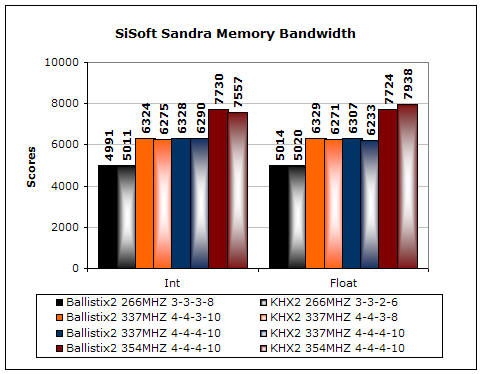
SiSoft Sandra is the most widely used memory bandwidth test. At the same rated speed, the lower latencies did not help memory bandwidth all that much. SiSoft Sandra seems to favor the higher frequencies when it comes to DDR2 memory. The Ballistix2 wins most of the time over the KHX2.
Aida32
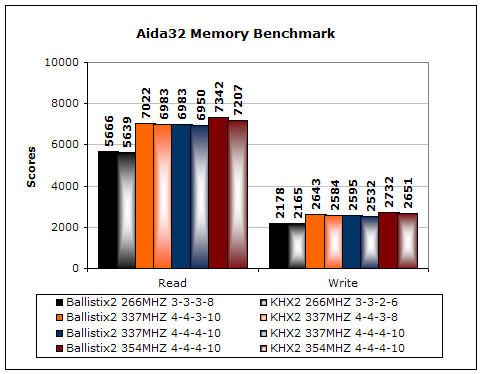
Much like Sandra, Aida32 tests the memory’s ability to read and write data in large chunks. The results show that the lower latencies seem to help just a little with performance. Much like Sandra, the Ballistix2 seems to lead in the results.
3DMark2001SE
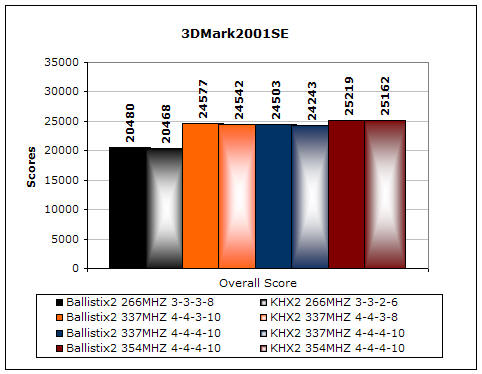
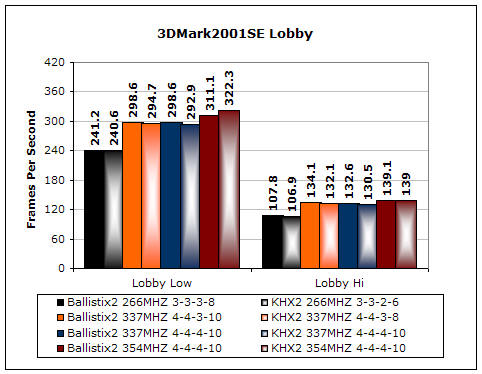
3DMark is probably the overclocker’s favorite benchmark. Unlike 3DMark2003, which stresses mainly the video card, 3DMark2001SE tests all of the system’s main components. Increasing the CPU speed, memory speed, and video card speeds will result in a better final score. The lower latencies definitely helped to squeeze out more points and frames. Once again, the Ballistix2 took the lead.
PCMark
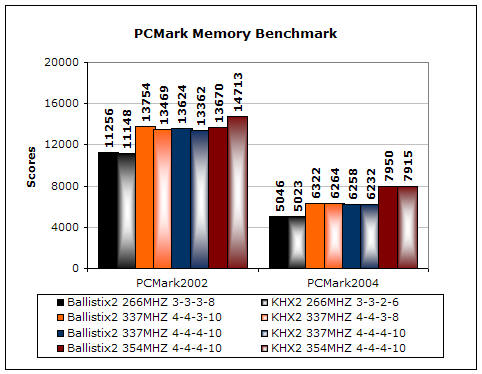
PCMark is another benchmark created by Futuremark. It tests the memory compression and decompression speeds in small to large chunks of data. For reviewing and testing memory, only the PCMark Memory Benchmark is selected. The score does not reflect the PCMark overall system score, but only the memory scores.
Doom 3
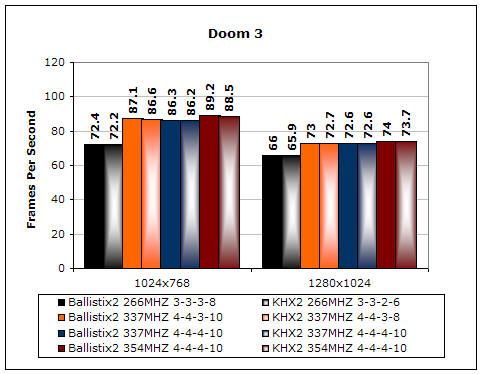
Although Doom 3 is known to be more graphic dependent than system dependent, the game responds positively when latencies are lowered and system bus is increased.
Results Continued
Far Cry
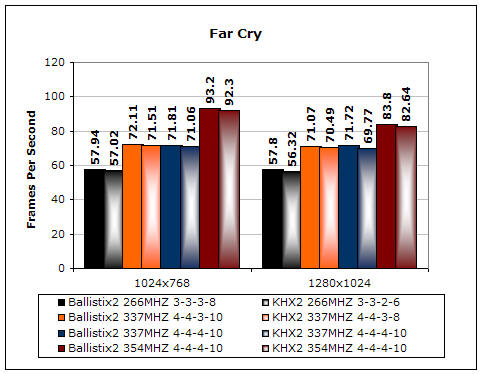
Far Cry is currently one of the most popular games and does a great job of taxing your system.
Unreal Tournament 2004
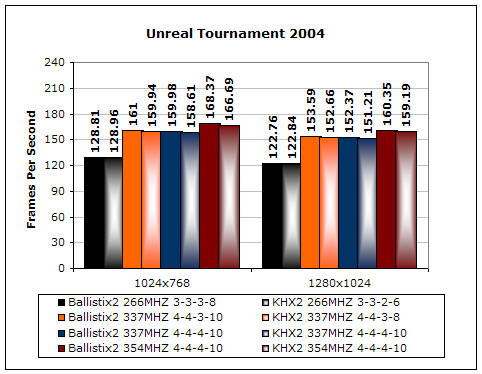
Unreal Tournament 2004 is another popular game that also doubles as a good benchmark. This game really likes memory bandwidth and it shows.
Super PI
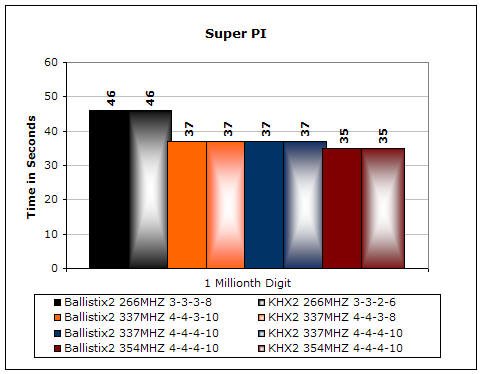
Since the value of PI is an infinite value, Super PI is a speed test to find the digit you’re looking for. In this case, we chose the millionth digit. Super PI benefits greatly from higher FSB as well as low latencies. In this case, both memory performed exactly the same, which should be the case.
PiFast
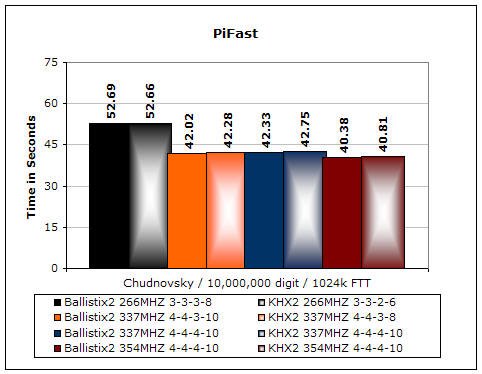
PiFast is similar to Super PI and the results can be greatly affected by a slight adjustment to the memory megahertz and latency.
Conclusion and Thoughts
The Crucial Ballistix2 provides even better performance than Kingston’s HyperX2, but comes with the ugly price tag of $174 for each 512MB stick. Because gaming systems now run with at least 1GB of system memory, this would bring the total cost of two sticks to roughly $350. Compared to the HyperX2, the price of the slightly faster Ballistix2 is roughly $50 more. For enthusiasts who want the best performance possible, the Ballistix2 are a great choice. For users on a budget, the HyperX2 is an excellent alternative. Personally, I would sacrifice the performance for the price. I’m not made of money and I’m sure that most of you aren’t either. However, the Crucial Ballistix PC2-5300 deserves a good recommendation for its better performance.
Pros:
- Beautiful yellow and black color combination
- High frequency rating with decent latencies
- Extremely stable
- Crucial customer service and lifetime warranty
- Great overclocking potential
Cons:
- More expensive than most competitors

We would like to thank Crucial for providing us the sample. If you have any questions or comments, feel free to hit us up in the forums. You can also check out more of our latest reviews on the front page.