

Corsair XMS2 TWIN2X1024-5400UL 1GB Dual Channel Kit
Introduction
The main reason why DDR2 memory was so disappointing during the beginning launch was because of the extremely loose latencies. Even with the benefit of carrying twice the amount of data back and forth, DDR2 simply could not keep up with DDR in terms of performance. It was quite hard to justify the need to move on to DDR2 when the performance was so lacking. Fortunately for enthusiasts, Corsair was the first to discover the great potential in Micron fatbody D9s. These chips are amazing. It ran extreme low latencies and responded very well to increased voltages. The lower latencies gave an incredible boost in performance, easily surpassing the performance of regular DDR. Not only did Corsair had the first DDR2 memory to run extreme low latencies, they were also the first to break the 1GHz barrier. Talk about killing two birds with one stone!
A little after the release of the 5400UL, Corsair announced the release of the 8000UL. The Corsair PC2-8000UL was the best DDR2 I have laid hands on. It was amazing. It overclocked extremely well with extreme low latencies and easily broke past the 1GHz barrier with slightly looser timings, with timings tighter than rated. The goal of the 8000UL was to run 1GHz with timings of 5-4-4-9. If it was able to run extreme low latencies, then why is Corsair still pushing their PC2-5400UL? The reason is that the 5400UL aims for the lowest latencies possible. My first thought was that it was made to be the best DDR2 memory in the tight timings crowd. Is it true?
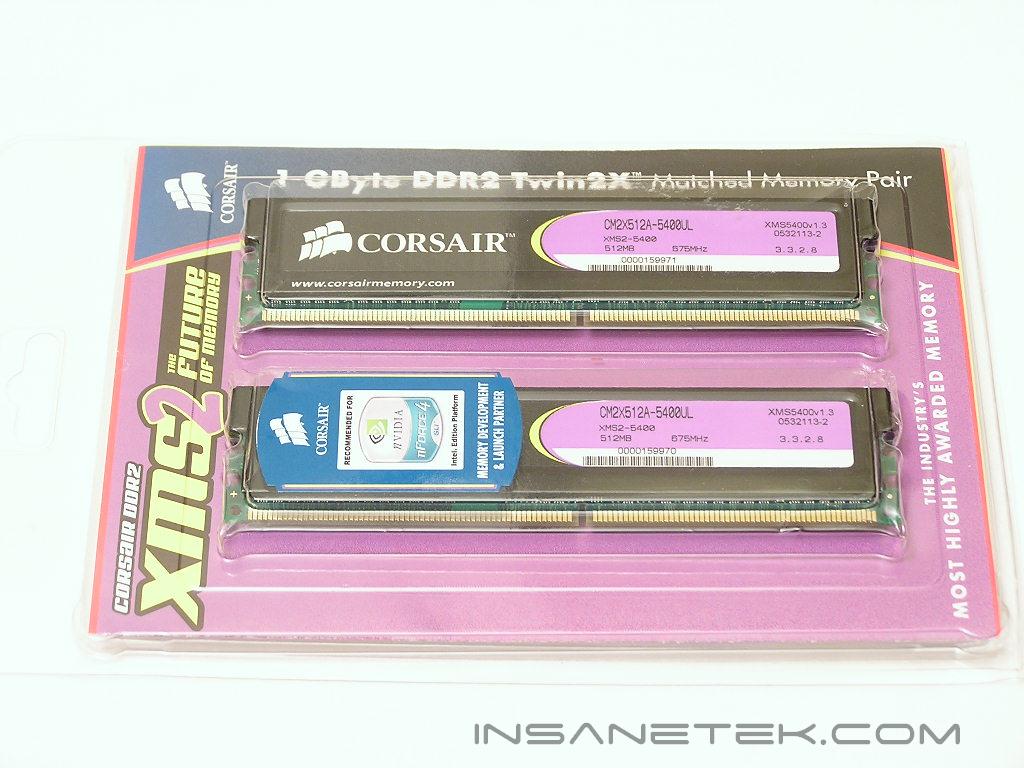
Corsair XMS2 PC2-5400UL
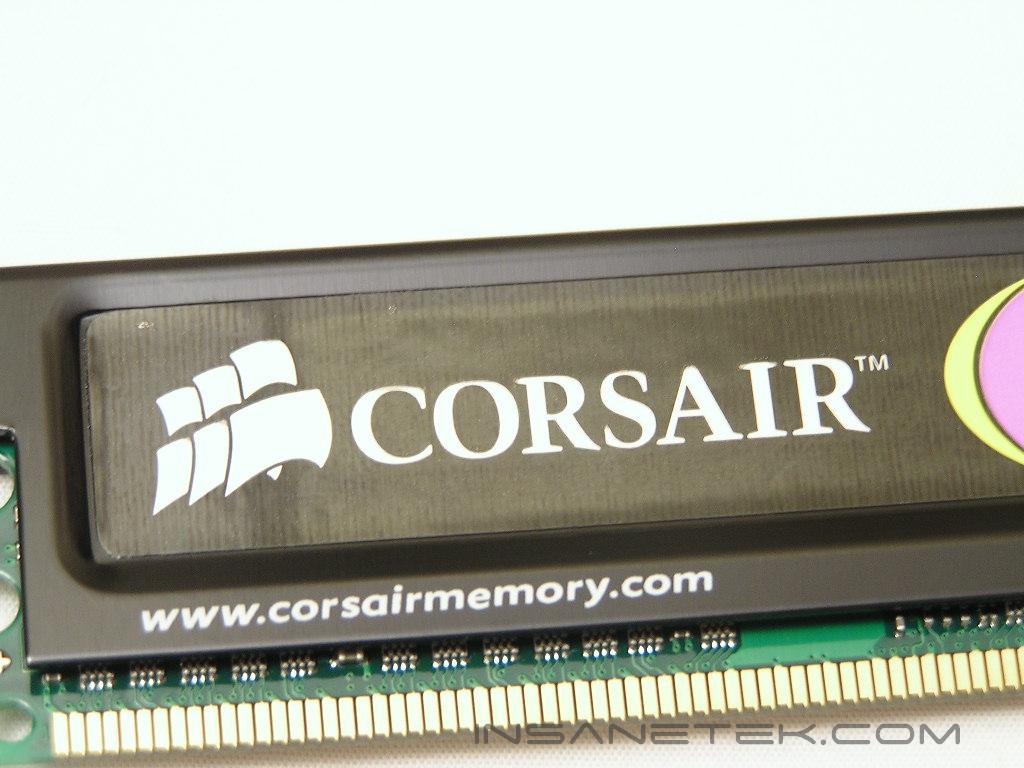
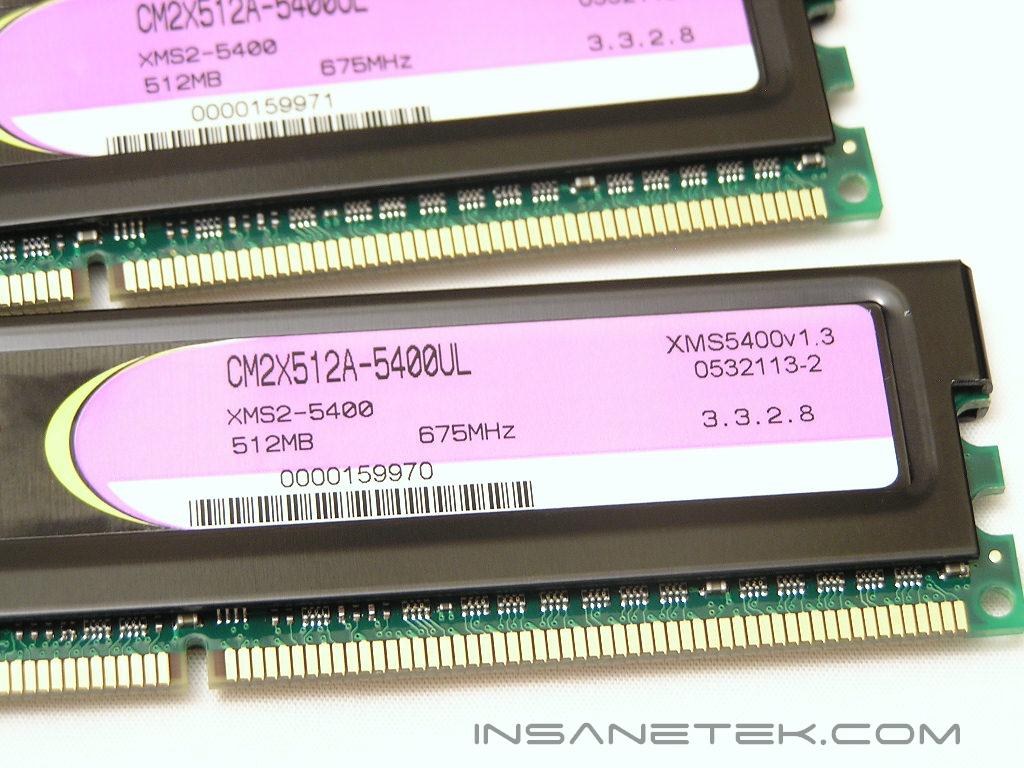
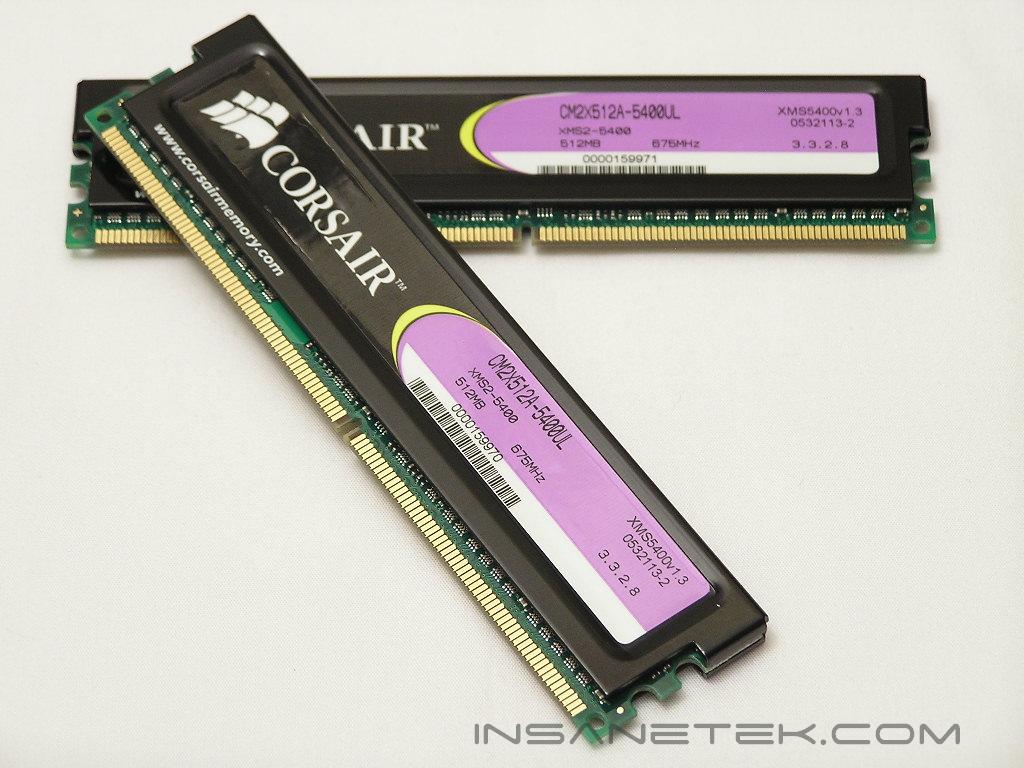
As with all the rest of Corsair’s memory, the PC2-5400UL came in a clamshell package with Corsair’s 2004 insert. The PC2-5400UL continues to use the typical black heatspreaders that Corsair has been using for the past ten million years. The DDR2 line just comes with no clips. Instead of using thermal tape between the heatspreader and the memory ICs, Corsair uses some kind of thermal adhesive. This prevents the heatspreaders from coming off. Don’t even bother trying to remove the heatspreaders. You will end up destroying your modules.
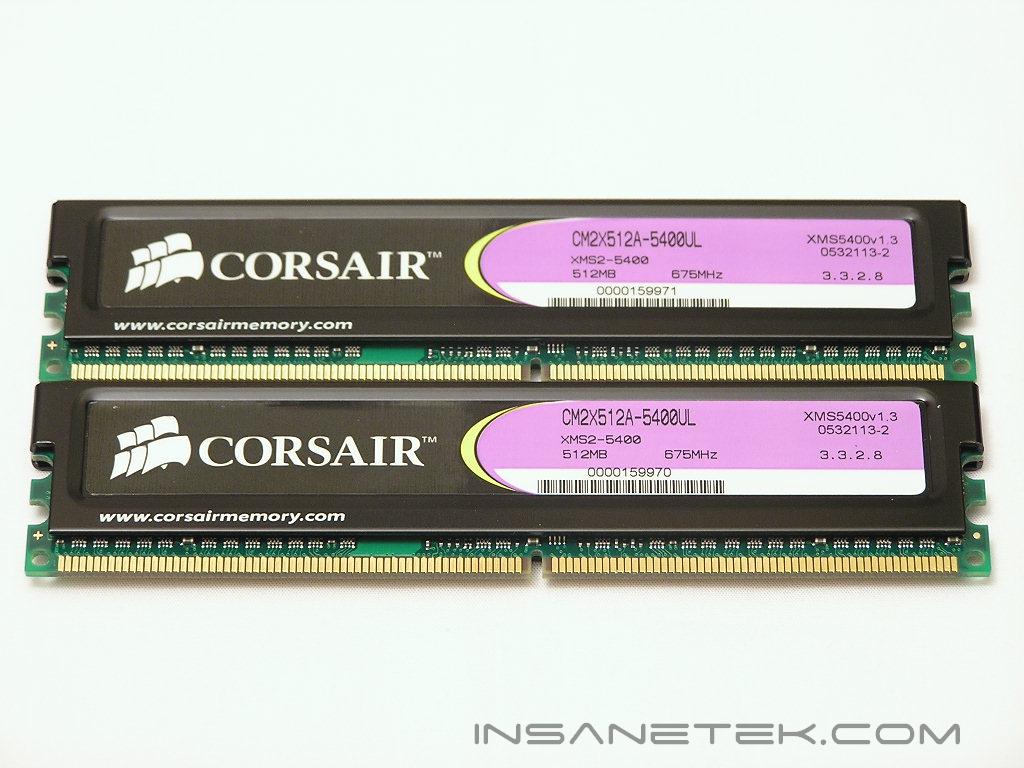
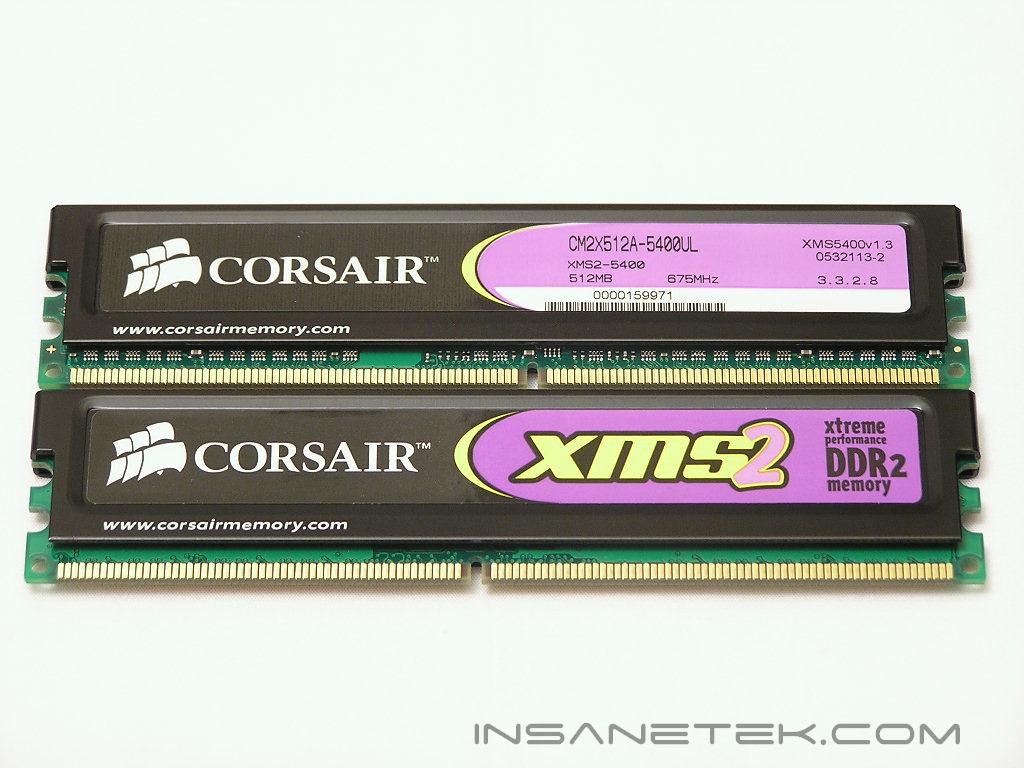
The PC2-5400UL is rated to run 337MHz, or DDR2-675, with timings of 3-3-2-8 and a voltage of 2.1v. The very first PC2-5400UL released was rated to run with even tighter timings of 3-2-2. Corsair changed this specification to allow users to run the tight timings across all Intel motherboards, not just the popular overclocker Asus P5WD2. The ICs used are none other than the famous Micron fatbody D9s. The exact stepping and date code are not known since removing the heatspreaders from DDR2 memory is just asking for trouble. I had a bad experience before and I’ve learned.
Test System and Overclocking
Test System:
- Intel Pentium D 840 3.2GHz
- Asus P5WD2 Premium
- 2 x 512MB Corsair XMS2 PC2-5400UL
- ATI Radeon X800XT
- Arctic Freezer 7
- Thermaltake PurePower 680W
Overclocking:
Keep in mind that during overclocking, the latencies are as follows: CAS-TRCD-TRP-TRAS
Throughout all tests, the multiplier has been kept at 14x to reduce any possible CPU bottleneck.
I am sure that many of you know the capabilities of the Micron fatbody D9s by now so all results will be conducted with a voltage of 2.3v. A lot of motherboards are supplying this voltage and those motherboards are typically the best boards to use for getting the best overclocks. Although the memory comes rated with timings of 3-3-2-8, I had no doubts that the memory was capable of extreme low latencies of 3-2-2-5. At a speed of 266MHz, the memory ran just fine with the extreme low latencies. In fact, it was capable of running all the way up to 350MHz, or DDR2-700, easily surpassing the rated speeds. I loosened the CAS latency to 4 and TRAS to 8 and proceeded to see if the memory would gain any advancement. Unlike the PC2-8000UL, the memory did not gain any increase. I tightened the CAS latency back to 3 and loosened the TRCD to 3, resulting with the rated timings of 3-3-2-8. With these timings, the 5400UL reached a decent 365MHz, or DDR2-730. Moving on to even looser timings of 4-3-2-8, the memory halted at 476MHz, or DDR2-952. That’s just a bit shy from the 1GHz barrier. The memory finally reached its max speed of 510MHz, or DDR2-1020, with timings of 5-3-3-9. I tried with even looser timings to see if another 5MHz increase was doable, but nothing helped. Overall, the overclocking headroom was not bad. It was not as great as the PC2-8000UL, but it was still very good.
Overclocking Results:
- 200FSB 3:4 266MHz 3-2-2-5 2.3v
- 210FSB 3:5 350MHz 3-2-2-5 2.3v
- 219FSB 3:5 365MHz 3-3-2-8 2.3v
- 238FSB 1:2 476MHz 4-3-2-8 2.3v
- 255FSB 1:2 510MHz 5-3-3-9 2.3v
Results
A series of memory intensive benchmarks will be run to test the performance of our sample. The other tests will be based on common benchmark programs, such as 3DMark and PCMark. Real life performance differences will be tested through current games, such as Far Cry and UT2004. Memory bandwidth benchmarks will be based off of SiSoft Sandra and Everest Home Edition. Super PI and PiFast will also be used to test memory performance, as the benchmark benefits largely from FSB increases.
SiSoft Sandra Memory Bandwidth
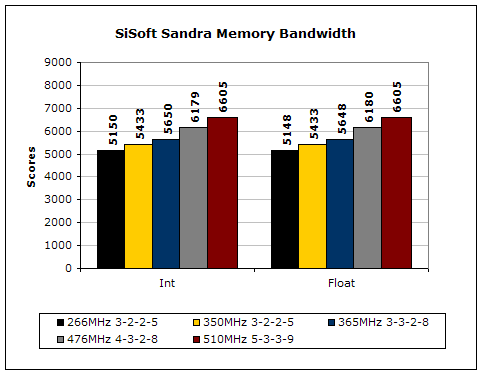
SiSoft Sandra is the most widely used memory bandwidth test. It can tell you the increase in performance from just lowering the latency timings.
Everest Home Edition
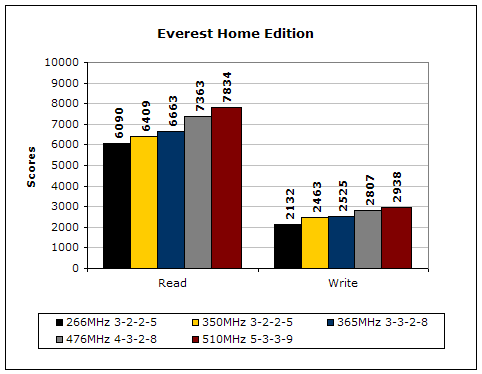
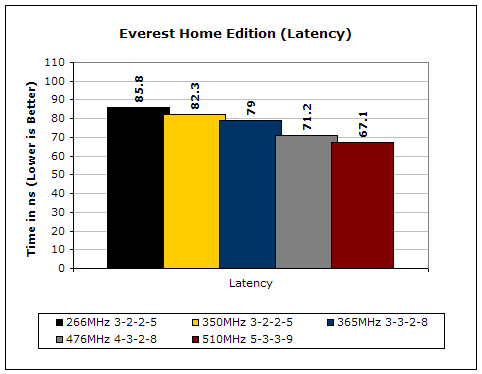
Much like Sandra, Everest Home Edition tests the memory’s ability to read and write data in large chunks. The results show that the lower latencies seem to help just a little with performance.
3DMark2001SE
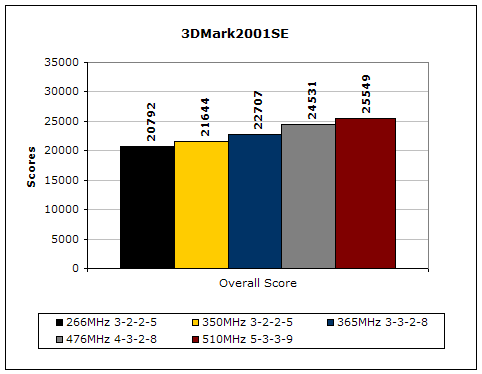
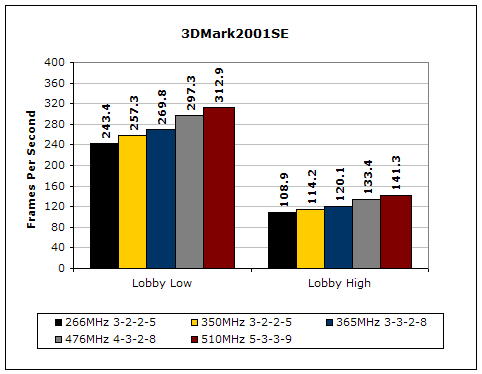
3DMark is likely the overclocker’s favorite benchmark. Unlike 3DMark2003, which stresses mainly the video card, 3DMark2001SE tests all of the system’s main components. Increasing the CPU speed, memory speed, and video card speeds will result in higher results in the final score.
Results Continued
Far Cry
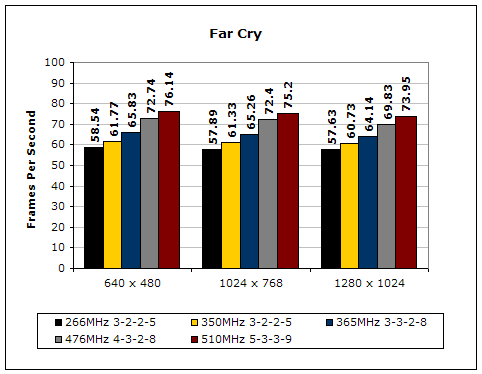
Since Far Cry is a game, the performance results will be very similar to 3dMark2001. I ran the benchmark at 640x480, so the benchmark would not be too GPU dependent. The tests under 1024x768 and 1280x1024 are an approximation of what kind of frames you’ll be getting. While the results are similar to 3dMark2001 in performance, this benchmark will give more significant results, because Far Cry is extremely demanding.
Unreal Tournament 2004
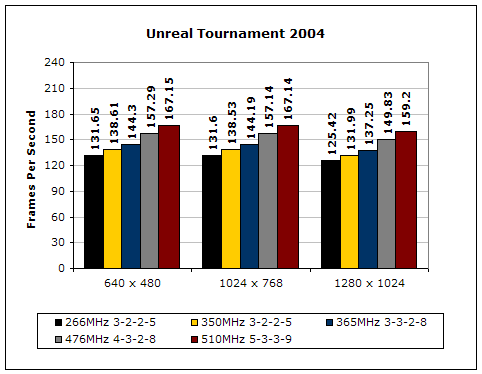
Unreal Tournament is another popular game engine to test overall system performance. Here, we can see the same results as Far Cry and 3dMark2001. Like Far Cry, UT2004 was also run at 640x480 to limit GPU dependency. The other resolutions provide an approximation of actual gameplay performance.
PCMark2002
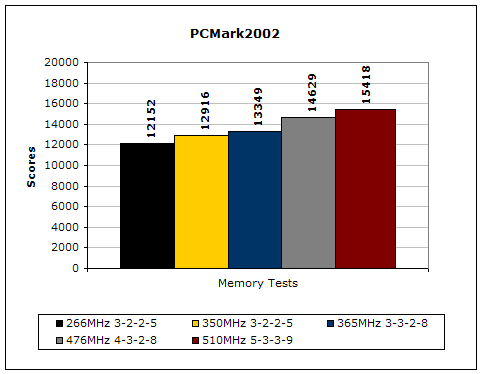
PCMark is another benchmark created by Futuremark. It tests the memory compression and decompression speeds in small to large chunks of data.
Super PI
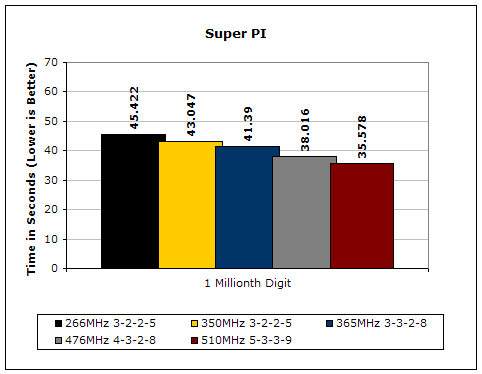
Since the value of PI is an infinite value, Super PI is a speed test to find the digit you’re looking for. In this case, we chose the millionth digit. Super PI benefits greatly from higher FSB, as well as low latencies.
PiFast
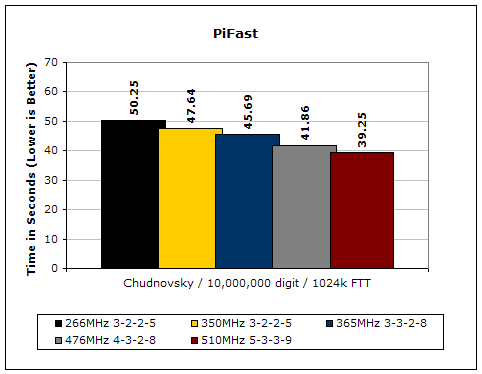
PiFast is similar to Super PI. The results can be greatly affected by a slight adjustment to the memory megahertz and latency.
Conclusion and Thoughts
Corsair’s DDR2 continues to excel once again. The overclocking potential of the PC2-5400UL is great and will take you places even with the extreme low latencies. For those who are bandwidth fanatics, be glad to know that the memory is easily capable of breaking the 1GHz barrier. The main question that boggles my mind is this: Why is Corsair still pushing the 5400UL when the 8000UL is better? The only answer that I can come up with is that in the future, the 8000UL will go through another revision and end up with another type of IC that cannot run the extreme low latencies. The 5400UL will still be kept the Micron fatbody D9s and continue to be the memory that allows extreme low latencies. That is the best guess I can come up with and honestly, I have no clue what the answer may be. The 5400UL is priced more expensive than the 8000UL, which is also mind boggling. Shouldn’t the faster part be more expensive? Especially when both of them use Micron fatbody D9s? The 5400UL memory is by no means bad. The memory is great and excels in performance. The only thing that prevented the memory from receiving the Highly Praised Award is the higher price over the 8000UL. The 5400UL is still another piece of art from Corsair though. It is still high quality DDR2 memory.
Pros:
- Runs extreme low latencies
- Overclocks amazingly well
- Uses Micron fatbody D9s
- Broke the 1GHz barrier
Cons:
- More expensive than the faster 8000UL part…?

We would like to thank Corsair for providing us the sample. If you have any questions or comments, feel free to hit us up in the forums. You can also check out more of our latest reviews on the front page.
UPDATE:
We just received word from Corsair that the price of the PC2-5400UL is indeed supposed to be lower than the PC2-8000UL. The reason why the price is currently more expensive is because the online retailers have yet to adjust their pricing. Corsair has notified them about this issue and the prices should be changed soon.