

Centon Advanced A2X512S4400HB 1GB Dual Channel Kit
Introduction
The transition from 1GB to 2GB system memory has begun. Enthusiasts are moving to 2GB either because they benefit from loading times in Battlefield 2 and MMORPGs or they are preparing for Microsoft’s upcoming new Windows operating system. Rumors have leaked that the Vista will need 2GB of system memory to operate smoothly. It may say the minimum requirement is 512MB, but we all know that every program you open will lag slower than a snail. The cost of jumping up to 2GB right now is quite costly. There are many enthusiasts out there who simply cannot fork out $300 for some good overclocking 2GB kits. These budget builders are still sitting at the 1GB stage, computing happily in Windows XP and waiting patiently while the newest games load.
Our last encounter with Centon’s Advanced memory was very pleasing. It used the infamous TCCD ICs and overclocked extremely well. We had a chance to look at their affordable 2GB solution and it only overclocked decently, losing to the rest of the competition we’ve looked at. Hopefully their 1GB PC4400 memory can be a much better overclocker and maybe even out clock their previous TCCD kit.
Centon Advanced PC4400
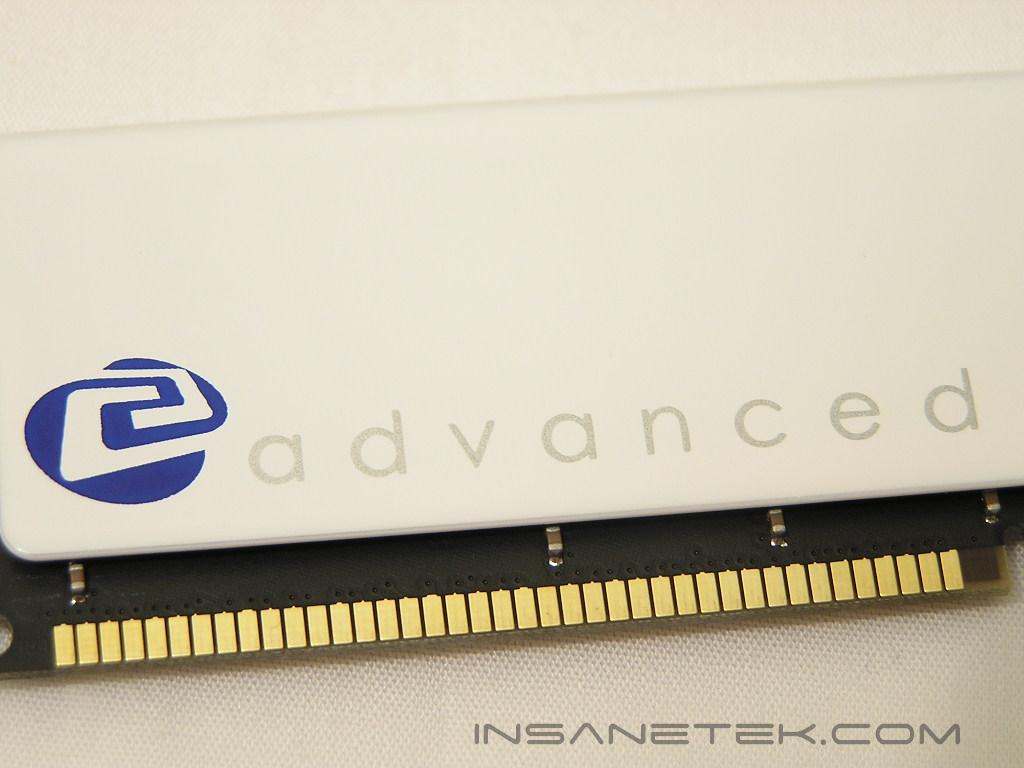
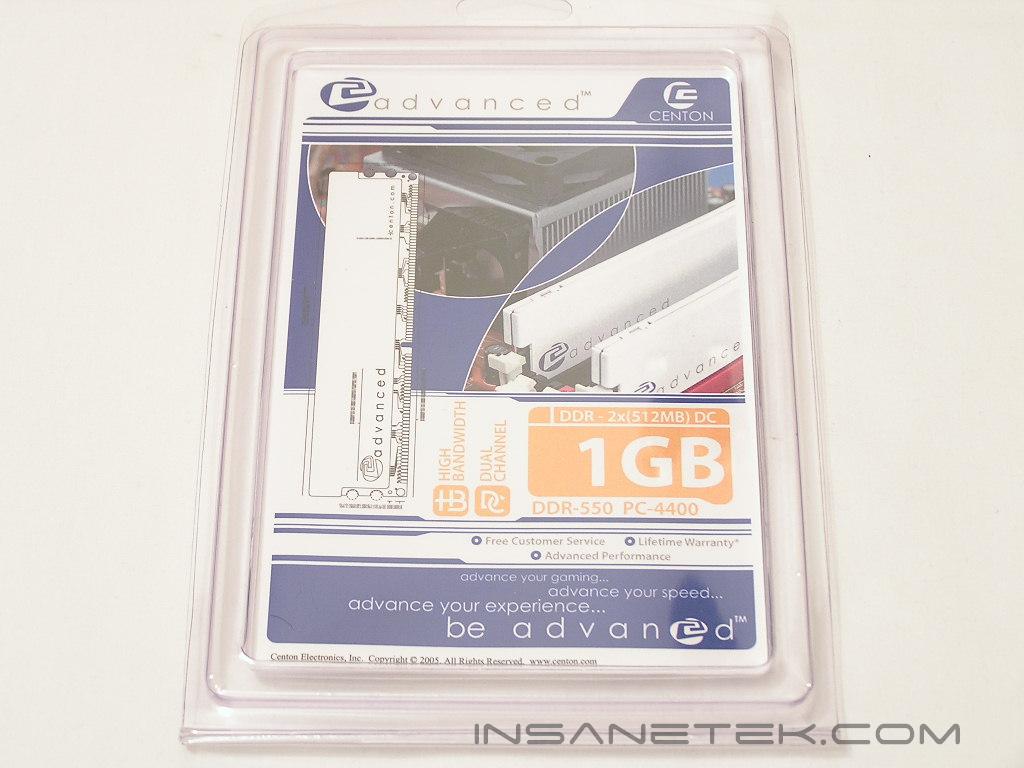
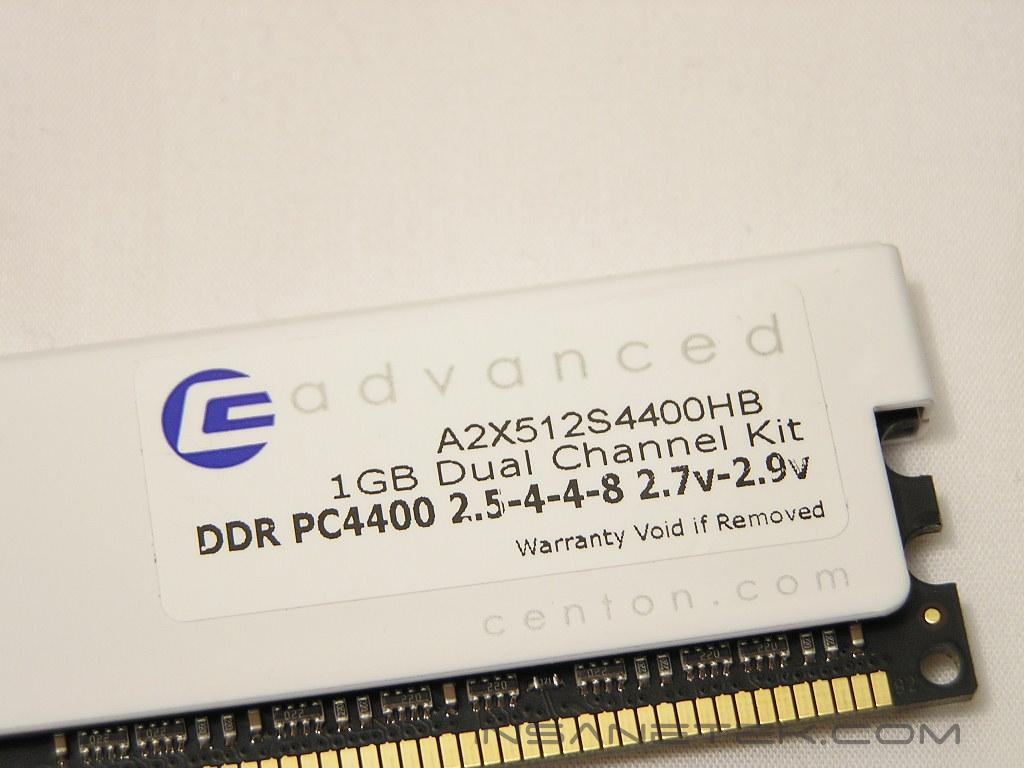
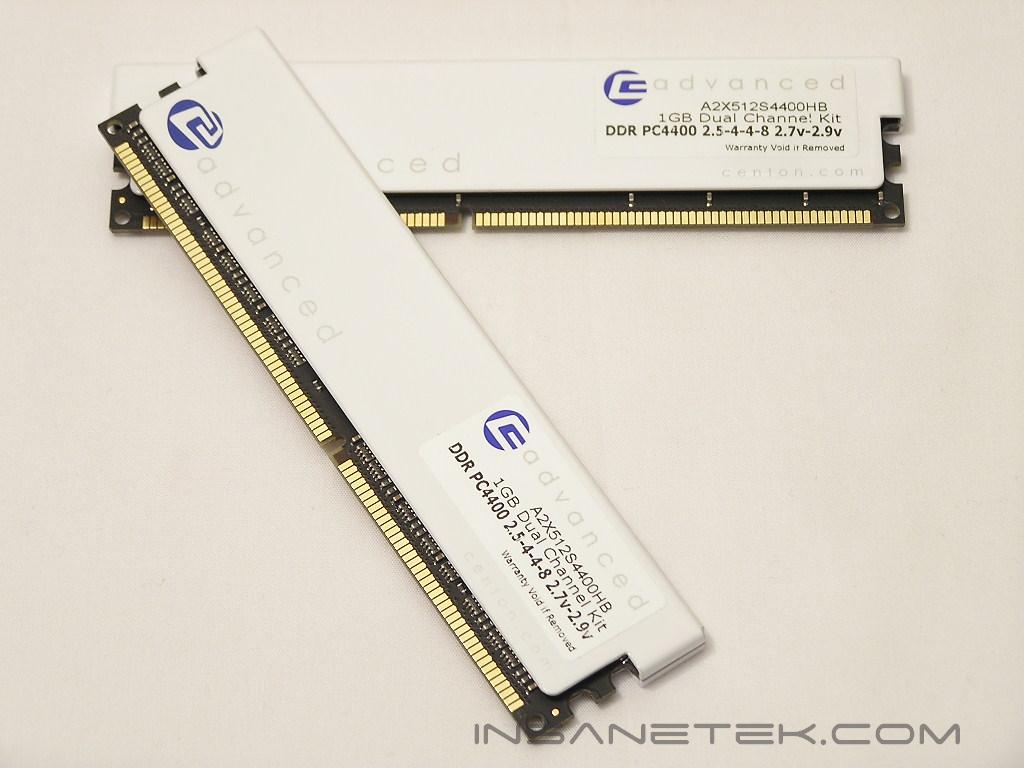
Wow that is one long name. It reminds me of Corsair’s naming scheme. The Advanced PC4400 comes in a clamshell package just like their PC3200 2GB kit. The Advanced PC4400 also comes with an improved look. If you remember Centon’s previous Advanced line, it was quite butt-ugly. The copper heatspreaders are painted to a glossy Apple white. It matches well with the black Brainpower 808 PCB.
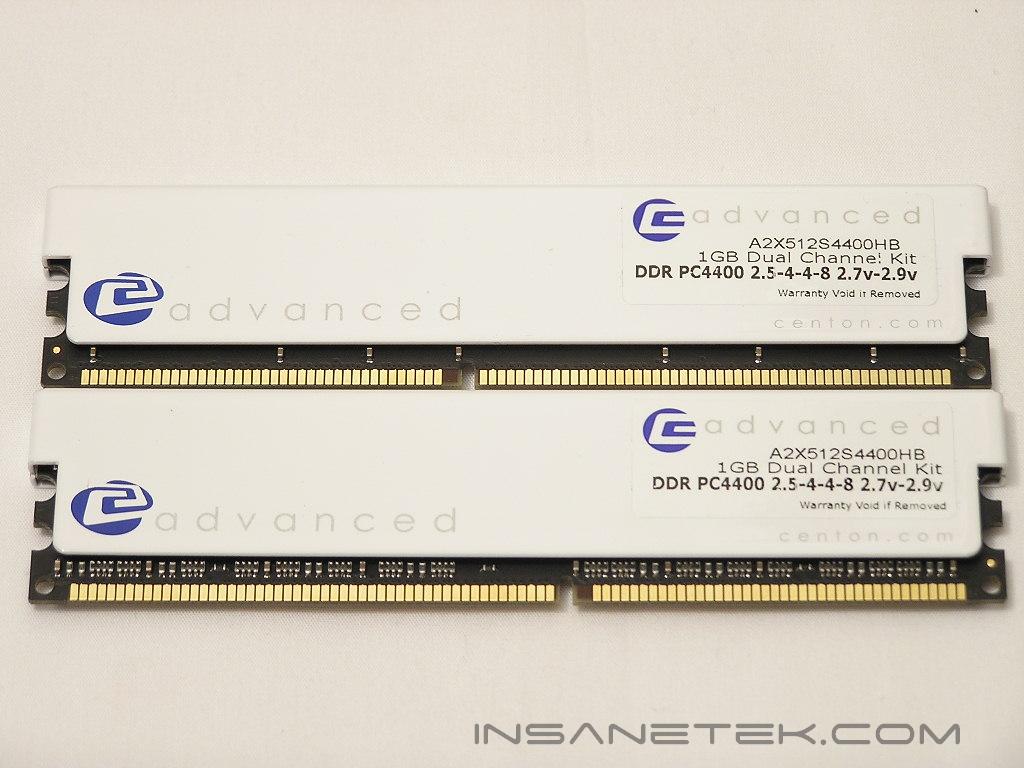
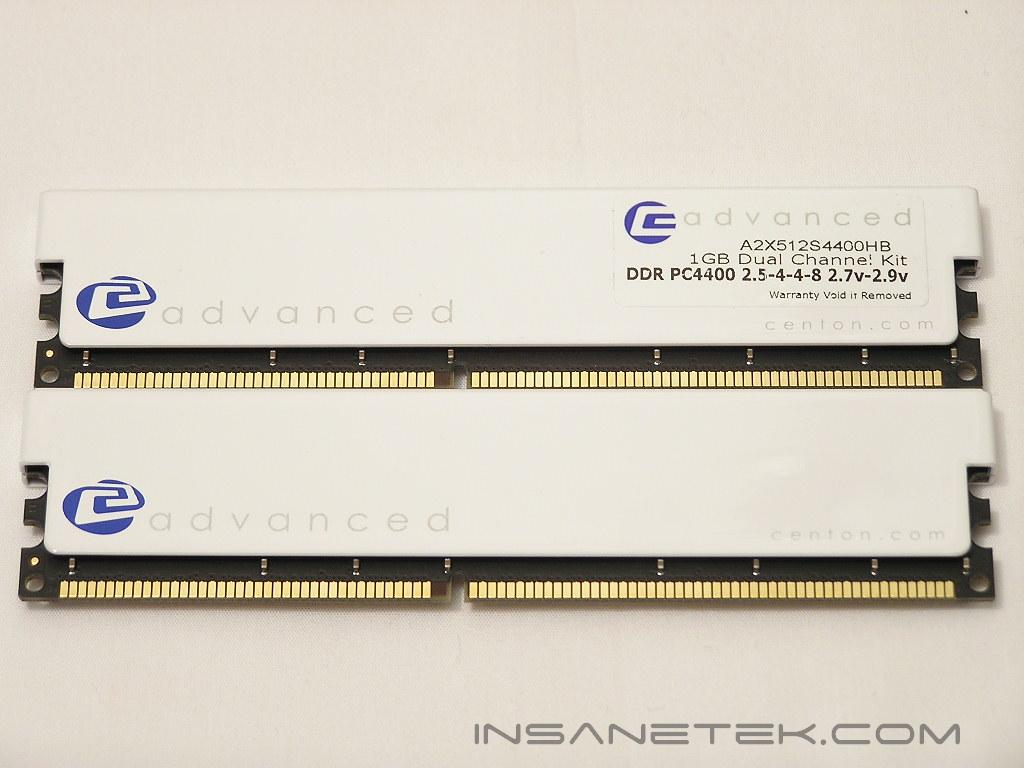
The Advanced PC4400 is rated at a speed of 275MHz with timings of 2.5-4-4-8 1T and a voltage range of 2.7v to 2.9v. The memory ICs used are none other than the popular Samsung TCCD. The date code on the sample I received at 519, one of the best TCCD dates currently available.
Test System and Overclocking
Test System:
- AMD Athlon 64 3000+ Venice
- DFI LANParty UT nF4 Ultra-D
- 2 x 512MB Centon Advanced PC4400
- ATI Radeon X800XT
- Arctic Cooling Freezer 64
- Thermaltake PurePower 680W
- BIOS 623-3 and orange slots
Overclocking:
Keep in mind that during overclocking, the latencies are as follows: CAS-TRCD-TRP-TRAS
Samsung TCCD ICs were first introduced to be Winbond BH5 replacements. It was first used by Corsair to run low latencies of 2-2-2-5 at 200MHz. This does not mean that all TCCD ICs can run 2-2-2-5 at 200MHz. The Gigaram PC3700 TCCD based memory was the first we’ve seen that was unable to operate at such timings. Because of this, I began the testing to see if it would allow low latencies at 200MHz. Fortunately, the Advanced PC4400 was able to run such timings at 200MHz. This means that enthusiasts who do not wish to overclock are able to a standard speed of 200MHz with the lowest latencies available. I skipped through the latencies of 2-3-2-5 and 2-3-3-6 and jumped to 2.5-3-3-7 because we all know that TCCD performs very well with these latencies. With just 2.6v, the Advanced PC4400 took off to a blistering speed of 290MHz. It was actually able to pass Memtest at 300MHz but Windows did not operate stably and benchmarks would crash. I loosened the timings to 2.5-4-3-7 and bumped the voltage to 2.8v and reached the memory’s max of 310MHz. These results are very impressive! Looser timings of 2.5-4-4-8 did not help. The weird thing about the Advanced PC4400 is that the required voltage scales with higher frequencies. At 290MHz 2.5-3-3-7, running 2.8v would yield errors. It was only when running 2.6v that everything was fine. This is not surprising when it comes to TCCD ICs. They are so inconsistent that it takes a great deal of time to get tweaking done correctly.
- 200MHz 2.0-2-2-5 1T 2.6v
- 290MHz 2.5-3-3-7 1T 2.6v
- 310MHz 2.5-4-3-7 1T 2.8v
Results
A series of memory intensive benchmarks will be run to test the performance of our sample. The other tests will be based on common benchmark programs, such as 3DMark and PCMark. Real life performance differences will be tested through current games, such as Far Cry and UT2004. Memory bandwidth benchmarks will be based off of SiSoft Sandra and Everest Home Edition. Super PI and PiFast will also be used to test memory performance, as the benchmark benefits largely from FSB increases.
SiSoft Sandra Memory Bandwidth
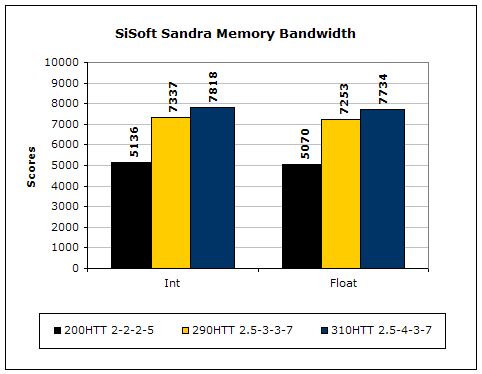
SiSoft Sandra is the most widely used memory bandwidth test. It can tell you the increase in performance from just lowering the latency timings.
Everest Home Edition
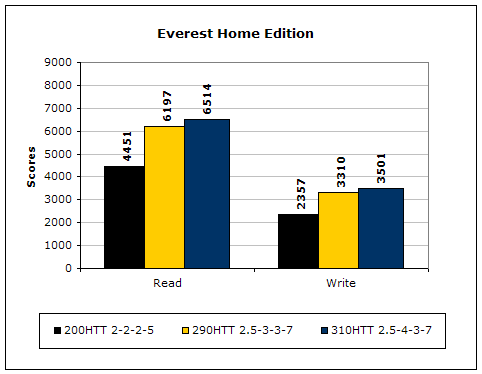
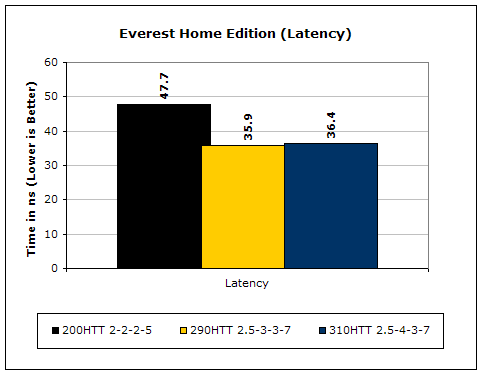
Much like Sandra, Everest Home Edition tests the memory’s ability to read and write data in large chunks. The results show that the lower latencies seem to help just a little with performance.
3DMark2001SE
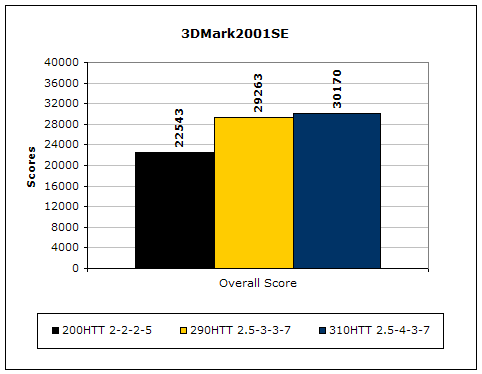
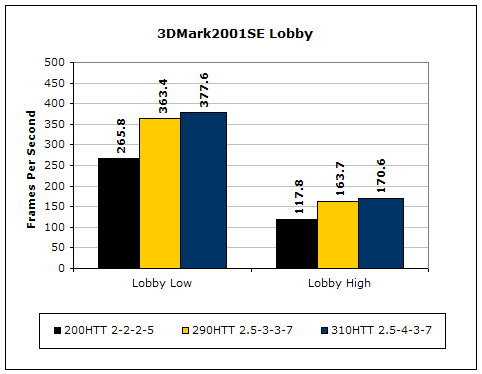
3DMark is likely the overclocker’s favorite benchmark. Unlike 3DMark2003, which stresses mainly the video card, 3DMark2001SE tests all of the system’s main components. Increasing the CPU speed, memory speed, and video card speeds will result in higher results in the final score.
Results Continued
Far Cry
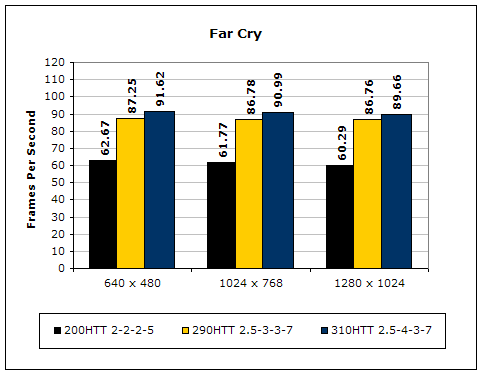
Since Far Cry is a game, the performance results will be very similar to 3dMark2001. I ran the benchmark at 640x480, so the benchmark would not be too GPU dependent. The tests under 1024x768 and 1280x1024 are an approximation of what kind of frames you’ll be getting. While the results are similar to 3dMark2001 in performance, this benchmark will give more significant results, because Far Cry is a lot more demanding.
Unreal Tournament 2004
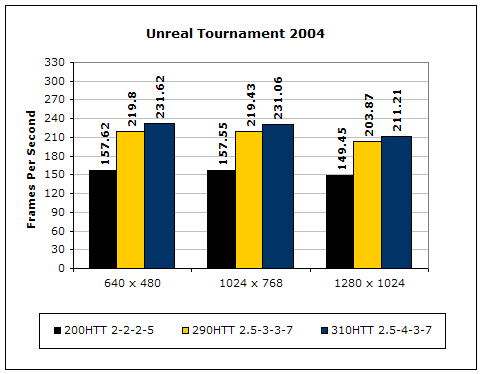
Unreal Tournament is another popular game engine to test overall system performance. Here, we can see the same results as Far Cry and 3dMark2001. Like Far Cry, UT2004 was also run at 640x480 to limit GPU dependency. The other resolutions provide an approximation of actual game play performance.
PCMark2002
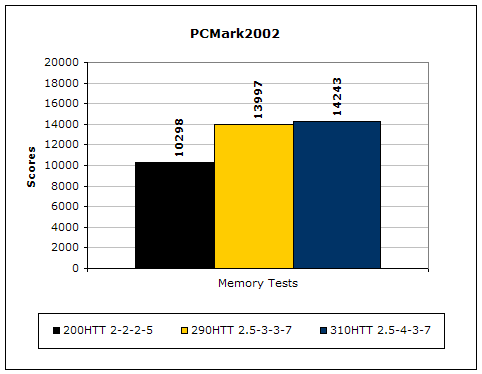
PCMark is another benchmark created by Futuremark. It tests the memory compression and decompression speeds in small to large chunks of data.
Super PI
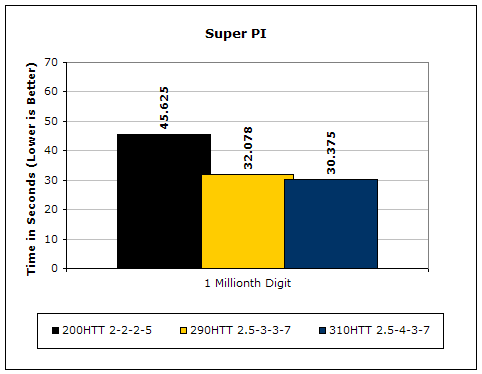
Since the value of PI is an infinite value, Super PI is a speed test to find the digit you’re looking for. In this case, we chose the millionth digit. Super PI benefits greatly from higher FSB, as well as low latencies.
PiFast
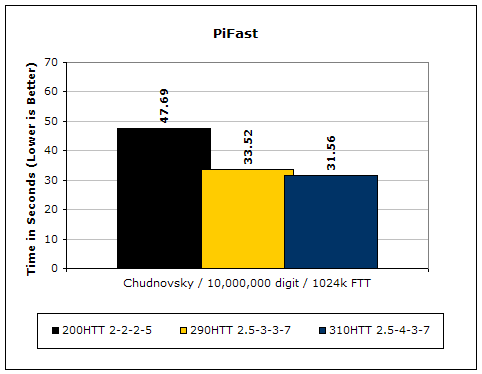
PiFast is similar to Super PI. The results can be greatly affected by a slight adjustment to the memory megahertz and latency.
Conclusion and Thoughts
The previous Centon Advanced PC3200 memory based on Samsung TCCD ICs was a great overclocker and still continues to be a great overclocker. The new Centon Advanced PC4400 one ups the previous. Samsung TCCD is still my current choice for 1GB solutions and the Advanced PC4400 proved to be a great choice for overclockers. The only other memory that overclocked this well was the OCZ Platinum PC4800 Elite Edition. The Advanced PC4400 is very close behind by just 5MHz, but the price difference will be quite surprising. Centon has made a great move into the enthusiast crowd with the Advanced PC4400. Overclocking is great, the price will be affordable (or so I’ve been told), and the appeal is just sexy. There is only one problem though. When will it be available for the general mass consumers? I have no idea. Maybe you can walk around in your nearest CompUSA and find some. If you want some high clocking 1GB kits, make sure these are on your list.
Pros:
- Sexy glossy white heatspreaders
- Overclocks very well
- Will be very affordable
Cons:
- Nothing really

We would like to thank Centon for providing us the sample. If you have any questions or comments, feel free to hit us up in the forums. You can also check out more of our latest reviews on the front page.