

Centon Advanced A2X512S4000LLU 1GB Dual Channel Kit
Introduction
Centon’s recent releases have been going in the right direction. Although their 2GB kit did not overclock so well, it will come with a very affordable price tag. Their TCCD memory was excellent, providing enthusiasts great overclocking headroom and insane bandwidth. The Advanced PC3200 2GB solution covered the enthusiasts who look for low latency 2GB kits. The Advanced PC4400 1GB solution covered the high megahertz and high bandwidth crowd. There is just one other crowd that Centon has yet to cover.
Although the hype for Winbond UTT memory is slowing fading, it does not mean that the memory is no longer in high demand. There are a lot of enthusiasts who swear by running extreme low latencies at high speeds. They do not care about pumping voltage and have no fear in juicing up the memory to squeeze out every last bit of performance. These are typically the benchmark gurus who look to break records. Winbond UTT at a voltage of 3.2v+ is not ideal for every day usage, even with dedicated cooling to the memory modules. Whatever the case, Centon is here again with another one of their enthusiast memory.
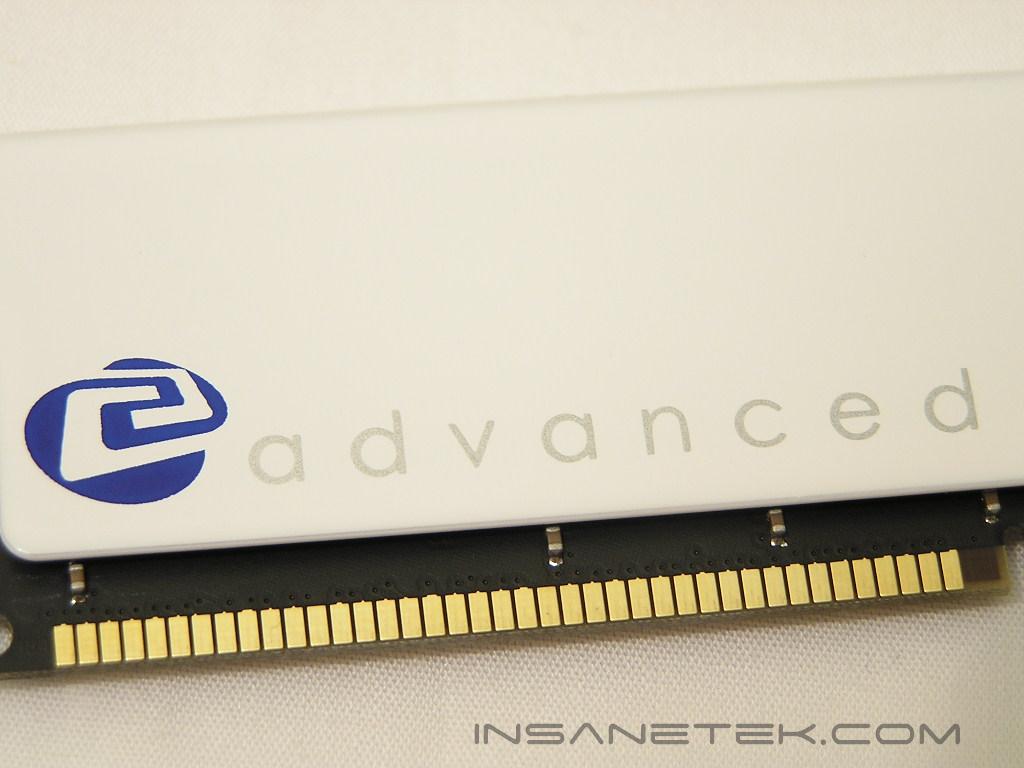
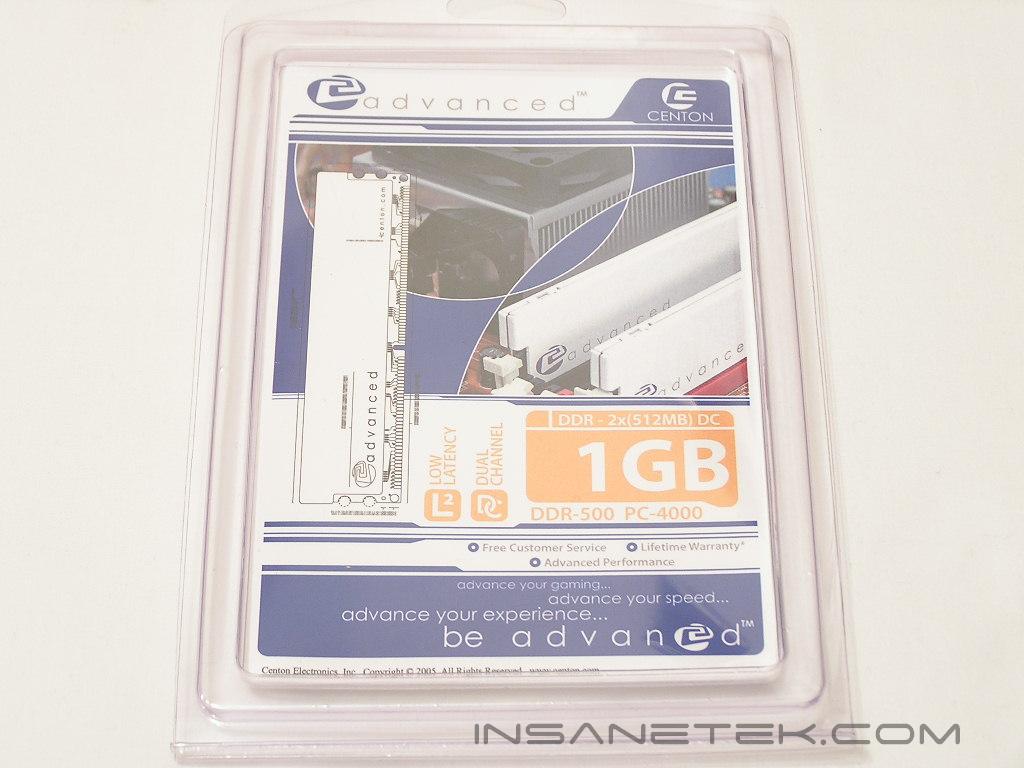
Centon Advanced PC4000
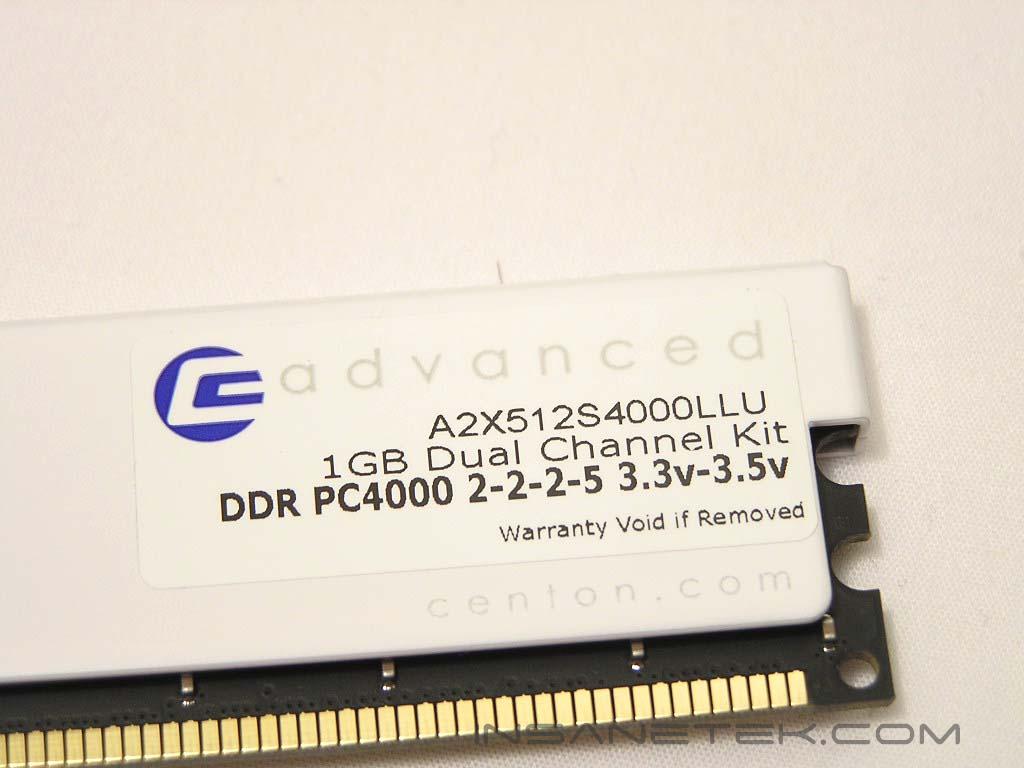
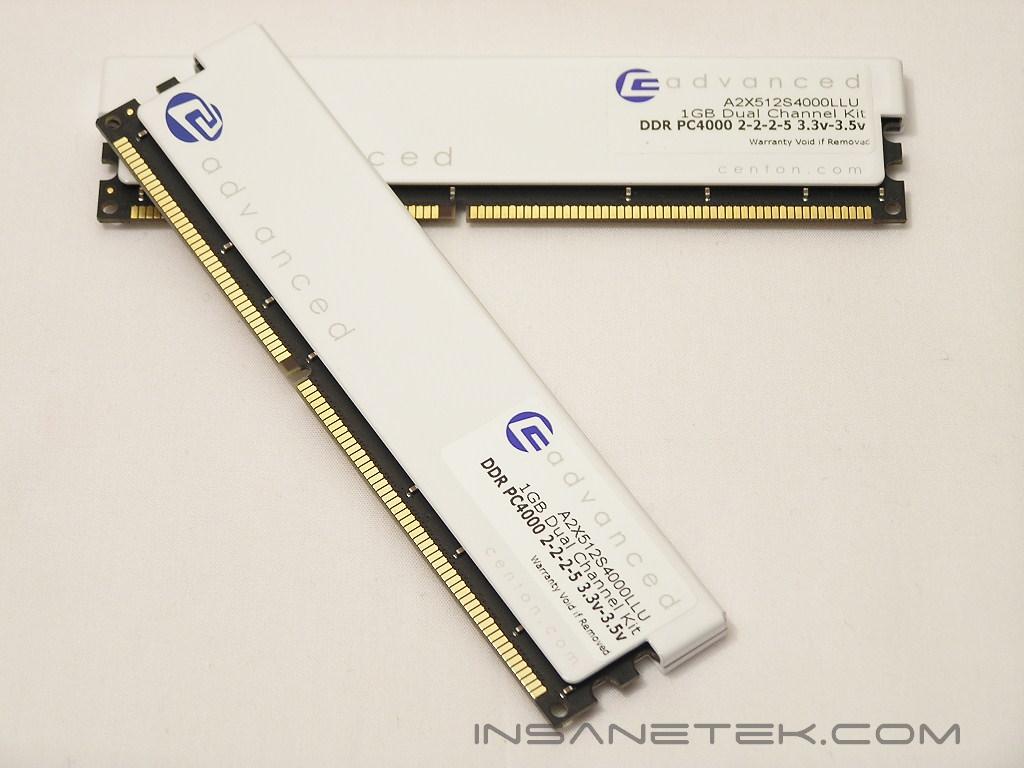
The DDR Advanced line continues to arrive with copper heatspreaders in a white glossy finish. The heatspreaders are nice and smooth and emit that elegant feel to Centon’s memory.
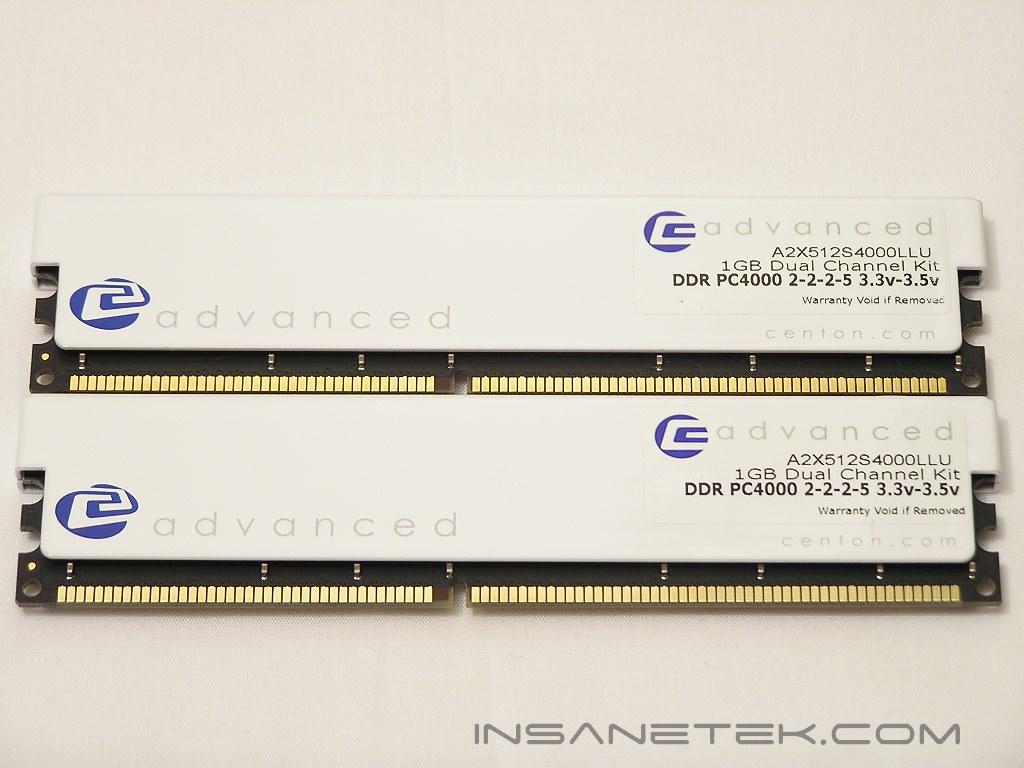
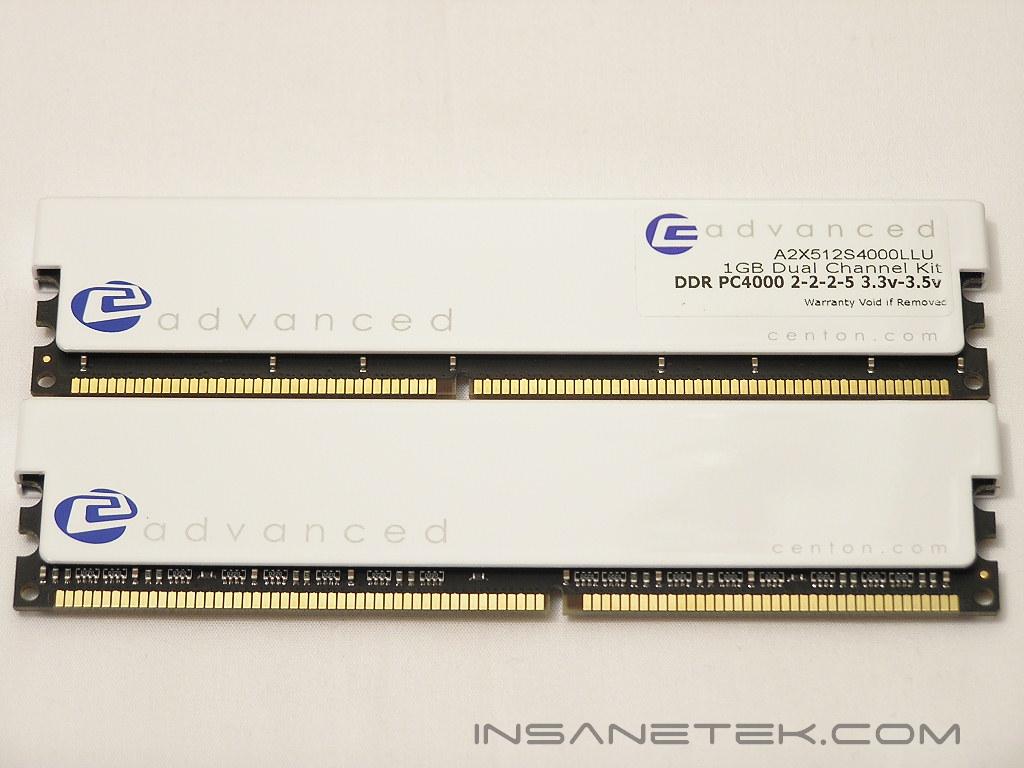
The Advanced PC4000 low latency memory uses the voltage hungry Winbond UTT BH5 ICs. The memory is rated at a speed of 250MHz with timings of 2-2-2-5. The required voltage to reach such a specification ranges from 3.3v-3.5v, depending on the luck of your draw. Some will require the max of 3.5v, but some will be lucky and barely need 3.2v. The black PCB used to is none other than the infamous Brainpower 808.
Test System and Overclocking
Test System:
- AMD Athlon 64 3000+ Venice
- DFI LANParty UT nF4 Ultra-D
- 2 x 512MB Centon Advanced PC4000
- ATI Radeon X800XT
- Arctic Cooling Freezer 7
- Thermaltake PurePower 680W
- BIOS 623-3 and orange slots
Overclocking:
Keep in mind that during overclocking, the latencies are as follows: CAS-TRCD-TRP-TRAS
Winbond UTT ICs are famous for their great overclocking results with low latencies of 2-2-2-5 and increased voltage. Because of that, all overclocking tests will be conducted with the latencies at 2-2-2-5. The voltage required will scale bit by bit to see how far the memory can go. Testing begins with the lowest voltage required at a speed of 200MHz. Surprisingly, the memory only needed 2.6v for stable operations. The low voltage also allowed the memory to overclock a good 10MHz to 210MHz. With an increase to 2.8v, the Advanced PC4000 gained another 15MHz, resulting with 225MHz. Those are the results that the OCZ Gold PC3500 GX was getting. Mighty impressive thus far. With the voltage set at 3.0v, the memory leaped to 240MHz, just a bit shy of the rated speed. To reach the rated speed of 250MHz, a measly 3.2v was needed. That voltage requirement is definitely pleasing since it is below the specified voltage requirement. The memory gained 5MHz every time 0.2v was increased; and this happened till the memory topped out at 260MHz. While the Advanced PC4000 did not break any insane overclocking records, it did provide pretty good numbers.
Overclocking Results:
- 200MHz 2-2-2-5 1T 2.6v
- 210MHz 2-2-2-5 1T 2.6v
- 225MHz 2-2-2-5 1T 2.8v
- 240MHz 2-2-2-5 1T 3.0v
- 250MHz 2-2-2-5 1T 3.2v
- 255MHz 2-2-2-5 1T 3.4v
- 260MHz 2-2-2-5 1T 3.6v
Results
A series of memory intensive benchmarks will be run to test the performance of our sample. The other tests will be based on common benchmark programs, such as 3DMark and PCMark. Real life performance differences will be tested through current games, such as Far Cry and UT2004. Memory bandwidth benchmarks will be based off of SiSoft Sandra and Everest Home Edition. Super PI and PiFast will also be used to test memory performance, as the benchmark benefits largely from FSB increases.
SiSoft Sandra Memory Bandwidth
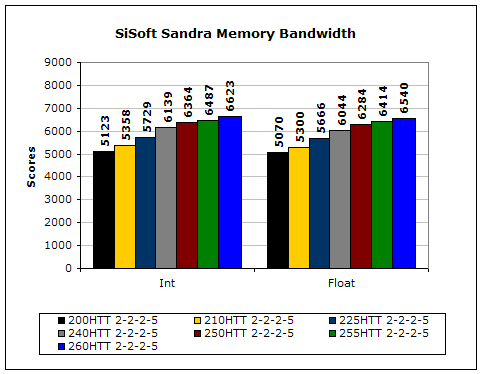
SiSoft Sandra is the most widely used memory bandwidth test. It can tell you the increase in performance from just lowering the latency timings.
Everest Home Edition
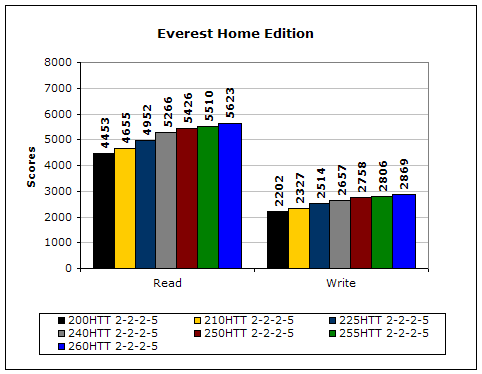
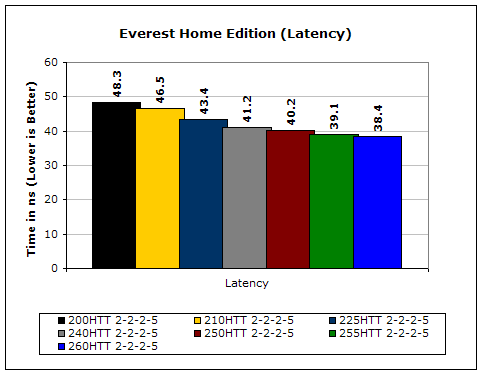
Much like Sandra, Everest Home Edition tests the memory’s ability to read and write data in large chunks. The results show that the lower latencies seem to help just a little with performance.
3DMark2001SE
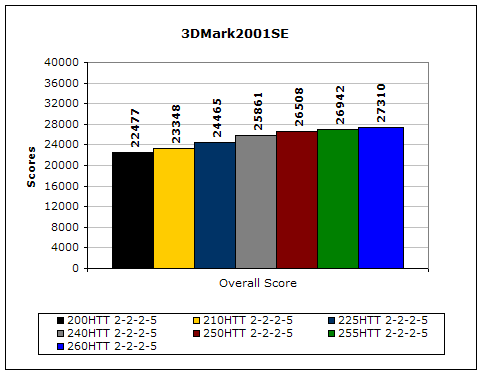
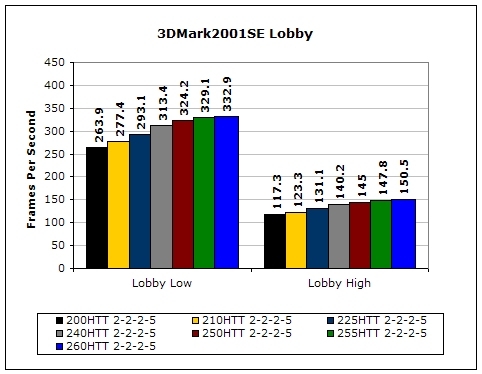
3DMark is likely the overclocker’s favorite benchmark. Unlike 3DMark2003, which stresses mainly the video card, 3DMark2001SE tests all of the system’s main components. Increasing the CPU speed, memory speed, and video card speeds will result in higher results in the final score.
Results Continued
Far Cry
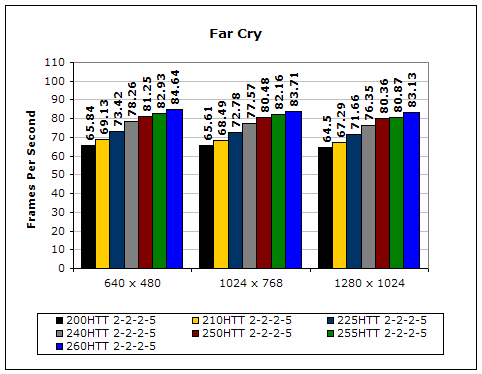
Since Far Cry is a game, the performance results will be very similar to 3dMark2001. I ran the benchmark at 640x480, so the benchmark would not be too GPU dependent. The tests under 1024x768 and 1280x1024 are an approximation of what kind of frames you’ll be getting. While the results are similar to 3dMark2001 in performance, this benchmark will give more significant results, because Far Cry is a lot more demanding.
Unreal Tournament 2004
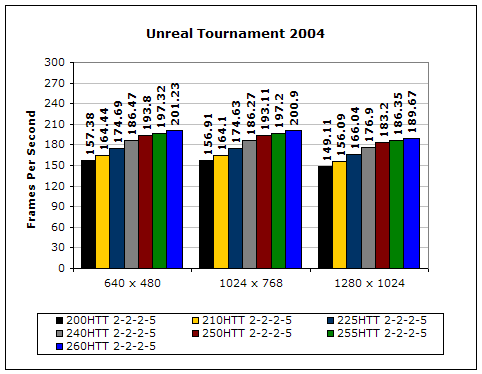
Unreal Tournament is another popular game engine to test overall system performance. Here, we can see the same results as Far Cry and 3dMark2001. Like Far Cry, UT2004 was also run at 640x480 to limit GPU dependency. The other resolutions provide an approximation of actual game play performance.
PCMark2002
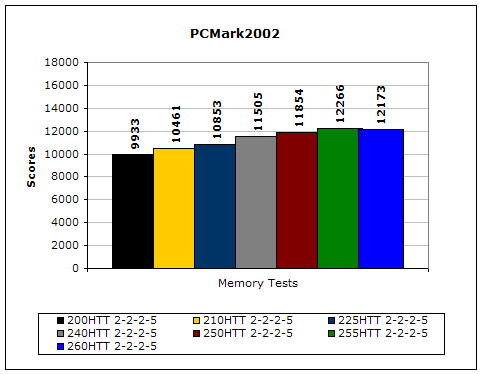
PCMark is another benchmark created by Futuremark. It tests the memory compression and decompression speeds in small to large chunks of data.
Super PI
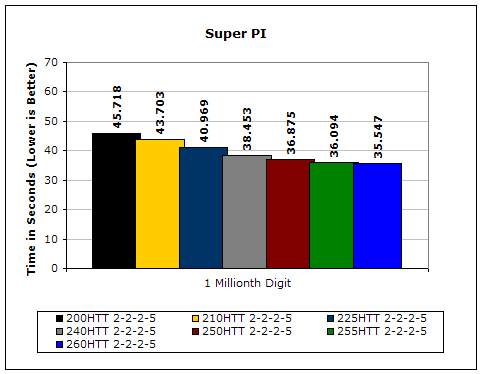
Since the value of PI is an infinite value, Super PI is a speed test to find the digit you’re looking for. In this case, we chose the millionth digit. Super PI benefits greatly from higher FSB, as well as low latencies.
PiFast
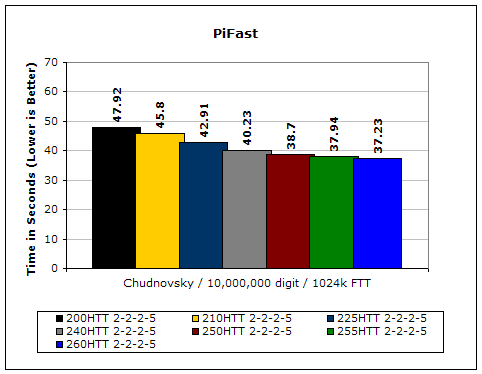
PiFast is similar to Super PI. The results can be greatly affected by a slight adjustment to the memory megahertz and latency.
Conclusion and Thoughts
Although I am not a big fan of Winbond UTT based memory, I would have to say that these Centon Advanced PC4000 modules are superb. I have encountered some Winbond UTT based memory in the past that would only yield a mere 250MHz memory frequency. And that was with 3.6v! Centon continues to release some quality memory for the hardcore enthusiasts. Their TCCD based PC4400 was awesome and rivaled OCZ’s flagship Elite Edition. These Advanced PC4000 Winbond UTT modules not only rival OCZ’s Voltage Extreme line, but also Mushkin’s Redline series. Memory companies should definitely watch out. Centon is ready to steal some attention.
Pros:
- Glossy white heatspreaders
- Sexy black PCB
- Responds very well to increased voltage
- Great overclock
Cons:
- Nothing really

We would like to thank Centon for providing us the sample. If you have any questions or comments, feel free to hit us up in the forums. You can also check out more of our latest reviews on the front page.