

A-DATA Vitesta PC4800 1GB Dual Channel Kit
Introduction
I wouldn’t be surprised if you’ve never heard of A-DATA. Many enthusiasts in the U.S. have no clue who they are. Most think that they’re newcomers and hesitate to try their products. The fact is, A-DATA is an extremely large memory manufacturer, but just in Asia. If you ever head to Taiwan, you’ll see A-DATA everywhere. Overclockers in Asia pick A-DATA as the top choice for overclocking memory, just like how top overclockers in the U.S. choose OCZ. It is only recently that they’re reaching out to the overclockers here in the U.S. As soon as they start sending out review samples and making themselves more available in the online market, I’m sure enthusiasts will pick up the name in no time.
Everyone believed that Mushkin’s Black Level II was the greatest memory based on the BH5 chip. It’s certainly incredible, but the highest overclock I’ve ever seen with BH5 at low latencies were with A-DATA sticks. I’m not 100% positive, but I believe A-DATA was one of the first to use Brainpower PCB before people began to realize the great potential in a Brainpower PCB. I know for sure that OCZ started the 808 here, but A-DATA probably started the use of it in Asia.
Because A-DATA high performance memory can’t be easily found, I took advantage of my vacation back to Taiwan and picked up a couple of sticks of their TCCD based memory. Their highest rated TCCD based memory is rated to run at a stunningly high 300HTT. OCZ recently announced their PC4800 memory, but it seems that A-DATA beat them to the punch. I picked these up well over 3 months ago. At that time, the memory was already widely available.
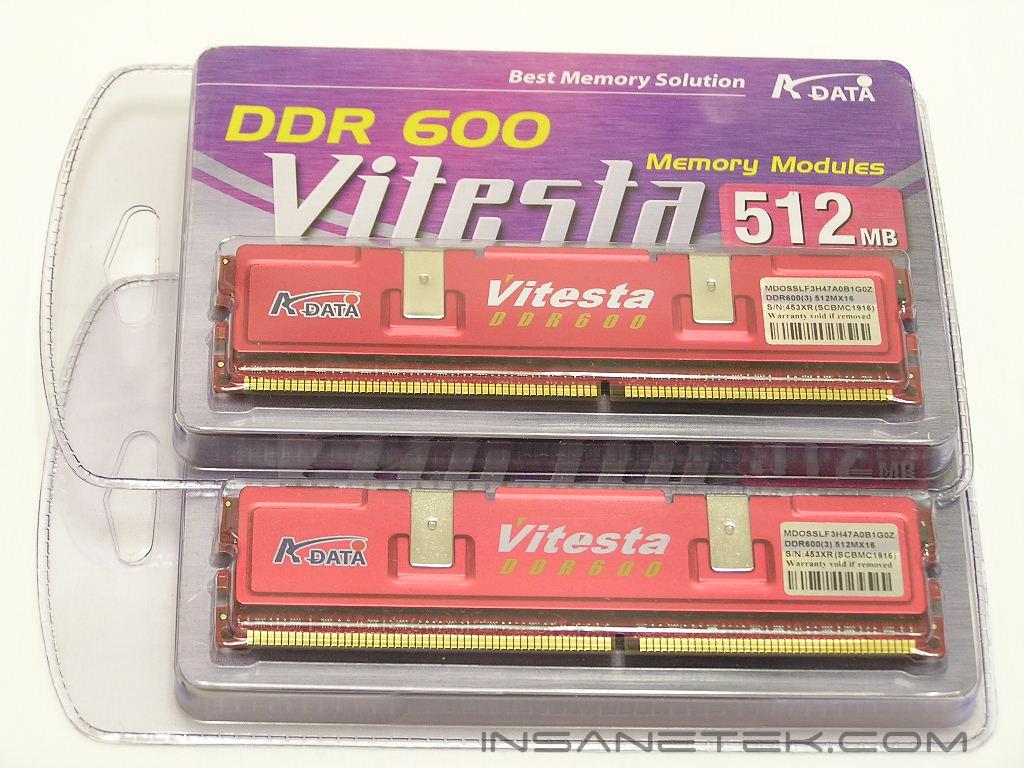
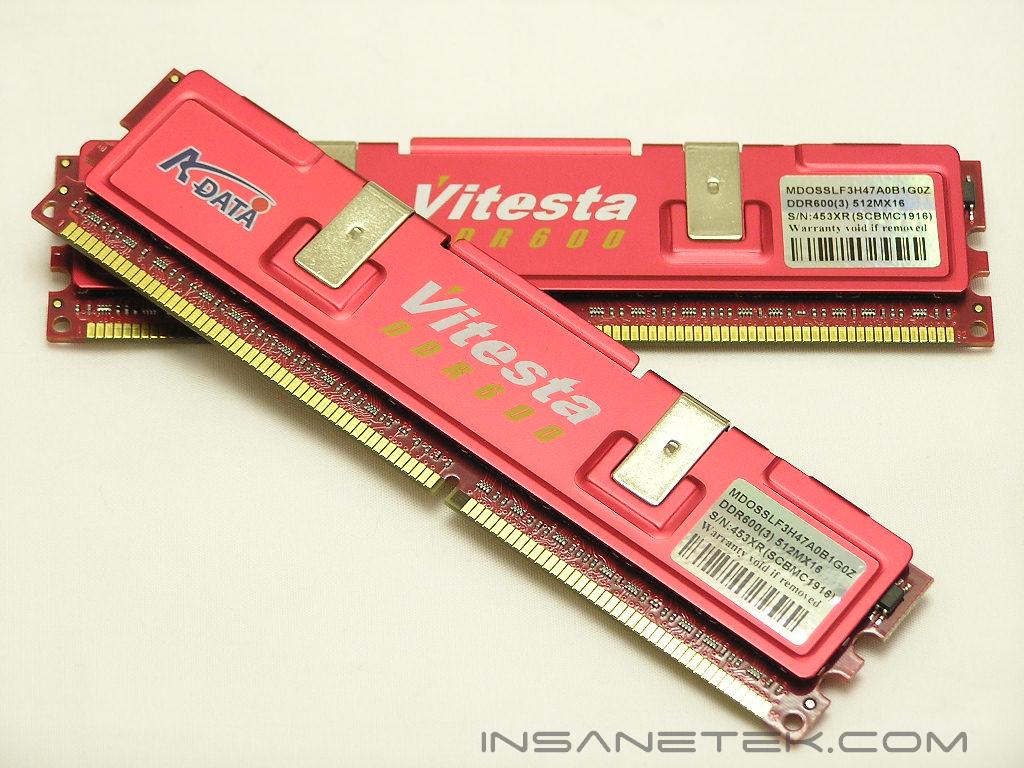
A-DATA Vitesta PC4800
While making my purchase, I was only able to find separate sticks instead of a dual channel kit. I wasn’t all that bothered, though, because the sticks featured the same PCB and use the same Samsung TCCD chips. The only difference might be the week of the chips. No worries, though, as the sticks will run fine in a dual channel system. The only thing that would worry me would be the overclock potential. Since the sticks weren’t tested to make sure they’d run 300HTT together, there are no guarantees. The only guarantee offered would be that a single stick could run 300HTT by itself, provided that your system is capable of it.
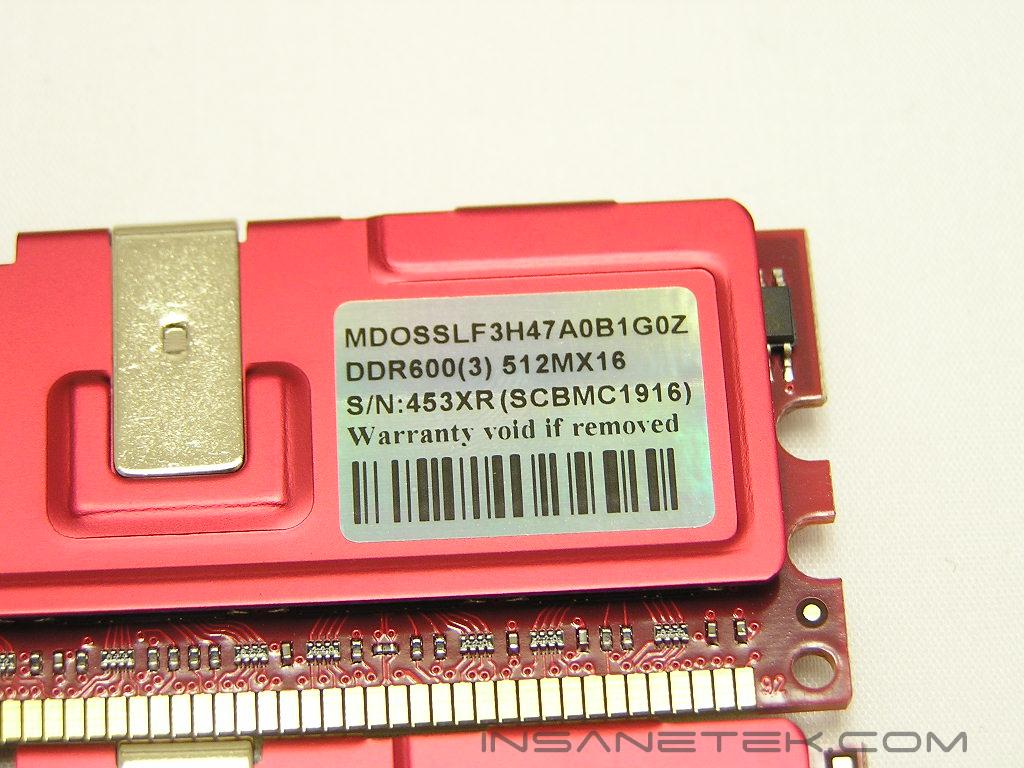
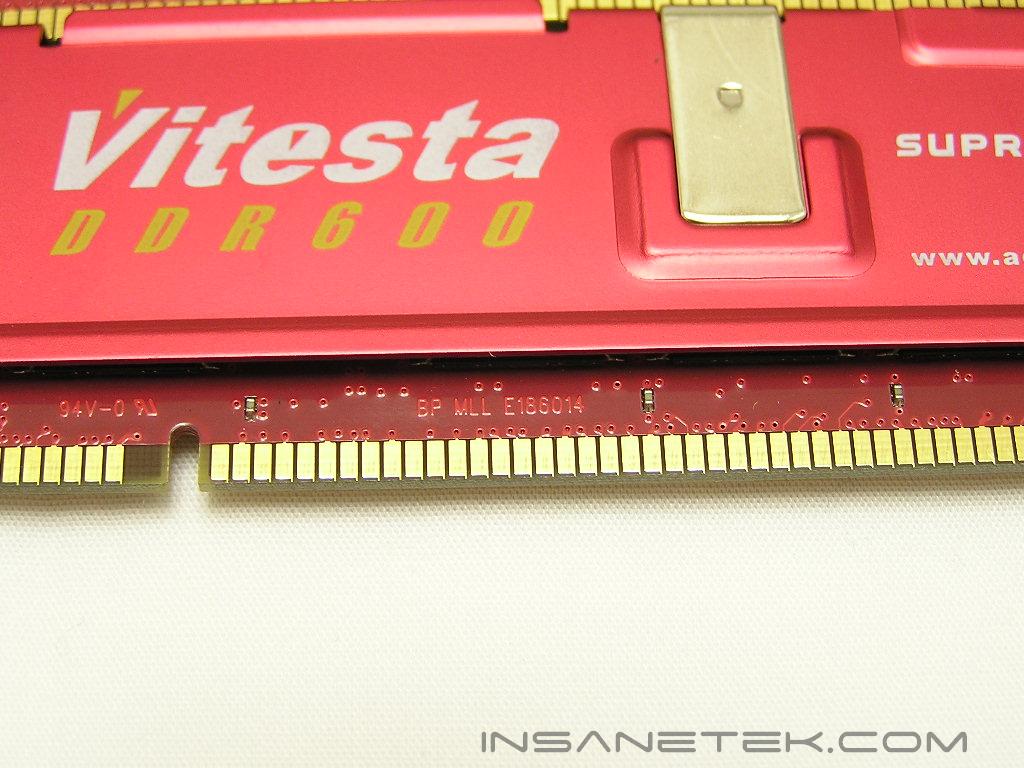
For the few who are familiar with A-DATA’s Vitesta line, they’ll immediately recognize the sexy red heatspreaders and red PCB. Although looks don’t really matter with memory, because it’s a small piece of hardware, it does help a little. The red will match nicely with the red Fatal1ty AN8!
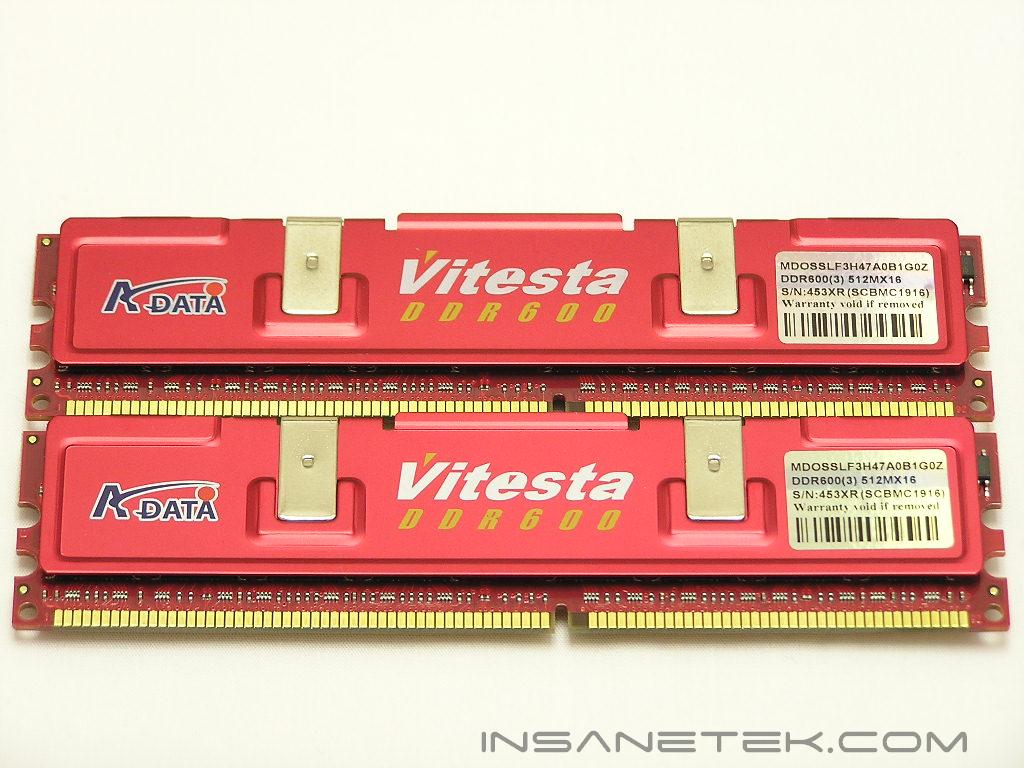
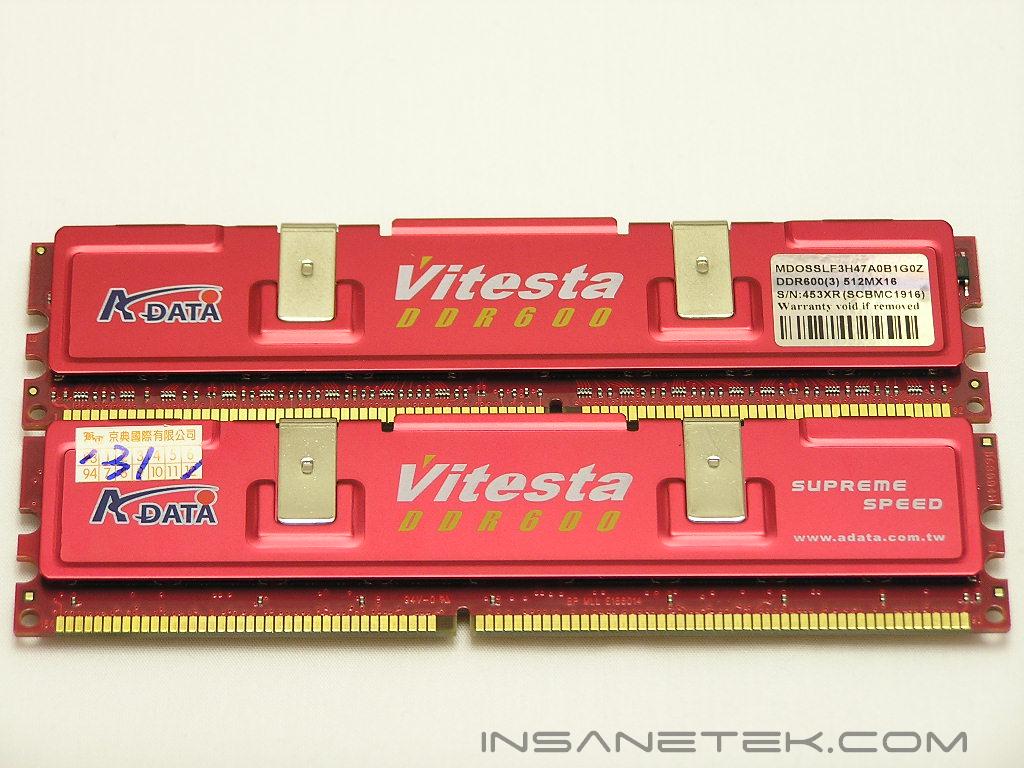
The Vitesta PC4800 comes rated at a CAS latency of 3 and is shown on the sticker with parentheses. The TRCD, TRP, and TRAS are not specified and could not be found on their website. From CPUID, the memory is rated to run 300MHZ at 3-5-5-9. That’s some high latencies, if you ask me. OCZ’s new PC4800 is rated to run lower at 2.5-4-4. As for the rated command rate setting, A-DATA answers that it’s made to run with 2T for compatibility issues. If your motherboard permits, it can even run 1T. As mentioned earlier, these sticks feature Samsung TCCD chips. I lifted the heatspreaders enough to sneak a peak and make sure. The PCB used is the same Brainpower as the ones found in the Corsair PC4400C25. Although it’s not the well loved 808, it should still be better than what’s generally available in the market.
Test System and Overclocking
Test System:
- AMD Athlon64 3000+ Winchester
- Abit Fatal1ty AN8
- 2 x 512MB A-DATA Vitesta PC4800
- Sapphire X800 (400/490)
- Enermax Noisetaker 470W
Overclocking:
Keep in mind that during overclocking, the latencies are as follows: CAS-TRCD-TRP-TRAS
The Fatal1ty AN8 was chosen as the testing motherboard because it’s one incredible board. We know that it definitely has the ability to run high HTT speeds, even with a 1:1 ratio. I knew that because of the Samsung TCCD chips, the memory is very well capable of running 200HTT at ultra low latencies of 2-2-2-5 1T. I continued further with the low latencies and reached a maximum of 210HTT. The result wasn’t very great, since most are capable of reaching at least 215HTT-220HTT. Slightly looser timings of 2-3-2-6 didn’t help; and with 2-3-3-6, I was able to reach 235HTT. The results aren’t too shabby. Now we get to the timings that everyone is interested in–2.5-3-3-7 1T. The first try was at 250HTT and, sure enough, it worked. The highest I was able to go with 2.5-3-3-7 1T was 270HTT. To me, the overclock with the latencies isn’t very impressive. Most of the TCCD based memory are able to overclock to 270HTT and almost always beyond. Nonetheless, I went further and achieved the highest overclock the memory would allow–275HTT with 2.5-4-4-8 1T. 3-4-4-8 1T didn’t allow any extra yield and changing the command rate to 2T didn’t help. No matter what I did, I was unable to run the memory at 300MHZ. This was disappointing to me; I had high hopes that it would be able to run 300MHZ in dual channel. I figured that it might be the possibility of separate sticks instead of a dual channel kit, so I decided to test a single stick. I kept the multiplier at 8x and sure enough, a single stick allowed me to hit 300HTT with latencies of 3-4-4-8, but with only with a command rate of 2T. Well we did learn one thing, and it’s that even though the memory is advertised at the same speeds and uses the same chips, it doesn’t mean they’ll run the rated speeds together, unless it’s a dual channel kit. It’s a good thing that the memory lived up to the specifications.
Because the test system is a dual channel system, testing will be conducted with both sticks of memory installed.
Highest overclock results: 9 x 275HTT
Overclocking Results:
- 200HTT 2.0-2-2-5 1T 2.8v
- 210HTT 2.0-2-2-5 1T 2.8v
- 235HTT 2.0-3-3-6 1T 2.8v
- 270HTT 2.5-3-3-7 1T 2.8v
- 275HTT 2.5-4-4-8 1T 2.8v
Results
SiSoft Sandra Memory Bandwidth
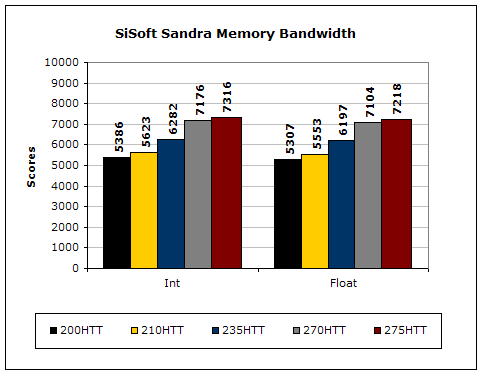
SiSoft Sandra is the most widely used memory bandwidth test. It can tell you the increase in performance from just lowering the latency timings. The results seem to scale linearly, despite the fact that the HyperTransport Bus is different when the overclock increases.
Everest Home Edition
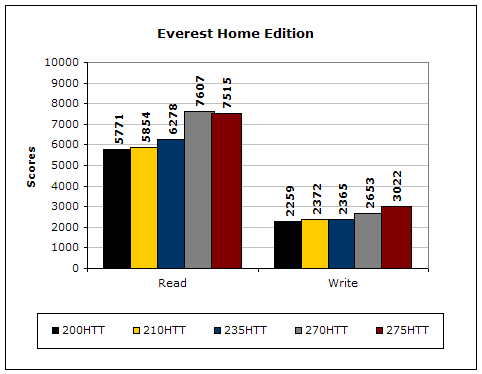
Everest Home Edition’s Memory Benchmarks show similar results as Sandra Memory Bandwidth.
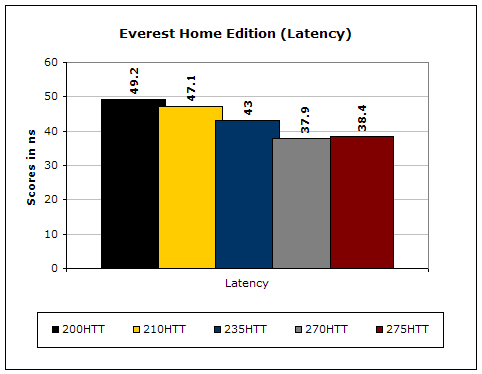
Everest Home Edition also includes a latency benchmark. The Athlon64’s performance with various latencies is also dependent upon its increase in CPU speed.
3DMark2001SE
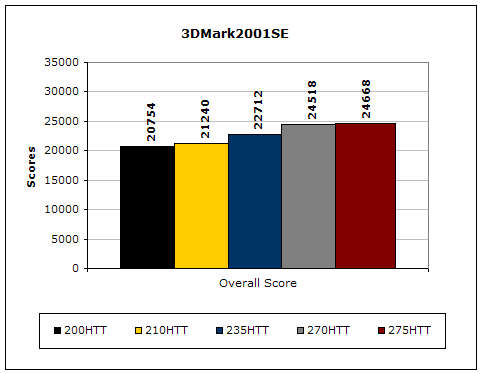
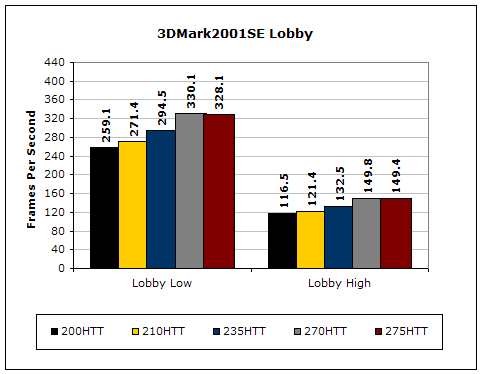
3DMark is probably the overclocker’s favorite benchmark. Unlike 3DMark2003, which stresses mainly the video card, 3DMark2001SE tests all of the system’s main components. Increasing the CPU speed, memory speed, and video card speeds will result in higher results in the final score.
Far Cry
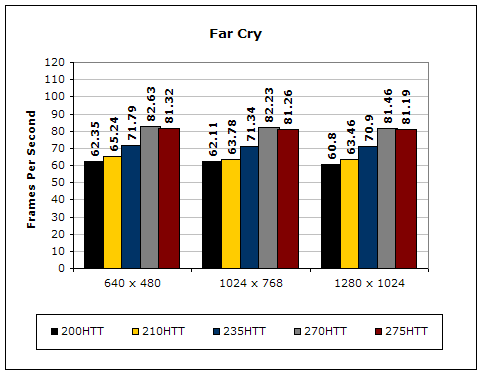
Since Far Cry is a game, the performance results will be very similar to 3dMark2001. I ran the benchmark at 640x480 so the benchmark would not be too GPU dependent. The tests under 1024x768 and 1280x1024 are there to show an approximate of what kind of frames you’ll be getting.
Results Continued
Unreal Tournament 2004
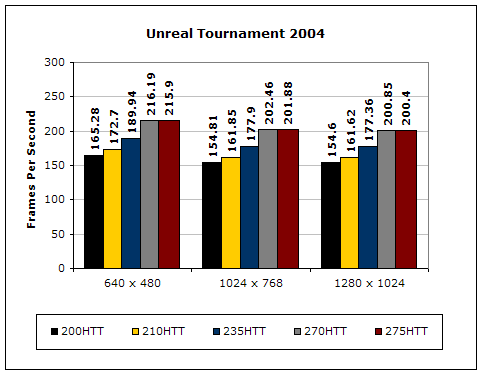
Unreal Tournament is another popular game engine to test overall system performance. Here, we can see the same results as Far Cry and 3dMark2001. Like Far Cry, UT2004 was also run at 640x480 to limit GPU dependency. The other resolutions are to give an approximate of actual gameplay performance.
PCMark
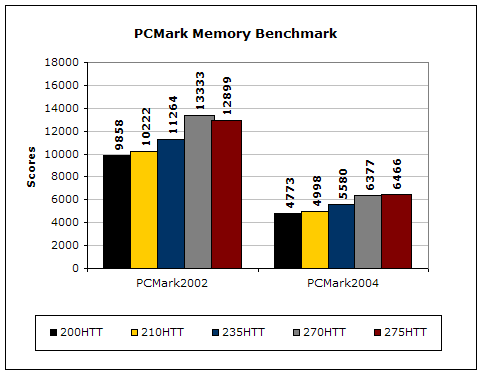
PCMark is another benchmark created by Futuremark. It tests the memory compression and decompression speeds in small to large chunks of data.
Super PI
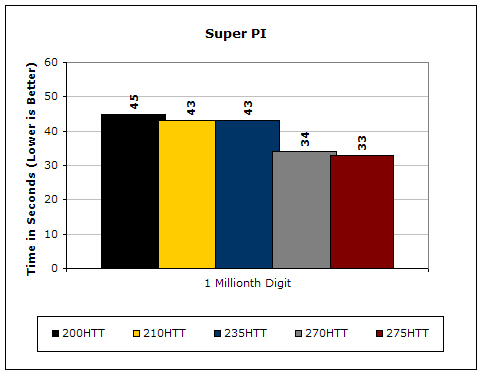
Since the value of PI is an infinite value, Super PI is a speed test to find the digit you’re looking for. In this case, we chose the millionth digit. Super PI benefits greatly from higher FSB as well as low latencies.
PiFast
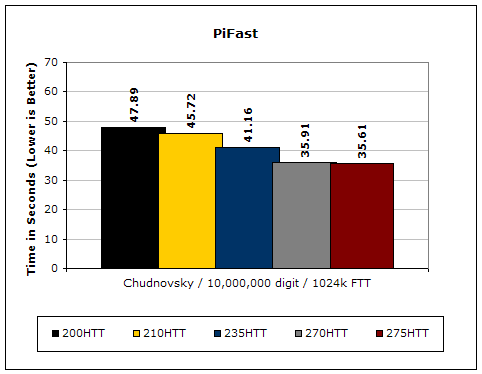
PiFast is similar to Super PI and the results can be greatly affected by a slight adjustment to the memory megahertz and latency.
Conclusion and Thoughts
Now that we’re more familiar with A-DATA and their potential, I must say that this stuff is pretty impressive. Sure it wasn’t able to run 300MHZ in dual channel, but that’s mainly because the sticks I found were separate and not in a dual channel kit. The difference between buying dual channel kits and buying two separate sticks of the same memory is that the manufacturer tests and makes sure that the dual channel kit can run at the specified speed and timings. At least we know that the sticks I have are capable of what they’re supposed to run, just by itself. Even when running together, it was able to reach PC4400 speeds comparable to other PC4400 TCCD based memory. It’s certainly not bad at all. If only I found an actual dual channel kit…
When I made the purchase of the memory back in December, it cost roughly $270. I asked my cousin back in Taiwan to check the prices for me and was informed that the prices dropped to about $260. That makes the memory quite affordable when compared to high rated memory, such as Mushkin PC4400 and Corsair PC4400C25. A-DATA is planning on ways of breaking into the U.S. market, and I have no reason to doubt that they’ll do very well. Their memory is aesthetically attractive and it does indeed perform well. They use good PCB’s and good memory IC’s. Once they establish their name, memory manufacturers are going to have another tough competitor to deal with. Just like OCZ, A-DATA’s high performance memory is targeted towards overclockers and gamers who need cutting edge performance. It’ll be interesting to see someone provide some challenge for OCZ.
Pros:
- Sexy red heatspreaders and PCB
- PC4800 = DDR600 = 300MHZ
- Reasonable price for high performance memory
- Runs just slightly better than rated timings at 300MHZ
- Probably the cheapest PC4800 memory available
Cons:
- Availability, can’t find it anywhere in the U.S.

If you have any questions or comments, feel free to hit us up in the forums. You can also check out more of our latest reviews on the front page.